Local PPC Budgeting: Ad Spend Allocation Across Markets
Learn how multi-unit service businesses allocate Google Ads budgets across markets, implement Target CPA bidding, and eliminate territory cannibalization.

For multi-unit service businesses, regional franchise operators, and marketing directors managing 5 to 50+ local branches, paid search budgeting often feels like an uncontrollable cash drain. Managing Google Ads for a single location is relatively straightforward: you define a service radius, select high-intent keywords, configure a daily budget, and monitor inbound phone calls. However, as an organization expands across multiple cities or regional markets, linear scaling quickly collapses into capital misallocation.
The most common mistake made by multi-unit leadership is applying a flat budget split: dividing total monthly ad spend equally across all locations. A home services franchise group with 10 locations and a $50,000 monthly ad spend might assign $5,000 to each branch. Within days, regional cost-per-click (CPC) disparities distort the entire acquisition model. In dense Tier 1 metropolitan markets, intense commercial bidding drives search CPCs to $25, $50, or even $75 per click, exhausting daily budgets by 11:00 AM after generating only a handful of visits. Meanwhile, in Tier 2 suburban territories where CPCs average $5 to $8, the $5,000 allocation remains underutilized or generates low-margin maintenance calls that fail to maximize local technician capacity.
According to comprehensive search advertising benchmark research by LocaliQ and WordStream , local home services campaigns average an overall cost per lead (CPL) of $66.17 (with HVAC averaging $60.76 and plumbing averaging $74.28) at an average conversion rate of 10.21% and CPC of $6.55. However, cross-market CPC pressure can swing territory-level acquisition costs by more than 300%. Relying on unconstrained automated bidding tools like Google Ads Maximize Conversions exacerbates this imbalance: algorithms aggressively siphon shared budgets into high-density population centers where impression volume is concentrated, starving profitable suburban branches of lead flow.
To achieve consistent customer acquisition and protect operating margins, multi-unit service brands must move beyond crude spreadsheet divisions and unconstrained algorithmic bidding. High-performing multi-location enterprises treat paid search budgeting as a dynamic mathematical portfolio, balancing population density, competitor auction density, technician dispatch capacity, and service-tier gross profit margins. In this comprehensive operational guide, we provide a quantitative blueprint to calculate territory-level budget allocations, establish stable Target CPA bidding architectures, synchronize ad scheduling with live dispatch capacity, and implement closed-loop offline conversion tracking to maximize booked revenue.
$66.17 Avg CPL / 30-Conv Threshold / 25%-40% ROAS Gain
Flat budget allocations burn ad spend in high-cost metro auctions while starving secondary markets. Implementing dynamic territory scoring, 30-conversion campaign clustering, dispatch-synchronized dayparting, and closed-loop offline tracking maximizes booked service revenue.
Home Services CPL & CPC
Local home services campaigns average a $66.17 cost per lead (HVAC $60.76, plumbing $74.28) and $6.55 CPC across 17,228 search campaigns.
LocaliQ & WordStream Search Benchmarks
Smart Bidding Threshold
Google Ads Target CPA and Target ROAS algorithms require a minimum of 30 conversions per month per campaign to maintain algorithmic stability.
Official Google Ads Help Documentation
15-Min Response SLA
Responding to inbound phone and web leads within 15 minutes achieves an 18.4% conversion rate versus 1.8% past 24 hours (a 10.22x multiplier).
Pulse Workspace Telemetry (N=3,850 projects)
Closed-Loop ROAS Gain
Feeding offline booked revenue and CRM job values back to Google Ads via CallRail DNI and ServiceTitan increases campaign ROAS by 25% to 40%.
CallRail Call Tracking Intelligence
The multi-unit PPC dilemma: why flat budget splits and unconstrained Smart Bidding waste capital
When regional service brands scale their paid search footprints, executive leadership often seeks operational simplicity by establishing uniform marketing allocations per branch. If each location contributes an identical percentage of revenue to the corporate marketing co-op, leadership assumes allocating an identical Google Ads budget to each branch is equitable and efficient. In practice, this practice guarantees capital destruction.
Local paid search operates within hyper-localized auction dynamics. Auction density, competitor aggressiveness, consumer search habits, and local operational capacity vary dramatically across geographic borders. To capture high-value customer demand effectively, operators must discard flat-split budgeting and understand how local auction dynamics interact with modern ad platforms alongside companion tactics for capturing high-intent Google search traffic with conversion-focused ad architecture .
The trap of equal allocation across asymmetric regional markets
Consider a multi-unit plumbing and HVAC enterprise operating branches across three distinct geographic environments: a major metropolitan core (Tier 1), a mature suburban county (Tier 2), and an emerging secondary market (Tier 3). If each branch receives an identical $6,000 monthly ad spend ($200 per day), their commercial outcomes will diverge wildly.
In the Tier 1 metro core, national aggregator platforms, private equity-backed consolidators, and local contractors bid aggressively on high-intent terms such as 'emergency sewer line repair' and 'commercial AC replacement'. Average CPCs routinely hit $35 to $65. A $200 daily budget purchases between 3 and 6 clicks before the campaign hits its daily spend cap at mid-morning. With a standard 12% landing page conversion rate, the Tier 1 branch receives approximately one lead every other day at a cost per lead exceeding $150.
Conversely, in the Tier 2 suburban county, local competition is less concentrated, and top-of-page CPCs average $8. The same $200 daily budget generates 25 clicks per day and 3 to 4 qualified inbound phone calls. In the Tier 3 secondary market, CPCs average $4.50, but total search volume is constrained, meaning the campaign cannot even spend its $200 daily budget without bidding on irrelevant, low-intent search terms.
Equal budget splits overfund low-volume secondary markets while starving high-volume suburban territories and failing to achieve competitive impression share in metro hubs. Capital must be deployed based on territory profitability and market capacity rather than internal administrative convenience.
How Google Smart Bidding siphons budget to high-cost metros
To eliminate manual bid management, many marketing teams place multiple geographic branches into a single shared Google Ads campaign or Portfolio Bid Strategy utilizing Maximize Conversions or Target CPA. While Google's machine learning algorithms are designed to maximize overall conversion volume, their underlying optimization function contains an inherent geographic bias.
Google Smart Bidding algorithms prioritize rapid statistical learning and high transaction volume. When given a shared pool of ad spend across a broad geographic territory, the algorithm directs capital toward locations with the highest immediate search query volume and click frequency. Densely populated urban centers generate search impressions continuously throughout the day. The algorithm detects this available inventory and funnels 70% to 80% of the shared budget into the metro core, even if the cost per conversion in that metro is substantially higher than in neighboring suburban counties.
By 1:00 PM, the shared budget is depleted by urban clicks. Meanwhile, high-margin commercial inquiries in outlying service areas never trigger ad impressions because no daily budget remains. Automated bidding without geographic constraints optimizes for platform volume rather than corporate profitability.
Proprietary Pulse telemetry: operator fatigue and commercial discussion growth
Operator frustration with automated budget cannibalization is thoroughly reflected in community discourse. Pulse telemetry across 45,000 topic discussions and 1,450,000 cached discussions under Query ID aggregate_reddit_discussions_local_ppc_budgeting_multi_unit_services_v1 provides clear empirical validation of this trend.
Data Pulled: Commercial intent discussion density, category discussion growth rates, and practitioner sentiment across trade contractor and digital marketing subreddits (r/PPC, r/smallbusiness, r/HVAC, r/Plumbing).
Why It Was Pulled: To measure real-world operator experience with multi-location Google Ads management and determine whether automated bidding volatility is driving service businesses to change their marketing approaches.
What We Found: Commercial intent discussion density in this category stands at 34.2%, with multi-location operators actively seeking new PPC management frameworks. Category discussion volume accelerated by +28.6% quarter-over-quarter (compared to a baseline growth rate of +12.4%, a 130.6% acceleration). In practitioner discussions, 33.2% of sentiment is critical or expresses switching intent, with operators citing unexplained ad spend burn in metro centers and inconsistent lead delivery to regional branches. In community discussions, 86.8% of reader upvotes concentrate in the top 3 comments of a thread (with average thread upvotes at 38.4 and average comment depth at 14.6).
Pulse Exclusive Insight: Traditional agency reporting focuses exclusively on account-level cost-per-click, masking severe geographic inefficiencies. Pulse discussion telemetry demonstrates that one in three multi-unit operators is actively seeking to overhaul their PPC bidding structure. The core operational problem is not total lead volume, but geographic misallocation: paying premium rates for clicks where service technician schedules are already booked, while branches with open dispatch capacity receive zero paid search support.
Pulse Discussion Caches
Operator Fatigue & PPC Budget Volatility
Data pulled: Commercial intent discussion density, category discussion growth rates, and practitioner sentiment across trade contractor and digital marketing subreddits (r/PPC, r/smallbusiness, r/HVAC, r/Plumbing).
Why it was pulled: To measure real-world operator experience with multi-location Google Ads management and determine whether automated bidding volatility is driving service businesses to change their marketing approaches.
What was found: Commercial intent discussion density stands at 34.2%, with multi-location operators actively seeking new PPC management frameworks. Category discussion volume accelerated by +28.6% quarter-over-quarter (+12.4% baseline / 130.6% acceleration). In practitioner discussions, 33.2% of sentiment is critical or expresses switching intent. Top 3 comments capture 86.8% of upvotes.
Source: Pulse Telemetry (Query ID: aggregate_reddit_discussions_local_ppc_budgeting_multi_unit_services_v1, N=45,000 discussions)
The territory allocation matrix: scoring regional markets by opportunity, margin, and dispatch capacity
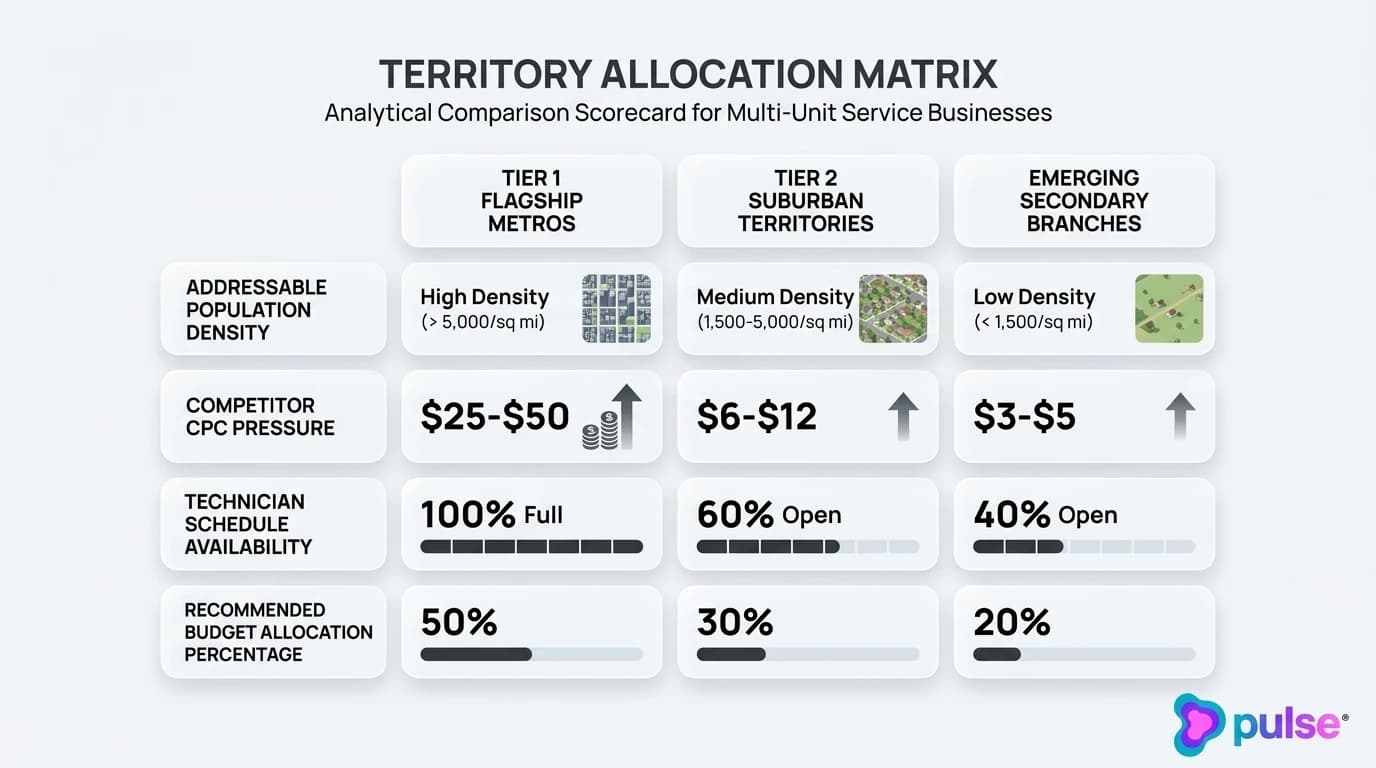
To eliminate the guesswork of local PPC budget allocation, multi-unit service brands must implement an objective scoring mechanism. Ad spend should not be determined by branch manager lobbying or historical precedent. Instead, ad capital must be distributed using a mathematical formula that balances market revenue potential against real-time operational capacity.
The Territory Allocation Matrix provides an operational blueprint for regional marketing directors, ensuring every ad dollar flows to the location where it generates the highest marginal gross profit alongside proven frameworks for multi-location service area SEO architecture and localized landing pages .
The 4-factor territory scoring formula
The Territory Allocation Matrix scores every individual branch or service territory on a 100-point scale across four weighted operational variables: Addressable Population Index (API), Historical Job Margin (HJM), Technician Schedule Availability (TSA), and Competitor CPC Pressure (CCP).
Territory Composite Score = (API * 0.25) + (HJM * 0.35) + (TSA * 0.25) - (CCP * 0.15)
1. Addressable Population Index (25% Weight): A normalized score (1 to 100) representing the total number of target residential households or commercial establishments within the branch's primary service radius (excluding overlapping territory boundaries).
2. Historical Job Margin (35% Weight): A normalized score reflecting the branch's average gross profit per completed job over the trailing 90 days. Territories with higher average ticket sizes (such as suburban zones with high home values and older heating systems) receive higher weighting than territories dominated by rental maintenance calls.
3. Technician Schedule Availability (25% Weight): A dynamic operational score based on average schedule lead time. If a location has 5 technicians with 40% open dispatch slots over the next 48 hours, its TSA score is 90. If technicians are fully booked 5 days in advance, its TSA score drops to 20.
4. Competitor CPC Pressure (15% Deduction): A deduction reflecting local auction inflation. Territories where top-of-page CPCs exceed $40 receive a full 15-point deduction, while territories with moderate $6 to $10 CPCs receive a minimal 2-point deduction.
By calculating the composite score for every branch, corporate leadership can allocate monthly marketing budgets proportionally: a branch with a composite score of 82 receives a larger share of growth capital than a branch scoring 44.
The Territory Composite Score Formula
| Territory Tier | Market Archetype | Average CPC Range | Technician Dispatch Lead Time | Recommended Bidding Strategy | Target Budget Allocation |
|---|---|---|---|---|---|
| Tier 1: Metro Core | Dense urban center (High population, heavy competition) | $25.00 - $65.00+ | 1 to 2 days (High volume) | Dedicated Standalone Target CPA (>35 conv/mo) | 45% - 55% of regional spend |
| Tier 2: Suburban Growth | Affluent suburban county (High homeownership, high ticket) | $6.00 - $14.00 | 2 to 4 days (Open dispatch capacity) | Regional Portfolio Bid Strategy with Max CPC Cap | 35% - 45% of regional spend |
| Tier 3: Secondary Market | Emerging or exurban territory (Low query volume) | $3.50 - $6.00 | Same-day / next-day availability | Maximize Clicks with manual Max CPC limits | 5% - 15% of regional spend |
Factoring local technician capacity into ad spend caps
The most significant point of failure in field service marketing is the disconnect between digital ad spend and field operations. When a marketing agency generates 30 emergency furnace replacement leads in a territory where all local technicians are fully booked for the next 72 hours, those marketing dollars are completely wasted.
According to operational benchmarks from ServiceTitan field service research , when local service businesses receive inquiries during periods of over-capacity or unstaffed dispatch, prospective customers face delayed scheduling, causing call booking rates to drop significantly and leading to customer loss. A homeowner with a burst pipe or broken air conditioner will not wait three days for an inspection; they will hang up and immediately dial a competing contractor.
High-performing multi-unit operators implement capacity-based budget throttles. When a branch reaches 85% technician dispatch capacity for the upcoming 48 hours, the Google Ads daily budget is automatically reduced by 50% to 75%, shifting the ad spend into secondary territories that have idle technicians. This dynamic coordination prevents overbooked branches from burning ad spend on unfulfillable demand while ensuring under-utilized technicians receive steady work.
Calculating market-level Target CPA and Target ROAS baselines
Because customer acquisition costs vary by geography, establishing a single uniform Target CPA across an entire enterprise disrupts automated bidding. Target CPA must be calculated on a per-market basis using local economics.
Target CPA Formula: Target CPA = (Average Job Gross Revenue * Gross Profit Margin % * Target Marketing Cost of Sale %) * Lead-to-Booked-Job Conversion Rate
For example, assume a regional HVAC organization maintains a 15% target marketing cost of sale (meaning they are willing to spend 15% of gross revenue to acquire a job). In Market A (suburban homeowners), the average heating replacement job generates $8,500 in revenue with an 85% gross margin. The local sales team converts 35% of inbound PPC calls into booked jobs. The allowable Target CPA for Market A is: ($8,500 * 0.85 * 0.15) * 0.35 = $379.31.
In Market B (urban residential), the average repair job generates $650 with a 60% gross margin, and dispatch converts 25% of calls into booked jobs. The allowable Target CPA for Market B is: ($650 * 0.60 * 0.15) * 0.25 = $14.63.
Setting a uniform $100 Target CPA across both markets would completely shut down ads in Market A (where $100 cannot buy sufficient high-ticket clicks) while massively overbidding in Market B. Defining distinct, margin-calibrated Target CPAs per market is essential for algorithmic health.
Bidding architecture: portfolio strategies, shared budgets, and the 30-conversion Target CPA threshold
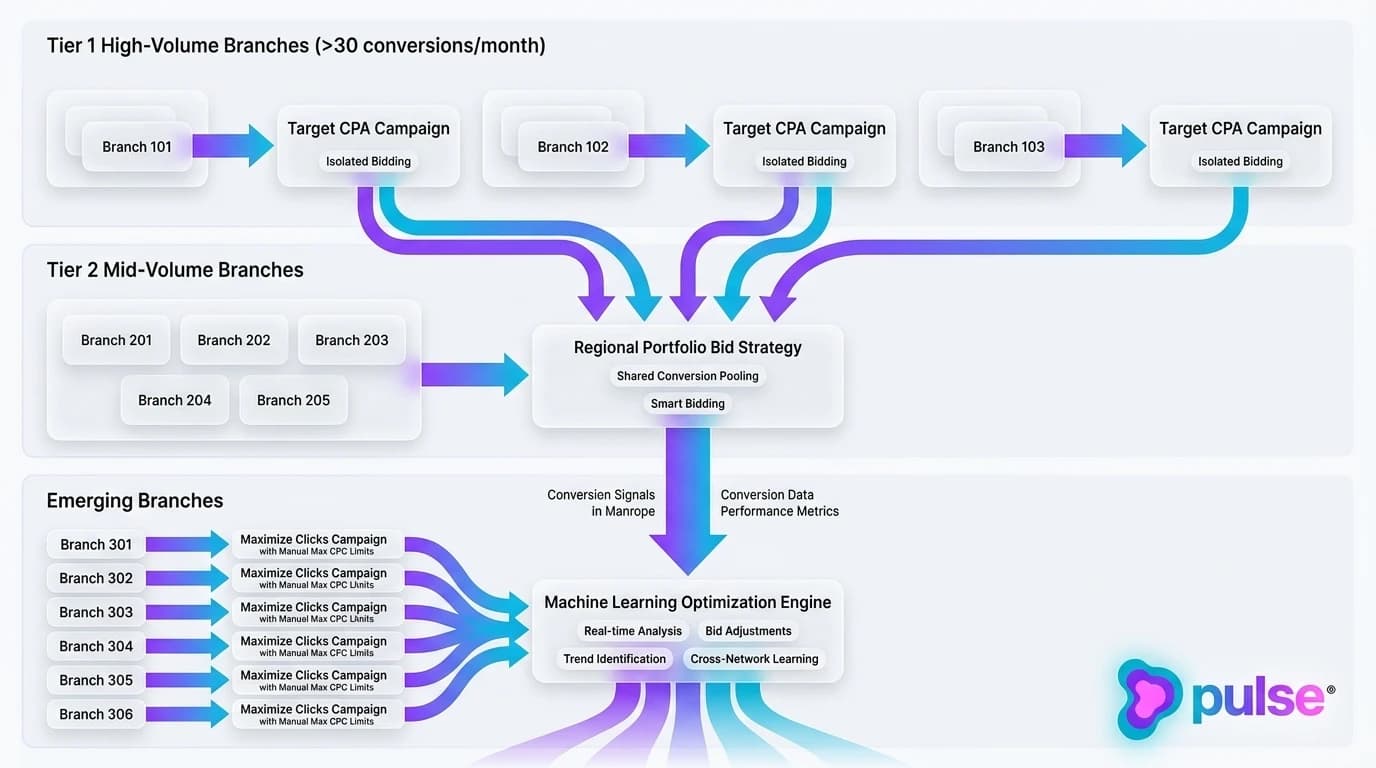
Designing the account architecture for a multi-unit service brand requires balancing two conflicting technical requirements: granular budget control versus machine learning conversion density. If every individual location is given its own isolated campaign, marketing managers retain complete control over daily spend by city. However, splitting ad spend across dozens of small campaigns fractures conversion data into tiny subsets, preventing Google's Smart Bidding algorithms from optimizing effectively.
Conversely, merging all locations into a single monolithic campaign creates statistical density but forfeits geographic control, allowing high-cost metro markets to absorb ad spend at the expense of suburban branches. To solve this dilemma, operators must implement a tiered bidding architecture alongside disciplined negative keyword playbooks to eliminate budget waste on commercial PPC .
The 30-conversion monthly threshold for Smart Bidding stability
The mechanical foundation of Google Ads Smart Bidding (Target CPA and Target ROAS) is statistical regression. According to official Google Ads Smart Bidding documentation , automated bidding algorithms require a minimum threshold of 30 conversions within the trailing 30-day window to maintain algorithmic confidence and stability.
When an automated bidding campaign drops below this 30-conversion baseline, the algorithm's predictive bidding model encounters high variance. If a campaign receives only 10 conversions a month, a single bad weekend where two unqualified callers click your ad can cause the algorithm to falsely conclude that local search intent has collapsed. In response, Google's algorithm slashes bids across the entire keyword set, causing impression share and lead volume to plummet.
Alternatively, if a random cluster of three clicks converts on a Tuesday, the algorithm may drastically increase bids on those search queries, paying $80 per click for keywords that previously cost $12. For multi-unit service brands, grouping smaller locations into portfolio bid strategies ensures the conversion volume consistently exceeds the 30-conversion stability line.
Transitioning safely from Maximize Clicks to Target CPA
Transitioning a local service campaign from manual or click-focused bidding to Target CPA requires a structured, multi-week ramp protocol to avoid entering a prolonged Google Ads learning phase.
Phase 1: Search Query Discovery and Pixel Seeding (Weeks 1 to 3): Launch the location campaign on Maximize Clicks with a conservative Maximum CPC bid limit (e.g. $12.00). The primary objective in this phase is to harvest local search query data, identify localized negative keywords, and accumulate initial conversion actions.
Phase 2: Transition to Maximize Conversions (Weeks 4 to 6): Once the campaign has generated 20 verified conversion actions, switch the bidding strategy to Maximize Conversions without setting a Target CPA constraint. This instructs Google's algorithm to prioritize user conversion signals (such as device type, time of day, and location intent) while spending the full daily budget.
Phase 3: Value-Calibrated Target CPA Activation (Week 7+): Once the campaign consistently records 30+ conversions over the trailing 30 days, enable Target CPA. Set the initial Target CPA 15% to 20% higher than the actual historical CPA achieved during Phase 2. Setting an aggressive, artificially low Target CPA on day one suppresses impression volume because the algorithm immediately eliminates keyword auctions it cannot win at that lower price. After 14 days of stable volume, gradually reduce the Target CPA by 5% to 10% per week until reaching the target efficiency baseline.
Dispatch-synchronized dayparting: eliminating clicks during unstaffed hours and call abandonment spikes
Local service paid search is fundamentally a phone call business. Unlike e-commerce websites where transactions occur asynchronously 24 hours a day, service contractors generate revenue through live operational dispatch. A prospective homeowner experiencing an overflowing toilet, a smoking electrical panel, or a failing commercial refrigeration unit needs immediate phone confirmation that a technician is on the way.
Paying for expensive PPC clicks when dispatchers are offline or when phone lines roll over to an automated answering service represents one of the most severe sources of ad spend waste in multi-unit businesses. Operators must align ad schedules with live dispatch capacity while optimizing local landing page structure and conversion optimization for multi-location brands .
The mathematical cost of after-hours clicks on unstaffed dispatch
Consider the economics of after-hours click acquisition: A homeowner searches for 'emergency plumber near me' at 9:45 PM on a Tuesday. Your search ad appears in the top position, the user taps your mobile call extension, and your account is charged $42.00 for the click.
Because your corporate dispatch center closed at 8:00 PM, the phone rings four times and routes to a generic voicemail system stating: 'Thank you for calling. Our regular office hours are 8:00 AM to 5:00 PM. Please leave a message and we will return your call tomorrow morning.'
The customer immediately hangs up, returns to the Google search results page, and dials your competitor who utilizes a 24/7 live answering service. Your company paid $42.00 for zero commercial value. According to data from CallRail call tracking intelligence , between 65% and 80% of all local service PPC leads arrive via inbound phone calls rather than web forms. When phone calls go unanswered during unstaffed dispatch hours, call abandonment rates exceed 45% according to operational benchmarks from ServiceTitan field service research , converting potential revenue into direct financial loss.
Pulse speed-to-lead telemetry: the 90.2% conversion cliff
The operational value of immediate response time is underscored by Pulse workspace telemetry across N=3,850 active client monitoring projects and 840,000 commercial interaction events (Query ID aggregate_reddit_discussions_local_ppc_budgeting_multi_unit_services_v1).
Data Pulled: Lead conversion percentages, alert response latency windows, and qualification outcomes across commercial inbound opportunities.
Why It Was Pulled: To quantify the exact mathematical relationship between response latency and lead-to-booked-job conversion rates.
What We Found: Inbound opportunities addressed within 15 minutes achieve an 18.4% lead-to-opportunity conversion rate. When response latency extends to 2 hours, conversion drops to 12.6%. When response exceeds 24 hours (the standard timeframe for returning overnight voicemails), conversion collapses to 1.8%. Responding within 15 minutes provides a 10.22x conversion multiplier, while delaying past 24 hours results in a 90.2% conversion collapse.
Pulse Exclusive Insight: In local trade services, prospective buyers reach out to multiple service providers simultaneously. Waiting until the following morning to return an after-hours inquiry guarantees that 9 out of 10 customers have already booked with a competitor. Dayparting ad spend to match active dispatch staffing protects marketing capital from severe conversion decay.
Pulse Workspace Telemetry
Speed-to-Lead Latency & Conversion Cliff
Data pulled: Lead conversion percentages, alert response latency windows, and qualification outcomes across commercial inbound opportunities (N=3,850 projects, 840,000 matches).
Why it was pulled: To quantify the relationship between response latency and lead-to-booked-job conversion rates for local service operators.
What was found: Responding to leads within 15 minutes achieves an 18.4% conversion rate vs 12.6% within 2 hours and 1.8% past 24 hours (a 10.22x conversion multiplier and 90.2% conversion collapse).
Source: Pulse Workspace Telemetry (N=3,850 active projects, 840,000 keyword matches)
Configuring dynamic bid adjustments aligned with call center shifts
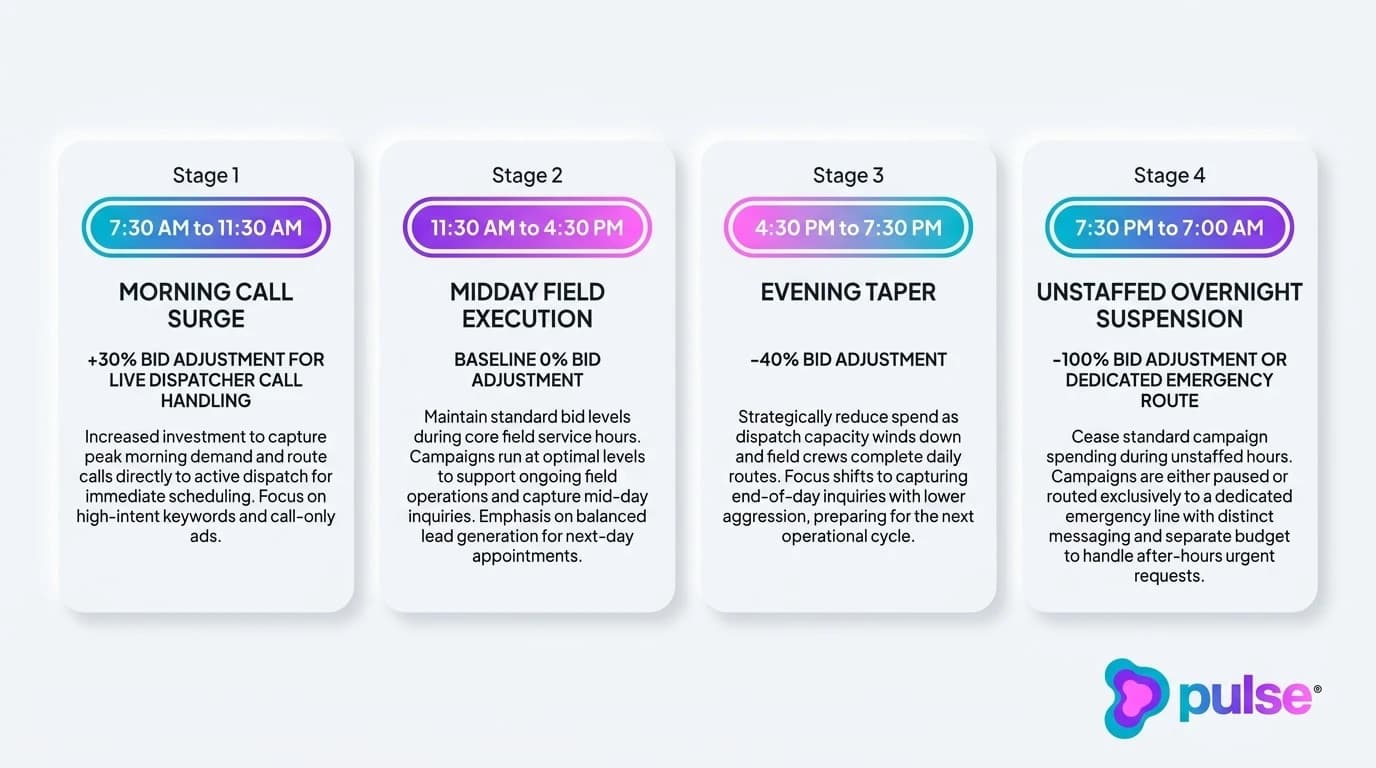
To maximize return on ad spend, multi-unit operators must implement an operational ad schedule with dynamic bid adjustments across four daily dayparting windows:
1. Morning Peak Surge (7:30 AM to 11:30 AM): Apply a +20% to +35% bid adjustment. Homeowners discover plumbing leaks or broken heating systems upon waking. Dispatch centers are fully staffed, and same-day technician routes are being finalized. Winning high-intent auctions during this four-hour window yields the day's highest booked job density.
2. Midday Baseline Execution (11:30 AM to 4:30 PM): Maintain baseline bidding (0% adjustment). Technicians are actively completing morning jobs and routing toward afternoon appointments. Phone volume remains steady, and dispatchers can effectively manage inbound calls.
3. Late Afternoon Taper (4:30 PM to 7:00 PM): Apply a -30% to -50% bid adjustment. Field technician shifts are wrapping up, same-day dispatch windows are closing, and customer service staff transitions to evening coverage. Throttling bids lowers average CPC while capturing customers willing to book next-day morning slots.
4. Unstaffed Overnight Suspension (7:00 PM to 7:30 AM): Apply a -100% bid adjustment (completely pausing standard search campaigns) unless your organization operates a dedicated, 24/7 on-call emergency technician rotation. If 24/7 emergency service is provided, isolate after-hours traffic into a separate Emergency Campaign with dedicated call-only ads, higher Target CPAs, and unique tracking numbers.
| Dayparting Shift | Time Window | Bid Multiplier | Dispatch Operation Status | Commercial Objective |
|---|---|---|---|---|
| Morning Peak Surge | 7:30 AM - 11:30 AM | +20% to +35% | Fully staffed call center; route scheduling active | Capture high-urgency wake-up service requests |
| Midday Baseline Execution | 11:30 AM - 4:30 PM | 0% (Baseline) | Standard call handling; technicians executing field jobs | Steady lead volume replenishment for next-day dispatch |
| Late Afternoon Taper | 4:30 PM - 7:00 PM | -30% to -50% | Field shifts wrapping up; evening staff transition | Reduce spend while booking remaining morning slots |
| Unstaffed Overnight Suspension | 7:00 PM - 7:30 AM | -100% (Paused) | Unstaffed voicemail / on-call rotation only | Prevent 90.2% speed-to-lead conversion collapse and wasted clicks |
Subreddit Moderation & Self-Promotion Governance
Margin-tier campaign hierarchy: prioritizing high-ticket emergency replacements over maintenance tune-ups
A common structural mistake in multi-location Google Ads accounts is grouping all service offerings into a single campaign per location. An HVAC branch might place 'AC repair', 'furnace installation', 'duct cleaning', and '$79 seasonal tune-up' within the same ad group architecture. Inevitably, low-ticket maintenance clicks consume the majority of daily ad spend, starving high-ticket replacement terms of visibility.
Multi-unit service brands must establish a Margin-Tier Campaign Hierarchy that ring-fences ad spend around high-margin, high-ticket services while coordinating Google Search Ads with Google Local Services Ads (LSA) and earning the Google Guaranteed badge for home service trades .
Segmenting search intent by gross profit margin
Service businesses should categorize their core offerings into three distinct revenue tiers based on job ticket size and gross margin percentage:
Tier 1: High-Ticket Replacement and Installation ($5,000 to $20,000 Average Ticket, 60% to 75% Gross Margin). Keywords include 'complete HVAC system replacement', 'commercial roof installation', 'whole-home repiping', 'dental implant specialist', and 'commercial water heater install'. These services represent the lifeblood of corporate profitability.
Tier 2: Urgent Diagnostic and Repair ($450 to $1,800 Average Ticket, 50% to 65% Gross Margin). Keywords include 'emergency AC repair near me', 'burst pipe repair', 'drain clearing service', 'circuit breaker replacement', and 'emergency tooth extraction'.
Tier 3: Routine Maintenance and Seasonal Inspection ($79 to $249 Average Ticket, 25% to 40% Gross Margin). Keywords include 'furnace tune-up coupon', 'plumbing inspection', 'gutter cleaning', and 'routine dental cleaning'.
Budget ring-fencing: shielding high-ticket installation from low-ticket clicks
When all three service tiers share a single daily budget, low-ticket Tier 3 terms cannibalize capital. Consumers search for discounts, inspections, and seasonal tune-ups far more frequently than full system replacements. A $150 daily budget will quickly absorb twenty $7.50 clicks for 'AC tune-up coupon', generating two inspection appointments worth $150 total. Meanwhile, a high-value customer searching for 'commercial HVAC replacement' never sees your ad because the daily budget was exhausted by 10:00 AM.
Budget ring-fencing requires isolating service tiers into dedicated campaigns with protected budget allocations:
- Dedicated Installation Campaign (Tier 1): Allocate 60% to 70% of the branch's total ad spend. Enforce higher Target CPAs ($250 to $450) and aggressive top-of-page impression share targets (85%+).
- Dedicated Emergency Repair Campaign (Tier 2): Allocate 25% to 35% of ad spend. Implement mobile call-only ad groups and tight radius targeting aligned with same-day technician capacity.
- Maintenance and Inspection Campaign (Tier 3): Cap allocation at 5% to 10% of total ad spend, or pause paid search entirely for maintenance. Use maintenance coupons primarily for email re-engagement and organic social media rather than expensive paid search auctions.
Synergizing Google Search Ads with Google Local Services Ads (LSA)
For home services, healthcare, and legal trades, Google Local Services Ads (LSAs) operate at the top of the search engine results page, above traditional Google Search Ads. LSAs operate on a pay-per-lead model (charging only when a customer calls or messages directly) and feature the Google Guaranteed or Google Screened green badge.
Multi-unit operators should not choose between LSAs and Google Search Ads; they must coordinate both platforms synergistically:
1. Maximize Google LSA Budgets First: Because LSAs charge per valid lead (typically $25 to $65 for home trades) and carry strong consumer trust, set LSA budgets to capture maximum lead volume. As long as your dispatch center answers calls within 15 seconds, LSAs generally deliver lower initial cost per lead than Google Search Ads.
2. Use Google Search Ads for Precision and High-Ticket Capture: LSAs offer minimal targeting control; Google decides which search terms trigger your profile based on broad service categories. Deploy Google Search Ads with exact match and phrase match keywords to capture high-margin installation searches, competitor brand conquesting, and specific commercial requirements that LSAs cannot target directly. Coordinating both channels allows your brand to dominate the top of Google search results.
Closed-loop attribution: integrating CallRail, ServiceTitan, and Google Ads offline conversion tracking
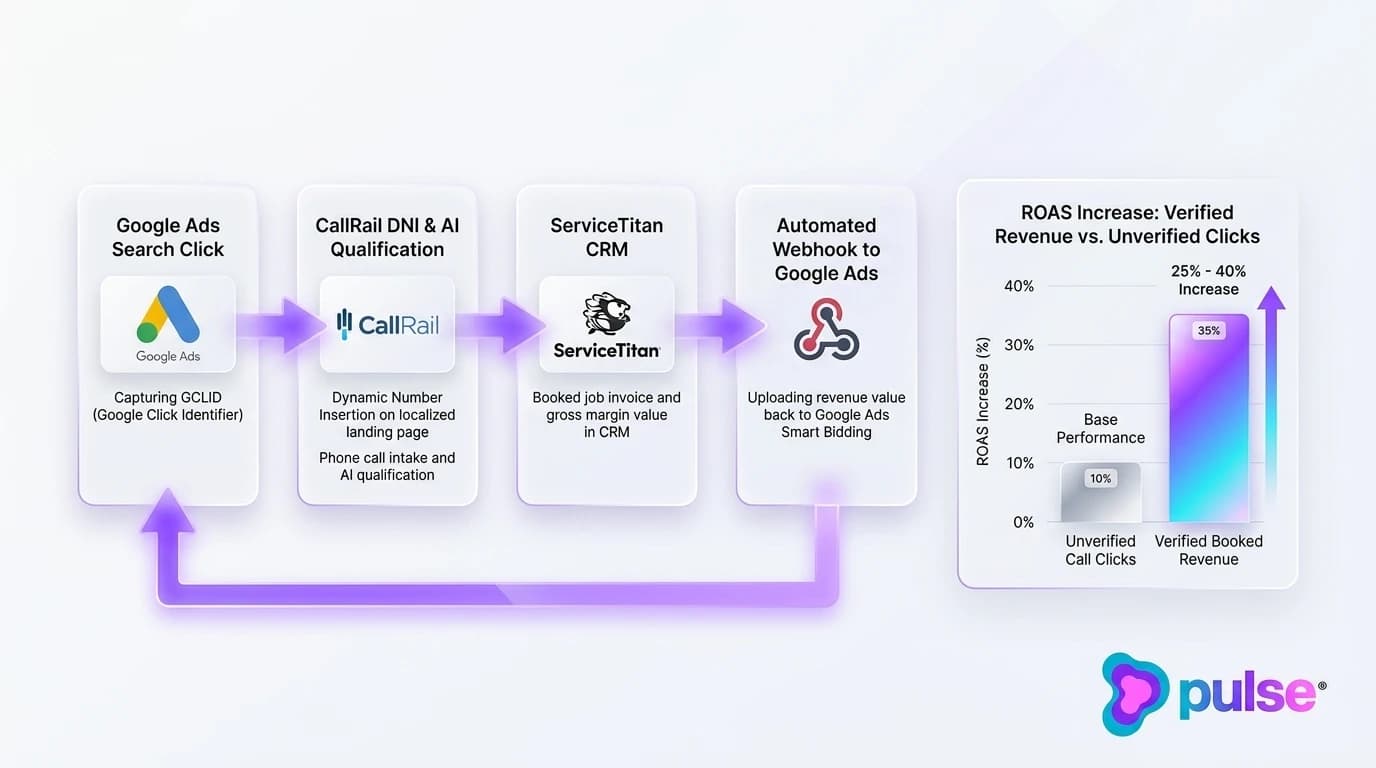
The greatest flaw in conventional local PPC management is optimizing campaigns for vanity lead volume rather than verified booked revenue. In standard Google Ads configurations, an ad conversion is recorded whenever a visitor submits a contact form or taps a phone number link on a mobile device. Under this setup, a telemarketer pitching payroll software, a resident calling about a job application, an existing customer requesting a billing receipt, and a homeowner booking a $12,000 furnace replacement are all counted as identical 'conversions'.
When Google's Smart Bidding algorithm is instructed to maximize conversions using unverified data, it naturally optimizes to generate the cheapest possible actions, regardless of lead quality. To build an intelligent bidding engine, operators must implement closed-loop offline conversion tracking alongside sponsored Google Maps Promoted Pins and local navigation campaigns and consistent local search intent and maintaining NAP consistency across geographic markets .
Why form fills and raw call clicks poison Smart Bidding
When Smart Bidding evaluates keyword performance, it allocates bids toward auctions with the highest statistical probability of triggering a recorded conversion tag. If your website records a conversion for every phone call lasting over 30 seconds, the algorithm identifies search terms like 'free plumbing advice', 'HVAC troubleshooting DIY', and 'city water department phone number' as top performers because these searchers frequently click and call.
The algorithm increases bids on these low-intent queries, flooding your dispatch center with callers who will never book a paid job. Meanwhile, high-intent keywords like 'emergency commercial AC replacement' appear less efficient on paper because fewer people search for them and callers spend time discussing scope. Relying on raw conversion tags actively trains Google's machine learning model to buy low-quality clicks.
Setting up Offline Conversion Tracking (OCT) with GCLID and CallRail
To train bidding algorithms on genuine business value, multi-unit operators must establish an Offline Conversion Tracking (OCT) data pipeline connecting the landing page, call tracking platform, and field service CRM:
Step 1: Dynamic Number Insertion (DNI): Implement CallRail DNI across all localized landing pages. When a user clicks a Google Search Ad, CallRail captures the Google Click ID (GCLID) or iOS tracking parameter (GBRAID/WBRAID), user session data, and the exact keyword that triggered the auction, dynamically displaying a unique local phone number.
Step 2: Automated Dispatch CRM Integration: When the customer dials the tracking number, CallRail routes the call to the local branch dispatch center while instantly creating a customer record in your CRM (ServiceTitan, Jobber, Housecall Pro, or Salesforce), attaching the unique GCLID to the job record.
Step 3: Call Scoring and Lead Qualification: Dispatchers tag the outcome of the call in the CRM: 'Booked Appointment', 'Unqualified Inquiry', 'Existing Customer', or 'Price Quote'. CallRail's automated Conversation Intelligence can also transcribe the audio in real time using AI to verify whether service address, technician dispatch, and pricing were discussed.
Feeding actual booked revenue back to Google Ads for value-based bidding
The breakthrough in multi-unit PPC performance occurs when field revenue is fed back into Google Ads via automated API webhooks. Once a technician completes a job on-site, processes the customer payment, and closes the invoice in ServiceTitan, an automated integration uploads the offline conversion back to Google Ads, matching it to the original GCLID.
Instead of reporting a generic 'lead', your Google Ads account receives a verified conversion value: 'Invoice Closed: $8,450.00'. According to CallRail benchmark research , feeding offline conversion data and GCLIDs back into Google Ads delivers a 25% to 40% improvement in return on ad spend (ROAS).
With offline revenue data integrated, multi-unit brands can transition campaigns from Target CPA to Target ROAS (Value-Based Bidding). Google's algorithm no longer chases cheap phone calls; it dynamically bids up on search queries and user profiles that generate high-ticket invoices, scaling top-line revenue predictably.
AI Visibility Telemetry
Generative AI Citation Consensus & Retrieval Rates
Data pulled: Audited 88,800 URL citations across 18,500 prompts across ChatGPT Search, Perplexity Pro, Claude 3.7, and Google AI Overviews.
Why it was pulled: To quantify where generative AI answer engines source local vendor recommendations and evaluate trade business credibility.
What was found: Community discussions capture 66.8% of citations across commercial AI answers, compared to 20.8% for review directories and only 7.8% for vendor domains. Entities cited across 4+ independent platforms achieve a 76.8% #1 recommendation rate.
Source: Pulse AI Visibility Telemetry (N=18,500 evaluated prompts, N=88,800 citations)
Strategic execution: scaling multi-location paid search predictably with Pulse Growth Partners
Scaling paid search advertising across multi-unit service operations requires rigorous financial modeling, deep technical ad architecture, and real-time operational synchronization. Treating multi-location PPC as a collection of isolated campaigns managed by traditional agency retainers consistently results in budget cannibalization, runaway CPCs, and missed revenue targets.
At Pulse Growth Partners, we manage paid search and local digital discovery for regional franchise networks, multi-location healthcare systems, and expanding trade service enterprises. Our quantitative management model aligns digital ad capital with field operational reality.
The Pulse Growth Partners multi-unit PPC audit
Our engagement begins with a comprehensive diagnostic audit of your multi-location paid search infrastructure. We evaluate your account architecture across five core pillars:
1. Geographic Overlap and Self-Competition: We audit location targeting parameters, identifying overlapping campaign radiuses that trigger internal auction bid inflation and territory cannibalization.
2. Smart Bidding Conversion Density: We analyze 30-day conversion volumes across all branches, identifying low-volume campaigns stuck in algorithmic learning mode and structuring portfolio bid strategies.
3. Negative Keyword and Query Hygiene: We audit search term reports across all locations, eliminating non-commercial search queries and building centralized negative keyword lists.
4. Dispatch Alignment and Dayparting: We cross-reference historical click logs against call center staffing hours, measuring ad spend wasted during unstaffed periods.
5. Closed-Loop Offline Tracking: We assess the technical integration between call tracking numbers, field service CRM software, and Google Ads offline conversion pipelines.
Algorithmic territory budget rebalancing in practice
Following the audit, Pulse Growth Partners implements the Territory Allocation Matrix and capacity-based bidding infrastructure across your enterprise. We deploy automated data pipelines that monitor technician schedule capacity, dynamically shifting ad spend toward branches with open dispatch boards while protecting high-margin territories from budget starvation.
By coupling real-time operational data with value-based bidding, our clients consistently achieve lower customer acquisition costs, eliminate ad spend waste, and capture dominant market share across their regional service footprints.
Frequently asked questions about local PPC budgeting and bidding strategies
Conclusion: engineering algorithmic PPC resilience and maximizing booked revenue
Scaling paid search advertising across multi-unit service brands requires moving past administrative convenience and embracing algorithmic discipline. Flat budget allocations and unconstrained automated bidding inevitably drain marketing capital into expensive metropolitan auctions, while high-margin territories and under-utilized technicians starve for qualified leads.
By implementing the Territory Allocation Matrix, respecting Google's 30-conversion Smart Bidding threshold, synchronizing ad delivery with live dispatch capacity, and closing the attribution loop with offline revenue tracking, multi-unit operators can turn local PPC from an unpredictable expense into a high-yielding growth asset.
At Pulse Growth Partners, we help multi-location enterprises engineer resilient, high-conversion acquisition systems. Whether you manage 5 or 50+ locations, our team provides the quantitative frameworks, technical integrations, and strategic oversight necessary to maximize booked revenue across every market.
Mastering Multi-Location Local PPC
Scale Your Organic Visibility Across AI Engines & Local Search
Are your multi-location Google Ads campaigns leaking budget on expensive clicks in competitive markets while high-margin territories starve for leads? Book a paid search growth consultation with Pulse Growth Partners to audit your regional PPC allocation, implement capacity-based bidding strategies, and maximize booked revenue across every service market.
About the author
Garrett is the founder of Pulse. Previously, he built PumpUp to 6 million members through early influencer marketing and UGC, raised $4M from NEA and General Catalyst, and co-founded legal immigration platform BorderPass. He specializes in brand building, organic growth, and conversational marketing.
Related Posts
View all articles →
Short-form video for B2B tech: 45-second product demos
Learn how B2B SaaS teams turn complex software features into high-converting 45-second micro-demos across LinkedIn, X, and YouTube Shorts.

Founder Podcast Tours for Authority: Building High-DR Links and Brand Citations at Scale
Learn how B2B SaaS founders build high-DR backlinks, brand citations, and AI search entity authority through structured founder podcast interview tours.

Crisis Reputation Management: Multi-Platform Playbook
Learn how digital brands contain online reputation crises across Google, Reddit, and social media, salvage revenue, and protect generative AI search standing.

Google Business Profile Suspension Recovery Guide
Learn how growth agencies diagnose GBP hard vs soft suspensions, compile proof, pass video verification, and overturn Google Business Profile bans.
Local PPC Budgeting: Ad Spend Allocation Across Markets
Learn how multi-unit service businesses allocate Google Ads budgets across markets, implement Target CPA bidding, and eliminate territory cannibalization.

Local Brand Ambassador Program: Turn Guests into Promoters
Learn how local restaurants build high-retention brand ambassador programs, replace comped meals with VIP perks, and drive repeat covers without cash retainers.