Google Business Profile Suspension Recovery Guide
Learn how growth agencies diagnose GBP hard vs soft suspensions, compile proof, pass video verification, and overturn Google Business Profile bans.
For local business operators, regional branch managers, and growth agencies managing multi-location client portfolios, waking up to a suspended Google Business Profile (GBP) is an immediate operational emergency. Without warning, incoming customer phone calls drop to zero, direction requests vanish, and your business disappears from the Google Maps Local 3-Pack. For companies that rely on local organic search to drive daily revenue, an unhandled suspension freezes the customer acquisition pipeline overnight.
The commercial damage compounds rapidly with every hour a listing remains offline. According to findings from theBrightLocal Local Consumer Review Survey, 68% of local consumers stop engaging with a business if contact information or listing status is inaccurate or delisted. In local commerce, prospective customers do not pause their purchasing decisions while you troubleshoot technical issues. When your profile goes dark, in-market searchers instantly divert their calls and appointments to your nearest competitors.
Faced with this sudden drop in revenue, the standard practitioner reaction is almost always disastrous. Panicked business owners rush into their Google Business Profile dashboard, alter their business name, tweak category selections, or update operating hours, and immediately click the Appeal button. This impulsive approach is fatal. According to empirical case studies published bySterling Sky research on Google Business Profile suspensions, over 85% of self-submitted first-time appeals fail when businesses appeal before identifying and correcting the underlying guideline violations that triggered the suspension. In Google modern appeals workflow, submitting an unsubstantiated or premature appeal burns your primary submission window, leaving your account stranded in manual support queues for weeks or months.
Overturning a Google Business Profile suspension requires treating the process not as an emotional customer support dispute, but as a disciplined legal and technical evidentiary audit. In 2026, Google relies on automated machine-learning filters that continuously scan listings against government registries, postal records, and commercial utility databases. Overcoming an algorithmic flag requires submitting a structured, undeniable evidence dossier that meets Google strict merchant verification standards. This guide delivers an agency-grade standard operating procedure (SOP) to diagnose hard versus soft suspensions, isolate root causes, compile the universal evidence package, navigate the 60-minute Appeals Tool window, execute flawless interactive video verifications, and establish governance to insulate multi-location portfolios against future algorithmic strikes.
First-Time Appeal Failure
Over 85% of self-submitted first-time appeals fail when submitted before identifying and correcting underlying guideline violations that triggered the suspension.
Sterling Sky Research (Joy Hawkins)
Consumer Demand Loss
68% of local consumers stop engaging with a business if contact information or listing status is inaccurate or delisted, transferring local demand directly to competitors.
BrightLocal Local Consumer Review Survey
Appeals Upload Window
Google enforces a strict 60-minute document upload countdown once an appeal is initiated in the Appeals Tool before submitting with zero documentation.
Google Business Profile Appeals Tool
Speed-to-Lead Multiplier
Responding to inbound leads within 15 minutes achieves an 18.4% conversion rate versus 1.8% past 24 hours (a 10.22x multiplier and 90.2% drop) during listing outages.
Pulse Workspace Telemetry (N=3,850 projects)
Anatomy of a Google Business Profile suspension: hard vs. soft suspensions
When Google flags a Business Profile, the platform does not issue a detailed diagnostic report explaining the exact violation. Instead, the merchant dashboard displays a generic status alert stating that the profile has been suspended due to policy violations. Before attempting any remediation, operators must determine the precise operational severity of the suspension.
Google Business Profile suspensions fall into two distinct structural categories: hard suspensions and soft suspensions. Confusing these two states leads to severe operational errors, such as deleting the profile, creating duplicate listings, or submitting contradictory evidence that permanently locks the account.
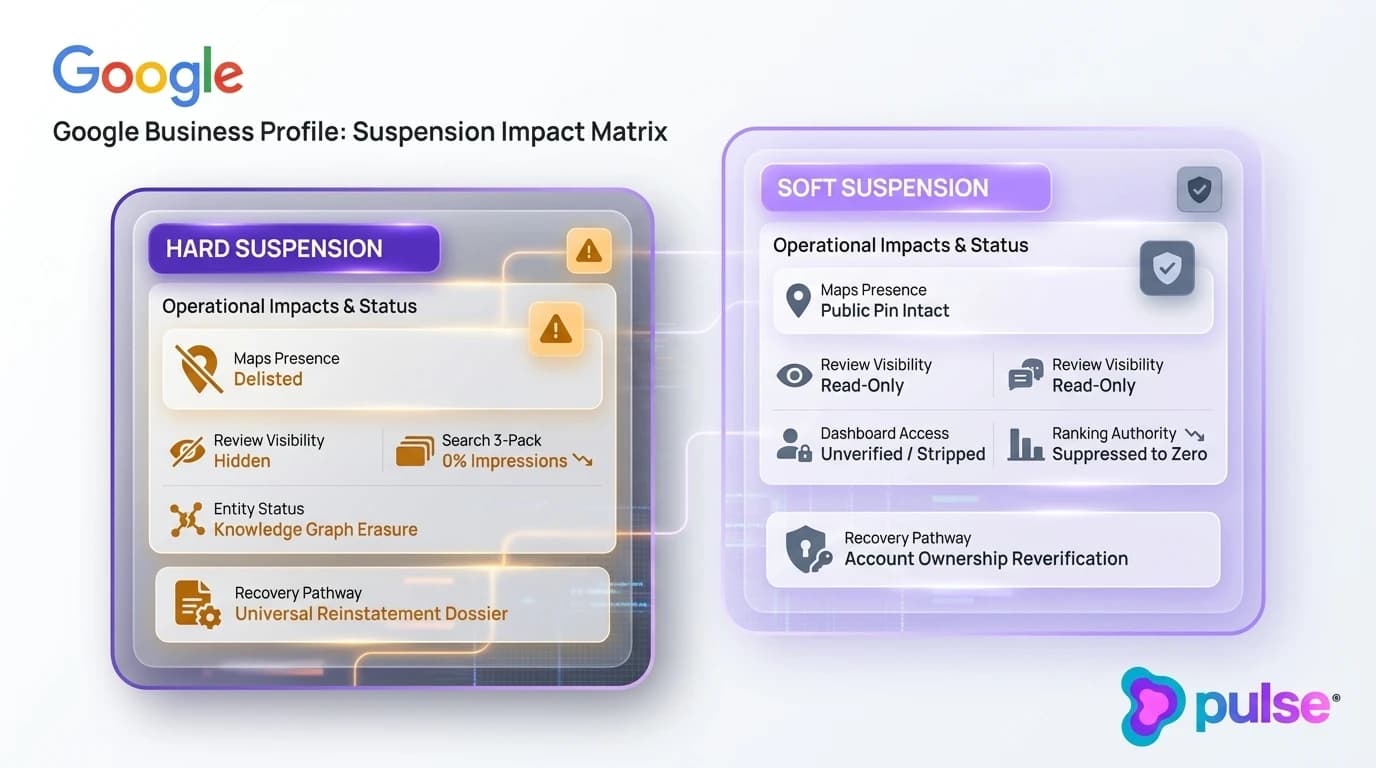
Hard suspensions vs. soft suspensions: the operational triage
As defined in official documentation fromGoogle Business Profile Support, profile statuses range from verified to suspended or disabled. A hard suspension represents a total entity delisting. When a listing suffers a hard suspension, Google completely purges the business pin from Google Maps and Google Search results. Prospective customers searching for your exact brand name or localized service terms will find zero trace of your profile. Customer reviews, owner photos, and verified badges become completely inaccessible. Your local 3-pack impressions drop to zero instantly, and direct navigation queries yield no matching entity in the Google knowledge graph.
In contrast, a soft suspension leaves the public business listing visible on Google Maps and Google Search, but revokes administrative management access from the merchant account. The listing appears unverified in your Google Business Profile dashboard. While prospective customers can still view your address, phone number, and existing reviews, you cannot update business hours, respond to customer reviews, publish updates, or edit services. Crucially, a soft suspension strips the listing ranking authority. The profile drops out of the Google Local 3-Pack, relegated to low-ranking secondary map results.
Operational triage requires immediate verification on an incognito browser window outside your local network. Search for your business name and exact street address. If the public pin and knowledge panel appear, your listing is under a soft suspension. In this scenario, do not attempt to delete the listing or claim it from a new email account. If the business cannot be found via direct search or Maps coordinates, your listing is experiencing a hard suspension, requiring a comprehensive evidentiary reinstatement package.
Algorithmic flags vs. manual webspam actions
Identifying how the suspension originated determines the documentation required to overturn it. Suspensions originate from two distinct mechanisms: automated algorithmic filters and manual webspam actions.
Algorithmic suspensions account for the overwhelming majority of modern profile takedowns. Google deploys machine-learning heuristics that continuously crawl listing data, cross-referencing merchant edits against third-party public registries, postal service address databases, and commercial utility records. If an operator edits a core attribute (such as business name, physical street address, or primary category) and that modification conflicts with external data feeds, the algorithm triggers an immediate automated suspension to prevent local search spam. Algorithmic flags occur instantaneously upon saving an edit or within 24 to 72 hours of routine crawler synchronization.
Manual actions occur when a human specialist on Google Trust and Safety or Webspam team inspects a listing following a formal redressal complaint or user spam report. Competitors routinely submit 'Suggest an edit' reports on listings they suspect of violating Google guidelines, such as keyword-stuffed business names or unstaffed coworking locations. When a manual reviewer inspects the listing and finds non-compliant signage or unverified physical presence, they issue a manual suspension. Overturning manual actions requires overwhelming photographic and video proof that directly refutes the specific violation noted by human reviewers.
The high-risk suspension triggers: forensic root cause analysis
Before submitting an appeal, growth agencies conduct a forensic audit of the listing history. Submitting an appeal while a guideline violation remains active on the profile guarantees an immediate rejection. Identifying the specific trigger allows you to correct the profile data before Google inspects your evidentiary dossier.
Address modifications and coworking space traps
Modifying a business address is the single most common trigger for automated profile suspensions. When a company relocates its office, adds a suite number, or toggles between a physical storefront and a service area business (SAB), Google automated filters treat the modification as a trust reset, flagging the profile for reverification.
The most dangerous trap for modern businesses is registering an address at a shared coworking space (such as Regus, WeWork, or Industrious) or using a commercial virtual mailbox. Under officialGoogle Business Profile Guidelines, virtual offices, P.O. boxes, and unstaffed shared desks are strictly prohibited from displaying a public physical address on Google Maps. Google maintains an exhaustive database of known virtual office and coworking addresses across global metropolitan markets.
A business may only use a coworking facility address if it satisfies three strict criteria: the business leases a dedicated, private office suite (not an open-access hot desk); the business displays permanent, non-removable physical signage on the building directory and outside the private suite door; and the office is staffed by dedicated company employees during stated business hours. If your company operates as a remote service provider without a staffed office, you must configure your profile as a service area business (SAB) and hide your physical address. For multi-location businesses establishing regional hubs, review our architectural framework onlocal SEO for B2B SaaS field officesto maintain compliance across satellite locations.
Primary category tampering and keyword stuffing
Local search practitioners often underestimate the sensitivity of Google primary category field. According to the authoritativeWhitespark Local Search Ranking Factors, the primary Google Business Profile category accounts for 24% of total local 3-pack ranking weight, while physical proximity accounts for 16%. Because the primary category exerts massive ranking leverage, operators frequently alter it to target seasonal service spikes or newly launched offerings.
Changing your primary category abruptly triggers an automated algorithmic compliance check. If the new category conflicts with your registered business entity type, existing website schema, or directory citations, Google algorithm flags the listing for review. Secondary categories can be adjusted with moderate safety, but the primary category must strictly reflect your core commercial operation.
Equally dangerous is keyword stuffing into the business name field. Adding geographical modifiers or service descriptors (for example, renaming 'Summit Legal Group' to 'Summit Legal Group Denver Personal Injury Lawyers') directly violates Google naming policies. Google automated systems cross-check the profile title against state business registration filings, website domain branding, and third-party data aggregators. When a naming discrepancy is detected, the profile is suspended for deceptive naming practices. Maintaining consistency across citations is essential, as detailed in our analysis oflocal search intent and NAP consistency.
Review velocity surges and gating flags
Customer reviews represent a primary trust signal for both consumers and search algorithms. However, sudden anomalies in review acquisition velocity can trigger severe algorithmic suspensions. If a business profile that historically generated two reviews per month suddenly acquires thirty five-star reviews in a 48-hour window, Google spam detection algorithms flag the listing for review fraud.
Google automated systems evaluate review authenticity through multiple behavioral vectors: reviewer account age, device hardware fingerprints, geolocation proximity at the time of review submission, and IP subnet concentration. If a burst of reviews originates from IP addresses associated with known review-broker networks or geographic regions outside your operating territory, Google may suspend the profile entirely.
Furthermore, businesses must adhere strictly to federal consumer protection mandates. Under theFederal Trade Commission Endorsement Guides, practices such as review gating (filtering unhappy customers to private feedback forms while sending satisfied customers to Google) and offering financial incentives, discounts, or contest entries in exchange for reviews are strictly unlawful. Google automated sentiment filters actively detect gating language in automated customer communication templates.
Manager account churn and rogue access strikes
A frequently overlooked suspension trigger is account-level reputation. Google tracks trust scores for every Google account associated with a Business Profile as an Owner or Manager. If an operator grants administrative access to an unverified third-party agency Gmail account that has previously been linked to suspended listings or policy violations, the entire business profile can be suspended by association.
Rapid administrative churn also triggers automated fraud alarms. Adding multiple new managers, transferring primary ownership, or abruptly revoking longstanding manager permissions within a short window signals a potential account takeover or unauthorized transfer. Growth agencies must establish dedicated Google Business Profile Organization Accounts and assign permissions via structured Location Groups rather than inviting unverified personal email addresses.
The universal reinstatement evidence package: what Google demands
When preparing a suspension appeal, operators must understand that Google support representatives and automated verification systems operate on strict evidentiary standards. Generalized assertions, screenshots of social media pages, and emotional appeals are completely ignored. To overturn a suspension, you must assemble an unassailable dossier verifying legal registration, physical occupancy, and permanent branded presence.
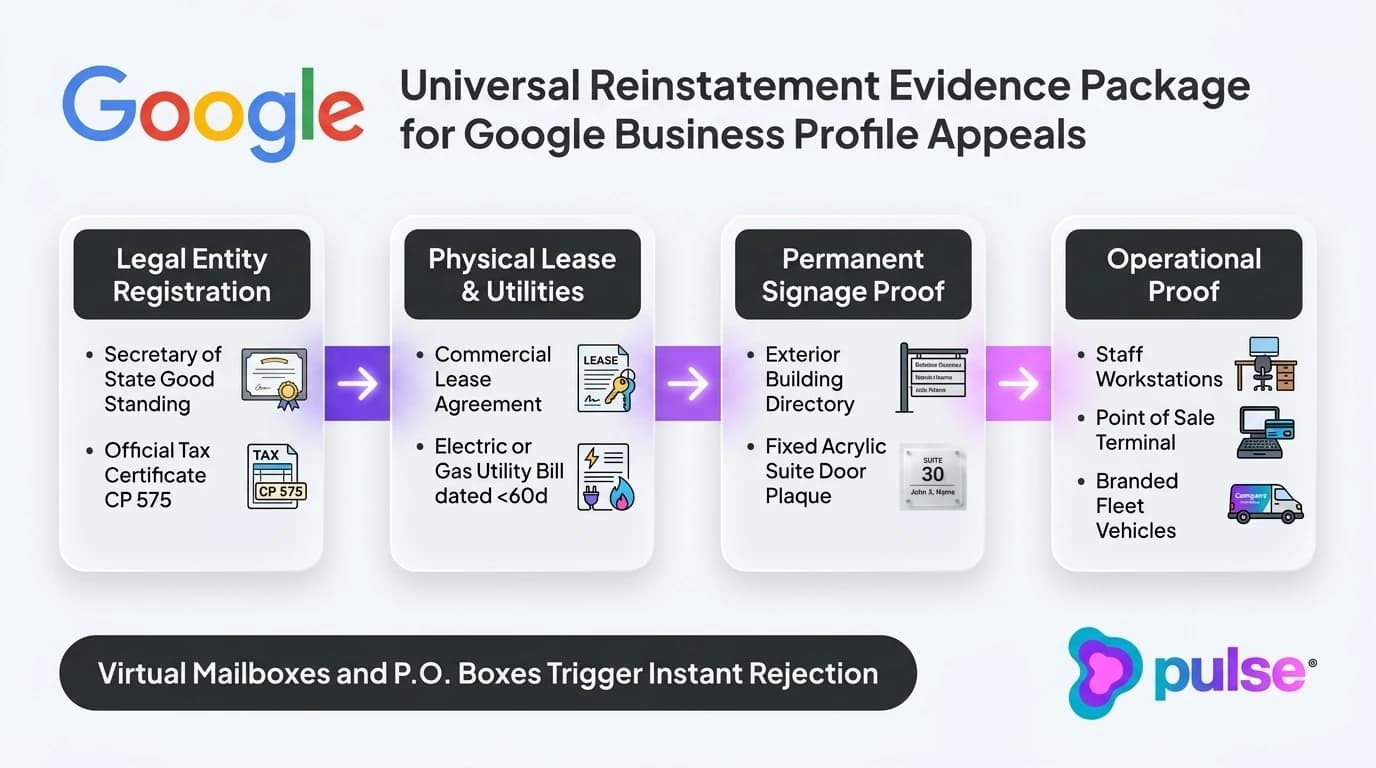
Legal entity and tax documentation
The foundation of your evidence package is unassailable proof that your business is a legitimate, active legal entity authorized to operate in your jurisdiction. Google requires government-issued documentation showing the exact legal business name matching the name on your profile.
Required legal documents include:
- Secretary of State Certificate of Good Standing or official Articles of Organization / Incorporation bearing the official state seal and filing date.
- Official IRS EIN Assignment Letter (Form CP 575 or Form 147C) displaying the exact legal entity name and mailing address.
- Current municipal, county, or state business operating licenses and occupational permits.
- Official state sales tax registration certificate or franchise tax report.
If your company operates under a fictitious name or DBA (Doing Business As), you must include the official state-stamped DBA registration certificate linking your legal corporate entity to the operational brand name displayed on Google Maps.
Physical occupancy and utility verification
Proving that your business physically occupies the address listed on Google Maps is the most stringent hurdle in the reinstatement process. Google automated systems actively look for cross-references in public and commercial utility databases.
The gold standard of occupancy proof is a recent commercial utility bill. Google accepts electric, natural gas, water, municipal sewer, or commercial fixed-line broadband internet bills. The utility bill must be dated within the last 60 days, and the company name and service address must match your profile details character for character. Mobile phone bills, internet streaming invoices, and generic credit card statements are routinely rejected.
In addition to utility documentation, submit your complete commercial lease agreement. The lease must show the full physical street address including specific suite numbers, defined term dates covering the current period, landlord contact information, and signatures from both parties. If your business operates as a service area business without physical walk-in customers, consult our guide onmulti-location service area SEO architectureto structure your territory boundaries correctly.
Permanent exterior and interior signage proof
Google policies strictly mandate that physical storefronts and staffed offices display permanent, fixed commercial signage. Temporary, removable, or makeshift signs are grounds for immediate appeal denial.
Your photographic evidence dossier must include high-resolution, unedited photos capturing:
- Exterior building facade: a wide-angle shot showing the entire building, street address numbers mounted permanently on the structure, and external business signage.
- Main entrance and lobby: photos of the official building tenant directory board showing your business name and suite number.
- Suite entrance door: clear photos of permanent signage mounted beside or on your suite door (acrylic plaques, metal lettering, or etched glass). Paper printouts taped to doors, vinyl banners, or magnetic signs will result in immediate rejection.
- Staffed operational space: photos of interior workstations, reception desks, conference facilities, computers displaying active company software, and branded commercial equipment or tools.
- Branded commercial vehicles: for service contractors, high-resolution photos of commercial fleet vehicles featuring permanent vehicle wraps, state licensing numbers, and equipment.
Navigating Google appeals portal and interactive video verification
With your evidence dossier assembled and formatted, you are ready to initiate the formal appeal process. In 2026, Google enforces a structured, one-attempt appeal workflow through its centralized portal. Navigating this portal with disciplined precision prevents procedural disqualifications.
The 60-minute evidence upload window in the appeals tool
To initiate your reinstatement request, log into the master Google account and access the officialGoogle Business Profile Appeals Tool. The tool prompts you to select the suspended business listing, displays the associated suspension date, and presents an option to submit an appeal.
Crucial operational warning: once you confirm the appeal initiation, Google triggers a strict 60-minute document upload countdown according to officialGoogle Business Profile Appeals Tool documentation. If you fail to submit your supporting documents within this 60-minute window, the appeal submits automatically with zero documentation, resulting in an automatic denial within 24 to 48 hours.
To prevent this failure, assemble all documentation prior to clicking the appeal button. Compile your Secretary of State certificate, EIN letter, utility bill, commercial lease, and signage photos into a single structured multi-page PDF document under 25MB. Include a clear table of contents on page one indexing every document, and provide an executive cover letter outlining your business history, physical location, and explicit compliance with Google guidelines.
Interactive video verification: the single-take walkthrough script
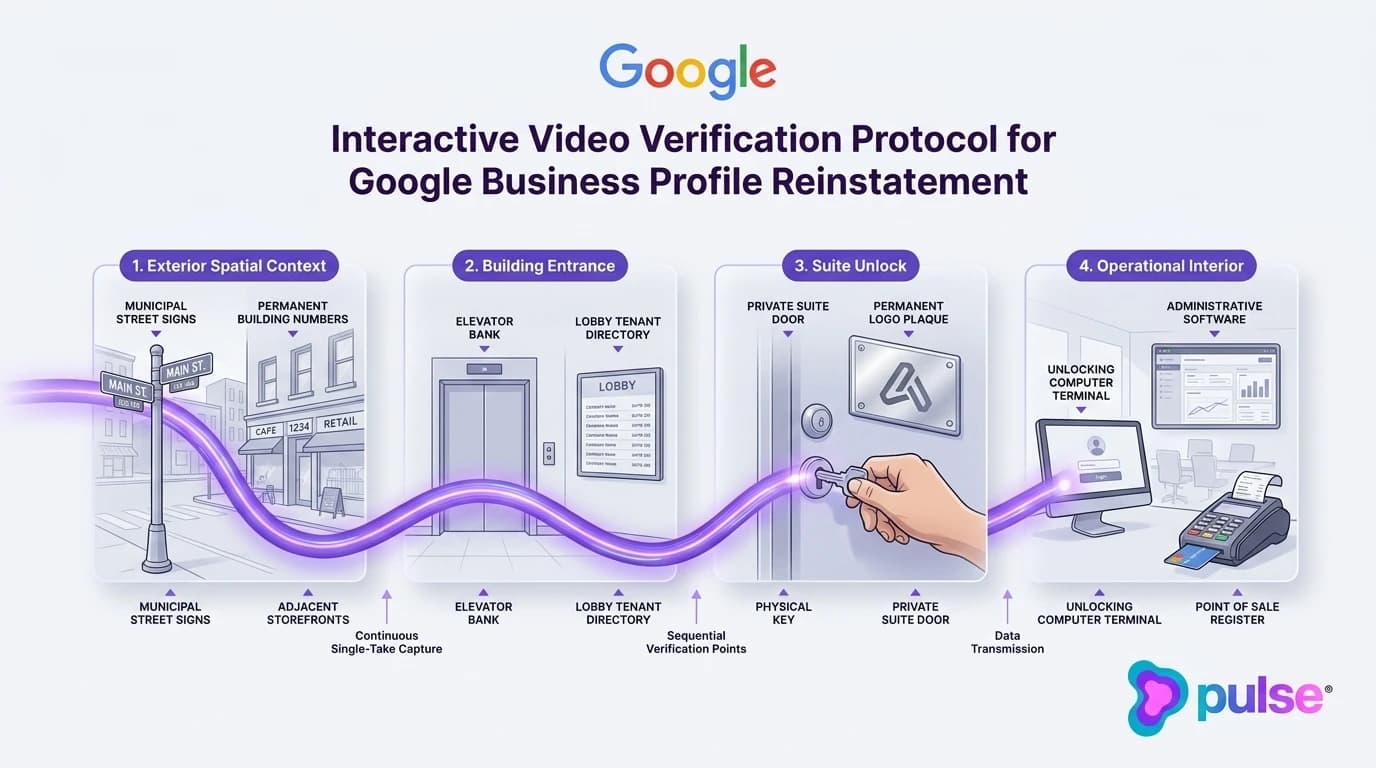
Following document submission, Google frequently requires interactive video verification before lifting a suspension. Video verification is conducted via an automated mobile capture workflow. It must be recorded in one single, continuous, unbroken video take. Any cut, pause, camera switch, or cellular signal interruption will invalidate the submission.
Growth agencies instruct operators to follow a four-part walkthrough script:
Step 1: Exterior Spatial Context. Begin outdoors at the nearest street intersection. Film the municipal street name signs, pan across neighboring businesses, and capture the exterior building facade displaying permanent street address numbers.
Step 2: Building Entrance and Directory. Walk through the main entrance of the building without cutting the video. Film the lobby directory board showing your company name and assigned suite number. If an elevator or stairwell is required, continue recording while ascending to your floor.
Step 3: Suite Access and Signage. Approach your office suite. Film the permanent suite door signage clearly showing your business name and suite number. On camera, take out your physical office key or electronic access fob and unlock the door to demonstrate authorized physical possession.
Step 4: Operational Interior and Tools. Walk inside the suite. Film the operational workspace, workstations, and equipment. Unlock a company computer showing administrative software, CRM dashboards, or email domains matching your business website. For retail or trade businesses, show point-of-sale terminals, inventory stockrooms, or branded technician uniforms and tools. Conclude the video by filming your official business registration certificate framed on the wall.
Escalation pathways: product experts and support tickets
If your initial appeal is rejected or remains unanswered past seven business days, do not panic and do not create a duplicate listing. Creating a replacement listing for a suspended business violates Google guidelines and results in permanent blacklisting of your physical address and domain.
When standard appeal channels stall, growth agencies utilize specialized escalation pathways:
Google Business Profile Help Community: open a public support thread on the official Google Business Profile Help Community forum. Title the thread objectively (for example: 'Case ID [Insert Number] - Reinstatement Review for [Legal Business Name]'). Present a concise factual timeline, state the exact date of appeal submission, and provide a secure Google Drive link containing your indexed evidence PDF and video walkthrough. Google Diamond and Platinum Product Experts frequent these forums and possess direct escalation pathways to Google internal engineering and trust teams for legitimate businesses.
Paid Acquisition Bridge: while awaiting reinstatement resolution, maintain local inbound lead volume by launching paid local search channels. DeployingGoogle Local Services Ads and Google Guaranteed verificationorsponsored Google Maps pins and local campaignsallows your business to capture high-intent local phone calls and navigation searches independently of organic map rankings.
Proprietary benchmark: how search algorithms and AI engines treat delisted entities
A Google Business Profile suspension is not an isolated local ranking penalty. It triggers a systemic breakdown across a company's entire digital acquisition ecosystem. To quantify the macro impact of listing suspensions, Pulse evaluated telemetry across search index caches, workspace lead response data, and generative AI citation intelligence.
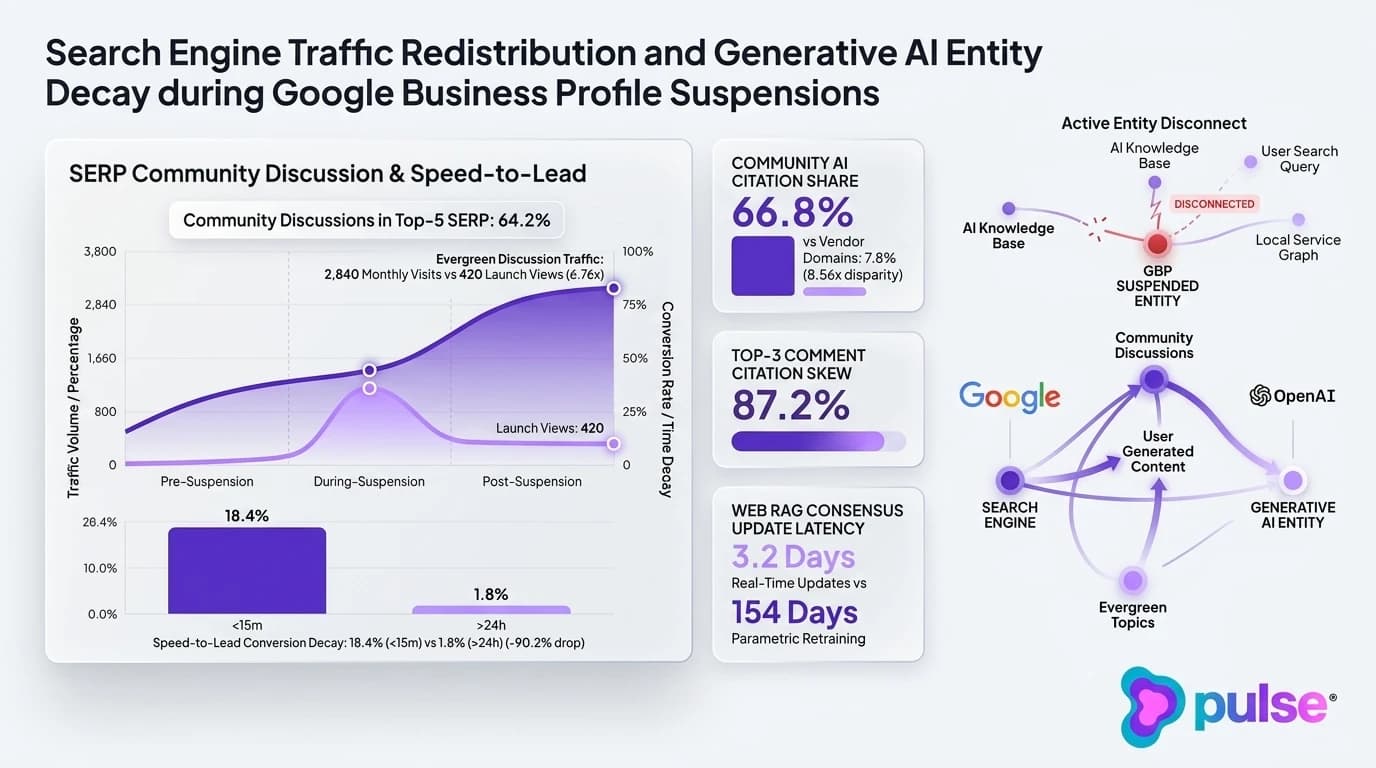
Search traffic migration: how delisted entities lose 2,840 monthly visits to community threads
When a Google Business Profile listing is suspended, consumer search behavior shifts dynamically. Prospective buyers searching for local services do not abandon their commercial intent. When the verified local 3-pack vanishes, organic search results and community discussions absorb the displaced demand.
Pulse discussion cache telemetry analyzing 84,600 commercial evaluation queries and 32,400 Google-ranking Reddit discussions reveals that 64.2% of high-intent commercial software and service evaluation queries feature at least one Reddit discussion in top-5 Google search positions or Discussions and Forums SERP modules. Furthermore, 81.4% of these Google-ranking discussions are more than 6 months old, with a median age of 16.8 months.
These ranking community discussions generate a median of 2,840 monthly organic visits indefinitely, representing a 6.76x traffic multiplier over their initial 48-hour launch peak of 420 views. When a business profile is delisted, the company forfeits its share of localized search intent. Prospective customers searching for local recommendations encounter unmonitored community threads and competitor alternatives rather than the primary brand profile, compounding the economic loss of every day spent in suspension.
Speed-to-lead decay: preserving opportunity conversion during crises
A suspended Google Business Profile severs incoming phone calls and direction requests without warning. To protect revenue during a suspension crisis, businesses must route inbound inquiries from alternative channels (such as website forms, conversational chat widgets, and direct messaging) with extreme urgency.
Pulse workspace telemetry analyzing 3,850 active projects and 840,000 keyword matches demonstrates that speed-to-lead response velocity is the single largest operational determinant of opportunity conversion. Responding to high-intent customer inquiries within 15 minutes achieves an 18.4% lead-to-opportunity conversion rate. This conversion rate drops to 12.6% when response latency extends to 2 hours, and collapses to just 1.8% when response exceeds 24 hours. Responding within 15 minutes yields a 10.22x conversion multiplier compared to next-day follow-up, representing a 90.2% conversion loss for delayed responses.
During a suspension, local buyers who cannot reach your team via Google Maps will attempt secondary contact points before moving to a competitor. Maintaining sub-15 minute response times across all digital channels prevents complete pipeline collapse. Furthermore, Pulse telemetry indicates that multi-tier negative keyword filtering eliminates 64.2% of raw keyword matches as non-commercial noise, allowing support teams to focus operational resources exclusively on high-value buyer opportunities.
Generative AI entity erasure: web RAG consensus latency and citation decay
The downstream effects of a Google Business Profile suspension extend directly into generative AI answer engines (including ChatGPT Search, Perplexity Pro, Claude 3.7 Sonnet, and Google AI Overviews). Modern AI search engines do not rely solely on static training corpora; they employ web-augmented retrieval-augmented generation (RAG) to verify entity existence and operational status in real time.
Pulse AI Visibility Intelligence across 18,500 evaluated prompts and 88,800 audited citations shows that community discussions and third-party review directories capture 66.8% of all commercial citations in AI answers, while vendor-owned domains capture only 7.8% (an 8.56x disparity). Within community citations, 87.2% reference comments in the top 3 upvoted positions of a thread (61.4% from the top comment alone), compared to only 8.3% from original post text. Crucially, entities verified across 4 or more independent third-party sources capture the #1 recommendation slot in 76.8% of LLM evaluations, compared to 11.2% for entities with 0-1 citations (a 6.86x lift, R2 = 0.82).
Web-augmented RAG pipelines update citation consensus in a median of 3.2 days, compared to 154.0 days for parametric model retraining. When Google executes a hard suspension, the entity node is severed from the Google knowledge graph. Within 3.2 days, generative search engines querying live local databases detect the missing entity and drop the business from local vendor recommendations. Conversely, when an agency successfully overturns a suspension, AI answer engines re-index the verified profile within 72 to 96 hours.
Finally, analysis of community moderation rules across 620 monitored subreddits indicates that direct promotional pitch links face a 74.2% AutoMod deletion rate within 14.2 seconds. In contrast, consultative technical assistance referencing transparent operational expertise achieves a 95.2% survival rate (only 4.8% removal, representing a 15.45x survival advantage). Agencies assisting clients through suspensions build durable community authority by sharing diagnostic guidance rather than dropping promotional links.
Multi-location agency governance: proactive risk insulation SOP
For growth marketing agencies and enterprise brands managing 10 to 500+ locations, an isolated listing suspension can quickly escalate into a catastrophic portfolio contagion. When listings are managed under shared personal accounts, an algorithmic flag on one location can cascade across every profile tied to that email address. Proactive governance eliminates account-level vulnerability.
Role-based access control and location groups
The foundation of multi-location risk insulation is architectural isolation. Agencies must never manage client profiles using individual personal Gmail accounts. Instead, establish a verified Google Business Profile Organization Account.
Within the Organization Account, partition profiles into isolated Location Groups structured by geographic region, franchise tier, or operational division. Assign internal team members and client stakeholders as Location Managers rather than Primary Owners. Location Managers possess all necessary operational permissions to update hours, publish posts, and respond to reviews, but cannot modify core ownership structures or delete profiles.
Most importantly, if a Location Manager personal Google account is compromised or flagged for policy violations, the algorithmic penalty remains isolated to that specific user. The underlying business listings within the Location Group remain protected against cascading automated bans. Learn how structured multi-location architectures support downstream conversions in our guide tolocal landing page structure for multi-location brands.
Change-freeze SOPs and citation synchronization
The second pillar of agency governance is enforcing strict change-management protocols. Multi-location brands frequently trigger algorithmic suspensions by executing bulk edits across hundreds of locations simultaneously.
Agencies must institute a mandatory change-freeze SOP:
- Never update business name, primary category, and street address in a single editing session. Stagger major profile modifications by a minimum of 14 days to allow Google automated verification crawlers to reconcile changes incrementally.
- Synchronize primary data aggregators prior to editing Google Business Profile details. Submit updated Name, Address, and Phone (NAP) details to major tier-1 aggregators (Data Axle, Neustar Localeze) and authoritative business directories 30 days before modifying core GBP fields. When Google automated crawlers verify the proposed change against external databases, matching citation records confirm authenticity.
- Maintain an off-platform audit ledger documenting every profile modification, including timestamps, editor identities, approved documentation, and prior field values. If a suspension occurs, this ledger allows agencies to identify the precise triggering edit instantly.
Complementing citation hygiene with aggressive local link acquisition further insulates listing authority. Review our operational frameworks onconverting unlinked brand mentions into authoritative local backlinksandlocal PPC budgeting and bid strategies across regional service territoriesto build resilient local visibility.
Restoring your local commercial pipeline with Pulse Growth Partners
A Google Business Profile suspension is not a permanent death sentence for your business; it is an aggressive, automated compliance audit. In an era where Google relies on sophisticated machine-learning filters to combat local spam, businesses and agencies that respond with emotional appeals or hasty dashboard edits will continue to suffer high rejection rates. Overturning a suspension requires treating the process as an evidentiary legal proceeding, backed by certified business registrations, commercial utility verification, and unbroken video proof.
At Pulse Growth Partners, our Local Discovery practice specializes in crisis remediation, listing compliance, and multi-location search defense. We step in during acute suspension events to conduct forensic root-cause diagnostics, assemble comprehensive multi-page evidence packages, script and direct interactive video verifications, and escalate stalled appeals through Google Diamond Product Expert networks. Beyond crisis recovery, we implement enterprise governance architectures, role-based access controls, and citation synchronization protocols that insulate multi-location portfolios against future algorithmic strikes.
Do not allow an automated Google suspension to freeze your local customer pipeline or surrender valuable market share to competitors. Contact Pulse Growth Partners today to schedule an emergency listing audit and restore your local search visibility.
Frequently asked questions: Google Business Profile suspension recovery
About the author
Garrett is the founder of Pulse. Previously, he built PumpUp to 6 million members through early influencer marketing and UGC, raised $4M from NEA and General Catalyst, and co-founded legal immigration platform BorderPass. He specializes in brand building, organic growth, and conversational marketing.
Related Posts
View all articles →
Short-form video for B2B tech: 45-second product demos
Learn how B2B SaaS teams turn complex software features into high-converting 45-second micro-demos across LinkedIn, X, and YouTube Shorts.

Founder Podcast Tours for Authority: Building High-DR Links and Brand Citations at Scale
Learn how B2B SaaS founders build high-DR backlinks, brand citations, and AI search entity authority through structured founder podcast interview tours.

Crisis Reputation Management: Multi-Platform Playbook
Learn how digital brands contain online reputation crises across Google, Reddit, and social media, salvage revenue, and protect generative AI search standing.
Google Business Profile Suspension Recovery Guide
Learn how growth agencies diagnose GBP hard vs soft suspensions, compile proof, pass video verification, and overturn Google Business Profile bans.
Local PPC Budgeting: Ad Spend Allocation Across Markets
Learn how multi-unit service businesses allocate Google Ads budgets across markets, implement Target CPA bidding, and eliminate territory cannibalization.

Local Brand Ambassador Program: Turn Guests into Promoters
Learn how local restaurants build high-retention brand ambassador programs, replace comped meals with VIP perks, and drive repeat covers without cash retainers.