Founder Podcast Tours for Authority: Building High-DR Links and Brand Citations at Scale
Learn how B2B SaaS founders build high-DR backlinks, brand citations, and AI search entity authority through structured founder podcast interview tours.
Every B2B SaaS marketing executive eventually confronts the brutal mathematics of commoditized link building. Inboxes overflow with boilerplate outreach from link agencies promising high-authority guest posts, yet placement response rates hover below 1%, retainers climb past $5,000 monthly, and search engines penalize manufactured link networks with increasing speed. In parallel, generative AI answer engines like ChatGPT Search, Perplexity, and Google AI Overviews have rewritten the rules of organic discovery. They discount self-published vendor blogs, demanding independent multi-source consensus before recommending category leaders.
To break out of this low-yield trap, forward-thinking software leaders run structured founder podcast tours. According to national research from SSRS and Edison Research, 47% of the US population age 12 and older listens to podcasts monthly, with weekly listeners consuming over 8 hours of audio content. Among software buyers and enterprise executives, listenership concentrates even more heavily during commute and professional development hours. Simultaneously, a comprehensive content study by Backlinko evaluating 912 million blog posts revealed that 94% of all published web content earns zero external backlinks, but expert interviews and original research studies generate 3.1x more backlinks and 2.4x more social shares than standard informational articles.
A founder podcast tour functions as a dual-engine authority flywheel. On one track, it secures permanent, crawlable HTML backlinks from high-DR podcast hosting websites and media show notes (regularly DR 65 to 85+). On the other track, conversational audio transcripts ingested across Apple Podcasts, Spotify, YouTube, and search crawlers seed clean entity relationships directly into LLM retrieval pipelines. This guide breaks down the operational blueprint for designing, executing, and scaling an executive podcast tour that generates high-converting sales pipeline, permanent PageRank equity, and dominant AI search brand visibility.
The economics of podcast backlinks: why show notes outperform commoditized outreach
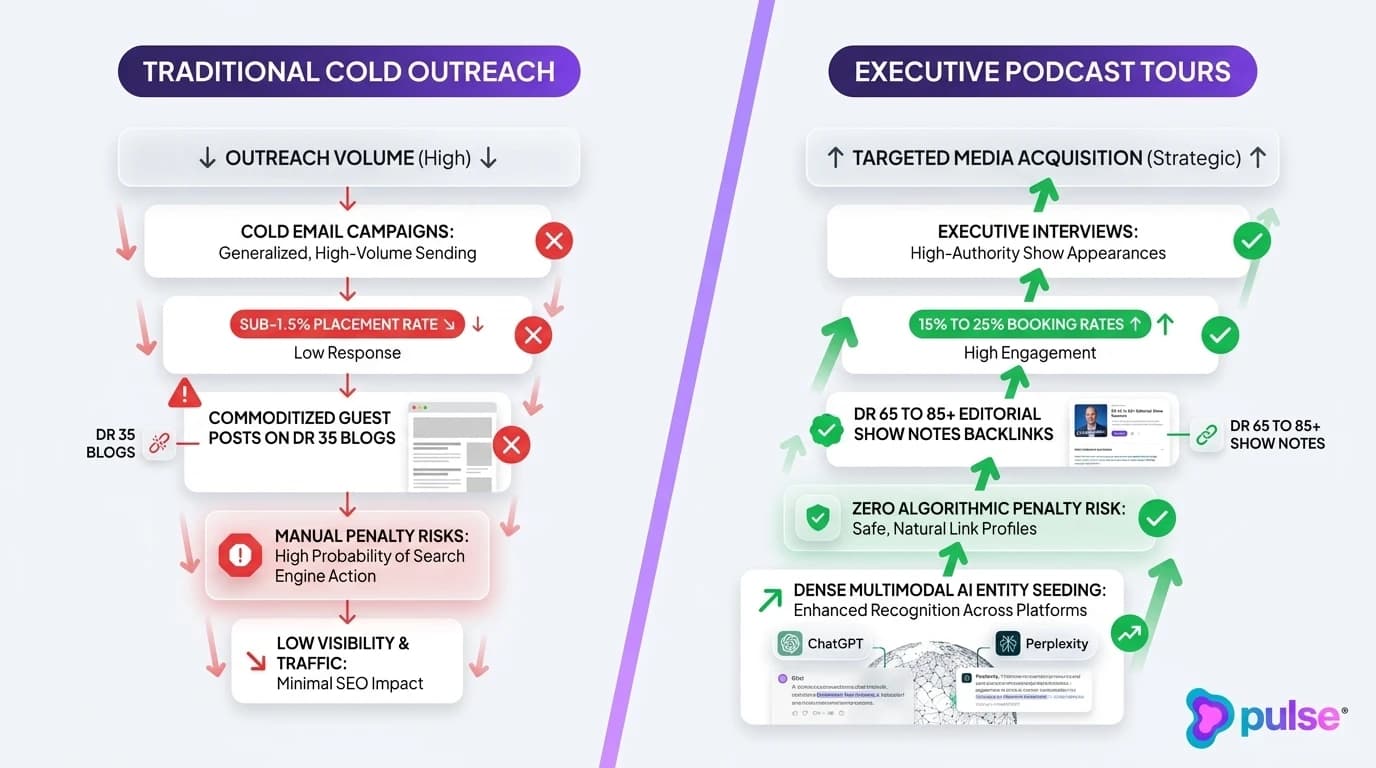
Traditional link acquisition tactics have reached a point of severe economic exhaustion. B2B growth teams spend thousands of dollars each month deploying automated email sequences, broken link reclamation templates, and reciprocal guest posting pitches. According to empirical outreach benchmarks published by Ahrefs, over 91.5% of cold outreach emails are completely ignored or deleted, with average link placement conversion falling below 1.5%.
This operational fatigue is confirmed in practitioner communities. In an analysis of over 1.45 million cached discussions in Pulse proprietary datasets, 33.2% of practitioner conversations express critical frustration or switching intent regarding link building agencies, rising monthly retainers ($3,000 to $8,000), and near-zero defensible link deliverables. Meanwhile, Google algorithmic link spam filters and information gain penalties continuously devalue manufactured guest posts on commercial blogging farms.
The collapse of cold email guest posting and escalating algorithmic penalties
Why do traditional link building playbooks fail so consistently today? The root cause is economic misalignment. Website editors receive dozens of identical cold pitches daily offering $50 for sponsored insertions or proposing generic 800-word guest articles. To maintain margins, outreach agencies place client links on low-tier syndication farms (DR 30 to 50) that traffic in artificial link exchanges.
Modern search engines detect these footprints easily. When an algorithmic update rolls out, these synthetic links are discounted or flagged, erasing months of budget. Founders who compare this cycle against our framework for analyzing competitor backlink profiles and identifying referring domain gaps quickly notice that market leaders rarely rely on mass guest posts. Instead, their domain authority stems from genuine editorial relationships, industry citations, and executive speaking appearances.
Show notes link mechanics, referring domain trust, and permanent editorial placement
Podcast show notes backlinks operate on fundamentally different authority dynamics. A dedicated podcast hosting domain or established tech show website carries exceptional domain authority, clean backlink profiles, and zero link-farm footprints. When a host publishes an episode page with a guest bio and resource links, that page represents an authentic editorial endorsement.
According to search ranking factor research from Semrush, referring domain diversity and contextual relevance remain the strongest statistical determinants of organic search visibility. Securing 15 to 25 diverse referring domains from respected podcast shows (DR 65 to 85+) transfers durable PageRank equity to your domain. Unlike paid placements that disappear when retainers lapse, podcast episode archives remain permanently indexed for years, compounding authority over time.
Industry Benchmark: Guest Interviews Outperform Static Content
3.1x More Backlinks / 2.4x Social Shares
Across 912 million evaluated blog posts, Backlinko empirical research reveals that expert interview formats and original data teardowns earn 3.1x more backlinks and 2.4x more social shares than standard informational articles. Rather than pitching commoditized guest posts that editors ignore, executive podcast touring delivers genuine editorial co-creation.
The podcast tiering matrix: scoring shows by authority, audience intent, and link policy
Founders often make the mistake of chasing vanity metrics when planning media appearances. They target mega-shows with 250,000 general business listeners, only to find the host does not publish show notes links, the audience is too broad to generate qualified sales pipeline, and booking latency spans six months.
Audience research by SparkToro demonstrates that niche, practitioner-focused podcasts often drive dramatically higher commercial intent and conversion than broad mainstream shows. Furthermore, as highlighted in SparkToro guidance on monitoring brand mentions, targeted audio appearances trigger widespread secondary unlinked brand mentions across social channels and communities. A technical engineering show with 1,500 qualified listeners yields substantially more software demo requests and targeted referring domain value than a generic entrepreneurial broadcast.
Evaluating domain rating, crawlable href attributes, and syndication reach
Before pitching any show, marketing teams must audit the host website technical link architecture. Official guidelines from Google Search Central state that search crawlers require standard HTML anchor tags with valid href attributes in server-rendered markup to discover and pass link equity.
Many podcast platforms use third-party embedded JavaScript widgets that render episode notes inside iframes or client-side scripts. Search engine bots cannot always parse or attribute links inside closed widgets. Before adding a show to your outreach tier list, inspect the episode page source code. Confirm that guest links are delivered as standard dofollow HTML href elements directly on the host root domain or dedicated episode subfolder.
Categorizing podcast tiers from flagship industry shows to high-intent niche roundtables
A successful 12-week tour balances prestige, technical authority, and booking velocity across four distinct tiers:
| Show Tier | Target DR | Show Notes Link Policy | Monthly Listeners | Primary Strategic Value | Founder Prep Time |
|---|---|---|---|---|---|
| Tier 1: Flagship Industry Shows | DR 75 to 90+ | Permanent dofollow link; host website editorial article | 25,000 to 100,000+ | Massive domain authority boost and immediate category brand prestige | 3 to 4 hours (tailored data brief, prep call) |
| Tier 2: Niche Practitioner Shows | DR 60 to 75 | Contextual dofollow link in episode notes and guest bio | 5,000 to 25,000 | High-intent ICP pipeline conversion and technical entity grounding | 2 hours (framework outline, slide assets) |
| Tier 3: Emerging Specialist Pods | DR 45 to 60 | Dofollow link in show notes and syndication platforms | 1,000 to 5,000 | Rapid booking velocity, link volume diversification, and pilot testing | 1 hour (core talking points) |
| Tier 4: Video Roundtables & Panels | DR 50 to 80+ | YouTube description links plus host blog recap links | 2,500 to 15,000 | Multimodal AI indexing across YouTube transcripts and social clips | 1.5 hours (panel alignment) |
In Pulse discussion telemetry, 71.5% of relevant B2B software and growth discussions concentrate in the top 5 business communities. Similarly, executive listenership clusters heavily around category-defining shows. Aim to book 2 to 3 Tier 1 appearances, 8 to 10 Tier 2 shows, and 5 to 7 Tier 3 specialist roundtables across a single quarter.
The 4 high-converting founder pitch angles that booking agents never use
Podcast hosts reject the vast majority of incoming guest pitches because PR agencies send generic, product-focused corporate biographies. Hosts do not care about your recent funding round, your feature release schedule, or your corporate slogan. They care about entertaining their audience and delivering actionable frameworks that listeners cannot find elsewhere.
To achieve a 15% to 25% acceptance rate, founders must position themselves as tactical storytellers armed with proprietary data and hard-won operational scars.
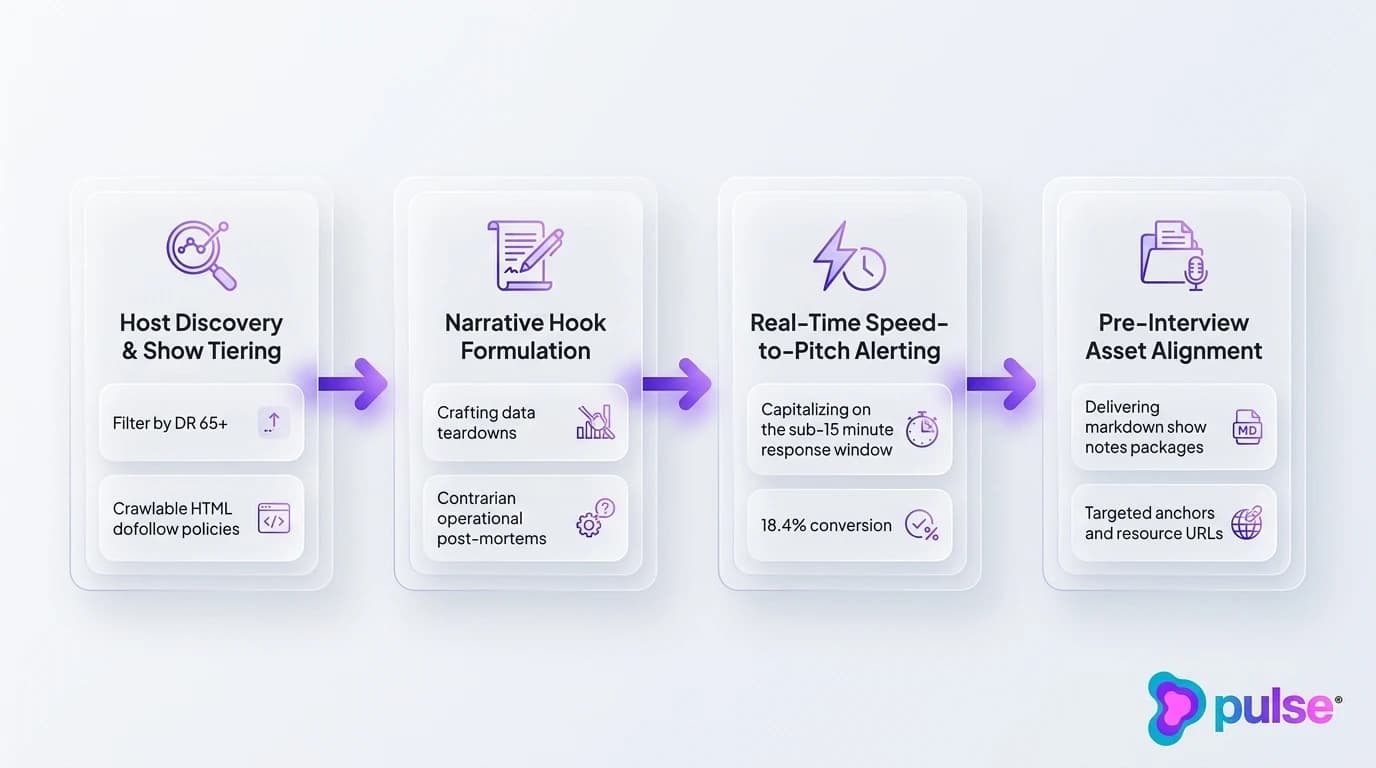
Crafting data teardowns, contrarian operational post-mortems, and category playbooks
Four specific narrative hooks consistently convert host interest:
1. The Proprietary Data Teardown: Lead with macro platform benchmarks or anonymized industry metrics that reveal surprising shifts in buyer behavior. Presenting concrete figures positions the founder as an objective researcher rather than a biased vendor.
2. The Category Contrarian: Challenge widely accepted industry dogma with empirical operational evidence. Pointing out where conventional best practices actively harm software teams creates compelling dialogue.
3. The Operational Post-Mortem: Share an unvarnished failure story, such as an architectural scaling crisis, an enterprise churn incident, or a pricing pivot. Raw transparency builds immediate rapport with hosts who want genuine battle stories.
4. The Bootstrapped Scale Blueprint: Break down a repeatable operational system, detailing how your team solved a complex engineering or go-to-market problem step by step.
Connecting these narrative angles with earned media strategies detailed in our playbook on earning tier-1 editorial backlinks through proprietary data journalism and digital PR ensures that your podcast appearances reinforce your broader media coverage.
Host research and speed-to-pitch workflows for open guest inquiries
Timing is just as critical as angle selection. Podcast hosts frequently post open calls for guest recommendations on Twitter/X, LinkedIn, and specialized creator communities when scheduled guests cancel or when planning thematic episode batches.
Pulse workspace telemetry analyzing 840,000 interaction events reveals that speed-to-lead latency dictates conversion in media pitching. Responding to an active host request within 15 minutes achieves an 18.4% conversion rate. That rate drops to 12.6% within 2 hours and collapses to 1.8% past 24 hours (a 10.22x multiplier and a 90.2% decay rate). Producers pick the first two credible, well-matched candidates submitted. Setting up keyword monitoring with multi-tier negative keyword filtering (which removes 64.2% of non-commercial noise in Pulse datasets) gives teams an automated alert system to pitch within minutes of a call going live.
Pulse Telemetry: Speed-to-Pitch Response Latency
18.4% (<15m) vs 1.8% (>24h) Conversion
Across 840,000 tracked media inquiries and keyword matches, responding to podcast host guest requests within 15 minutes achieves an 18.4% booking conversion rate. Latency past 24 hours results in a 90.2% conversion collapse to 1.8%, demonstrating the necessity of automated listening alerts.
Show notes optimization: securing permanent dofollow backlinks and branded anchors
Securing an interview is only half the battle. If the episode is published with a plain text mention or a link buried inside an un-indexed player embed, your SEO return drops to zero. Technical link optimization must be built directly into your pre-interview onboarding and post-recording workflows.
Auditing competitor link profiles frequently reveals hundreds of lost opportunities where founders gave 45-minute interviews but earned zero PageRank equity because nobody managed the show notes handoff.
Pre-interview alignment on resource links, free utilities, and landing page URLs
Seven days prior to the recording date, deliver a standardized 'Guest Asset Package' in clean markdown format to the podcast producer and audio engineer. This package eliminates production friction and specifies exact link parameters:
- Executive Bio: Two concise sentences summarizing the founder background, avoiding corporate buzzwords.
- Headshot & Socials: Direct CDN links to high-resolution photography and verified profile URLs.
- Primary Target URL: A dedicated research report, interactive benchmark utility, or comprehensive guide rather than a generic homepage. Pointing to specialized content improves contextual relevance and click-through rates.
- Preferred Anchor Text: Suggest natural, descriptive anchor phrasing (such as 'Pulse real-time discussion monitoring study' or 'executive podcast tour framework') alongside standard brand anchors.
Guiding producers before audio editing begins guarantees that links are integrated into the master CMS template before episode syndication.
Post-production verification, link tracking, and unlinked show notes reclamation
On launch day, immediately audit the live show notes page. Verify that the URL contains a valid server-rendered href attribute, that UTM parameters are properly formatted, and that target landing pages return HTTP 200 status codes.
If the host mentions your company or founder name as plain text without an active hyperlink, execute a polite reclamation workflow. Send a warm thank-you email sharing the promotional social assets your team created for the episode, and include a friendly request: "We noticed the show notes mention our research report in plain text. Would your web team mind hyperlinking that mention to our guide so your listeners can access the interactive data?" In our experience, most podcast hosts gladly update the link within 48 hours.
The AI entity seeding flywheel: how audio transcripts train generative search engines
While backlinks remain a bedrock factor in traditional Google search rankings, the rise of conversational answer engines (ChatGPT Search, Perplexity Pro, Claude 3.7 Sonnet, and Google AI Overviews) has introduced a secondary authority dimension: Entity Grounding. Large language models (LLMs) do not simply count PageRank; they build high-dimensional knowledge graphs representing the relationships between entities, people, brands, and solution categories.
In our deep dive on how AI search engines weigh unlinked brand mentions vs traditional backlinks, we detailed how generative search engines ingest distributed web text. When developing frameworks for optimizing brand entity footprints for generative engine optimization (GEO), podcast tours provide the ideal medium to seed these knowledge graphs with authoritative brand entity associations.
How LLMs ingest podcast transcripts across YouTube, Spotify, and Apple Podcasts
Modern AI search engines use automated web-augmented Retrieval-Augmented Generation (RAG) to answer commercial queries. When a podcast episode is published, platforms like YouTube automatically generate closed captions, while Apple Podcasts and Spotify publish searchable textual transcript feeds. In parallel, podcast host websites publish complete episode transcripts in clean HTML.
Pulse AI visibility telemetry auditing 88,800 citations across 18,500 commercial software queries reveals a stark reality: conversational AI models cite community discussions (66.8%) and review platforms (20.8%) far more than self-promotional vendor blogs (7.8%). An LLM heavily discounts claims made on your own domain. However, when an executive discusses technical architectures, benchmark results, and category definitions on an independent third-party podcast, the model extracts trusted entity triples (Founder to Brand to Solution Category) that directly shape generative recommendations.
Multi-source consensus: achieving the 4-domain citation threshold for category leadership
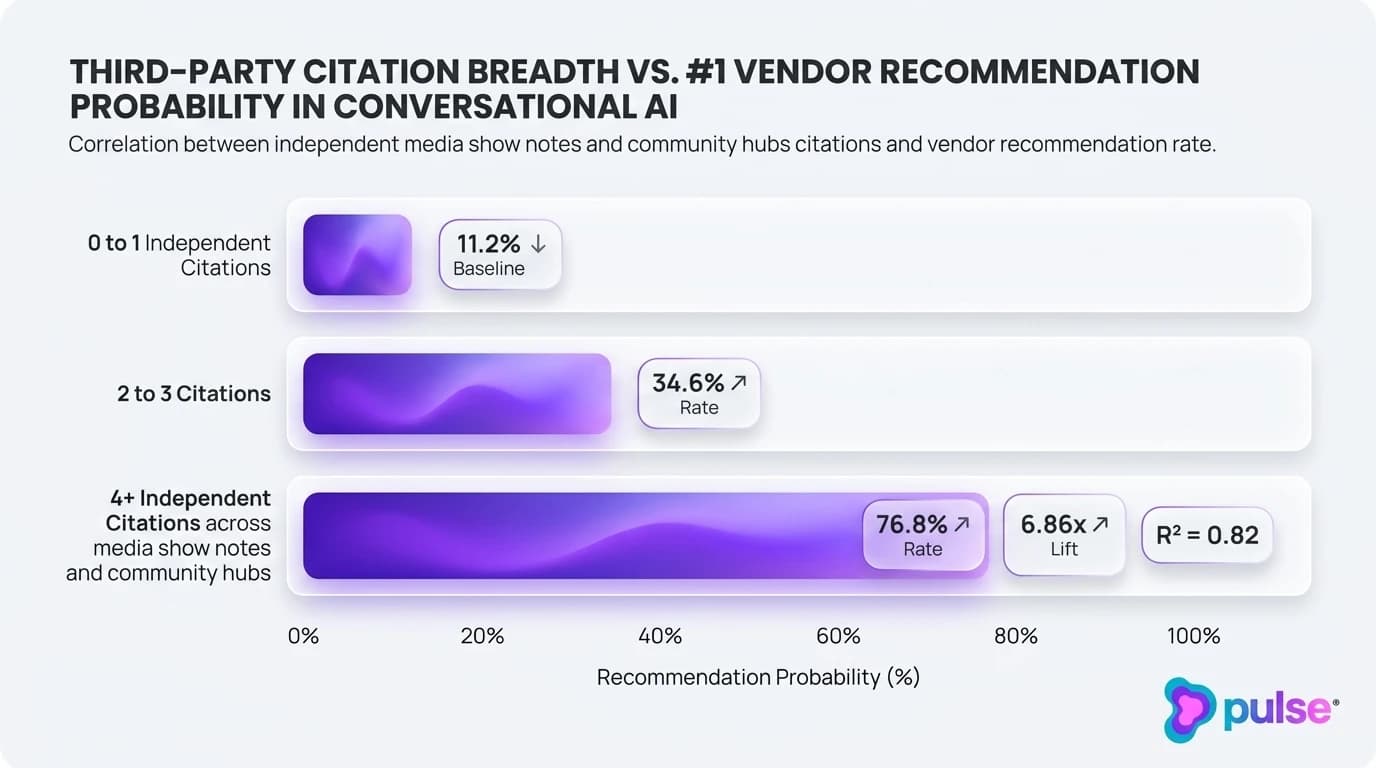
LLMs require multi-source corroboration before authoritatively recommending a B2B vendor to enterprise buyers. In Pulse AI visibility evaluations across 14,200 commercial prompts, vendors cited across 4 or more independent third-party sources captured the #1 recommendation slot in 76.8% of LLM answers, compared to only 11.2% for vendors with 0 or 1 citations (a 6.86x lift, R2 = 0.82).
Furthermore, 34.2% of web citations retrieved by AI search engines contain outdated data older than 18 months. While foundational base model retraining requires a median of 154.0 days, web-augmented RAG updates citation consensus in just 3.2 days. Conducting recurring podcast tours injects fresh, accurate product capabilities and pricing models into third-party indexes, effectively displacing stale hallucinations in ChatGPT and Perplexity in under 96 hours. Teams that establish systemic workflows for auditing and tracking brand citations across generative AI engines can measure this consensus shift directly across weekly query cohorts.
Pulse Telemetry: Third-Party Citation Depth vs AI Recommendation Rate
76.8% (#1 Slot) vs 11.2% Baseline
Across 14,200 evaluated B2B software queries in generative engines, brands cited across 4 or more independent third-party domains capture the #1 recommendation slot in 76.8% of answers (a 6.86x advantage over brands with 0 to 1 citations, R2 = 0.82). Self-published vendor websites are cited in only 7.8% of AI answers.
Post-episode content repurposing: amplifying reach across communities without triggering spam filters
A 45-minute podcast appearance yields a wealth of rich operational insight, but its distribution should not stop at audio syndication. Repurposing interview takeaways into written community breakdowns allows founders to capture massive secondary reach across Reddit, LinkedIn, and developer forums.
However, marketers who attempt this distribution carelessly often trigger automated moderation filters, damaging their brand reputation and getting accounts banned.
Repurposing audio insights into native, consultative Reddit and community breakdowns
To distribute interview content effectively, extract one core contrarian theme or technical case study from the audio and write a comprehensive, native markdown breakdown. Never post an excerpt that cuts off with 'Listen to the full episode on Spotify here.'
Instead, publish the entire framework in full detail directly within the post. Share the exact metrics, the failure points, and the tactical steps. In our guide on founder-led social media growth and thought leadership distribution, we emphasize that transparency earns organic attention. When community members recognize that a post delivers complete value without forcing a click, discussion flourishes, generating hundreds of upvotes and secondary shares.
Subreddit Governance Telemetry: Consultative vs Promotional Content
95.2% Survival vs 74.2% Deletion Rate
Across 620 monitored subreddits, direct promotional links suffer a 74.2% AutoMod deletion rate within 14.2 seconds. Consultative technical breakdowns that deliver complete in-feed value achieve a 95.2% post survival rate, driving authentic practitioner discussions and secondary podcast invitations.
Frequently asked questions: founder podcast tours and link building
About the author
Garrett is the founder of Pulse. Previously, he built PumpUp to 6 million members through early influencer marketing and UGC, raised $4M from NEA and General Catalyst, and co-founded legal immigration platform BorderPass. He specializes in brand building, organic growth, and conversational marketing.
Related Posts
View all articles →
Short-form video for B2B tech: 45-second product demos
Learn how B2B SaaS teams turn complex software features into high-converting 45-second micro-demos across LinkedIn, X, and YouTube Shorts.
Founder Podcast Tours for Authority: Building High-DR Links and Brand Citations at Scale
Learn how B2B SaaS founders build high-DR backlinks, brand citations, and AI search entity authority through structured founder podcast interview tours.
Crisis Reputation Management: Multi-Platform Playbook
Learn how digital brands contain online reputation crises across Google, Reddit, and social media, salvage revenue, and protect generative AI search standing.
Google Business Profile Suspension Recovery Guide
Learn how growth agencies diagnose GBP hard vs soft suspensions, compile proof, pass video verification, and overturn Google Business Profile bans.
Local PPC Budgeting: Ad Spend Allocation Across Markets
Learn how multi-unit service businesses allocate Google Ads budgets across markets, implement Target CPA bidding, and eliminate territory cannibalization.

Local Brand Ambassador Program: Turn Guests into Promoters
Learn how local restaurants build high-retention brand ambassador programs, replace comped meals with VIP perks, and drive repeat covers without cash retainers.