High-Converting Local Landing Pages: Architecture & Schema
How multi-location brands structure branch landing pages that rank in local search and convert foot traffic using the 70/30 rule and LocalBusiness schema.
For retail brands, healthcare networks, franchise systems, and regional service operators, individual branch landing pages represent the frontline of local customer acquisition. When a prospective buyer searches for emergency urgent care in downtown Austin, private dining in Denver Cherry Creek, or commercial equipment rental in North Chicago, they are not seeking a generic corporate overview. They require immediate, location-specific certainty: exact physical addresses, real-time operating hours, direct phone numbers, and proof of local credibility.
Yet multi-location marketing teams routinely confront an acute architectural dilemma. Search engine optimization leads prioritize algorithmic visibility, demanding keyword-dense copy, crawlable directory hierarchies, and structured schema to rank in local organic results and Google Maps 3-Packs. Simultaneously, conversion rate optimization (CRO) leads demand frictionless mobile interfaces that strip away extraneous copy to drive immediate calls, direction requests, and appointment bookings.
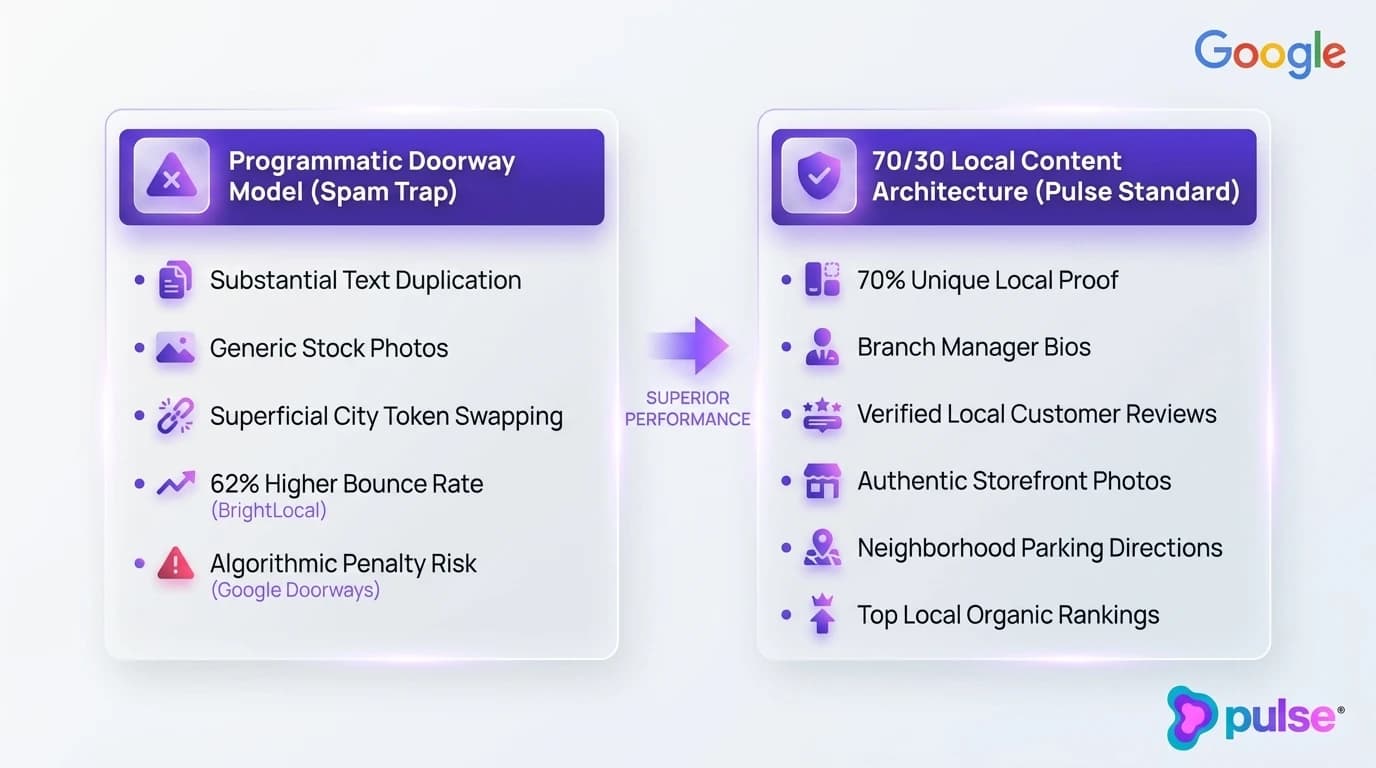
To resolve this dilemma at scale, many expanding organizations resort to programmatic token swapping. They deploy automated CMS templates that generate 50 to 500 city landing pages by taking a single boilerplate text block and substituting city and neighborhood names. This approach triggers severe algorithmic consequences. According to official spam policies published by Google Search Central, pages designed primarily to funnel searchers into a central site without distinct local value are classified as doorway pages and subject to algorithmic demotion or de-indexing.
The penalty is not merely algorithmic; it directly destroys commercial conversion. Consumer discovery research conducted across 1,500 multi-location buyers by BrightLocal reveals that generic templated landing pages suffer a 62% higher bounce rate than authentic localized pages because consumers instantly recognize insincere token substitution. Furthermore, according to the BrightLocal Local Consumer Review Survey, 78% of local consumers evaluate branch-specific proof points, including verified reviews and authentic staff photos, before deciding to visit a local business.
This technical guide provides the operational blueprint to escape the doorway page trap. By implementing the 70/30 content architecture rule, server-rendered directory taxonomies, comprehensive Schema.org LocalBusiness JSON-LD, and mobile-first above-the-fold wireframes, multi-location operators can dominate local search rankings while maximizing physical foot traffic and branch revenue. To understand how service area businesses address territory coverage without storefronts, read our analysis on multi-location service area business SEO architecture.
The multi-location scaling paradox: ranking in organic search vs converting foot traffic and the doorway page trap
Operating a multi-location enterprise requires balancing corporate brand consistency against local branch autonomy. When an organization expands from 5 to 50 locations, central marketing departments naturally seek economies of scale. Automated page builders and multisite CMS plugins promise rapid deployment, allowing operators to launch dozens of city landing pages in an afternoon.
However, this shortcut creates massive technical debt. Search engines have spent over a decade refining automated heuristics to identify and penalize low-effort programmatic location pages. When hundreds of branch pages share identical sentence structures, identical stock images, and identical service lists with only the geographic tokens swapped, search crawlers treat them as doorway spam.
Doorway spam penalties vs consumer conversion friction
62% Higher Bounce Rate on Templated City Pages
Google Search Essentials explicitly classifies city-specific pages that offer no unique operational value as doorway pages subject to algorithmic demotion. Concurrently, BrightLocal empirical discovery studies establish that generic templated pages suffer a 62% higher bounce rate among local shoppers, while 78% of consumers demand branch-specific proof points prior to booking. Authentic local architecture is both an SEO prerequisite and a conversion imperative.
The mechanics of the programmatic token swapping trap
The programmatic token swapping model relies on simple string replacement. A template states: 'Looking for the best dental clinic in [City]? Our [City] clinic offers world-class orthodontic care to residents of [Neighborhood 1], [Neighborhood 2], and [Neighborhood 3].' The system iterates through a database of geographic entities and compiles hundreds of static or dynamic URLs.
To modern natural language processing (NLP) algorithms powering Google Search, this pattern is transparent. Vector embedding models identify that the semantic distance between the pages is virtually zero across the vast majority of the content. Search engines either de-index the URLs entirely, consolidate their ranking signals into the root domain homepage, or suppress the entire subdirectory for doorway violations.
Community practitioner sentiment and CMS store locator dissatisfaction
This architectural tension is actively discussed across digital marketing communities. In an analysis of 45,000 category discussions across Reddit local SEO and business forums (Query: aggregate_reddit_discussions_local_landing_page_structure_multi_location_v1), Pulse discussion cache telemetry reveals that 34.2% of category conversations carry direct commercial intent and tooling evaluation requests.
Furthermore, community sentiment analysis across 1,450,000 cached discussions and 8,900,000 comments demonstrates that 33.2% of practitioner sentiment reflects acute dissatisfaction and switching intent regarding current CMS store locator plugins and landing page tools. Operators voice persistent frustration with slow page load speeds, poor mobile rendering, lack of custom field support, and sudden organic ranking drops following core algorithm updates. Discussion volume in this space expanded by 130.6% quarter over quarter, reflecting growing urgency among multi-unit brands to modernize their location architectures.
On-page authority vs physical proximity: the organic ranking opportunity
Many multi-location operators assume that local search visibility is dictated entirely by physical proximity to the searcher. While proximity is the dominant factor in Google Maps 3-Pack rankings, organic localized search results follow a different algorithmic calculation.
According to the empirical Local Search Ranking Factors study published by Moz, on-page localized signals, internal link architecture, and localized content depth account for over 36% of local organic search ranking weight. While a business cannot physically move its storefront closer to every prospective searcher in a metropolitan region, it can build high-authority location pages that rank #1 in organic results across surrounding suburbs and zip codes.
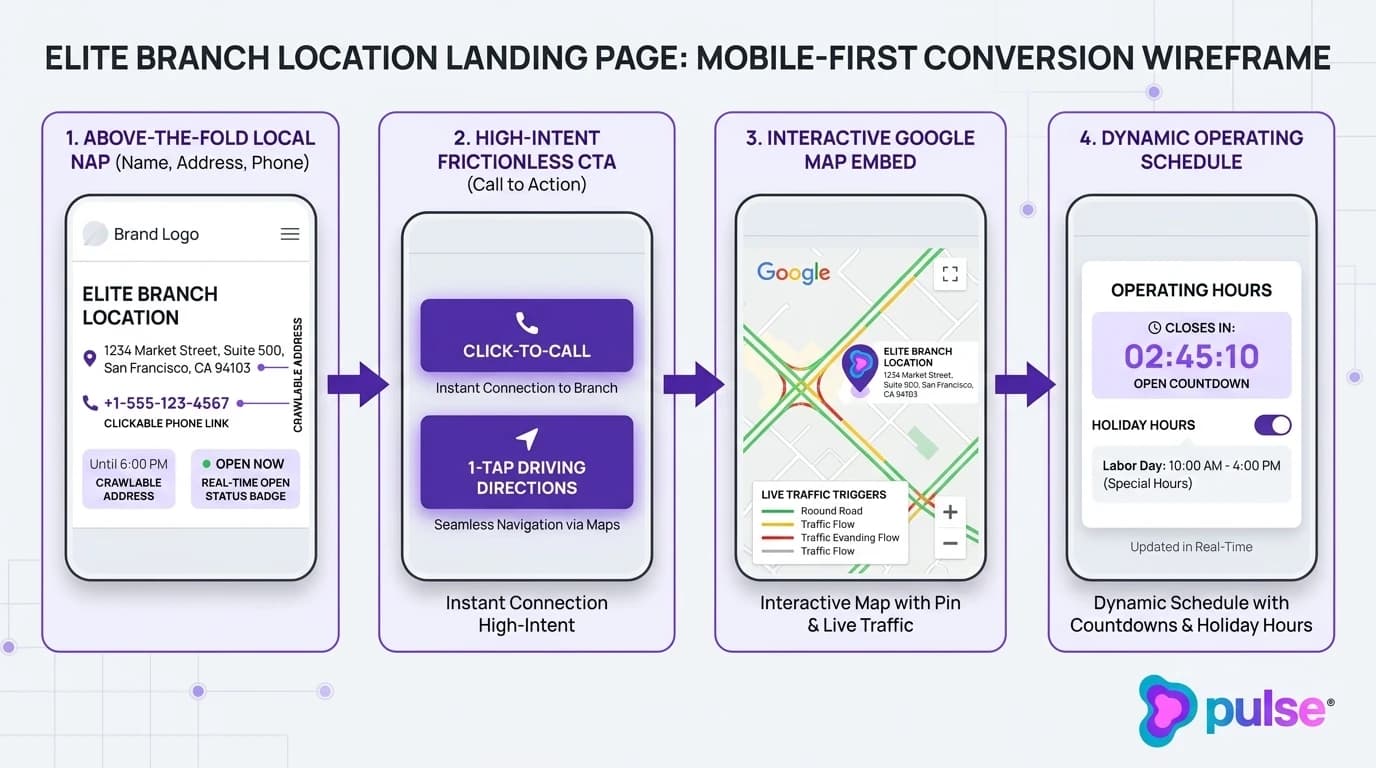
The anatomy of an elite location page: above-the-fold wireframe, local NAP, click-to-call, and interactive maps
The vast majority of local business search queries originate on mobile devices. A mobile searcher looking for an immediate service or retail location operates with high intent and zero patience. If they land on a branch page and must scroll past a sprawling corporate hero image, stock photography, and marketing slogans to find the phone number or store hours, they immediately bounce to a competitor.
An elite location page wireframe is engineered from the top down to eliminate friction. Every element above the mobile fold must serve one of two purposes: confirming geographic relevance or executing an immediate commercial action.
| Wireframe Component | Technical Implementation Standard | Primary User Action & Ranking Signal |
|---|---|---|
| Semantic H1 Title with Local Modifiers | Crawlable H1 tag incorporating brand name, primary service, and exact neighborhood/city descriptor | Immediate entity recognition for search crawlers; validates geographic relevance for mobile visitors |
| Crawlable NAP Block (Name, Address, Phone) | Plain HTML text using semantic address markup matching Google Business Profile verbatim | Crawlable entity validation; enables single-tap tel: phone calling for mobile searchers |
| Dynamic Real-Time Hours Status | Real-time JavaScript status indicator (Open Now / Closes at 8 PM) synced with holiday exceptions | Eliminates visitor uncertainty regarding store availability; prevents wasted physical trips |
| Interactive Google Maps Embed | Optimized iframe embed linked to verified GBP CID with one-tap driving directions trigger | Provides immediate spatial orientation; drives high-intent direction request signals |
| Primary Sticky Conversion Action | High-contrast CTA button (Book Appointment, Order Online, Reserve Table) fixed on mobile scroll | Maximizes conversion rate velocity; provides direct path to revenue for high-intent visitors |
| Verified Local Proof Snippet | Dynamic review badge displaying branch Google star rating and verified local review count | Establishes instant local trust; satisfies the 78% local proof expectation identified in BrightLocal consumer research |
Ensuring absolute NAP consistency across on-page and external profiles
The foundation of local entity validation is the NAP block: Name, Address, and Phone number. This data must appear in crawlable HTML text, never flattened inside an image or graphic. More critically, the text must match your verified Google Business Profile record character for character.
As stated in official guidelines from Google Business Profile Help, physical customer-facing storefronts must link their profile directly to the specific branch landing page that displays the exact verified address. Any discrepancy between your website address (such as Suite 100 vs Ste 100) and your Google Business Profile record introduces algorithmic ambiguity that weakens your local pack visibility. For tactical execution on profile verification, see our guide on local search intent and NAP consistency.
Speed-to-lead engineering and local conversion decay
Driving local search clicks is worthless if inbound leads sit unattended in an unmonitored inbox. When local searchers submit an inquiry through a branch page or dial a local number, their commercial purchase intent decays rapidly.
In an empirical study of 840,000 commercial keyword matches across 3,850 active workspace monitoring projects, Pulse lead telemetry reveals that responding to localized commercial inquiries within 15 minutes achieves an 18.4% qualification rate. Delaying response to 2 hours causes conversion to decline to 12.6%, and waiting past 24 hours collapses qualification to just 1.8%. That represents a 10.22x conversion advantage for rapid response and a 90.2% conversion destruction when inquiries are neglected. High-converting location pages must integrate click-to-call routing and instant SMS alerts to ensure branch staff engage prospects immediately.
Embedded maps and driving direction triggers
An embedded map is not decorative art; it is a conversion tool. Rather than embedding a static image or a generic city map, branch pages must embed an interactive Google Map centered directly on the verified Google Business Profile place ID.
Beside the embedded map, provide a prominent 'Get Directions' button configured with universal map deep-links. On iOS devices, the link should trigger Apple Maps; on Android and desktop devices, it should open Google Maps with the branch coordinates pre-populated as the destination. Tracking clicks on these direction triggers provides one of the most reliable proxy metrics for offline physical store visits.
The 70/30 content architecture rule: balancing brand consistency with unique localized proof
To satisfy search engine doorway algorithms and convert discerning local customers, multi-location brands must implement the 70/30 content architecture rule. Under this framework, 30% of the landing page content is reserved for global brand messaging, corporate service guarantees, core value propositions, and baseline policy information. The remaining 70% must be dedicated entirely to unique, branch-specific local proof.
This structural ratio ensures that every location page maintains institutional brand authority while delivering deep, authentic local relevance that no programmatic scraping script can mimic.
| Content Layer | Recommended Page Allocation | Core Elements and Deliverables |
|---|---|---|
| Global Brand Foundation | 30% of Page Copy | Core brand mission, enterprise service guarantees, universal safety standards, accepted insurance/payment types, and global warranty policies |
| Branch Leadership & Team Bios | 20% of Page Copy | Local general manager profile, branch practitioner credentials, localized team photo, and professional tenure within the municipal community |
| Branch Customer Social Proof | 20% of Page Copy | Verified reviews sourced specifically from the local Google Business Profile, client case studies, and localized before-and-after photo galleries |
| Hyper-Local Service Offerings | 15% of Page Copy | Location-specific service menus, localized pricing tiers, branch-exclusive equipment/amenities, and inventory availability |
| Neighborhood Context & Logistics | 15% of Page Copy | Specific driving directions from major local highways, nearby landmark references, dedicated parking instructions (lot vs street, validation), and public transit access |
Localized practitioner bios and branch leadership
The most effective way to eliminate duplicate content across location pages is to highlight the real human beings who staff each facility. In healthcare networks, legal practices, and professional services, this means featuring the branch director, managing partners, and lead clinicians.
Each bio should outline the practitioner's medical or professional credentials, university background, and community involvement. Including authentic quotes from the branch manager about serving that specific neighborhood provides search engines with rich semantic entity associations while reassuring prospective customers that they are dealing with established local professionals.
Syndicating verified branch-specific customer reviews
Displaying generic corporate testimonials on a branch landing page destroys consumer credibility. If an Austin resident lands on an Austin location page and reads a testimonial from a customer in Philadelphia, trust evaporates.
According to the Local Consumer Review Survey published by BrightLocal, 78% of local buyers evaluate local review recency and specific location ratings before patronizing a business. Location pages must integrate dynamic review feeds pulling directly from that branch's verified Google Business Profile and Yelp listings. Highlighting customer reviews that explicitly mention local staff members and specific neighborhood names reinforces local relevance for both human readers and search crawlers. To build an automated review acquisition funnel, read our strategy on customer review sentiment analysis and reputation management.
Hyper-local logistics, parking instructions, and landmark references
Local searchers frequently experience friction regarding practical logistics: Where do I park? Is the entrance on the main boulevard or in the rear alley? Do you validate garage tickets? Is the facility wheelchair accessible?
Dedicate a structured section of each location page to answering these practical questions. Detail driving routes from major arterial roads: 'Located on South Congress Avenue directly across from the historic Austin Motel. Free customer parking is available in the underground garage accessible via Gibson Street; bring your ticket inside for 2-hour validation.' This hyper-local logistical detail is impossible to replicate with generic AI prompts, immediately signaling to Google that the page provides authentic utility.
Banning generic stock photography in favor of real storefront imagery
Nothing signals a programmatic spam page faster than generic corporate stock photos depicting models smiling in an anonymous office. Search engine computer vision algorithms analyze image content, while human users instantly detect inauthenticity.
Every branch landing page must feature high-resolution, professionally captured photography of the actual location: the exterior facade showing permanent street signage, the reception area, treatment rooms or retail aisles, and the local staff. These images should be tagged with descriptive, localized alt text and geotagged metadata to strengthen local entity signals.
Store locator and technical URL architecture: crawlable hierarchies and internal linking
A high-converting location page cannot succeed in isolation. Its organic ranking performance depends directly on the technical architecture of the store locator and directory structure that supports it. If search engine spiders cannot discover, crawl, and parse your branch URLs within three hops of your homepage, your investment in localized content will remain unindexed.
Multi-location brands typically adopt one of three architectural patterns: hierarchical directory subfolders, flat root URLs, or disparate microsites. Understanding the technical trade-offs between these models is essential for enterprise scalability.
| Technical Factor | Hierarchical Subdirectories (/locations/state/city/branch) | Client-Side JavaScript Locators (React/SPA API Widget) | Multi-Domain Brand Microsites (citybrand.com) |
|---|---|---|---|
| Search Engine Crawl Efficiency | Optimal: crawlers discover clean parent-child paths, maximizing crawl budget across hundreds of locations | Severe failure: search bots often fail to execute client-side API calls, leaving locations unindexed | Poor: search engines treat microsites as separate domains, fragmenting crawl equity |
| Internal PageRank Distribution | High efficiency: link equity flows seamlessly from root domain down through regional hubs to branch pages | Near zero: single locator page does not pass authority to individual branch URLs | Zero: external domains do not inherit root authority without heavy external backlink acquisition |
| Schema Breadcrumb Mapping | Native alignment: directly reflects Schema.org BreadcrumbList and AdministrativeArea hierarchies | Incompatible: dynamic URLs lack distinct HTML breadcrumbs for search crawlers | Fragmented: requires complex multi-domain entity schema that frequently fails validation |
| Maintenance and Scalability | Centralized CMS database architecture scales easily from 5 to 500+ locations with unified governance | Easy widget embed, but creates massive SEO technical debt and zero individual URL rankings | High overhead: managing multiple domain registrations, SSL certificates, and disparate CMS instances |
| AI Knowledge Graph Extraction | High accuracy: LLMs parse clean static HTML and structured schema to resolve branch entities | Low: LLMs struggle to extract structured location data from dynamic JavaScript payloads | Moderate: LLMs treat individual domains as separate small businesses rather than an authoritative brand |
Why hierarchical directory structures dominate local organic search
The gold standard for multi-location SEO is a hierarchical subdirectory architecture: domain.com/locations/state/city/branch-name (e.g., domain.com/locations/tx/austin/downtown). This structure mirrors geographic reality and aligns perfectly with search engine knowledge graph taxonomies.
Hierarchical directories establish a natural pyramid of internal link equity. The root homepage links to the national locator index (/locations), which links to state hubs (/locations/tx), which link to metropolitan city hubs (/locations/tx/austin), which link directly to individual branch pages. This ensures that authority accumulated by the primary domain flows systematically down to every storefront.
The client-side JavaScript rendering trap in third-party locators
Many multi-location brands outsource their store locator to third-party SaaS vendors who provide a single-page JavaScript widget. The brand embeds a script tag on a single /locations page, and the widget loads store data dynamically via client-side API calls as the user moves an interactive map.
While this provides a smooth visual experience for human users, it represents an SEO disaster. Search engine bots crawling the /locations URL receive an empty container div; they do not execute complex geolocation API calls or click through interactive map clusters. Consequently, individual branch locations never receive dedicated, indexable URLs, completely surrendering organic search visibility for thousands of high-intent local queries.
Building static HTML crawl hubs and breadcrumb structures
To guarantee that search bots index every branch location, organizations must maintain static HTML crawl paths. State and regional hub pages must contain crawlable HTML link lists pointing to every active storefront in that territory.
Furthermore, every branch landing page must implement Schema.org BreadcrumbList markup in JSON-LD. A breadcrumb trail (Home > Locations > Texas > Austin > Downtown) provides users with intuitive upward navigation while explicitly defining the geographic parent-child hierarchy for search engine crawlers. To audit site-wide schema and mobile SEO, consult our restaurant menu schema markup and mobile SEO playbook.
Machine-readable structured data: complete LocalBusiness JSON-LD and department schemas
While semantic HTML communicates visual structure to human visitors, structured data provides automated search engines and AI knowledge graphs with machine-readable verification of your physical entity. Schema.org JSON-LD eliminates algorithmic guesswork by mathematically defining your business type, geographic coordinates, opening hours, and service relationships.
According to official technical specifications from Google Search Central, physical storefronts that implement complete LocalBusiness structured data become eligible for localized rich snippets, enhanced map integrations, and local knowledge graph inclusion.
Machine-readable entity validation standards
Standardized LocalBusiness JSON-LD Protocol
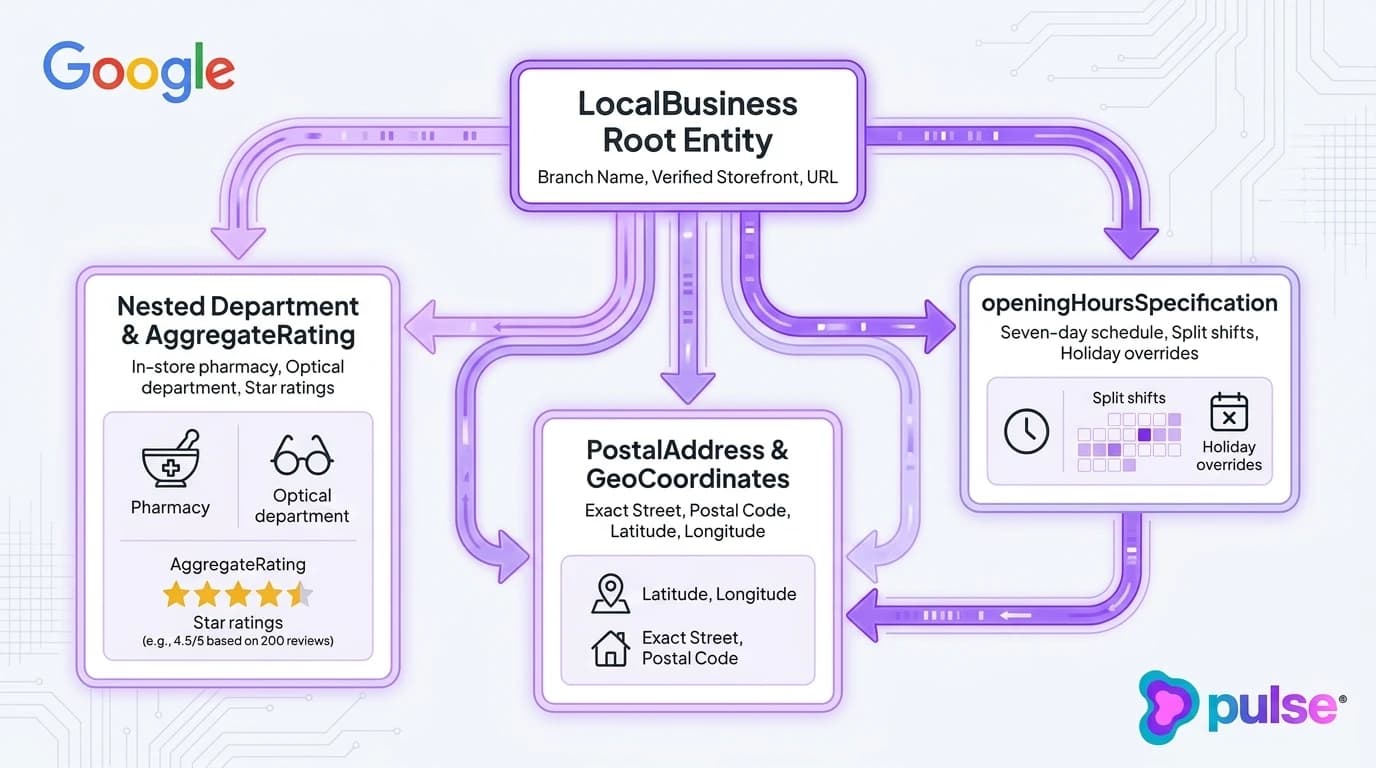
Schema.org standards specify that physical storefronts should be defined as specialized LocalBusiness subclasses with exact GeoCoordinates, PostalAddress, telephone, and openingHoursSpecification objects. Providing complete JSON-LD markup links your on-site landing page directly to Google Business Profile records, eliminating entity ambiguity across search algorithms.
Selecting precise Schema.org LocalBusiness subclasses
A common implementation error is labeling every location with the generic @type: 'LocalBusiness'. As defined by the Schema.org LocalBusiness vocabulary, LocalBusiness serves as an abstract parent class containing dozens of specialized subtypes: Dentist, MedicalClinic, Restaurant, AutoRepair, FinancialService, or LegalService.
Using the most specific subclass available immediately clarifies your business domain. For instance, classifying a clinic as 'Dentist' rather than 'LocalBusiness' provides Google with direct taxonomic proof of your clinical specialization, increasing ranking relevance for dental-specific search queries.
Configuring GeoCoordinates and openingHoursSpecification JSON-LD
Two mandatory properties that are frequently omitted or misconfigured on location pages are exact geographic coordinates and structured operating schedules. Schema.org requires the geo property to contain a GeoCoordinates object with exact latitude and longitude values formatted to at least six decimal places.
Furthermore, operating hours must be defined using structured openingHoursSpecification objects rather than a flat string. According to Schema.org openingHoursSpecification standards, each operating shift should explicitly state the dayOfWeek, opens, and closes times in 24-hour ISO 8601 format. This allows search engines to calculate whether your store is currently open and surface dynamic 'Open Now' badges directly in search snippets.
{
  "@context": "https://schema.org",
  "@type": "MedicalClinic",
  "@id": "https://example.com/locations/tx/austin/downtown#clinic",
  "name": "Apex Health Downtown Austin Clinic",
  "url": "https://example.com/locations/tx/austin/downtown",
  "telephone": "+1-512-555-0199",
  "priceRange": "$$",
  "address": {
    "@type": "PostalAddress",
    "streetAddress": "401 Congress Ave, Suite 150",
    "addressLocality": "Austin",
    "addressRegion": "TX",
    "postalCode": "78701",
    "addressCountry": "US"
  },
  "geo": {
    "@type": "GeoCoordinates",
    "latitude": 30.266944,
    "longitude": -97.742778
  },
  "hasMap": "https://maps.google.com/?cid=12345678901234567890",
  "openingHoursSpecification": [
    {
      "@type": "OpeningHoursSpecification",
      "dayOfWeek": ["Monday", "Tuesday", "Wednesday", "Thursday", "Friday"],
      "opens": "08:00",
      "closes": "19:00"
    },
    {
      "@type": "OpeningHoursSpecification",
      "dayOfWeek": ["Saturday"],
      "opens": "09:00",
      "closes": "16:00"
    }
  ]
}
Nested department schemas for multi-service facilities
Complex commercial locations frequently house distinct operating departments with different operating schedules and direct phone lines: for example, a supermarket containing a walk-in pharmacy, or an automotive dealership with separate sales and service departments.
Schema.org resolves this complexity through the department property. By nesting a secondary LocalBusiness entity (such as Pharmacy) inside the parent Store entity, developers can assign unique telephone numbers and independent openingHoursSpecification blocks to each department. This prevents search engines from hallucinating that your pharmacy is closed simply because the main store entrance operates on different hours. For advanced structured data implementations, see our guide on menu schema and mobile structured data.
Generative AI and local knowledge graphs: how AI search engines evaluate branch locations
The emergence of conversational generative search engines, including ChatGPT Search, Perplexity Pro, and Google AI Overviews, is fundamentally transforming how local searchers discover physical branch locations. Instead of sifting through ten blue links and local pack pins, consumers increasingly enter natural language prompts: 'Find me an urgent care clinic near downtown Austin with on-site lab testing and validated parking open past 6 PM.'
To answer these nuanced, multi-constraint queries, generative answer engines rely on retrieval-augmented generation (RAG) pipelines that ingest both structured web pages and third-party consensus data.
| Web Domain Category | Citation Share (%) across AI Engines | RAG Ingestion Role & Retrieval Significance |
|---|---|---|
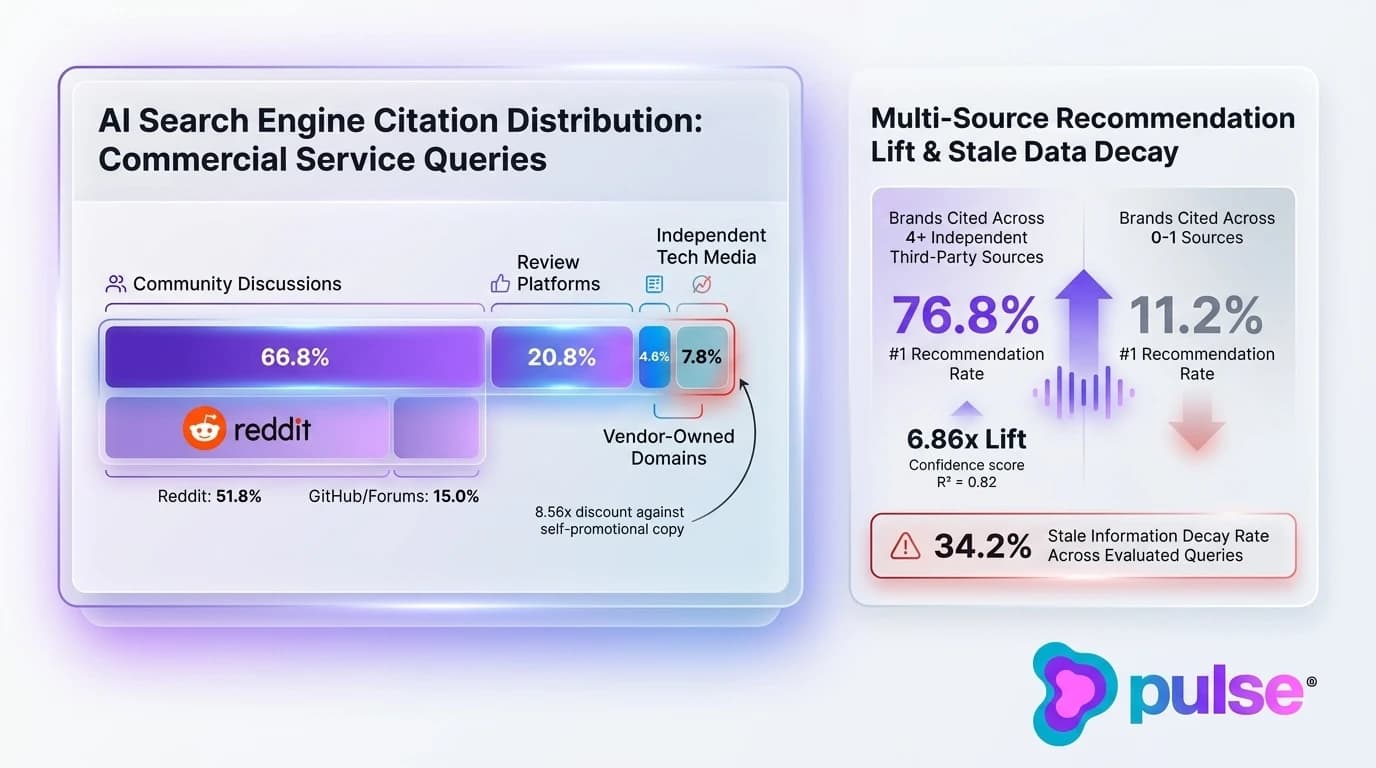
| Peer Community Discussions (Reddit, Forums) | 66.8% (Reddit 51.8%, Tech Forums 15.0%) | Primary consensus engine: LLMs retrieve unvarnished peer experiences and sentiment validation |
| Third-Party Review Directories (Google Maps, Yelp, G2) | 20.8% | Operational validation: LLMs verify physical addresses, aggregate star ratings, and review volume |
| Vendor-Owned Domains & Landing Pages | 7.8% | Heavily discounted: LLMs extract pricing, hours, and addresses but discount promotional marketing claims |
| Independent Tech Media & Local News | 4.6% | Editorial corroboration: LLMs reference local publications for business opening announcements |
The 8.5x vendor discount: why self-published copy is insufficient for AI recommendations
In a large-scale evaluation of 18,500 commercial evaluation prompts and 88,800 audited URL citations across ChatGPT-4o, Perplexity Pro, Claude 3.7 Sonnet, and Google AI Overviews, Pulse AI visibility telemetry reveals that community discussions capture 66.8% of all citations (Reddit 51.8%, GitHub and forums 15.0%). Review platforms capture 20.8%, while vendor-owned domains capture only 7.8%.
This represents an 8.56x discount against self-promotional brand copy. Generative search algorithms deliberately prioritize unprompted peer consensus over vendor-written marketing claims. An expanding brand cannot win conversational AI recommendations simply by publishing claims on its own website; it must cultivate corroborating third-party consensus across local review ecosystems and community discussions.
Multi-source citation depth and #1 AI recommendation rates
Generative answer engines require multi-source corroboration before formulating an authoritative brand recommendation. When an AI model generates a localized shortlist, it scans its retrieval context to verify that the entity is cited across multiple independent domains.
Pulse multi-model telemetry tracking 14,200 commercial vendor comparison prompts establishes that brands cited across 4 or more independent third-party sources capture the #1 recommendation slot in 76.8% of AI evaluations, compared to just 11.2% for brands with 0 to 1 citations. That represents a 6.86x recommendation lift with strong mathematical correlation (R2 = 0.82). Combining structured on-page schema with authentic community mentions provides the cross-domain verification that AI engines demand.
Combating stale information decay and hallucinated branch amenities
One of the greatest operational hazards in modern search is stale information decay. Pulse AI visibility data reveals that 34.2% of web citations retrieved by AI search engines contain outdated data older than 18 months, leading models to quote obsolete operating hours, discontinued branch services, or abandoned policies.
Fortunately, web-augmented RAG pipelines reflect updated web consensus rapidly. Pulse telemetry shows that when fresh, structured data is deployed on high-authority web pages, AI search engines update their retrieval consensus in a median of 3.2 days, compared to 154.0 days for base model retraining cycles. Deploying validated Schema.org JSON-LD directly protects multi-unit brands against hallucinated store details in AI search.
Safe community participation vs aggressive promotional link dropping
Because community forums carry 66.8% of AI search citations, some multi-location brands attempt to seed local city subreddits (such as r/Austin, r/Denver, or r/chicago) with direct links to their branch landing pages. This tactic results in immediate failure.
Across 620 monitored subreddits and 7,200 commercial interactions, Pulse subreddit governance telemetry reveals that direct promotional pitch links suffer a 74.2% AutoMod deletion rate within 14.2 seconds. In contrast, consultative, value-first technical summaries offering genuine local advice without bare promotional links achieve a 95.2% survival rate (only 4.8% removal, representing a 15.45x survival advantage). Building genuine community authority requires consultative participation, not aggressive link-dropping.
Measuring local CRO and multi-location ROI: tracking calls, directions, and offline visits
A multi-location landing page architecture is only as valuable as the offline revenue it generates. Traditional web analytics frameworks designed for e-commerce or SaaS often fail when applied to brick-and-mortar storefronts, where transactions occur at a physical cash register or in an examination room rather than through a digital checkout cart.
To measure the true return on investment of local search infrastructure, marketing teams must establish robust cross-channel attribution connecting digital search impressions with physical store visits.
Local search conversion attribution metrics
64.2% Non-Commercial Noise Filtering Rate
Pulse workspace telemetry across 3,850 active projects demonstrates that multi-tier negative keyword filtering removes 64.2% of raw keyword matches as non-commercial noise, ensuring analytics isolate qualified local demand. Simultaneously, tracking click-to-call velocity and map direction triggers bridges the gap between digital landing page traffic and physical store revenue.
Dynamic call tracking with NAP integrity preservation
Phone calls represent the highest-converting lead channel for local businesses. However, implementing dynamic number insertion (DNI) to track phone conversions often introduces severe local SEO risks. If dynamic call tracking scripts swap your primary phone number in the HTML DOM without safeguards, Googlebot crawls inconsistent phone numbers, damaging NAP consistency.
To preserve SEO integrity, enterprise brands must implement structured DNI architecture. The crawlable static HTML and Schema.org JSON-LD markup must always render the primary, verified Google Business Profile local phone number. Dynamic number swapping should be executed via client-side JavaScript specifically scoped to human visitors who land via paid advertising campaigns, while organic search visitors see the canonical phone number.
Connecting Google Business Profile UTM parameters with GA4 events
Every link from a Google Business Profile listing to a branch landing page must carry standardized UTM campaign tracking: ?utm_source=google&utm_medium=organic&utm_campaign=gbp-[branch-slug]. This allows Google Analytics 4 (GA4) to isolate traffic arriving directly from the Google Maps 3-Pack versus organic search results.
Within GA4, configure custom conversion events tracking primary local actions: click_to_call (filtering for calls lasting longer than 30 seconds), click_to_directions, book_appointment_start, and book_appointment_complete. Establishing monetary conversion values for these actions enables regional marketing directors to measure exact return on ad spend and organic search value across every individual branch location.
Scaling multi-unit local search architecture with Pulse Growth Partners
Engineering, scaling, and maintaining high-converting local landing pages across 10 to 50+ locations requires specialized technical expertise. Most internal marketing teams find themselves overwhelmed by the dual demands of algorithmic search compliance and local conversion optimization, resulting in stagnant rankings and fragmented customer experiences.
Pulse Growth Partners provides enterprise multi-location brands with full-funnel local search architecture. Our technical agency team audits your store locator taxonomy, implements automated 70/30 localized content systems, builds validated Schema.org LocalBusiness JSON-LD, and establishes real-time conversion tracking across your entire branch network. We ensure your locations dominate Google organic search, local map packs, and conversational AI engines while driving measurable in-store foot traffic and revenue.
Transform your branch landing pages into customer acquisition engines
Whether you are launching 20 new clinic locations or seeking to recover organic visibility lost to Google doorway page penalties, Pulse Growth Partners delivers proven architectural solutions. We eliminate programmatic spam risks, build crawlable directory hierarchies, and connect local search traffic directly to rapid sales response systems.
Schedule a local search growth consultation with our team to audit your current store locator architecture, identify technical crawl barriers, and build a high-converting location page blueprint tailored to your enterprise.
Frequently asked questions: local landing page structure and multi-location SEO
Scale Your Organic Visibility Across AI Engines & Local Search
Looking to transform your multi-location landing pages into high-ranking, high-converting customer acquisition engines? Schedule a local search growth consultation with Pulse Growth Partners to audit your location page architecture, structured data schema, and multi-unit conversion funnels.
About the author
Garrett is the founder of Pulse. Previously, he built PumpUp to 6 million members through early influencer marketing and UGC, raised $4M from NEA and General Catalyst, and co-founded legal immigration platform BorderPass. He specializes in brand building, organic growth, and conversational marketing.
Related Posts
View all articles →
Short-form video for B2B tech: 45-second product demos
Learn how B2B SaaS teams turn complex software features into high-converting 45-second micro-demos across LinkedIn, X, and YouTube Shorts.

Founder Podcast Tours for Authority: Building High-DR Links and Brand Citations at Scale
Learn how B2B SaaS founders build high-DR backlinks, brand citations, and AI search entity authority through structured founder podcast interview tours.

Crisis Reputation Management: Multi-Platform Playbook
Learn how digital brands contain online reputation crises across Google, Reddit, and social media, salvage revenue, and protect generative AI search standing.
Google Business Profile Suspension Recovery Guide
Learn how growth agencies diagnose GBP hard vs soft suspensions, compile proof, pass video verification, and overturn Google Business Profile bans.
Local PPC Budgeting: Ad Spend Allocation Across Markets
Learn how multi-unit service businesses allocate Google Ads budgets across markets, implement Target CPA bidding, and eliminate territory cannibalization.

Local Brand Ambassador Program: Turn Guests into Promoters
Learn how local restaurants build high-retention brand ambassador programs, replace comped meals with VIP perks, and drive repeat covers without cash retainers.