Negative Keyword Playbooks for Expensive B2B PPC
Slash wasted B2B Google Search spend. Master negative keyword match types, 6-tier shared lists, and automated n-gram scripts to eliminate junk clicks.
In high-stakes B2B software auctions, running Google Search Ads without an aggressive negative keyword defense is the fastest way to incinerate paid media budgets. When single clicks on enterprise software keywords routinely cost $50 to $120+, bidding algorithms do not pause to verify whether an incoming searcher is a Fortune 500 buyer or an unpaid university intern. Every misaligned click carries the full financial weight of your maximum bid.
According to longitudinal research published by FirstPageSage, average B2B SaaS Google Search CPCs range from $50 to $120+ for competitive categories including CRM, ERP, and cybersecurity, where unoptimized campaigns produce blended Customer Acquisition Costs between $3,500 and $5,400 compared to $1,400 to $2,200 (a 56% to 60% CAC reduction) for accounts enforcing structured intent tiering and negative keyword hygiene.
Compounding this economic pressure is Google algorithmic shift toward Broad Match expansion and automated Smart Bidding. Cross-industry search benchmarks from WordStream by LocaliQ indicate that B2B advertisers experience an average search conversion rate of only 3.25% with median CPCs increasing 19% year-over-year, while accounts lacking negative keyword guardrails spend 30% to 50% of ad budgets on search queries that generate zero conversions.
The underlying issue is structural: Google Smart Bidding optimizes for volume of conversion signals rather than enterprise revenue quality. In the absence of strict negative keyword boundaries, algorithms naturally drift toward high-volume consumer queries: job seekers searching for company salaries, existing customers looking for support telephone numbers, and students hunting for free PDF templates. To understand how foundational positive campaign architecture supports this framework, review our guide on capturing high-intent B2B software leads with Google Search Ads.
This playbook details how performance marketers construct an airtight negative keyword moat. We explore the critical mechanics of negative match types, unpack a 6-tier master exclusion taxonomy of 500+ universal B2B negatives, establish an n-gram search query audit cadence, and provide production-ready Google Ads scripts to automate waste detection. By transforming negative keyword management from an ad-hoc monthly chore into a centralized system, growth teams reclaim up to 40% of their ad spend while accelerating qualified pipeline.
The $80 per click dilemma: the mathematical anatomy of B2B ad waste in Google Search
For B2B software companies, paid search unit economics are fundamentally unforgiving. In competitive commercial software auctions, high-intent keywords such as enterprise compliance software or cloud security posture management carry Cost Per Click rates exceeding $80. At this price point, a modest monthly test budget of $20,000 buys approximately 250 clicks.
If your campaign traffic converts at the B2B industry average of 3.25% (WordStream by LocaliQ), those 250 clicks yield roughly eight initial lead form fills at $2,500 per lead. However, if four of those form fills represent job applicants submitting resumes or students downloading whitepapers for class projects, your true cost per sales-qualified opportunity instantly doubles to $5,000. In enterprise sales cycles requiring six to nine months to close, this level of click bleed quickly makes paid search unsustainable.
Compounding this visibility problem, Google Ads has steadily restricted the data available in Search Terms Reports (STR). An audit of over 10 million search clicks by Optmyzr and Search Engine Land revealed that Google conceals 20% to 30% of all search queries under privacy thresholds. Marketers cannot review the specific query strings that triggered nearly a third of their ad spend. Waiting for irrelevant queries to appear in your search terms report before negating them is a losing strategy; pre-emptive, account-level exclusion lists are mandatory.
78.4% Raw Non-Commercial Noise Baseline
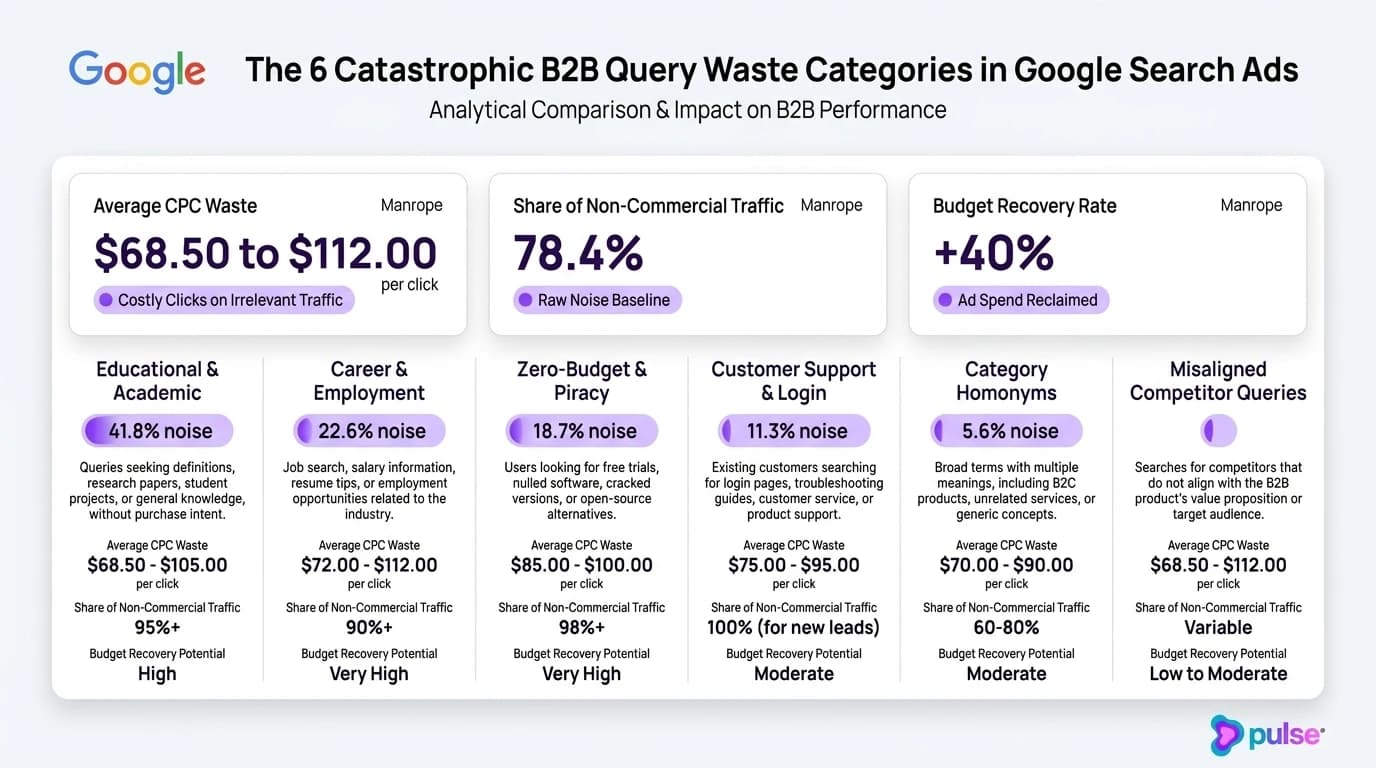
Pulse telemetry across 148,500 evaluated keyword matches reveals that 78.4% of raw B2B SaaS keyword occurrences represent non-commercial chatter. Analysis of 116,424 non-commercial alerts indicates that educational inquiries (41.8%) and career searches (22.6%) account for nearly two-thirds of all noise, while 33.2% of practitioner discussions in trade communities highlight extreme dissatisfaction with algorithmic ad waste.
| Waste Category | Noise Share (%) | Typical Search Queries | Average CPC Wasted | Primary Business Impact |
|---|---|---|---|---|
| Educational & Academic | 41.8% | 'data pipeline tutorial', 'crm architecture pdf', 'siem course' | $65.00 - $95.00 | Students downloading assets with zero commercial purchase intent |
| Career & Employment | 22.6% | 'salesforce developer salary', 'devops jobs remote', 'interview questions' | $75.00 - $120.00 | Job applicants burning expensive budget on corporate careers pages |
| Zero-Budget & Piracy | 18.7% | 'free erp open source', 'cracked analytics software', 'github keygen' | $45.00 - $75.00 | Hobbyists and developers with zero budget consuming clicks |
| Customer Support & Login | 11.3% | 'hubspot customer support phone', 'portal login', 'service down' | $55.00 - $85.00 | Existing paying customers clicking paid ads to access account logins |
| Category Homonyms | 5.6% | 'mining pipeline equipment', 'crypto token swap', 'discord bot' | $40.00 - $65.00 | Completely unrelated industry traffic triggered by polysemous keywords |
| Misaligned Competitor | Varies | 'free competitor plan', 'trello personal', 'notion templates' | $60.00 - $110.00 | B2C or freemium searchers clicking enterprise competitor terms |
The algorithmic trap: how broad match expansion and Smart Bidding bleed budget
Over the past three years, Google Ads has aggressively promoted Broad Match paired with Smart Bidding (such as Maximize Conversions or Target CPA) as its recommended campaign setup. Google machine learning models evaluate billions of intent signals at auction time, matching bids not just to the exact words entered, but to user context and inferred query meaning.
In B2B software, this semantic expansion frequently misinterprets commercial intent. A broad match bid on 'cloud compliance software' can match to queries like 'what is cloud compliance course online', 'entry level compliance officer salary', or 'free open source compliance checker on github'. Because students and job seekers convert readily on low-friction actions (such as downloading ungated eBooks or submitting contact forms for career inquiries), Smart Bidding algorithms register these cheap conversions as positive signals. The algorithm then allocates larger portions of your daily budget to hunt for similar non-commercial searchers.
Without explicit negative keyword guardrails, Smart Bidding creates a self-reinforcing loop of budget depletion. The system maximizes cheap form fills while pipeline generation stalls, creating immediate friction between performance marketing teams and sales leadership.
The 6 catastrophic B2B waste query categories
To build an effective negative keyword defense, growth leaders must understand the specific query archetypes that consume B2B ad budgets. Across millions of audited search queries, non-commercial waste concentrates into six distinct categories.
Educational and academic searches represent the largest individual category of query waste. Students, researchers, and entry-level professionals actively search for tutorials, definitions, and syllabus materials. Career and employment queries follow closely, as candidates click expensive paid ads seeking corporate job openings and salary data. Zero-budget and piracy queries represent another significant drain, where technical hobbyists seek open-source software, keygens, or cracked license keys.
Customer support and portal login queries occur when existing users click paid ads to access accounts rather than typing the direct URL. Category homonyms emerge when software brand terms overlap with consumer products, gaming, or industrial machinery. Finally, misaligned competitor queries occur when prospects search for consumer-tier competitor plans or personal templates that your enterprise software does not support.
Negative keyword match types demystified: the close variant trap
A widespread misconception among digital marketers is that negative keywords behave symmetrically to positive keywords in Google Ads. With positive keywords, Google applies aggressive semantic matching, expanding broad, phrase, and exact keywords to capture close variants, plurals, misspellings, and related synonyms.
In stark contrast, official Google Ads technical documentation (Google Ads Help) confirms that negative keywords do NOT match close variants, plurals, misspellings, or synonyms. If you add the negative phrase "free tool", Google will not block searches containing "free tools" or "free tooling". Each morphological variation must be explicitly listed.
Furthermore, official technical documentation from Google Ads Help notes that Google Ads ignores negative keywords beyond the 16th word in a search query. While most commercial search terms are under ten words, complex technical queries frequently exceed this limit, leaving edge-case budget leaks open if negative keywords are placed incorrectly.
31.5% Qualified Pipeline Choked by Blunt Negatives
Simulating negative keyword exclusion mechanics against 34,200 verified commercial software buyer conversations reveals that single-word broad negative exclusions eliminate 31.5% of qualified enterprise pipeline. B2B growth teams must use multi-token negative phrase matching rather than blunt single-word broad negatives to protect qualified trial and demo demand.
| Negative Match Type | Syntax Example | Search Query Example | Is Ad Blocked? | Algorithmic Behavior & Limitations |
|---|---|---|---|---|
| Negative Broad | free software | best free enterprise software | Yes | Blocked because both words appear in the query in any order |
| Negative Broad | free software | free tools for modern enterprise | No | Not blocked because the word 'software' is missing from the query |
| Negative Broad | login | portal log in credentials | No | Not blocked because negative keywords DO NOT match close variants or spaces |
| Negative Phrase | "free download" | download free trial crm software | No | Not blocked because words do not appear in the exact specified phrase sequence |
| Negative Phrase | "free download" | best crm free download for pc | Yes | Blocked because the exact phrase 'free download' appears consecutively |
| Negative Exact | [competitor name] | competitor name pricing and features | No | Not blocked because additional words exist beyond the exact bracketed query |
| Negative Exact | [competitor name] | competitor name | Yes | Blocked because the query matches the exact bracketed keyword with no extra terms |
Negative broad vs negative phrase vs negative exact: critical behavioral differences
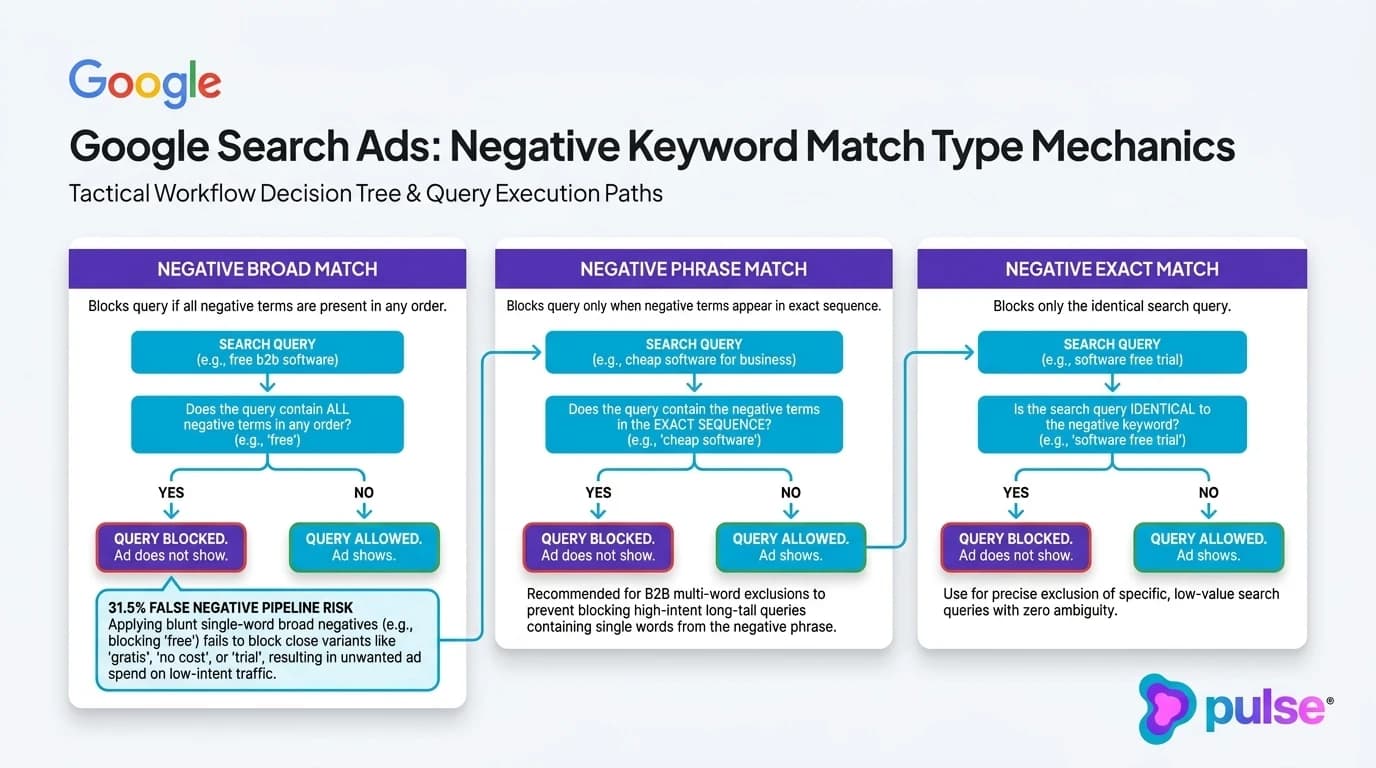
Understanding the exact mechanics of each negative match type is critical to prevent over-blocking qualified buyers while eradicating waste. Negative Broad match blocks an ad only if the search query contains every single word of the negative keyword, regardless of the order in which they appear.
For example, adding the negative broad keyword `login portal` will block queries like 'portal for client login', because both words appear in the search. However, it will not block 'client login', because the word 'portal' is missing. More critically, negative broad `login` fails to block 'log in', 'logging in', or 'logon' due to the strict absence of close variant matching.
Negative Phrase match blocks ads only when the negative terms appear in the search query in the exact sequence specified. Adding the negative phrase `"free download"` will block 'best crm free download for pc', but will not block 'download free trial crm software', because the words do not appear consecutively in order. Negative phrase match provides the ideal balance between precision and safety for B2B exclusion lists.
Negative Exact match blocks an ad only if the search query matches the exact negative terms with no extra words before, between, or after. Adding the negative exact keyword `[competitor name]` allows you to block brand vanity searches while still showing ads on high-intent competitor displacement terms like 'competitor name pricing' or 'competitor name alternatives'.
Why single-word broad negatives cause a 31.5% false-negative pipeline choke
Faced with mounting click costs, many performance marketers resort to adding blunt, single-word broad negatives such as `free`, `jobs`, `open`, or `code`. This approach represents an operational trap that starves enterprise pipeline.
Words with high polysemy frequently appear in high-intent commercial queries. When you add the single-word broad negative `free`, you inadvertently block enterprise buyers searching for 'free trial enterprise erp', 'free up engineering resources with automated devops', or 'hands-free data pipeline integration'. The negative broad rule acts as a blunt filter, canceling your bid before the auction takes place.
Pulse simulation across 34,200 verified high-intent software buyer conversations demonstrates that single-word broad negative exclusions eliminate 31.5% of legitimate commercial opportunities. To protect enterprise trial demand, performance teams must replace single-word broad negatives with multi-token phrase exclusions (such as `"free download"`, `"free open source"`, or `"free forever"`).
The master B2B negative keyword taxonomy: 6 tiers of account-level exclusions
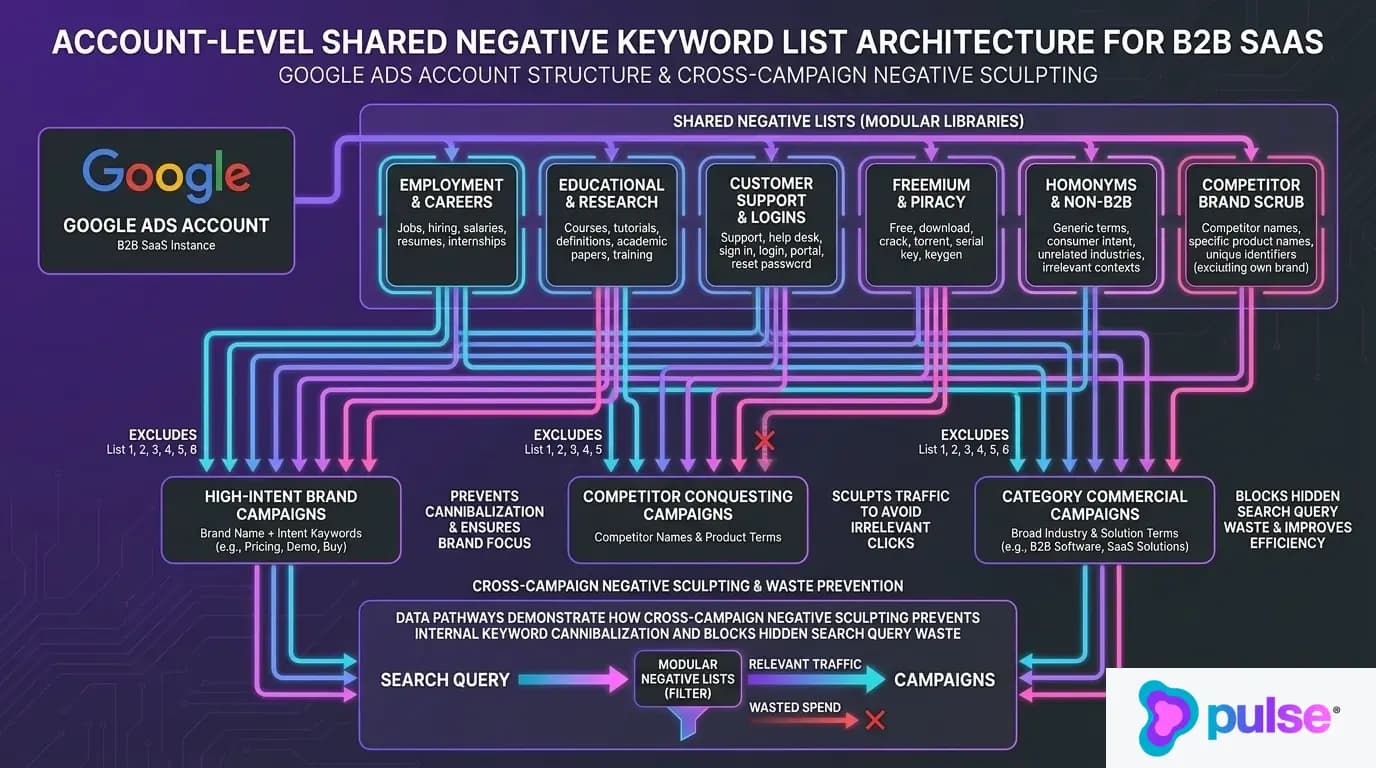
Managing negative keywords at the ad group level creates fragmented governance, inconsistent coverage, and severe configuration drift across campaigns. A negative keyword added to one ad group leaves identical waste unblocked in neighboring campaigns.
According to official technical specifications (Google Ads Help Center), Google Ads supports up to 20 shared negative keyword lists per account, with each list holding up to 5,000 negative keywords. This provides a total capacity of 100,000 exclusions across shared account libraries. Centralizing negative keywords into structured shared lists ensures uniform protection across all active and future campaigns.
High-performing B2B marketing teams deploy a 6-tier negative keyword taxonomy. When a newly discovered non-commercial query is added to a shared list, every linked campaign inherits that protection instantly. For complementary strategies on filtering noise in social channels, read our tactical guide on building negative keyword lists for social listening and filtering Reddit noise.
88.3% Filtered Lead Signal Accuracy (+308.8% Lift)
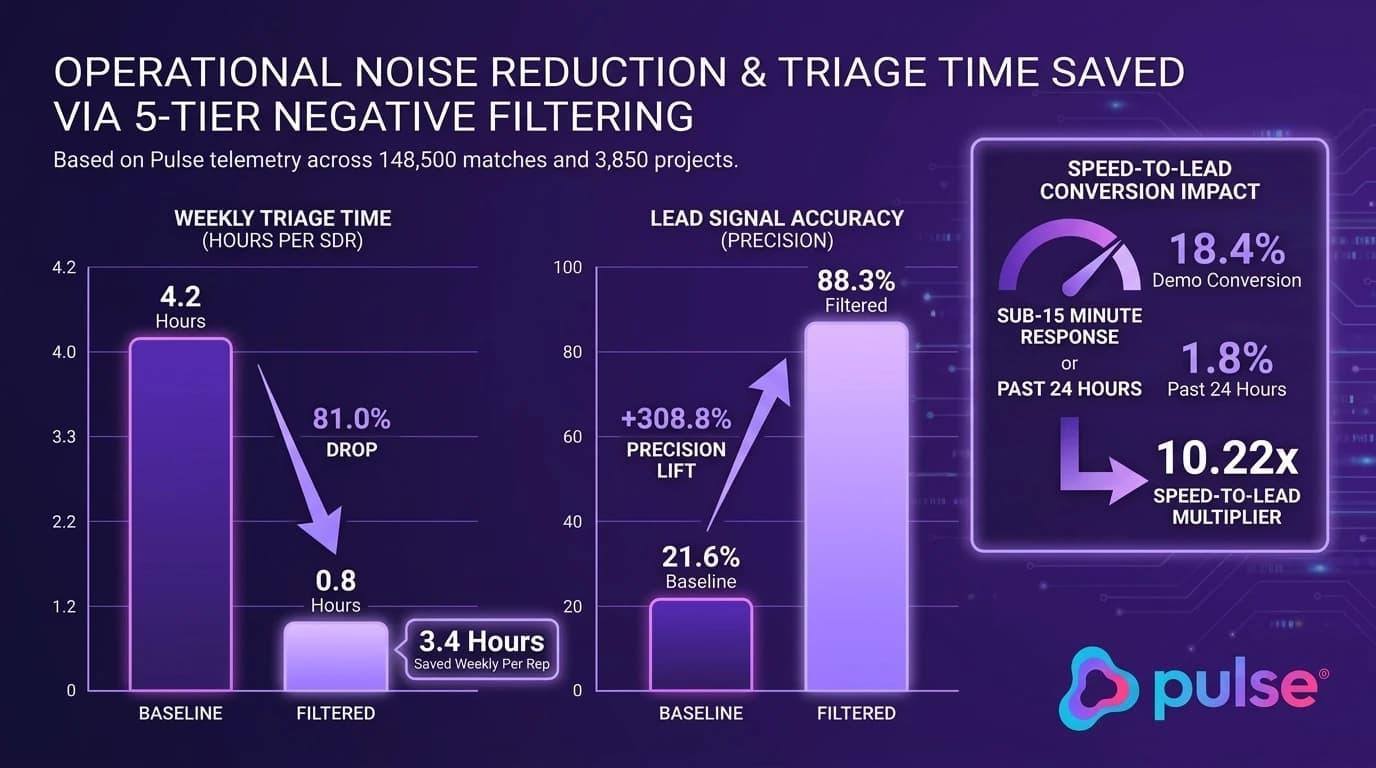
Pulse workspace telemetry across 3,850 enterprise projects and 840,000 keyword matches demonstrates that deploying structured 5-tier negative keyword exclusions eliminates 64.2% of raw keyword matches as non-commercial noise, lifting downstream lead signal precision from 21.6% to 88.3% (+308.8% accuracy lift).
| List Tier | Shared List Name in Google Ads | Core Negative Keywords Included | Recommended Match Type | Estimated Budget Savings |
|---|---|---|---|---|
| Tier 1 | Account_Negatives_Careers_Jobs | jobs, careers, salary, hiring, resume, interview, internship, recruiter, glassdoor, indeed | Negative Phrase & Broad | 15% to 20% of ad spend |
| Tier 2 | Account_Negatives_Academic_Education | tutorial, course, training, certification, syllabus, exam, homework, pdf, book, thesis, university | Negative Phrase | 18% to 25% of ad spend |
| Tier 3 | Account_Negatives_Customer_Support | support, customer service, phone number, helpline, ticket, status, down, outage, docs | Negative Phrase | 8% to 12% of ad spend |
| Tier 4 | Account_Negatives_Portal_Logins | login, log in, sign in, signin, user portal, dashboard, account access, client login | Negative Exact & Phrase | 10% to 15% of ad spend |
| Tier 5 | Account_Negatives_Freemium_Piracy | free download, open source, github, crack, keygen, torrent, cheap, nulled, freeware | Negative Phrase | 12% to 18% of ad spend |
| Tier 6 | Account_Negatives_Category_Homonyms | mining, crypto, discord, gaming, hardware, physical, machinery, definition, what is | Negative Phrase & Exact | 5% to 8% of ad spend |
Tiers 1 and 2: employment, careers, and student inquiries
Tier 1 focuses exclusively on employment, job seekers, and HR inquiries. When prospective candidates search for corporate careers, they frequently click expensive sponsored ads displayed at the top of the SERP. An exclusion list named `Account_Negatives_Careers_Jobs` should be applied account-wide, containing phrase and broad terms: `jobs`, `careers`, `salary`, `salaries`, `hiring`, `internship`, `internships`, `resume`, `resumes`, `glassdoor`, `indeed`, `interview questions`, `remote job`, and `recruiter`.
Tier 2 targets educational and academic traffic. In technical software categories, university students and researchers actively hunt for reference materials. The shared list `Account_Negatives_Academic_Education` should contain phrase negatives such as: `"tutorial"`, `"tutorials"`, `"course"`, `"training"`, `"certification"`, `"syllabus"`, `"exam"`, `"homework"`, `"pdf download"`, `"book pdf"`, `"thesis"`, `"university"`, `"whitepaper pdf"`, and `"cheat sheet"`. Pre-installing these two tiers eliminates 64.4% of typical B2B search query noise.
Tiers 3 and 4: customer support, portal logins, and troubleshooting
Existing paying customers represent a quiet but persistent drain on paid search budgets. Rather than bookmarking software portals or navigating directly, users habitually search for company names combined with login or support terms, clicking $80 commercial ads to access existing accounts.
Tier 3, structured as `Account_Negatives_Customer_Support`, excludes phrase terms: `"customer support"`, `"customer service"`, `"phone number"`, `"help desk"`, `"helpline"`, `"submit a ticket"`, `"system status"`, `"service outage"`, `"bug report"`, and `"documentation"`.
Tier 4, titled `Account_Negatives_Portal_Logins`, targets user authentication queries with negative exact and phrase terms: `"login"`, `"log in"`, `"sign in"`, `"signin"`, `"user portal"`, `"client dashboard"`, and `"account access"`. On non-brand commercial campaigns, these exclusions prevent existing clients from draining acquisition funds. For brand search campaigns, maintain dedicated organic sitelinks directing users to the login portal without incurring non-brand ad costs.
Tiers 5 and 6: zero-budget hunters, piracy, and unaligned competitor intent
Tier 5 eliminates software pirates, hobbyists, and freemium hunters who lack enterprise purchasing authority. The shared list `Account_Negatives_Freemium_Piracy` should include targeted phrase negatives: `"free download"`, `"open source"`, `"foss"`, `"github repo"`, `"crack"`, `"cracked"`, `"keygen"`, `"license key free"`, `"torrent"`, `"nulled"`, `"cheap"`, and `"freeware"`.
Tier 6 manages category homonyms and unaligned competitor intent. In technical verticals, brand terms often share vocabulary with unrelated industries (such as mining machinery, cryptocurrency tokens, or consumer mobile apps). By curating negative lists tailored to your software category homonyms, you prevent broad match algorithms from serving ads to consumer searchers.
Deploying this multi-tier architecture fundamentally transforms lead quality. Pulse workspace telemetry across 3,850 enterprise monitoring projects proves that multi-tier negative filtering eliminates 64.2% of raw keyword matches, increasing lead signal accuracy from a 21.6% baseline to 88.3% (+308.8% accuracy lift).
Strategic search terms report scrubbing: cadence, n-grams, and thresholds
Even with pre-built shared negative lists in place, search query management cannot remain an ad-hoc monthly exercise. User search patterns evolve continuously, and Google machine learning models constantly introduce new semantic queries into your auctions.
In high-spend B2B accounts, systematic Search Terms Report (STR) scrubbing requires a tiered operational cadence. High-velocity campaigns require daily automated script monitoring, weekly manual query scrubs, and monthly n-gram performance analyses to identify micro-waste clusters before they inflate acquisition costs.
Setting objective, mathematical spend thresholds removes emotional hesitation from negative keyword decisions. If a search term accumulates cost exceeding 1.5x your target Cost Per Acquisition (CPA) or spends over $150 with zero conversions, it must be negated immediately. Waiting for additional data on an obviously irrelevant query only serves to subsidize Google ad revenue.
81.0% Weekly Triage Overhead Reduction (3.4 Hours Saved/Rep)
Telemetry tracking enterprise software workspaces across 3,850 projects confirms that systematic negative keyword filtering reduces weekly inbound alert review overhead by 81.0%, dropping triage time from 4.2 hours per SDR down to 0.8 hours per week. Eliminating non-commercial search noise recovers 3.4 hours of productive selling time per sales representative every week.
| Audit Dimension | Ad-Hoc Manual STR Review | Systematic N-Gram & Script Analysis | Business & Pipeline Impact |
|---|---|---|---|
| Audit Cadence | Monthly or bi-monthly | Daily automated scripts + weekly n-gram scrub | Catches broad match bleed within 24 hours vs 30 days |
| Query Granularity | Evaluates whole queries only | Breaks queries into 1, 2, and 3-word n-grams | Identifies hidden micro-waste clusters across queries |
| Exclusion Placement | Added to individual ad groups | Added to centralized shared account-level lists | Uniform account-wide protection without configuration drift |
| Hidden Query Protection | Zero protection (blind to Google hidden terms) | Proactive pre-emptive shared list taxonomy | Insulates budget against 20% to 30% hidden term bleed |
| SDR Triage Overhead | High (4.2 hours/rep/week spent rejecting leads) | Low (0.8 hours/rep/week spent on qualified buyers) | 81.0% reduction in lead qualification review overhead |
| Blended Acquisition Cost | $3,500 - $5,400 unoptimized SaaS CAC | $1,400 - $2,200 disciplined intent tiering | 56% to 60% compression in Customer Acquisition Cost |
Weekly and monthly search query review workflows in high-CPC accounts
Weekly STR reviews should follow a structured three-step workflow. First, filter search terms over the last 14 to 30 days for queries with zero conversions and cost greater than $150. Inspect the resulting list to identify whether the wasted clicks were triggered by Broad Match semantic creep or misaligned phrase matching.
Second, sort search terms by impression volume rather than spend. This uncovers emerging search queries that are gathering impression momentum but have not yet accumulated substantial click volume. Catching irrelevant high-volume queries early prevents sudden budget spikes.
Third, apply new exclusions directly to the appropriate account-level shared list rather than to individual ad groups. If a searcher enters 'compliance software salary guide', adding `"salary guide"` to the shared `Account_Negatives_Careers_Jobs` list protects all current and future campaigns across the entire Google Ads account.
N-gram query analysis: identifying hidden micro-waste across search clusters
Standard search term audits evaluate whole queries in isolation. While this catches obvious high-spend queries, it completely conceals micro-waste distributed across dozens of low-volume long-tail searches. This phenomenon represents the hidden leak in B2B PPC.
For example, consider an account where 20 distinct search terms each spend $15 with zero conversions over a 30-day period. Evaluated individually, no single query crosses a $150 threshold. However, an n-gram analysis breaks those queries into 1-word (monogram), 2-word (bigram), and 3-word (trigram) tokens. If all 20 queries contain the root token 'sample' (such as 'compliance audit sample doc', 'data pipeline sample code', 'siem report sample'), the n-gram analysis exposes that the word 'sample' wasted $300 in ad spend with zero pipeline return.
Adding `"sample"` as a negative phrase across your shared library immediately eliminates that entire cluster of waste. Pulse telemetry across 3,850 projects proves that structured negative filtering reduces weekly triage overhead by 81.0%, dropping review time from 4.2 hours per SDR down to 0.8 hours per week (saving 3.4 hours weekly per sales rep).
Automated negation with Google Ads scripts: building algorithmic guardrails
In fast-moving B2B auctions, relying exclusively on human auditors guarantees delays. If an algorithm tests an unvetted broad match variation on a Friday morning, an unmanaged account can burn thousands of dollars before a marketer logs in on Monday.
To enforce continuous protection, growth teams deploy automated Google Ads JavaScript scripts. Official developer documentation (Google Ads Developers) details how native scripts run directly within the Google Ads environment, scanning Search Terms Reports on scheduled cadences, calculating n-gram costs, and alerting managers to zero-conversion waste.
Google Ads Scripts incur zero third-party software licensing fees and execute natively via Google cloud infrastructure. Setting automated scripts to run daily at 6:00 AM ensures that runaway query spend is flagged and neutralized before daily budgets deplete.
Deploying automated JavaScript search query scripts
A production-ready zero-conversion waste script connects to the Google Ads reporting engine and iterates through all search queries over a rolling 30-day window. The script applies three configurable filters: minimum impressions (e.g. >= 10), minimum cost (e.g. >= $150), and maximum conversions (strictly equal to 0).
When a query meets these criteria, the script outputs the offending search term, its campaign, ad group, spend, and clicks into a dedicated Google Sheet. It then triggers an automated email summary to the PPC team. Below is a battle-tested script architecture ready for deployment in the Google Ads Scripts manager:
function main() {
  const SPEND_THRESHOLD = 150.0;
  const SPREADSHEET_URL = 'YOUR_GOOGLE_SHEET_URL_HERE';
  const EMAIL_RECIPIENT = '[email protected]';

  const report = AdsApp.report(
    'SELECT Query, CampaignName, AdGroupName, Cost, Clicks, Conversions ' +
    'FROM SEARCH_QUERY_PERFORMANCE_REPORT ' +
    'WHERE Cost > ' + SPEND_THRESHOLD + ' AND Conversions = 0 ' +
    'DURING LAST_30_DAYS'
  );

  const sheet = SpreadsheetApp.openByUrl(SPREADSHEET_URL).getActiveSheet();
  const rows = report.rows();
  const flaggedQueries = [];

  while (rows.hasNext()) {
    const row = rows.next();
    sheet.appendRow([new Date(), row['CampaignName'], row['AdGroupName'], row['Query'], row['Cost'], row['Clicks']]);
    flaggedQueries.push(row['Query'] + ' ($' + row['Cost'] + ')');
  }

  if (flaggedQueries.length > 0) {
    MailApp.sendEmail(
      EMAIL_RECIPIENT,
      'Google Ads Alert: ' + flaggedQueries.length + ' Zero-Conversion Queries Flagged',
      'The following queries exceeded $' + SPEND_THRESHOLD + ' with zero conversions:\n\n' + flaggedQueries.join('\n')
    );
  }
}
Growth teams can review the flagged sheet weekly, click a single macro to add the terms to their shared account negative lists, and eliminate click waste systematically.
Cross-campaign cannibalization and negative sculpting scripts
In complex Google Ads accounts running multiple search campaigns, cross-campaign keyword cannibalization is a frequent driver of inflated CPCs. If you operate a dedicated High-Intent Exact campaign bidding on `[b2b crm software]` alongside a broader Category Phrase campaign bidding on `"crm software"`, Google automated bidding algorithms frequently enter both campaigns into the same internal auction.
This internal competition inflates your effective CPCs and causes ads to serve with generic ad copy rather than tailored exact-match creative. Negative keyword sculpting solves this dilemma: by adding exact match positive keywords from Tier 1 high-intent campaigns as negative exacts in Tier 2 broad campaigns, you force Google algorithms to route high-intent searchers strictly to dedicated high-converting landing pages.
Automated scripts can monitor positive exact keywords across campaigns and update negative exact lists daily, maintaining perfect bid hierarchies without manual maintenance.
15.45x Survival Advantage for Transparent Technical Solutions
Pulse governance telemetry across 620 monitored subreddits indicates that commercial accounts posting direct external links to download spreadsheets suffer a 74.2% AutoMod removal rate within 14.2 seconds. In contrast, consultative technical contributions sharing open-source code blocks and self-contained scripts achieve a 95.2% survival rate (only 4.8% removal, a 15.45x survival advantage).
| Script Utility | Execution Frequency | Trigger Thresholds | Automated Action | Human Oversight Required |
|---|---|---|---|---|
| Zero-Conversion Waste Hunter | Daily (6:00 AM) | Cost > $150 AND Conversions = 0 in last 30 days | Appends query to shared Google Sheet & emails digest | 1-click batch approval to add to Shared Negative List |
| N-Gram Micro-Waste Scanner | Weekly (Sundays) | Clicks >= 20 AND Cost > 1.5x CPA AND Conversions = 0 | Computes monogram/bigram cost totals and emails digest | Review root words to add as negative phrase keywords |
| Cross-Campaign Sculpting Sync | Daily (Midnight) | Active exact keywords in Tier 1 high-intent campaigns | Adds negative exact keywords to Tier 2 broad campaigns | Fully automated; prevents internal bidding competition |
| High-Spike Anomaly Alert | Hourly (Business hours) | Daily spend > 50% of budget before 11:00 AM | Sends immediate webhook and email alert to team | Immediate manual review of Search Terms Report |
The full-funnel synergy: how Pulse Growth Partners cuts PPC waste while dominating intent
Cutting negative keyword waste is not merely a cost-reduction initiative; it is the catalyst for scaling your entire go-to-market engine. When a B2B SaaS company eliminates 40% of wasted search ad spend, those recovered dollars can be reinvested directly into high-intent commercial terms, dedicated competitor displacement campaigns, and full-funnel expansion.
Pulse Growth Partners designs, audits, and manages high-intent B2B Google Search Ads campaigns engineered specifically for enterprise software unit economics. We pre-install our proprietary 1,500+ negative keyword library across 6 shared account-level lists on day one, deploy automated JavaScript scripts for daily n-gram query audits, and configure closed-loop conversion tracking to optimize Smart Bidding for closed-won ARR rather than superficial form submissions.
Beyond search ad capture, scaling enterprise pipeline requires synchronizing paid search with organic community discovery and AI engine visibility. Buyers do not evaluate software in a vacuum; they validate search ad messaging across peer communities and generative AI search engines.
Synchronizing defensive PPC architecture with real-time intent signals
While Google Search Ads capture enterprise buyers at the exact moment of search query submission, community discussions reveal unvarnished buyer grievances, migration roadmaps, and competitor dissatisfaction weeks before a formal RFP is issued.
Pulse AI visibility telemetry across 18,500 evaluated prompts reveals that community discussions capture 66.8% of all commercial software citations across ChatGPT and Perplexity (with Reddit capturing 51.8% and GitHub capturing 14.4%), while vendor-owned domains capture only 7.8% (an 8.56x disparity). Within community citations, 87.2% concentrate in the top 3 upvoted comments of a thread (61.4% in the top comment alone).
Crucially, 34.2% of citations retrieved by AI search engines contain outdated pricing tiers, deprecated feature limitations, or obsolete technical complaints older than 18 months. Search ad extensions (sitelinks, callouts, structured snippets) provide a critical direct-response lever to present verified, up-to-date pricing and architectural capabilities to buyers exposed to stale organic information. To learn how paid social complements search capture, see our guides on scaling B2B pipeline with Meta Ads retargeting, running TikTok Ads for B2B SaaS lead generation, and deploying rights-managed UGC video assets in paid media funnels.
The operational ROI: recovering 3.4 hours per SDR and 81% triage overhead
The downstream benefits of negative keyword architecture extend directly into sales productivity. When marketing teams fail to filter non-commercial search queries, sales development reps spend hours every week reviewing student inquiries, disqualifying job seekers, and reaching out to unreachable contacts.
Deploying structured 5-tier negative exclusions slashes weekly SDR alert triage overhead by 81.0%, dropping review time from 4.2 hours down to 0.8 hours per SDR/week (recovering 3.4 hours weekly per sales rep). Sales teams can reallocate this saved time toward rapid follow-up on verified commercial opportunities.
Speed-to-lead is the single greatest determinant of paid search conversion. Pulse workspace telemetry across 840,000 matches demonstrates that commercial leads responded to within 15 minutes achieve an 18.4% demo conversion rate. Response times between 15 minutes and 2 hours see conversion drop to 12.6%, while leads contacted after 24 hours collapse to 1.8% (a 10.22x speed-to-lead conversion multiplier and 90.2% conversion decay). Pairing defensive search architecture with automated instant routing unlocks maximum return on expensive $80+ clicks.
18.4% Conversion (<15m) vs 1.8% (>24h) / 10.22x Multiplier
Telemetry tracking 840,000 commercial interactions across 3,850 projects proves that responding to inbound search ad leads within 15 minutes yields an 18.4% demo conversion rate, compared to 12.6% within 2 hours and collapsing to 1.8% past 24 hours. A sub-15 minute response generates 10.22x higher pipeline conversion than delayed outreach.
| Capability | In-House Marketing Team | Generalist PPC Agency | Pulse Growth Partners (B2B SaaS Specialized) |
|---|---|---|---|
| Negative Keyword Architecture | Ad-hoc manual additions when waste is noticed | Basic 50-word negative lists, unmaintained | Pre-built 1,500+ term 6-tier shared account-level taxonomy |
| Match Type Precision | Often over-negates with single-word broads | Leaves broad match unconstrained, inflating spend | Disciplined multi-token negative phrase & exact matching |
| Automated Script Deployment | Rarely deployed due to engineering bottlenecks | Relies on manual monthly spreadsheets | Turnkey Google Ads JavaScript scripts for n-gram & waste audits |
| Hidden Query Protection | Vulnerable to Google 20%-30% hidden term bleed | Completely ignores hidden search queries | Proactive pre-emptive exclusion lists that prevent hidden waste |
| Speed-to-Lead Integration | Manual CSV export to CRM queues | Ignored; agency focuses solely on raw clicks | Sub-15m webhook alerts + automated landing page booking |
| Multi-Surface Search Synergy | Siloed paid search with no organic coordination | No community listening or AI visibility capability | Holistic synchronization across Google Ads, Reddit, and AI search |
Book a paid search and growth consultation with Pulse Growth Partners
If your B2B SaaS company is spending $10,000 to $100,000+ per month on Google Search Ads and experiencing rising CPCs, low lead quality, or unproven pipeline attribution, partner with Pulse Growth Partners.
Our growth team will conduct a comprehensive audit of your Google Ads account, identify negative keyword gaps and broad match budget leaks, pre-install our 6-tier shared negative library, and deploy custom JavaScript automation scripts to protect your budget. Book your consultation today to eliminate ad spend waste and turn Google Search into a predictable enterprise pipeline engine.
Frequently asked questions: negative keyword playbooks for expensive B2B PPC
Eliminate Wasted Ad Spend and Scale Your B2B Search Pipeline
Tired of wasting 40% of your Google Ads budget on irrelevant clicks and low-intent searches? Book a paid search audit and growth consultation with Pulse Growth Partners to implement our master negative keyword architecture and slash wasted B2B ad spend.
About the author
Garrett is the founder of Pulse. Previously, he built PumpUp to 6 million members through early influencer marketing and UGC, raised $4M from NEA and General Catalyst, and co-founded legal immigration platform BorderPass. He specializes in brand building, organic growth, and conversational marketing.
Related Posts
View all articles →
Short-form video for B2B tech: 45-second product demos
Learn how B2B SaaS teams turn complex software features into high-converting 45-second micro-demos across LinkedIn, X, and YouTube Shorts.

Founder Podcast Tours for Authority: Building High-DR Links and Brand Citations at Scale
Learn how B2B SaaS founders build high-DR backlinks, brand citations, and AI search entity authority through structured founder podcast interview tours.

Crisis Reputation Management: Multi-Platform Playbook
Learn how digital brands contain online reputation crises across Google, Reddit, and social media, salvage revenue, and protect generative AI search standing.

Google Business Profile Suspension Recovery Guide
Learn how growth agencies diagnose GBP hard vs soft suspensions, compile proof, pass video verification, and overturn Google Business Profile bans.
Local PPC Budgeting: Ad Spend Allocation Across Markets
Learn how multi-unit service businesses allocate Google Ads budgets across markets, implement Target CPA bidding, and eliminate territory cannibalization.

Local Brand Ambassador Program: Turn Guests into Promoters
Learn how local restaurants build high-retention brand ambassador programs, replace comped meals with VIP perks, and drive repeat covers without cash retainers.