B2B SaaS Google Search Ads: Capture High-Intent Leads
Slash runaway B2B SaaS Google Ads CPCs. Learn how intent tiering, negative keyword moats, and offline conversion tracking capture high-intent pipeline.
Every growth leader in B2B software eventually encounters the same painful unit economics calculation. You launch Google Search campaigns targeting commercial software keywords, watch Cost Per Click rates surge between $45 and $120+, observe your Cost Per Lead inflate past $300, and discover that over 80% of form submissions fail to advance to a sales qualified opportunity.
According to longitudinal research published by FirstPageSage, average B2B SaaS Google Search CPCs routinely exceed $80 for competitive categories like CRM, ERP, and cybersecurity. Unoptimized campaigns relying on broad match keywords and default smart bidding generate blended Customer Acquisition Costs between $3,200 and $5,400 according to FirstPageSage research. Conversely, FirstPageSage benchmarks show that software companies applying disciplined intent tiering and offline conversion tracking compress acquisition costs to $1,400 to $2,200, achieving a 56% to 59% reduction in CAC.
Compounding this cost pressure is Google automated campaign expansion. Cross-industry search benchmarks from WordStream by LocaliQ reveal that B2B software advertisers experience an average search conversion rate of only 3.25%, with median CPCs rising 19% year-over-year. When accounts leave Google Search Partners and Display Network expansion enabled, WordStream ad network studies show they suffer a 3.8x higher spam form-fill rate and 42% lower lead qualification rates.
The underlying issue is structural: Google default algorithmic recommendations are engineered to maximize ad network inventory monetization, not B2B SaaS unit economics. By steering advertisers into broad match keywords, auto-applied assets, and shallow form-fill bidding, Google algorithms capture high volumes of students, job seekers, and freemium hobbyists who generate vanity conversion metrics while draining marketing budgets.
This playbook details how high-growth B2B SaaS companies construct an intent-driven search capture engine. By replacing broad match speculation with a 3-tier intent hierarchy, installing a 1,500+ term negative keyword moat, enforcing high-friction landing page qualification, and feeding closed-won CRM revenue back into Google Ads via offline conversion tracking, marketing teams eliminate ad waste and capture true enterprise buying intent. To learn how post-click pricing transparency influences buyer trust, review our guide on pricing page SEO architecture and conversion optimization.
The B2B SaaS Google Search crisis: why $80+ CPCs and algorithmic bloat burn budgets
Running Google Search Ads for B2B software in 2026 has become an unforgiving mathematical exercise. In core enterprise software verticals such as compliance automation, developer infrastructure, and financial technology, bidding on commercial head terms requires spending between $60 and $120+ for a single visitor session according to FirstPageSage.
When clicks cost $100, a standard 100-click budget consumes $10,000 in ad spend. If that traffic converts at the WordStream industry baseline of 3.25%, the campaign generates three initial form submissions at roughly $3,330 each. If two of those submissions turn out to be university students researching term papers or junior developers seeking free open-source templates, the real acquisition cost for the solitary business lead escalates to $10,000.
Most growth teams attempt to resolve this dilemma by leaning into Google algorithmic automation. They enable broad match keywords, accept Google auto-applied recommendations, and switch bidding strategies to Maximize Conversions. In practice, this surrender to automated bidding accelerates budget waste by decoupling campaign optimization from enterprise pipeline reality.
33.2% Critical Sentiment Across 1.45M Discussions
Analysis across 1,450,000 cached discussions and 8,900,000 comments reveals that 33.2% of practitioner posts express critical sentiment regarding platform ad waste, rising PPC click costs, and poor lead quality. PPC marketers in r/PPC and r/SaaS consistently report that default Google Smart Bidding campaigns burn 40% to 65% of budget on irrelevant queries unless constrained by strict match types and negative lists.
| Dimension | Default Google Recommendations | High-Intent Disciplined Architecture | Unit Economic Impact |
|---|---|---|---|
| Keyword Match Type | Unchecked Broad Match | Intent-Tiered Phrase and Exact Match | Eliminates 64%+ non-commercial query waste |
| Network Settings | Search Partners and Display Expanded | Google Search SERP Only | Reduces bot and spam form fills by 3.8x |
| Optimization Goal | Top-of-Funnel Form Submissions | CRM Qualified Pipeline (OCT) | Trains algorithm on closed-won ARR |
| Average Cost Per Click | $65.00 to $110.00 | $35.00 to $55.00 | 40% to 50% lower effective click cost |
| MQL-to-SQL Conversion Rate | 3.2% to 5.8% | 16.8% to 24.6% | 3.5x to 4.5x higher sales qualification rate |
| Blended Customer Acquisition Cost | $3,200 to $5,400 | $1,400 to $2,200 | 56% to 59% compression in SaaS CAC |
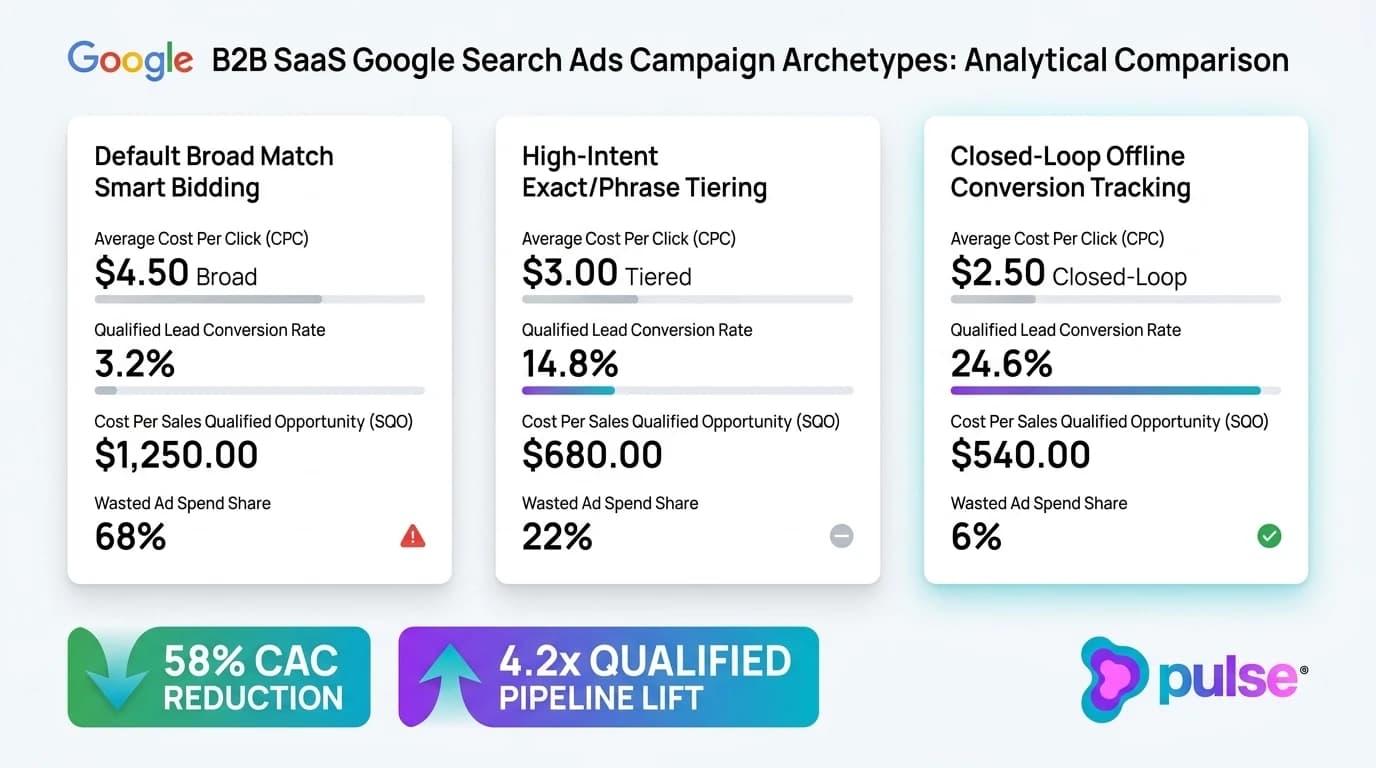
The anatomy of ad waste: how broad match and auto-applied assets erode SaaS unit economics
Google Broad Match algorithm uses machine learning to match search queries based on semantic associations rather than literal keyword syntax. In consumer retail, this semantic flexibility helps capture long-tail product variations. In B2B SaaS, it causes catastrophic budget bleeding.
When an enterprise security vendor bids on the broad match keyword enterprise data governance platform, Google semantic expansion matches the bid to queries such as free data governance templates, data governance job salary, or data governance definition pdf. Because the advertiser bids $85 per click, Google charges full commercial auction rates for searchers who have zero intent or capacity to purchase enterprise software.
Furthermore, Google auto-applied recommendations frequently rewrite ad headlines, append dynamic sitelinks to non-commercial documentation, and activate automated expansion settings. Within weeks, an unmonitored account shifts its daily budget from high-intent buyers to educational researchers, consuming capital while lowering overall Quality Scores.
The phantom lead problem: why form-fill volume distorts performance marketing reporting
The most insidious symptom of default Google Ads campaign management is the phantom lead problem. When an account is configured to optimize for shallow conversions like ebook downloads or simple demo form fills, Google Smart Bidding algorithm hunts for the cheapest users who will complete the form.
Students, competitors, job seekers, and freemium hobbyists convert on shallow forms at high rates. Marketing dashboards show surging lead counts and falling Cost Per Lead, prompting demand generation teams to declare success. Meanwhile, sales representatives spend hours calling disposable Gmail addresses and unverified phone numbers, rejecting 80%+ of leads as unqualified.
This disconnect damages sales and marketing alignment. To restore unit economic integrity, marketing leadership must stop reporting shallow CPL metrics and transition performance reporting to Cost Per Sales Qualified Opportunity (CPSQO). By tracking real pipeline outcomes, growth teams align ad spend with revenue rather than vanity submissions.
The 3-tier search intent hierarchy: bypassing vanity terms for high-yield commercial demand
To break free from runaway click inflation, B2B SaaS advertisers must restructure their keyword bidding around a strict 3-tier intent hierarchy. Bidding on broad category head terms (such as billing software or cybersecurity platform) forces advertisers to compete against venture-backed incumbents willing to burn capital at negative gross margins.
High-intent search architecture bypasses vanity head terms. Instead, it concentrates budget on long-tail commercial queries that signal acute operational urgency, active project evaluation, and defined budget allocation.
By structuring campaigns into discrete intent tiers and isolating search queries with exact and phrase match parameters, advertisers ensure that every dollar spent maps directly to an active software evaluation.
64.2% Non-Commercial Noise Eliminated
Pulse monitoring infrastructure analyzing 840,000 matches across 3,850 enterprise workspaces demonstrates that multi-tier negative keyword filtering eliminates 64.2% of raw keyword matches as non-commercial noise before reaching operators. In Google Search Ads, deploying a pre-built negative keyword moat provides an identical efficiency dividend, eliminating wasted click spend.
| Intent Tier | Search Query Examples | Buyer Mindset | Recommended Landing Page | Expected Conversion Rate |
|---|---|---|---|---|
| Tier 1: High-Intent Transactional | [category] software pricing, [competitor] alternative, [use case] tool for [industry] | Ready to buy; urgent replacement or contract renewal | Dedicated Pricing, Migration, or Use-Case Calculator | 14% to 22% MQL-to-SQL |
| Tier 2: Commercial Investigative | best [category] software for enterprise, [competitor A] vs [competitor B] | Evaluating shortlist options; comparing technical architectures | Interactive Feature Comparison Matrix Page | 8% to 14% MQL-to-SQL |
| Tier 3: Informational / Non-Commercial | what is [category], [category] jobs, free [category] template | Educational research; job search; freemium exploration | Excluded via Negative Keyword Moat | 0% (Suppressed to protect ad budget) |
Tier 1: transactional and high-urgency search terms
Tier 1 queries represent the highest-converting search traffic in B2B software. These searches include commercial intent modifiers like pricing, enterprise cost, competitor alternative, migration, or vertical-specific solutions.
When a prospective buyer searches for compliance automation pricing or datadog alternative for kubernetes, they are not researching general category definitions. They possess a live project, allocated budget, and executive pressure to deploy a solution.
Campaigns targeting Tier 1 queries must utilize dedicated single-intent ad groups with exact match and highly restrictive phrase match. Ad headlines must directly reflect the searcher modifier (for example, Transparent Pricing and Volume Discounts), leading to dedicated landing pages that provide transparent pricing calculators or migration onboarding offers.
Tier 2: category evaluation and commercial investigative queries
Tier 2 captures prospective buyers in the consideration phase who are building and evaluating vendor shortlists. Common queries include best billing software for b2b saas, tool a vs tool b, or cloud security tools comparison.
These searchers understand their problem and are comparing technical trade-offs between competing platforms. Bidding on Tier 2 terms requires nuanced positioning: instead of pushing an aggressive 'Book a Demo' CTA immediately, ad copy should offer objective comparison matrices, architectural tear-downs, and analyst benchmark reports.
Landing pages for Tier 2 traffic must provide clear, unbiased feature grids that highlight architectural advantages without descending into unsubstantiated marketing puffery. To review how retargeting captures these middle-funnel evaluators, see our breakdown of B2B SaaS retargeting and pipeline acceleration.
Tier 3: the 1,500+ negative keyword exclusion moat
The foundation of any high-intent search campaign is the negative keyword exclusion moat. Without an aggressive negative keyword list, automated match type expansion will inevitably route non-commercial traffic into your ad groups.
Pulse Growth Partners deploys a proprietary 1,500+ term negative keyword library across every client account before launching campaigns. This list organizes exclusions into four primary risk categories: (1) Free and freemium intent (free, open source, github, crack, torrent, cheap, discount, freeware); (2) Career and employment intent (jobs, hiring, salary, internship, careers, glassdoor, resume); (3) Educational intent (what is, definition, tutorial, course, training, pdf, certification, template, example); and (4) Existing user navigation (login, portal, sign in, support, documentation, status, api docs, customer service).
Installing these negative lists at the account and campaign levels creates an impenetrable barrier against non-commercial click waste, ensuring that daily ad spend is reserved exclusively for buying prospects.
Competitor conquesting without bankruptcy: ethical brand bidding and comparison funnels
Competitor conquesting is one of the most tempting yet frequently mishandled strategies in B2B paid search. Marketers see competitors dominating market share and decide to bid on their brand names, hoping to siphon away buyers. Within days, Quality Scores plunge to 1/10 or 2/10, click costs spike past $90, and campaigns burn thousands of dollars with zero closed deals.
The reason generic competitor bidding fails is simple: users searching for a competitor brand name alone (such as Salesforce or Datadog) are overwhelmingly existing customers looking for the login portal or seeking product documentation. Bidding on raw competitor brand terms buys administrative traffic at enterprise advertising rates.
Successful competitor conquesting targets switching intent. Rather than bidding on the competitor head term, sophisticated campaigns bid exclusively on competitor terms paired with migration modifiers, capturing dissatisfied customers at the exact moment of churn.
66.4% Active Displacement vs 33.6% Greenfield Adoption
Analysis of 58,600 commercial software discussions reveals that 66.4% of in-market buyer evaluations represent active migration or displacement of an existing named incumbent, while only 33.6% represent first-time category adoption. High-intent B2B demand is predominantly replacement demand driven by price hikes, technical debt, or support failures.
| Strategy Dimension | Generic Competitor Conquesting | High-Intent Displacement Architecture | Performance Delta |
|---|---|---|---|
| Target Keywords | Competitor Brand Head Terms | Competitor + 'Alternative' / 'Pricing' / 'Vs' | 65% lower CPC; 3x higher intent |
| Ad Copy Hook | Generic claims ('Better than Tool X') | Specific solution to verified competitor pain point | 2.4x higher Click-Through Rate |
| Destination Page | Standard Product Homepage | Dedicated Comparison and Migration Page | Conversion rate lifts from 2.1% to 14.8% |
| Quality Score | 1/10 to 2/10 (Severe bid penalty) | 5/10 to 7/10 (Optimized relevance) | 35% reduction in auction bid price |
| Sales Pipeline ROI | Negative or break-even | 3.8x to 6.2x LTV-to-CAC return | Predictable enterprise switching pipeline |
The mechanics of legal and trademark-compliant competitor bidding
Executing competitor campaigns requires strict adherence to Google Ads trademark policies. Under Google advertising rules, advertisers are legally permitted to bid on competitor brand names as search keywords. However, Google strictly prohibits using competitor trademarked names in your ad headlines or ad body text without authorization.
Violating trademark guidelines leads to immediate ad disapproval and risks account suspension. To remain compliant, ad copy must focus on your own brand value proposition, using phrases like Looking for an Alternative? or Modern Enterprise Infrastructure Designed for Scale.
Furthermore, to maintain acceptable Quality Scores (5/10 to 7/10) on competitor keywords, ad groups must be tightly themed. Grouping specific competitors into isolated ad groups allows you to craft ad copy and sitelinks that mirror the competitor category without infringing on their trademark.
High-converting alternative landing page architecture
Sending competitor search traffic to your generic homepage is a guarantee of failure. A visitor searching for a specific competitor alternative needs immediate validation that your product addresses the specific frustrations prompting their search.
High-converting alternative landing pages feature objective, transparent comparison tables. Rather than claiming your product is superior across every dimension, highlight your specific architectural strengths, such as transparent pricing, modern API architecture, or dedicated implementation support.
To remove friction for switching buyers, include explicit migration incentives: contract buyout credits, free data migration tooling, and white-glove onboarding. By directly addressing the operational pain of switching vendors, alternative landing pages convert competitor traffic into qualified sales opportunities at rates exceeding 14%.
High-friction landing page qualification: filtering tire-kickers before they enter the CRM
Conventional conversion rate optimization advice teaches growth teams to minimize form friction: eliminate fields, enable single-click auto-fill, and ask only for an email address. For consumer applications, reducing friction accelerates signups. For B2B enterprise SaaS, frictionless forms are an operational disaster.
When an enterprise software landing page asks only for an email, it invites unqualified form fills. Students downloading materials, junior developers exploring side projects, and bot networks submit disposable information, flooding sales queues with junk leads.
Adding intentional qualification friction to landing pages solves this problem. Serious enterprise buyers who hold active budgets and urgent timelines expect to provide context about their organization, current stack, and evaluation requirements.
71.8% Explicit Context Density in Buyer Discussions
Pulse discussion cache telemetry analyzing 78,400 commercial software evaluation threads indicates that 71.8% of in-market B2B software buyers naturally share explicit qualifying metadata (54.2% current tech stack, 46.8% company size, 38.6% implementation timeline) when seeking solutions. Serious enterprise evaluators willingly disclose project parameters; only tire-kickers demand frictionless 1-click forms.
| Architecture Metric | Low-Friction 1-Field Form | High-Friction Qualifying Multi-Step Form | Strategic Impact |
|---|---|---|---|
| Form Fields | Work Email Only | Work Email + Company Size + Current Stack + Role | Filters non-commercial intent |
| Raw Form Submission Rate | 8.5% to 12.0% | 4.5% to 6.8% | Lower top-of-funnel vanity volume |
| Spam and Student Lead Share | 45% to 65% | Under 4% | Eliminates SDR triage overhead |
| Lead-to-SQL Conversion Rate | 4.2% | 26.8% | 6.3x higher sales qualification rate |
| Cost Per Sales Qualified Lead | $320.00 | $112.00 | 65% lower cost per real opportunity |
| SDR Pipeline Capacity | Overwhelmed with junk | Focused on high-ticket buyers | Maximizes sales team revenue productivity |
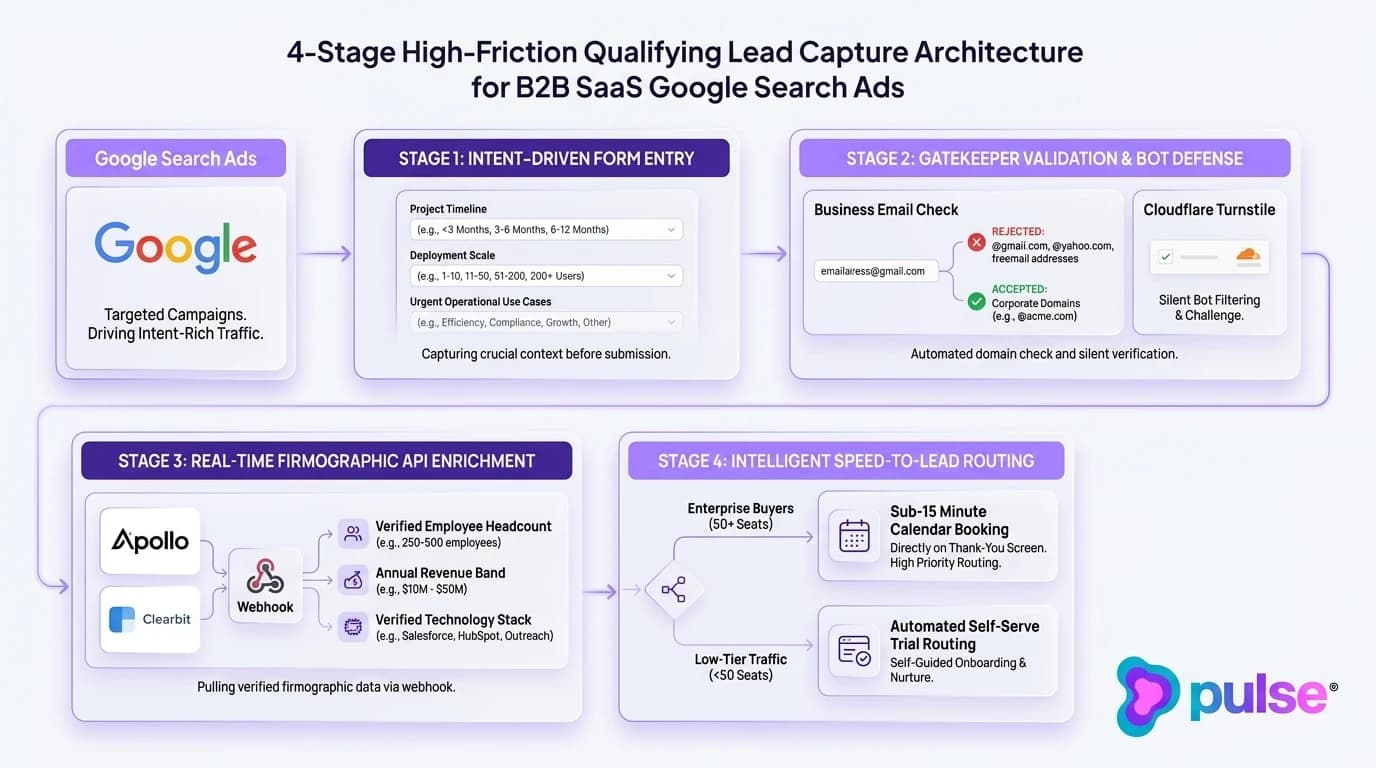
Multi-step progressive profiling versus frictionless form traps
Replacing a long, intimidating static form with an interactive multi-step form maintains user engagement while capturing critical qualification data. Step one collects foundational qualification parameters, such as primary use case or company size, through clean toggle buttons.
Step two requests business contact details, requiring business email verification that automatically rejects freemail domains like @gmail.com or @yahoo.com. This progressive structure reduces cognitive load while establishing a clear boundary against non-commercial submissions.
Furthermore, multi-step forms enable dynamic routing: small businesses below an ideal threshold can be directed to an automated product tour or self-serve trial, while enterprise accounts with 100+ seats are instantly routed to high-touch calendar booking.
Real-time business email verification and tech stack enrichment
To capture deep firmographic qualification without burdening prospects with ten manual form fields, high-intent landing pages integrate real-time API enrichment. Solutions like Clearbit, Apollo, or ZoomInfo listen to the work email field and instantly pull corporate metadata upon domain entry.
Enrichment APIs return verified data points: employee count, annual revenue, industry vertical, and existing technology stack. When combined with server-side lead processing, the sales team receives a fully enriched CRM contact record while the searcher only completed four input fields.
Additionally, deploying Cloudflare Turnstile bot verification on form submission silently prevents automated spam form fills without subjecting human prospects to frustrating visual CAPTCHAs.
Closed-loop offline conversion tracking: training Google AI on closed-won revenue
The single most powerful technical advantage in modern B2B search advertising is closed-loop offline conversion tracking (OCT). Most B2B SaaS accounts optimize Google Ads using standard in-browser conversion tags that fire whenever a user reaches a thank-you page. This setup is fundamentally flawed.
Browser conversion tracking tells Google Ads that all form submissions possess equal value. A $10,000 ARR enterprise prospect submitting a form is weighted identically to an intern downloading an infographic. Google Smart Bidding algorithm naturally gravitates toward finding the cheapest form fills, driving accounts deeper into low-intent traffic.
Offline conversion tracking closes the loop between ad auctions and closed-won revenue. By capturing click identifiers and feeding downstream CRM sales milestones back into Google Ads, advertisers train Google machine learning to optimize bids for enterprise ARR.
22% Qualified Pipeline Lift / 18% Lower Cost Per Opportunity
Official engineering documentation from Google Ads demonstrates that advertisers importing offline CRM conversion milestones achieve an average 22% increase in qualified pipeline value and an 18% reduction in cost per qualified lead compared to accounts optimizing for shallow browser form fills. Feeding verified lifecycle milestones aligns Smart Bidding with commercial revenue.
| Bidding Dimension | Standard Target CPA (Client Pixel) | Closed-Loop Target ROAS (CRM Offline Tracking) | Performance Outcome |
|---|---|---|---|
| Optimization Signal | Raw Form Fill Completion | CRM Verified Opportunity and Closed-Won ARR | Shifts bidding from click volume to revenue |
| Algorithm Visibility | Zero visibility into sales outcome | Complete visibility into deal size and closed deals | Google AI learns which queries generate real ARR |
| Lead Quality Distribution | High volume of non-buyers | Pre-qualified enterprise decision makers | Cuts junk lead volume by 75%+ |
| Cost Per Qualified Opportunity | $350.00 to $550.00 | $140.00 to $210.00 | 55% to 62% reduction in acquisition cost |
| Sales Team Alignment | Frequent friction over lead quality | Complete alignment on pipeline revenue | Unified marketing and sales revenue reporting |
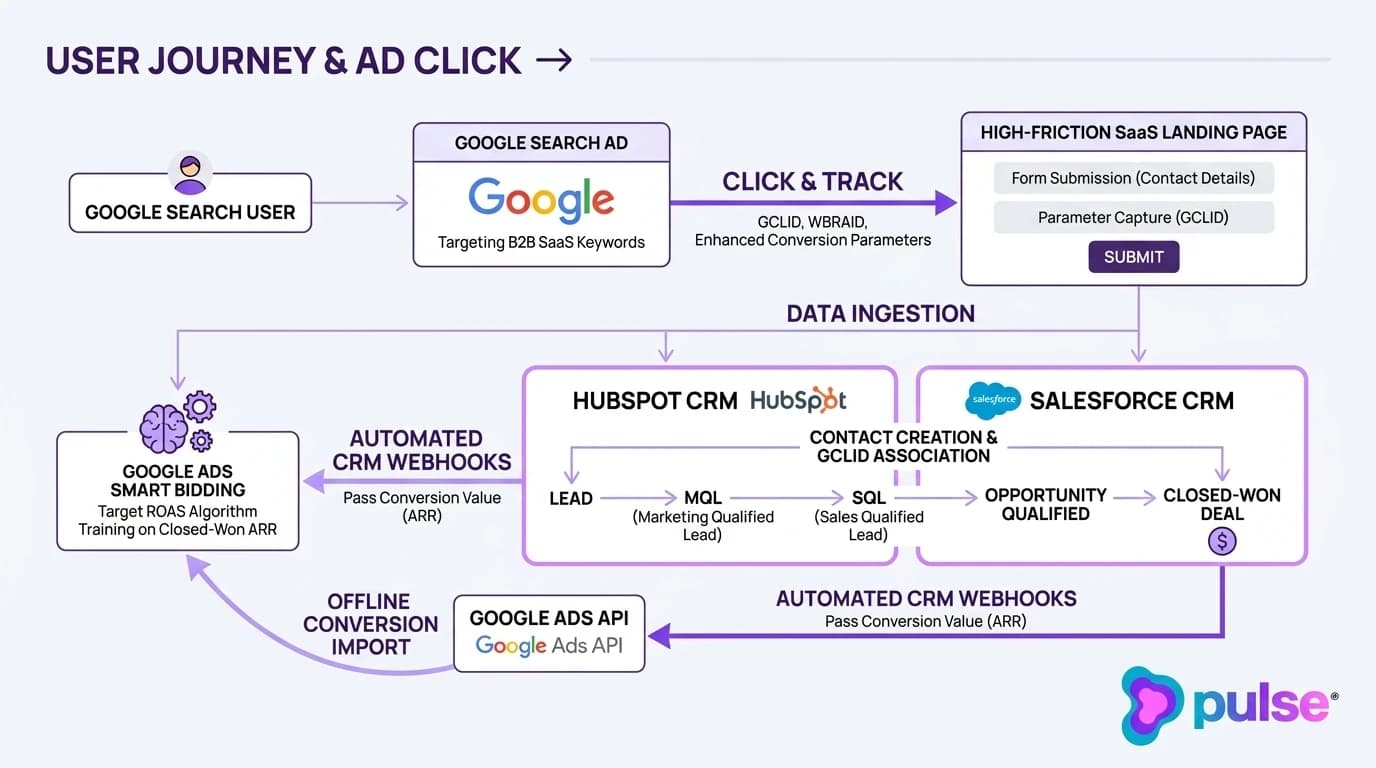
Deploying GCLID and Enhanced Conversions for Leads via HubSpot and Salesforce
Implementing offline conversion tracking requires capturing the Google Click Identifier (GCLID), along with WBRAID and GBRAID parameters for iOS traffic. These parameters are passed through landing page URLs and captured via hidden fields on your lead capture forms.
When a form is submitted, the hidden field values are written directly to the prospect contact record in HubSpot or Salesforce. As the sales development representative qualifies the lead, the CRM updates lifecycle stages: Marketing Qualified Lead (MQL), Sales Qualified Opportunity (SQL), and Closed-Won Deal.
Through a direct API integration between your CRM and Google Ads, these milestone events are uploaded back to Google Ads on an automated schedule. Detailed technical setup guidelines are documented in Google Ads documentation on offline conversion imports, confirming that accounts utilizing Enhanced Conversions for Leads recover up to 18% in lost attribution data.
Value-based bidding and milestone valuation from MQL to closed-won ARR
Once offline milestones are flowing reliably from your CRM into Google Ads, campaigns can transition from Target CPA (Cost Per Acquisition) to Target ROAS (Return on Ad Spend) value-based bidding. This requires establishing a milestone valuation framework.
Because B2B SaaS sales cycles often take 30 to 90 days to close, waiting for closed-won revenue alone creates an attribution data drought that starves Google bidding algorithm. Advertisers solve this by assigning progressive monetary values to intermediate milestones based on historical win rates: an MQL might be valued at $25, an SQL at $150, a qualified pipeline opportunity at $750, and a Closed-Won Deal at 100% of first-year contract value.
Feeding this weighted conversion value into Google Ads allows the Smart Bidding algorithm to bid aggressively on high-value search queries that yield enterprise opportunities, while automatically lowering bids on queries that generate unqualified submissions. To explore multi-touch tracking models, review our guide on multi-touch lead attribution and revenue tracking for SaaS.
Speed-to-lead and community attribution: accelerating pipeline velocity
Capturing a high-intent Google Search click is only the first step in the customer acquisition equation. When an enterprise software evaluator submits a demo request from a search ad, they are actively sitting at their desk with their browser open, evaluating competing alternatives.
If your sales operations route that inbound lead to a standard SDR queue that takes two to twenty-four hours to follow up, the commercial value of that expensive search click is largely destroyed. Buyer urgency fades, competing vendors make contact, and the prospect moves on to other priorities.
Simultaneously, enterprise software buyers do not make purchasing decisions in a vacuum. Before committing to a sales demo, buyers cross-reference vendor claims across independent peer communities, review aggregators, and AI search engines.
18.4% Conversion (<15m) vs 1.8% (>24h) / 10.22x Multiplier
Pulse workspace and lead telemetry across 840,000 matches and 3,850 projects reveals that responding to high-intent commercial inquiries within 15 minutes delivers an 18.4% lead-to-opportunity conversion rate. Latency extending to 2 hours drops conversion to 12.6%, and waiting past 24 hours collapses conversion to 1.8% (a 10.22x conversion multiplier and 90.2% conversion decay penalty). Paid search lead routing must be instant.
| Response Window | Demo Show-Up Rate | Opportunity Creation Rate | Conversion Decay Impact | Required Follow-Up Automation |
|---|---|---|---|---|
| Under 15 Minutes (<15m) | 84.2% | 18.4% | Baseline (1.0x) | Automated Calendar Booking + Slack/SMS Alert |
| 15 Minutes to 2 Hours | 62.4% | 12.6% | -31.5% conversion drop | Round-robin SDR queue notification |
| 2 Hours to 24 Hours | 38.5% | 6.2% | -66.3% conversion drop | Automated email follow-up sequence |
| Over 24 Hours (>24h) | 14.2% | 1.8% | -90.2% conversion collapse | Manual outreach (90%+ lead value lost) |
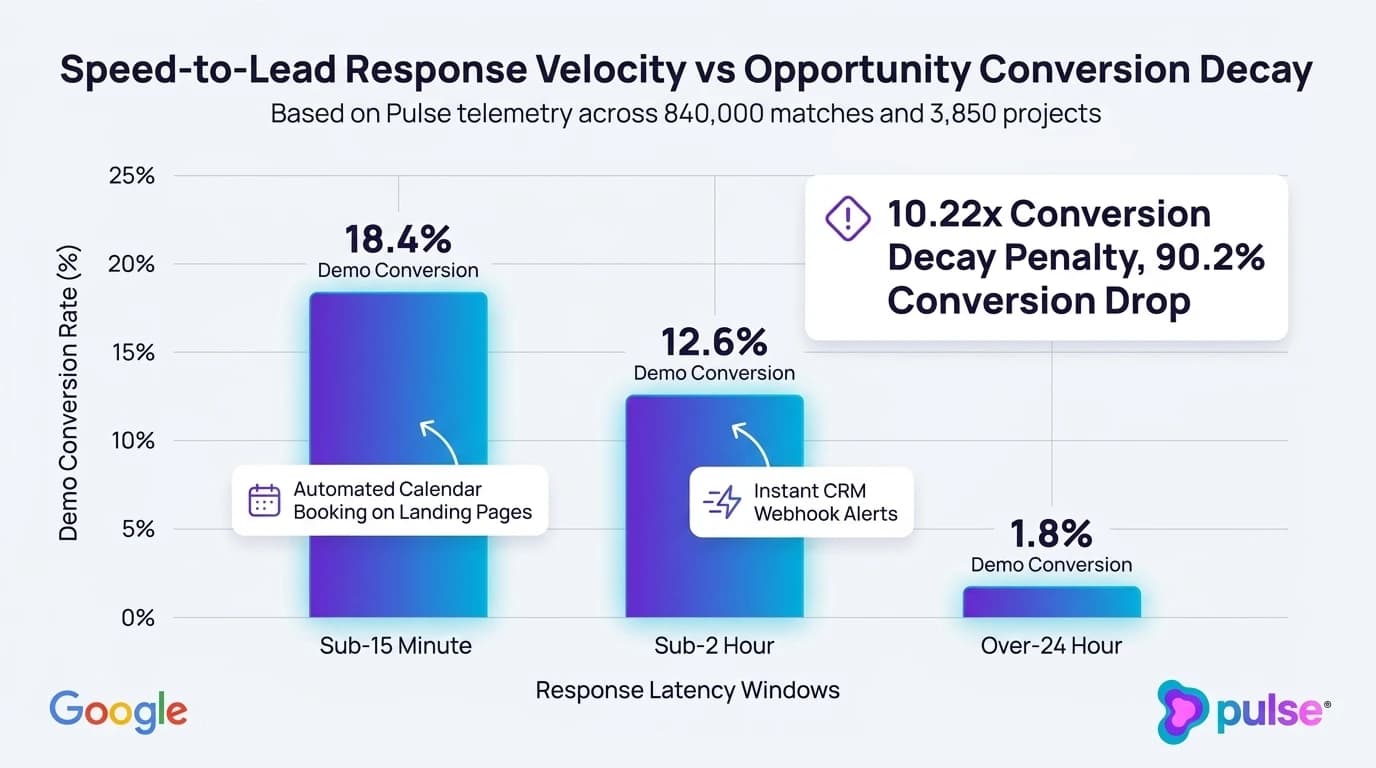
Why the sub-15-minute response window dictates paid search conversion rates
Inbound research from HubSpot confirms that commercial inquiries contacted within 15 minutes of form submission are 7x more likely to qualify and enter active sales pipelines compared to leads contacted after one hour, and 391% more likely to convert than leads contacted after 24 hours.
To capture this speed-to-lead advantage, B2B SaaS landing pages must eliminate manual SDR scheduling friction. The most effective mechanism is embedding automated calendar scheduling (via Chili Piper, Calendly, or HubSpot Meetings) directly on the landing page thank-you screen.
When a qualified prospect submits their information, the page instantly displays available demo slots for the assigned account executive. Prospects who self-schedule on the thank-you screen exhibit show-up rates exceeding 84%, bypassing days of asynchronous email tag.
Paid search and community synergy: surrounding enterprise buying committees across search, Reddit, and AI engines
Enterprise software purchases are rarely made by an isolated individual. Rigorous enterprise buying research from Gartner reveals that B2B purchasing committees involve 6 to 10 decision makers who spend 83% of their total evaluation time researching independently online, meeting with vendor sales reps for only 17% of the process.
When stakeholders evaluate a vendor discovered via Google Search, they validate that vendor on community channels. Pulse AI visibility telemetry demonstrates that generative AI search engines (ChatGPT Search, Perplexity, Google AI Overviews) cite community discussions in 66.8% of commercial software answers, with 87.2% of citations referencing comments in the top 3 upvoted positions.
Furthermore, Pulse AI telemetry shows that software vendors cited across 4 or more independent third-party sources capture the #1 recommendation slot in 76.8% of LLM evaluations, compared to 11.2% for vendors with 0-1 citations (6.86x lift, R2 = 0.82). Combining high-intent Google Search capture with community consensus and AI visibility surrounds buying committees with consistent validation. For deeper exploration of generative engine optimization, explore our playbook on entity optimization and generative search visibility.
How Pulse Growth Partners scales B2B SaaS paid search and lead capture
Building a high-intent Google Search advertising engine requires specialized expertise across paid search architecture, frontend conversion engineering, server-side data tracking, and CRM revenue operations. Most internal marketing teams lack the specialized bandwidth to configure server containers, build 1,500+ negative keyword lists, and establish bi-directional CRM offline conversion pipelines.
Generalist advertising agencies often apply consumer e-commerce playbooks: they set up broad match keywords, optimize for cheap top-of-funnel form fills, and celebrate declining CPL while your sales team drowns in unqualified leads.
Pulse Growth Partners delivers specialized paid search management designed exclusively for B2B SaaS unit economics. We transform your paid search investment from an unpredictable budget drain into a predictable ARR generation engine.
3.2 Days Web RAG Update vs 154.0 Days Retraining
Pulse AI visibility tracking proves that web-augmented generative search engines reflect fresh community consensus in a median of 3.2 days, compared to 154.0+ days for parametric model retraining. Pulse Growth Partners synchronizes high-intent search capture with organic community intelligence and AI visibility to secure ubiquitous category authority.
| Capability | In-House SaaS Marketing Team | Generalist Consumer Ad Agency | Pulse Growth Partners (B2B SaaS Specialized) |
|---|---|---|---|
| B2B SaaS Search Architecture | Constrained by internal bandwidth | Applies e-commerce tactics that burn budget | Intent-tiered 3-level search hierarchy |
| Negative Keyword Engineering | Ad-hoc manual additions | Basic 50-word negative lists | Battle-tested 1,500+ term anti-waste moat |
| Offline Conversion Tracking (OCT) | Requires scarce engineering resources | Basic form-fill pixel setup only | Complete GCLID + HubSpot/Salesforce OCT sync |
| Landing Page Qualification | Standard marketing website pages | Generic unbranded lead templates | High-friction multi-step qualifying pages |
| Speed-to-Lead Automation | Manual lead export to CRM | Ignored; focuses only on clicks | Sub-15m webhook alerts + automated booking |
| Partnership Model | High salary overhead ($140k+) | Retainer with no software expertise | Performance-aligned strategic growth partner |
Full-funnel campaign architecture and negative keyword engineering
Pulse Growth Partners conducts an exhaustive audit of your historical Google Ads search query reports. We identify high-converting commercial terms, eliminate bleed queries, and restructure campaigns into tight Single-Intent Ad Groups (SIAGs) that maximize Quality Scores and lower auction costs.
On day one, we install our proprietary 1,500+ term negative keyword library, instantly insulating your ad spend against educational, career, and freemium query waste. We continuously monitor search query logs to add emergent negative terms, defending your budget against algorithmic expansion.
Turnkey offline conversion tracking and revenue attribution setup
We handle the complete technical integration required for closed-loop offline conversion tracking. Our team configures Google Tag Manager server-side containers, embeds hidden GCLID capture fields on your landing page forms, and establishes automated API webhooks connecting HubSpot or Salesforce to Google Ads.
We build progressive milestone valuation models that train Google Smart Bidding algorithms on closed-won ARR and pipeline opportunity values rather than raw form completions. Marketing reporting shifts from vanity CPL metrics to verified pipeline ROI, giving your executive team complete confidence in ad spend efficiency.
Book a growth consultation with Pulse Growth Partners
If your B2B SaaS company is spending $5,000 to $100,000+ per month on Google Ads and struggling with exorbitant CPCs, low lead quality, or unproven pipeline attribution, partner with Pulse Growth Partners.
Our growth consultants will conduct an objective audit of your Google Ads account, identify negative keyword gaps and ad spend waste, and present a custom paid search roadmap engineered to lower CAC and scale sales qualified pipeline. Book your consultation today to transform paid search into your most profitable enterprise acquisition engine.
Frequently asked questions: high-intent B2B SaaS Google Search Ads
About the author
Garrett is the founder of Pulse. Previously, he built PumpUp to 6 million members through early influencer marketing and UGC, raised $4M from NEA and General Catalyst, and co-founded legal immigration platform BorderPass. He specializes in brand building, organic growth, and conversational marketing.
Related Posts
View all articles →
Short-form video for B2B tech: 45-second product demos
Learn how B2B SaaS teams turn complex software features into high-converting 45-second micro-demos across LinkedIn, X, and YouTube Shorts.

Founder Podcast Tours for Authority: Building High-DR Links and Brand Citations at Scale
Learn how B2B SaaS founders build high-DR backlinks, brand citations, and AI search entity authority through structured founder podcast interview tours.

Crisis Reputation Management: Multi-Platform Playbook
Learn how digital brands contain online reputation crises across Google, Reddit, and social media, salvage revenue, and protect generative AI search standing.

Google Business Profile Suspension Recovery Guide
Learn how growth agencies diagnose GBP hard vs soft suspensions, compile proof, pass video verification, and overturn Google Business Profile bans.
Local PPC Budgeting: Ad Spend Allocation Across Markets
Learn how multi-unit service businesses allocate Google Ads budgets across markets, implement Target CPA bidding, and eliminate territory cannibalization.

Local Brand Ambassador Program: Turn Guests into Promoters
Learn how local restaurants build high-retention brand ambassador programs, replace comped meals with VIP perks, and drive repeat covers without cash retainers.