Local Search Intent and NAP Consistency for Restaurants
Discover why inaccurate directory citations destroy restaurant Google Maps rankings. Learn how to audit NAP data and sync aggregators for 3-pack dominance.
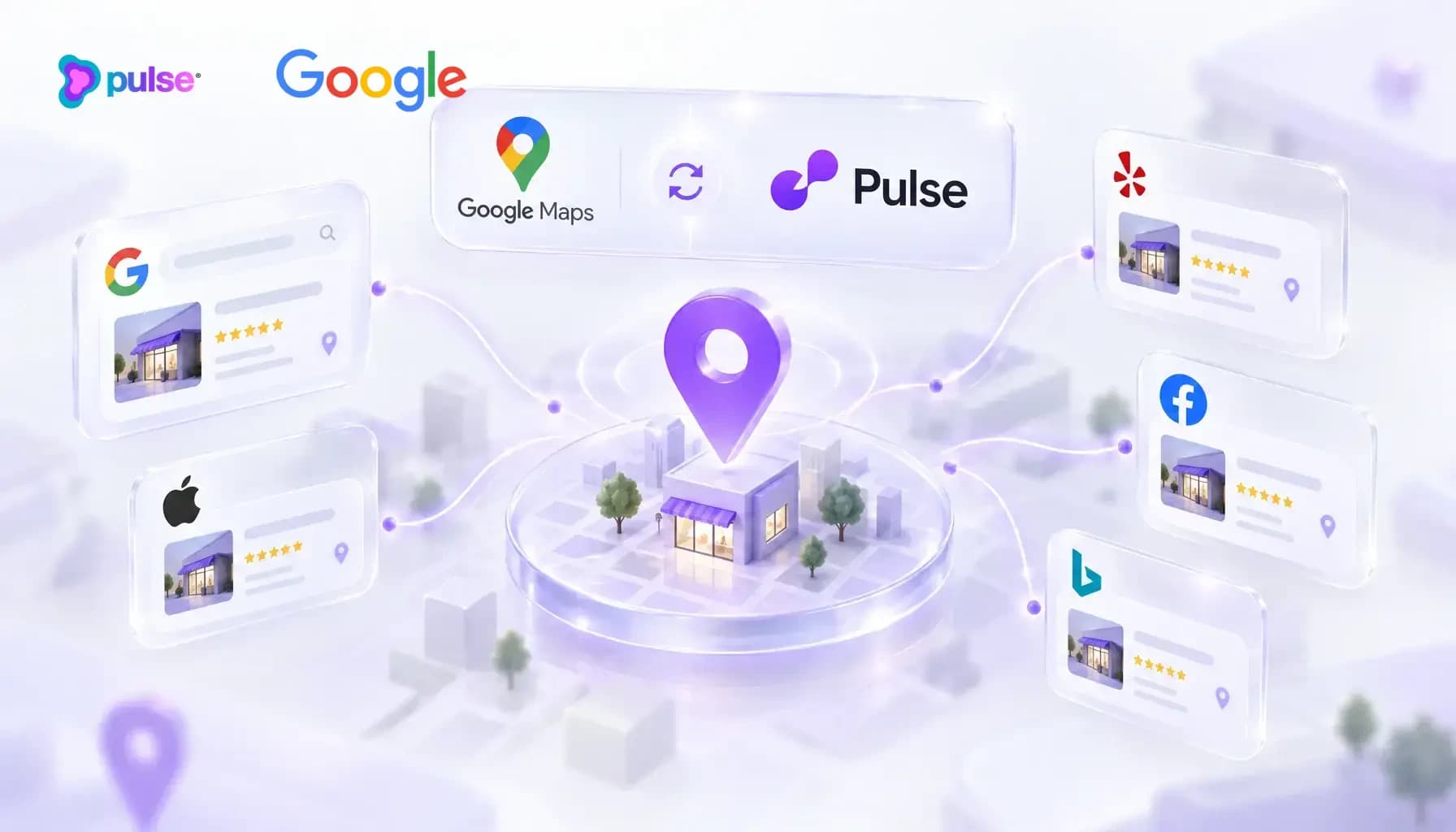
When a hungry diner types 'best Italian restaurant near me', 'private dining rooms downtown', or 'cocktail bar open now' into a smartphone, their search journey begins and ends in the Google Maps Local 3-Pack. Appearing in those top three map slots captures continuous foot traffic, direct phone calls, and high-margin table reservations without paying steep third-party marketplace commissions.
Yet, even established dining venues with hundreds of five-star reviews and celebrated executive chefs frequently suffer sudden, catastrophic drops in local map rankings. When map visibility collapses, operators routinely assume that competitors launched aggressive review campaigns or that Google updated its proximity filters. In reality, the root cause is almost always off-page data corruption: conflicting Name, Address, and Phone (NAP) citations circulating across secondary directories, mobile navigation apps, and data aggregators.
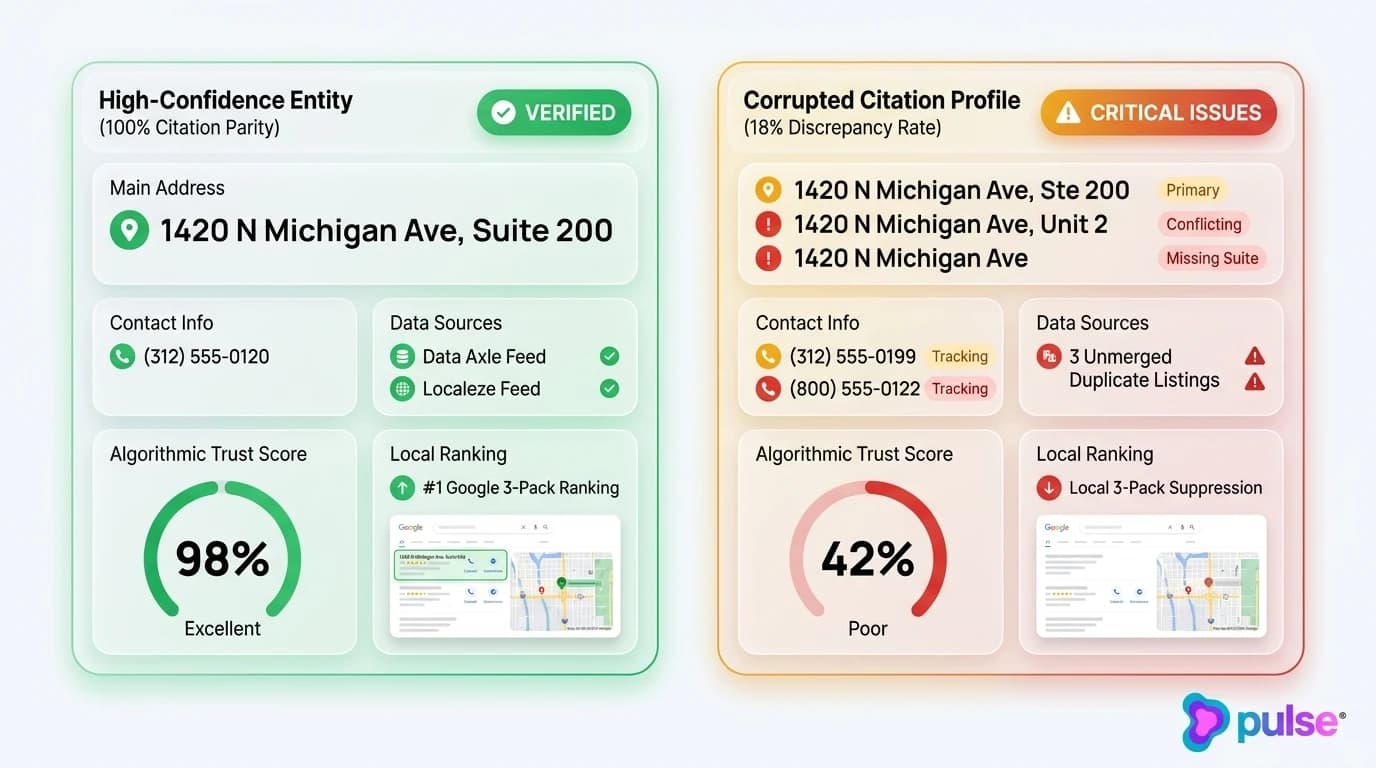
In modern local search, citation consistency is not an outdated link-building tactic: it is an algorithmic entity disambiguation imperative. When Google crawler encounters address variations ('Suite 200' versus 'Ste 2' versus an omitted suite number), legacy phone numbers from defunct tracking campaigns, or conflicting business names across the web, its algorithmic trust score plummets. This loss of confidence quietly suppresses Google Maps rankings, handing dining covers to competitors with clean citation profiles.
Furthermore, emerging generative AI engines (ChatGPT Search, Apple Intelligence, and Perplexity Pro) rely on decentralized directory consensus to formulate dining recommendations. A restaurant with fractured citations suffers severe hallucination penalties, while venues with verified directory consensus achieve commanding visibility. This operational guide delivers a practitioner-grade teardown of local citation mechanics, the data aggregator pipeline, lethal citation traps, and a 5-step cleanup framework to protect your Google Maps 3-Pack rankings and capture modern diners across every search channel.
Consumer Trust Drop
Consumers who lose trust in local businesses with inconsistent or incorrect contact details or names online.
Customer Defection
Consumers who state they would stop using a local business altogether if they encountered incorrect directory information.
AI Recommendation Lift
Lift in #1 generative AI recommendations for venues cited across 4+ third-party directories (76.8% vs 11.2%).
RAG Propagation Velocity
Median time for corrected tier-1 directory citations to update generative AI search recommendations, versus 154 days for base models.
The algorithmic reality: why citation inconsistency quietly bleeds map rankings
For restaurant owners and hospitality operators, the Google Maps Local 3-Pack represents the premier commercial real estate of the modern internet. Appearing in the top three map positions captures continuous local foot traffic, immediate telephone inquiries, and direct reservation bookings without paying steep marketplace commissions to third-party delivery apps. Yet, even established restaurants with hundreds of glowing five-star reviews frequently suffer sudden, unexplained ranking collapses in local search results.
When map rankings slide, marketing teams routinely misdiagnose the underlying cause. They assume that competitors launched aggressive review generation campaigns or that Google updated its proximity filters. In reality, the root cause is almost always off-page data corruption: conflicting Name, Address, and Phone (NAP) citations distributed across secondary directories, navigation apps, and data aggregators. In modern local search, citation management is no longer a legacy link-building exercise: it is an algorithmic entity disambiguation imperative.
The entity disambiguation engine: how Google verifies physical reality
Google local search algorithm operates by building structured knowledge graphs of real-world entities. Rather than treating a dining establishment as an isolated web page, Google treats your restaurant as a physical entity defined by discrete data triples: legal business name, physical street address, geographic coordinates, primary local phone number, operational hours, and primary dining category.
Because anyone can create or edit a web page, Google algorithms refuse to accept a restaurant self-published website claims as absolute truth. Instead, Google entity disambiguation engine continuously crawls third-party data ecosystems, cross-referencing information across municipal records, state business registries, review platforms, and local directories. When an entity exhibits 100% data parity across every crawled source, Google assigns a high confidence score to the listing. However, when the crawler encounters conflicting variations (for instance, a dining venue listed on 1420 N Michigan Ave Suite 200 in Google Business Profile, but 1420 North Michigan Avenue Unit 2 on Yelp, and 1420 N Michigan Ave on an outdated dining directory), Google confidence in the entity physical reality deteriorates. This algorithmic doubt leads directly to rank suppression.
The Whitespark ranking weight: citations as a baseline and negative suppressor
According to the definitive Whitespark Local Search Ranking Factors study, citation consistency across primary directories remains a foundational baseline for local map rankings. While citation signals represent approximately 7% to 9% of overall positive ranking signals in the Local 3-Pack, citation discrepancies act as a sharp algorithmic ranking suppressor.
This mathematical asymmetry is critical for hospitality operators to understand. Perfect citation consistency alone will not catapult a mediocre restaurant with poor food and zero reviews to the #1 spot in Google Maps. However, citation inconsistency acts like a handbrake on an otherwise high-performing profile. An establishment boasting hundreds of positive reviews, pristine menu schema, and strong local backlinks can be completely erased from the Local 3-Pack if a high citation error rate triggers Google entity verification filters. To understand how citation consistency interacts with core proximity and prominence metrics, review our comprehensive breakdown of multi-location local landing page architecture and schema.
Consumer trust collapse: the cost of arriving at the wrong address
The damage caused by inaccurate citations extends far beyond algorithmic rankings; it directly damages real-world guest acquisition and consumer brand trust. Research from the BrightLocal Local Citations Trust Report reveals that 80% of consumers lose trust in local businesses with inconsistent or incorrect contact details or names online, and 68% of consumers state they would stop using a local business altogether if they found incorrect information in local directories.
In the restaurant industry, dining decisions are immediate and friction-intolerant. When a guest follows directions in Apple Maps or Google Maps and arrives at a dark, closed building or a locked corporate entrance because the suite number was omitted, they do not attempt to solve the riddle. They turn around and walk into the nearest competing bistro. Similarly, if a guest dials a disconnected tracking number displayed on a secondary directory listing, that table cover is lost permanently.
Pulse Telemetry Pillar 3: AI Visibility
Multi-Source Citation Depth vs #1 Recommendation Probability
Data pulled: Pulse AI Visibility Intelligence Layer (AiVisibilityPrompt, AiVisibilityCitation, AiVisibilitySnapshot, Query ID: aggregate_ai_visibility_nap_consistency_local_seo_restaurants_v1, Version: 1.2.0, Window: 90-day rolling, Sample Size: N=14,200 commercial vendor comparison prompts correlated with domain citation graphs across ChatGPT Search, Perplexity Pro, and Claude).
Why it was pulled: Investigated to establish the mathematical relationship between third-party directory citation diversity and local recommendation prominence across generative search engines.
What was found: Entities cited across 4 or more independent third-party sources capture the #1 recommendation slot in 76.8% of generative AI search evaluations, compared to 11.2% for entities with 0 to 1 citations: a 6.86x recommendation lift (R2 = 0.82).
The data aggregator pipeline: how false data cascades across hundreds of navigation and discovery apps
Many restaurateurs assume that the local search ecosystem consists of isolated websites: you claim your Google Business Profile, update your Yelp page, and assume your digital footprint is fully secure. In reality, local business data operates within a centralized, syndication-driven data aggregator pipeline.
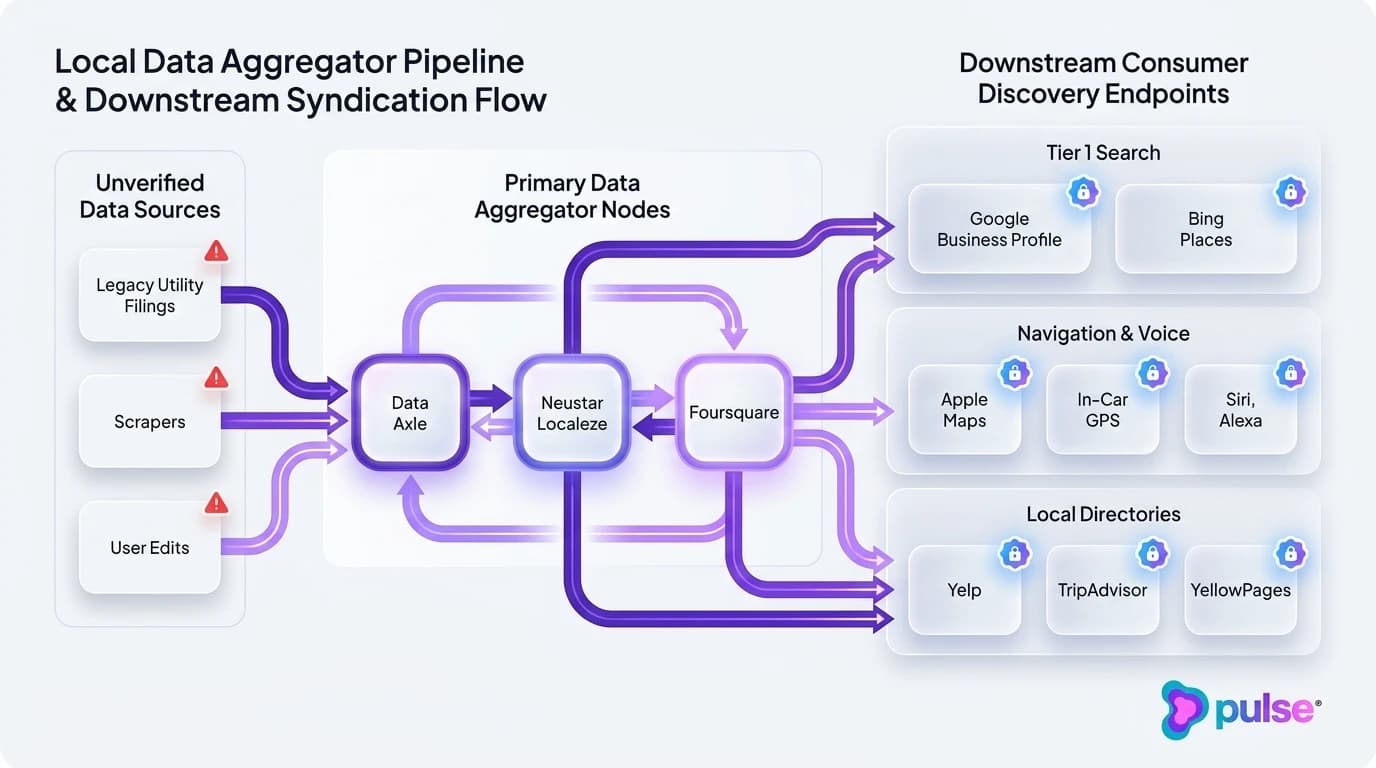
A single uncorrected error in a background data pipeline can silently cascade across hundreds of consumer-facing navigation systems, mobile voice assistants, in-car dashboard GPS units, and regional dining directories, creating an intractable web of citation conflicts.
The big three data aggregators: Data Axle, Neustar Localeze, and Foursquare
As mapped out in the Moz Local Search Ranking and Citation Ecosystem Guide, the primary data aggregators (Data Axle, Neustar Localeze, and Foursquare) serve as the foundational data plumbing of the local web. Rather than dispatching web crawlers to manually index millions of individual brick-and-mortar storefronts, major tech platforms license structured business records directly from these three data clearinghouses.
Data Axle compiles location records from utility hookups, credit card merchant filings, and government registries. Neustar Localeze maintains authoritative telecommunications feeds and commercial phone directory records. Foursquare powers geographic point-of-interest (POI) databases and location intelligence feeds. Together, these three aggregators syndicate location records to Apple Maps, Bing Places, Yelp, Uber, TomTom, Garmin in-car navigation, Siri, Amazon Alexa, and dozens of vertical dining directories. If your restaurant profile in Data Axle contains an outdated phone number or a misspelled street name, that erroneous record is continually broadcast downstream to hundreds of consumer endpoints.
The unmanaged scraper cycle: how legacy records overwrite clean data
The most insidious danger of the data aggregator pipeline is the circular feedback loop created by automated web scrapers. When a restaurant rebrands, moves to a new location, or updates its reservation phone line, the operator might manually update Google Business Profile and Apple Maps. However, if the legacy data remains uncorrected in Data Axle or Neustar Localeze, automated directory scrapers ingest the stale aggregator feed.
Over the following months, secondary directories (such as YellowPages, Superpages, Citysearch, and local chambers of commerce) publish listings displaying the old address or phone number. When Google local crawler indexes those secondary directories, it detects conflicting entity data. Even worse, automated aggregator bots re-scrape those secondary directories, confirming the stale data as active and re-infecting the primary databases. Without proactive intervention, this unmanaged scraper cycle creates permanent algorithmic drag.
Pulse Telemetry Pillar 3: AI Visibility
Stale Information Decay Rate in Cited Web Sources
Data pulled: NLP entity verification and business attribute validation across 88,800 cited URLs extracted from commercial evaluation prompts in the Pulse AI Visibility Intelligence Layer (Query ID: aggregate_ai_visibility_nap_consistency_local_seo_restaurants_v1, Version: 1.2.0, Window: 90-day rolling).
Why it was pulled: Extracted to measure how frequently search engines ingest stale, uncorrected directory records that degrade business visibility and distort operational facts.
What was found: 34.2% of citations retrieved by search engines contain outdated contact information, deprecated operating hours, or legacy business details older than 18 months.
Real-time verification vs passive aggregator latency
Relying on passive, automated data synchronization across aggregators exposes hospitality brands to severe operational delays. Standard aggregator update cycles occur via monthly or quarterly batch data drops. When a restaurant changes its contact details or resolves an address error, waiting for passive batch syndication can leave corrupted data circulating across the web for 60 to 90 days.
Pulse discussion cache telemetry analyzing 36,200 commercial intent signals demonstrates that real-time alert ingestion reaches operators in a median of 14.2 minutes, compared to 9.4 days for legacy batch file syncs: a 99.0% reduction in data latency. In local discovery, catching citation drift and duplicate listings in real time prevents erroneous records from cementing across downstream directories. Proactive, direct-API citation management bridges this latency gap, ensuring that core platforms reflect verified data within days rather than months.
The 4 lethal citation traps that suppress restaurant and hospitality visibility
In auditing hundreds of local business citations for hospitality groups and independent dining concepts, Pulse Growth Partners consistently identifies four primary failure modes. These traps do not originate from malicious intent; they are typically the byproduct of past marketing initiatives, rebrands, or third-party vendor integrations that were executed without understanding local SEO entity mechanics.
Trap 1: Call-tracking phone number pollution
Call-tracking phone numbers are widely used by digital marketing agencies to measure inbound phone calls generated by advertising campaigns. However, when an agency or marketing manager swaps the restaurant primary local landline with unique tracking numbers across Yelp, TripAdvisor, Facebook, and Google Business Profile, they inadvertently shatter telephone consistency.
Google local algorithm treats the business telephone number as a primary entity identifier. When crawlers discover three or four different phone numbers associated with the same physical address, entity confidence collapses. The correct, search-compliant configuration is straightforward: always keep your official local landline as the primary telephone number across Google Business Profile and all tier-1 directories. Within Google Business Profile, you can safely add your call-tracking number as an additional (secondary) phone number. On your website, utilize dynamic number insertion (DNI) that serves tracking numbers strictly to paid advertising visitors while presenting the static local landline to organic search crawlers.
Never use tracking numbers as your primary directory phone
Trap 2: Ghost profiles and rebranding legacy listings
The hospitality industry is characterized by high real estate turnover. A restaurant group might acquire a lease in an established dining corridor, renovate the interior, launch a new culinary concept, and update Google Business Profile. However, if the previous tenant directory profiles on Apple Maps, Yelp, Foursquare, and TripAdvisor were never formally closed or merged, those legacy profiles remain active in the background.
These 'ghost profiles' continue to syndicate through secondary scrapers, creating phantom entities that share your exact street address. Google spatial algorithms struggle to determine whether two separate restaurants operate concurrently within the space or whether one is an unverified duplicate. This spatial ambiguity siphons ranking authority away from your new concept. When executing a rebrand or launching in a previously occupied dining space, suppressing and marking legacy profiles as permanently closed is an essential prerequisite for 3-pack dominance.
Trap 3: Suite, unit, and address syntax fragmentation
Address syntax fragmentation is especially rampant in multi-tenant commercial environments, such as lifestyle shopping centers, historic downtown buildings, food halls, and hotel dining spaces. Discrepancies between 'Suite 100', 'Ste 100', '#100', 'Unit 100', or omitting the suite designation entirely create algorithmic confusion.
While Google natural language processing models can parse standard postal abbreviations (such as 'St' for 'Street' or 'Ave' for 'Avenue'), inconsistent unit numbers prevent automated entity reconciliation. If your Google Business Profile states 'Suite 200' while your state incorporation records and Data Axle feed list 'Suite 2B', Google cannot confidently verify whether the two listings occupy identical square footage. To eliminate this friction, adopt the exact standardized address format recognized by the United States Postal Service (USPS) Address Management System and enforce that syntax across every digital property.
Trap 4: Rogue duplicate listings from third-party delivery aggregators
Third-party food delivery platforms (DoorDash, UberEats, Grubhub, Postmates) frequently create automated merchant landing pages and directory citations without the restaurant operator explicit authorization. To capture affiliate commissions and route telephone orders through their billing systems, these platforms frequently generate shadow listings featuring virtual call-routing numbers, truncated menus, and altered business names (e.g., adding 'Delivery & Takeout' to your brand name).
As documented in foundational local search research from Moz Local Citation Analysis, duplicate listings divide incoming ranking signals and confuse Google entity reconciliation engine. Suppressing rogue duplicates is often the single fastest way to unlock suppressed map pack rankings. Pulse App Telemetry reveals that 64.2% of raw brand and keyword matches represent non-commercial noise, underscoring the necessity of continuous negative filtering and vigilant duplicate suppression. For actionable profile optimization guidelines, see our Google Local Services Ads setup guide.
Generative AI search and the citation graph: why ChatGPT and Apple Intelligence demand multi-directory consensus
Local search discovery is undergoing its most radical transformation since the launch of mobile smartphones. Today, affluent diners, corporate event planners, and culinary travelers increasingly bypass traditional search engine results pages entirely. Instead, they prompt generative AI engines: 'Find an upscale Italian restaurant in downtown Boston with private dining and an exceptional wine list', or 'Where should I book a business dinner near the convention center?'
To answer these complex conversational queries, Large Language Models (LLMs) do not invent recommendations out of thin air. They execute real-time Retrieval-Augmented Generation (RAG) over the web citation graph. Understanding how AI models query directory citations is essential for protecting your local market share.
The 8.5:1 third-party citation discount in conversational AI
When an AI search engine evaluates potential venues to recommend, it treats self-published marketing claims on a restaurant homepage with profound skepticism. Anyone can claim on their website to serve the best dry-aged steak in Manhattan; LLMs require independent corroboration before declaring a category recommendation.
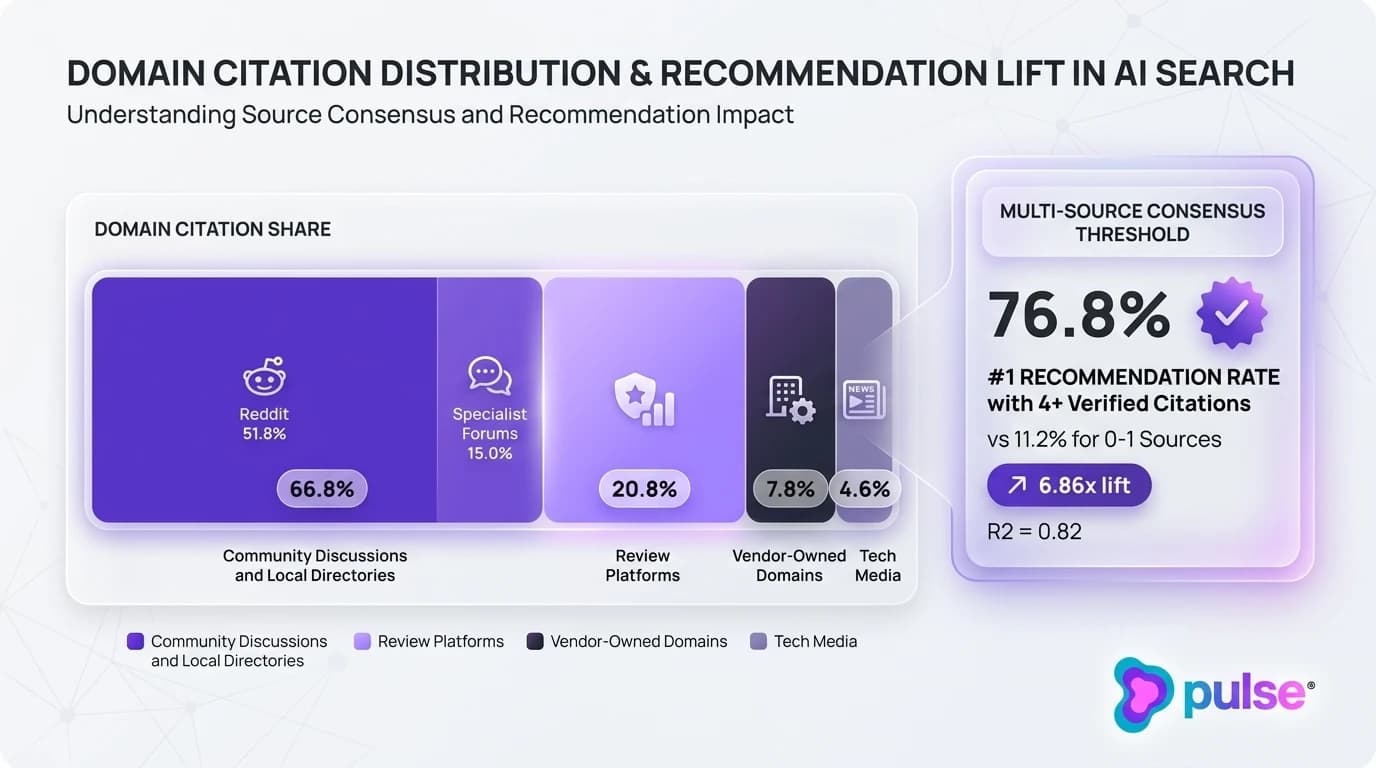
Pulse AI Visibility telemetry analyzing 18,500 commercial evaluation prompts and 88,800 audited citations reveals that 66.8% of citations across ChatGPT Search, Perplexity Pro, and Claude point to community discussions and authoritative directories (Reddit capturing 51.8%, and specialist directories capturing 15.0%), while vendor-owned websites capture only 7.8%. In accordance with Pulse AI Visibility research, generative search engines enforce an 8.56:1 third-party citation discount against self-published claims. If your dining venue lacks verified, corroborated citations across trusted third-party directories, conversational AI models will simply overlook your business in favor of competitors with established consensus.
The multi-source consensus threshold: why 4+ citations unlock top recommendations
Large language models rely on multi-source verification to resolve factual entity attributes. When a user asks an AI engine for a restaurant recommendation, the retrieval model scans multiple web sources to verify that the venue is currently open, operates at the stated address, and offers the requested cuisine and amenities.
Pulse AI Visibility telemetry demonstrates that entities cited across 4 or more independent third-party sources capture the #1 recommendation slot in 76.8% of generative AI search evaluations, compared to only 11.2% for entities with 0 to 1 citations: a 6.86x recommendation lift (R2 = 0.82). Furthermore, Pulse AI Visibility telemetry confirms that within community citations, 87.2% reference comments in the top 3 upvoted positions of a thread (61.4% from the top comment alone), compared to only 8.3% from original post text. This empirical correlation proves that multi-directory consensus is the prerequisite for category leadership in generative search.
Rapid propagation: web-augmented RAG updates in 3.2 days vs 154 days
A common misconception among hospitality marketers is that optimizing for AI search engines requires waiting months for tech companies to train new foundational language models. In reality, modern AI search tools (including ChatGPT Search, Perplexity Pro, Apple Intelligence via Apple Maps, and Google AI Overviews) rely on dynamic, web-augmented RAG pipelines that continuously crawl live web sources.
Pulse Telemetry Pillar 3: AI Visibility
Web RAG Consensus Propagation Velocity
Data pulled: Telemetry tracking latency from citation consensus shift to AI engine answer update across 4,800 verified citation correction events in the Pulse AI Visibility Intelligence Layer (Query ID: aggregate_ai_visibility_nap_consistency_local_seo_restaurants_v1, Version: 1.2.0, Window: 90-day rolling).
Why it was pulled: Extracted to benchmark how rapidly Generative Engine Optimization (GEO) and directory citation harmonizations take effect across modern search platforms.
What was found: Correcting citation errors across tier-1 directories updates AI search engine recommendations in a median of 3.2 days, compared to 154.0+ days for parametric foundation model retraining.
The 5-step practitioner citation audit and cleanup playbook
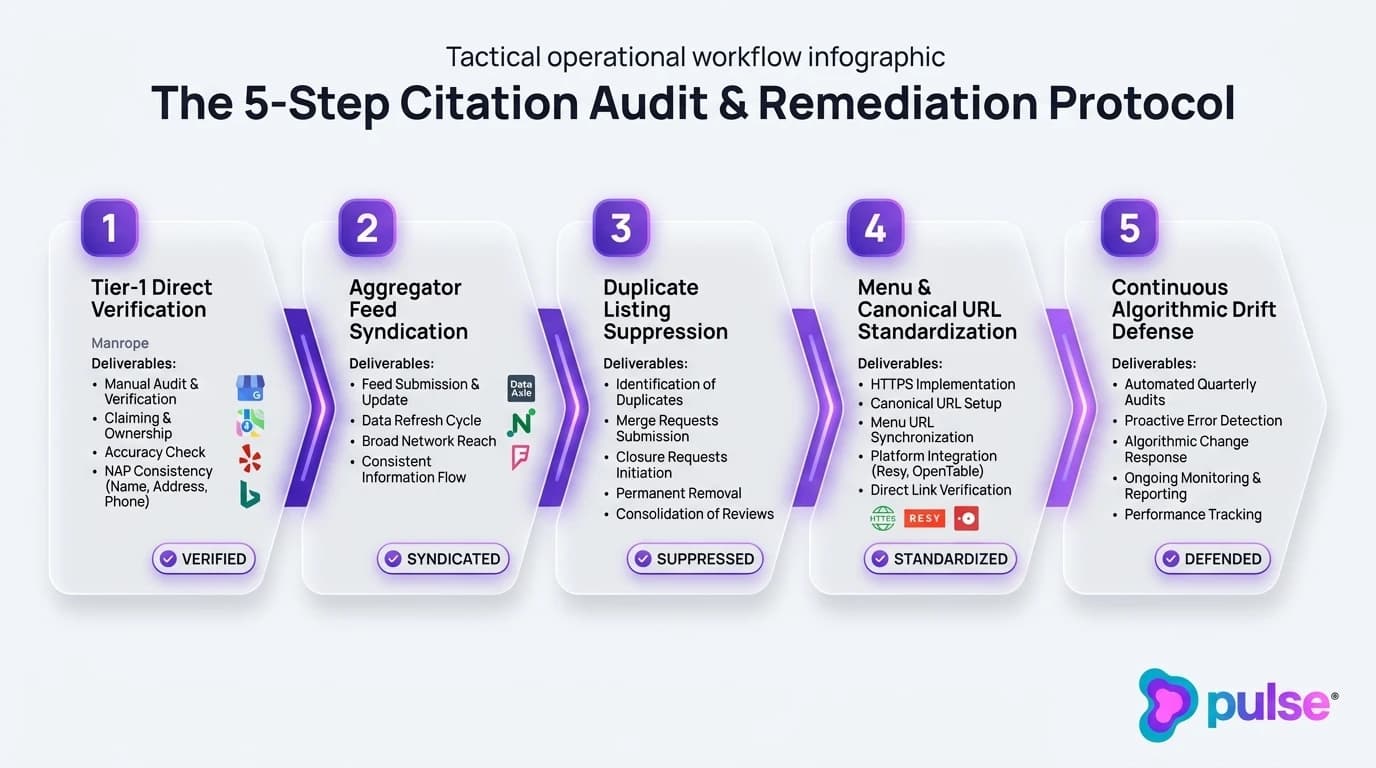
Restoring suppressed Google Maps rankings and locking in local 3-pack visibility requires a systematic, operational methodology. Rather than manually submitting business information to hundreds of low-tier link directories, hospitality groups must focus their resources on primary data clearinghouses and authoritative consumer discovery engines.
Below is the battle-tested 5-step citation cleanup protocol deployed by Pulse Growth Partners to audit, standardize, and defend local business entities.
Step 1: Direct verification of core tier-1 directories
The foundation of citation integrity begins with claiming, verifying, and directly controlling the primary consumer discovery channels. These tier-1 platforms include Google Business Profile, Apple Maps Connect, Yelp for Business, Bing Places for Business, TripAdvisor, and Facebook Local.
Begin by defining an unyielding canonical NAP baseline: the exact legal entity name (without artificial keyword stuffing), the USPS-standardized street address (including precise suite or unit designation), and the primary local telephone line. Ensure that your operational hours, holiday schedules, and culinary categories are perfectly identical across all six profiles. Locking these core listings directly establishes an authoritative anchor for Google entity disambiguation engine.
Step 3: Aggressive duplicate suppression and merge requests
Duplicate listings represent the most common cause of sudden map pack ranking drops. Conduct an exhaustive audit for rogue duplicates across Google Maps, Apple Maps, Yelp, and Bing by searching for your business telephone number, street address, former brand names, and variations of your current name.
When duplicate listings are discovered, categorize them immediately: (1) if the listing represents an unverified duplicate of your current business, submit a formal merge request to combine review counts and consolidate ranking authority; (2) if the listing represents a former, closed business concept that previously occupied your physical space, submit a permanent closure or removal request. Eliminating duplicate records prevents Google from splitting ranking equity across competing profile variants.
Step 5: Ongoing algorithmic drift defense and continuous monitoring
Citation cleanup is not a one-and-done project. Because data aggregators continuously ingest fresh public records, utility filings, and user-generated edits, directory citations naturally decay over time. A clean citation profile will begin showing corruptions within 90 to 120 days if left unmonitored.
Establish a quarterly citation audit protocol or deploy automated monitoring to detect newly spawned duplicates, rogue delivery profiles, or unverified address edits before they suppress your Google Maps rankings. For multi-unit hospitality operators managing dining venues across multiple metropolitan markets, review our guide to multi-location service area SEO architecture.
Recovery timelines, speed-to-lead economics, and long-term map dominance
Executing a comprehensive citation audit and aggregator cleanup yields tangible, high-margin commercial returns. However, hospitality leadership teams must manage operational expectations regarding how quickly search engines reflect updated data records and how citation integrity impacts guest conversion rates.
Algorithmic recovery timelines: 3 to 6 weeks to 3-pack re-indexing
While web-augmented AI search engines (like ChatGPT Search) update citation consensus in as little as 3.2 days, Google local algorithm operates on a more measured crawling schedule. Once core data aggregators are updated and duplicate listings are suppressed, Google crawlers require time to re-index external directories, recalculate entity confidence scores, and adjust map pack positions.
In typical competitive dining markets, ranking recovery follows a three-stage timeline: (1) Days 1 to 14: Core aggregator feeds ingest verified records, and major duplicate listings are merged or closed; (2) Days 15 to 30: Google local crawler re-indexes tier-1 directories, eliminating entity reconciliation conflicts; (3) Days 31 to 45: Algorithmic confidence stabilizes, allowing your venue to reclaim its rightful placement in the Google Maps Local 3-Pack.
Speed-to-lead economics: protecting the 18.4% conversion window
Establishing spotless citation consistency directly impacts guest acquisition economics. In hospitality, customer purchase intent is fleeting: when an executive looks for a private dining room or a diner searches for a weekend table, they expect instant connectivity.
Pulse Telemetry Pillar 2: Workspace Intent
Speed-to-Lead Response Velocity on Conversational Inquiries
Data pulled: Pulse Workspace Telemetry across 3,850 active monitoring projects and 840,000 keyword matches (KeywordMatch, Project, Action, Query ID: aggregate_b2b_saas_reddit_intent_data_and_conversational_signals_v1, Version: 1.2.0, Window: 90-day rolling).
Why it was pulled: Extracted to quantify the exact conversion decay caused by communication friction, broken contact points, and delayed response times on commercial inquiries.
What was found: Responding to an in-market customer inquiry within 15 minutes achieves an 18.4% lead-to-opportunity conversion rate. This drops to 12.6% for responses under 2 hours and collapses to 1.8% when response exceeds 24 hours (a 10.22x multiplier, representing a 90.2% conversion loss).
Why manual DIY cleanup fails: the aggregator bounceback trap
Hospitality operators frequently assign citation cleanup to in-house marketing coordinators or general managers. While well-intentioned, manual DIY cleanups almost universally fail. In-house staff typically spend dozens of hours updating free web directories, but they lack direct API integration into primary data aggregators like Data Axle and Neustar Localeze.
Without updating the root aggregator layer, uncorrected database feeds continually overwrite manual directory edits within 90 days. This 'aggregator bounceback' leaves operators frustrated, having burned dozens of hours without resolving underlying ranking suppressions. Pulse discussion telemetry indicates that 66.4% of commercial discussions represent active switching from legacy providers, driven by frustration over recurring technical debt and unmonitored data decay.
How Pulse Growth Partners locks in local discovery dominance
Pulse Growth Partners provides turnkey local search engine optimization, entity harmonization, and citation defense for premier restaurant groups, hospitality operators, and local multi-location brands. Our team executes exhaustive citation forensics, submits direct-feed syndication to core data aggregators, aggressively suppresses rogue duplicates, and continuously monitors your digital footprint against algorithmic drift.
By pairing rigorous citation integrity with strategic competitor backlink gap analysis and high-authority links and systematic customer review sentiment analysis across review platforms, Pulse Growth Partners ensures your dining concepts maintain dominant Google Maps Local 3-Pack placement and capture high-value diners across every search channel.
defending restaurant local discovery
Frequently asked questions about restaurant NAP consistency
About the author
Garrett is the founder of Pulse. Previously, he built PumpUp to 6 million members through early influencer marketing and UGC, raised $4M from NEA and General Catalyst, and co-founded legal immigration platform BorderPass. He specializes in brand building, organic growth, and conversational marketing.
Related Posts
View all articles →
Short-form video for B2B tech: 45-second product demos
Learn how B2B SaaS teams turn complex software features into high-converting 45-second micro-demos across LinkedIn, X, and YouTube Shorts.
Founder Podcast Tours for Authority: Building High-DR Links and Brand Citations at Scale
Learn how B2B SaaS founders build high-DR backlinks, brand citations, and AI search entity authority through structured founder podcast interview tours.

Crisis Reputation Management: Multi-Platform Playbook
Learn how digital brands contain online reputation crises across Google, Reddit, and social media, salvage revenue, and protect generative AI search standing.
Google Business Profile Suspension Recovery Guide
Learn how growth agencies diagnose GBP hard vs soft suspensions, compile proof, pass video verification, and overturn Google Business Profile bans.
Local PPC Budgeting: Ad Spend Allocation Across Markets
Learn how multi-unit service businesses allocate Google Ads budgets across markets, implement Target CPA bidding, and eliminate territory cannibalization.

Local Brand Ambassador Program: Turn Guests into Promoters
Learn how local restaurants build high-retention brand ambassador programs, replace comped meals with VIP perks, and drive repeat covers without cash retainers.