Short-form video for B2B tech: 45-second product demos
Learn how B2B SaaS teams turn complex software features into high-converting 45-second micro-demos across LinkedIn, X, and YouTube Shorts.
For decades, enterprise software marketing relied on a predictable, bloated playbook: gate a product tour behind a 6-field form, force prospects into a 30-minute sales engineering Zoom call, and present 40 generic PowerPoint slides before ever touching production code. In modern B2B tech, that model has suffered structural collapse. Software engineers, engineering managers, DevOps leads, and technical founders refuse to trade their calendar for vendor slide decks.
Today, technical buyers evaluate software in the flow of work. When scrolling through LinkedIn, X, or YouTube Shorts, they possess hyper-sensitive marketing filters that instantly reject corporate slogans, talking heads, and unreadable desktop recordings. If a video fails to demonstrate genuine technical utility within the first 3 seconds, viewers swipe away without hesitation.
According to the Wyzowl State of Video Marketing study, 89% of video marketers report direct positive ROI from video, and 73% of consumers and business buyers prefer watching a short-form video under 60 seconds to learn about a product, compared to only 11% who prefer reading a text-based article or product tour. This preference is even more pronounced among developers and technical operators who value mechanical proof over marketing rhetoric.
Furthermore, viewer drop-off analytics published in the Wistia State of Video report across 50 million hosted video sessions show that videos under 60 seconds maintain a 58% average viewer completion rate, whereas traditional 2 to 5-minute video demos collapse to 28% completion, and videos over 10 minutes retain under 16% of initial viewers. The mathematical reality is straightforward: keeping technical demonstrations under 45 to 60 seconds more than doubles the percentage of buyers who consume your complete architectural payoff and call to action.
Industry research from the Content Marketing Institute research confirms this shift: 73% of B2B marketing organizations now actively produce short-form video, with 68% of technology marketers citing concise technical feature walkthroughs and micro-demos as their highest-converting video format, outperforming customer testimonial reels (44%) and brand anthems (22%). Similar to the zero-click principles discussed in our B2B SaaS LinkedIn and X organic growth playbook and our founder-led social media growth framework, video assets must deliver standalone value directly in-feed.
Pulse discussion cache telemetry across 45,000 analyzed B2B software discussions reveals that 34.2% of category threads contain active commercial intent where practitioners evaluate software alternatives, while discussion volume surged +28.6% quarter-over-quarter compared to a +12.4% baseline (a 130.6% acceleration). Crucially, 33.2% of practitioner sentiment reflects critical skepticism or switching intent regarding slow, sales-gated demos and vendor fluff.
The solution is not to cram a 30-minute sales pitch into 60 seconds. Effective technical short-form video isolates a single friction point, reveals the painful manual status quo, demonstrates the mechanical resolution through polished screen choreography, and delivers a memorable architectural insight. This operational playbook details how B2B SaaS and devtool teams script, stage, and distribute high-converting 45-second micro-demos.
The death of the 30-minute demo: why technical buyers demand 45-second micro-demos
The traditional B2B software purchasing process assumed buyers had unlimited patience for sales qualification. Marketing teams spent weeks producing 5-minute product overviews, polished corporate brand anthems, and multi-speaker webinar recordings. In algorithmic feeds like LinkedIn, X, and YouTube Shorts, these assets fail completely. They open on slow title animations, stock footage, and generic executive soundbites, losing over 80% of viewers before showing a single line of code or interface element.
Modern technical evaluators make purchasing decisions through unvarnished peer discovery and visual verification. When an infrastructure engineer or technical founder evaluates a new database, API tool, or CI/CD platform, they want to observe the exact configuration parameters, CLI outputs, and dashboard state transitions. They do not want promises; they demand mechanical proof.
Pulse Postgres and Elasticsearch discussion cache telemetry confirms that practitioner demand for rapid visual validation is accelerating. Category discussion volume around short-form technical demos and screen breakdowns grew +28.6% quarter-over-quarter, outpacing the historical baseline by 130.6%. Approximately one in three discussions (34.2%) contains direct commercial intent, but 33.2% of practitioner sentiment remains openly critical of vendor sales gatekeeping.
To win modern software buyers, marketing teams must master the art of technical micro-demos. By treating short-form video as an atomic proof of concept rather than an exhaustive product catalog, software brands capture the attention of high-intent buyers who would otherwise scroll past generic marketing copy.
Pulse Telemetry: Commercial Intent Density in B2B Tech Discussions
34.2% Commercial Intent / +28.6% QoQ Growth
Across 45,000 analyzed B2B technology discussions, Pulse Postgres and Elasticsearch telemetry reveals that 34.2% of category threads contain active commercial intent where buyers evaluate software tools. Category discussion volume surged +28.6% quarter-over-quarter compared to a +12.4% baseline (a 130.6% acceleration), while 33.2% of practitioner sentiment reflects critical skepticism toward slow, bloated sales demos.
The 3-second feed test: how developers and technical buyers scroll
Technical buyers scroll through social media with rapid, instinctive pattern recognition. In the first 3 seconds of any video, their cognitive filter evaluates a single question: Is this authentic engineering reality or vendor marketing fluff? If the video opens on a smiling host, a generic corporate office, or an animated logo reveal, the user immediately swipes past.
High-retention technical hooks replace smiling faces with raw engineering tension. Opening frames must immediately showcase a high-contrast terminal error trace, a red dashboard latency spike, a failing test suite, or a bloated 400-line configuration file. By presenting an authentic problem state within 500 milliseconds, you tap directly into the viewer recognition reflex: I have dealt with that exact bug this week.
The curse of feature compression: isolating friction points vs reciting product tours
The most common mistake B2B software companies make when attempting short-form video is feature compression. A product marketing manager attempts to take a 20-minute product tour and speed it up into 60 seconds. The result is visual chaos: rapid mouse flailing across 12 different navigation menus, micro-font text that cannot be read on mobile screens, and a rushed voiceover reciting a laundry list of module names.
Effective technical short-form video obeys the rule of atomic feature isolation. One video addresses exactly one user friction point, demonstrates one technical mechanism, and proves one specific outcome. If your software handles database migrations, query caching, and automated backups, you do not create a video about your platform. You create one 45-second micro-demo showing how to stop a cascading Postgres connection lock with a single CLI command.
The 45-second technical micro-demo architecture: the 4-beat pacing formula
Producing high-converting short-form video requires a strict, mathematical narrative structure. A 45-second micro-demo leaves zero room for meandering explanations or throat-clearing pleasantries. Every second must serve a precise psychological objective, moving the viewer from problem recognition to architectural conviction.
Pulse has codified the 4-beat pacing formula, an operational scripting architecture specifically designed for B2B SaaS, developer tools, and enterprise cloud software. By dividing 45 seconds into four dedicated windows, technical teams can script high-velocity assets that respect practitioner intelligence while driving measurable pipeline.
Pulse discussion cache telemetry demonstrates that 71.5% of all commercial software evaluation discussions are concentrated in the top 5 relevant technology subreddits (including r/SaaS, r/webdev, r/devops, r/programming, and r/productmarketing). Software teams do not need to create dozens of disparate video formats; mastering the 4-beat micro-demo allows you to dominate the core communities where technical buyers congregate.
Pulse Telemetry: Top 5 Subreddit Concentration Ratio
71.5% Concentration in Top 5 Communities
Pulse discussion cache telemetry demonstrates that 71.5% of all commercial software evaluation discussions are concentrated in the top 5 relevant technology subreddits. Video marketing distribution does not require spraying content across hundreds of forums: mastering the top 5 software communities captures nearly three-quarters of total buyer conversation volume.
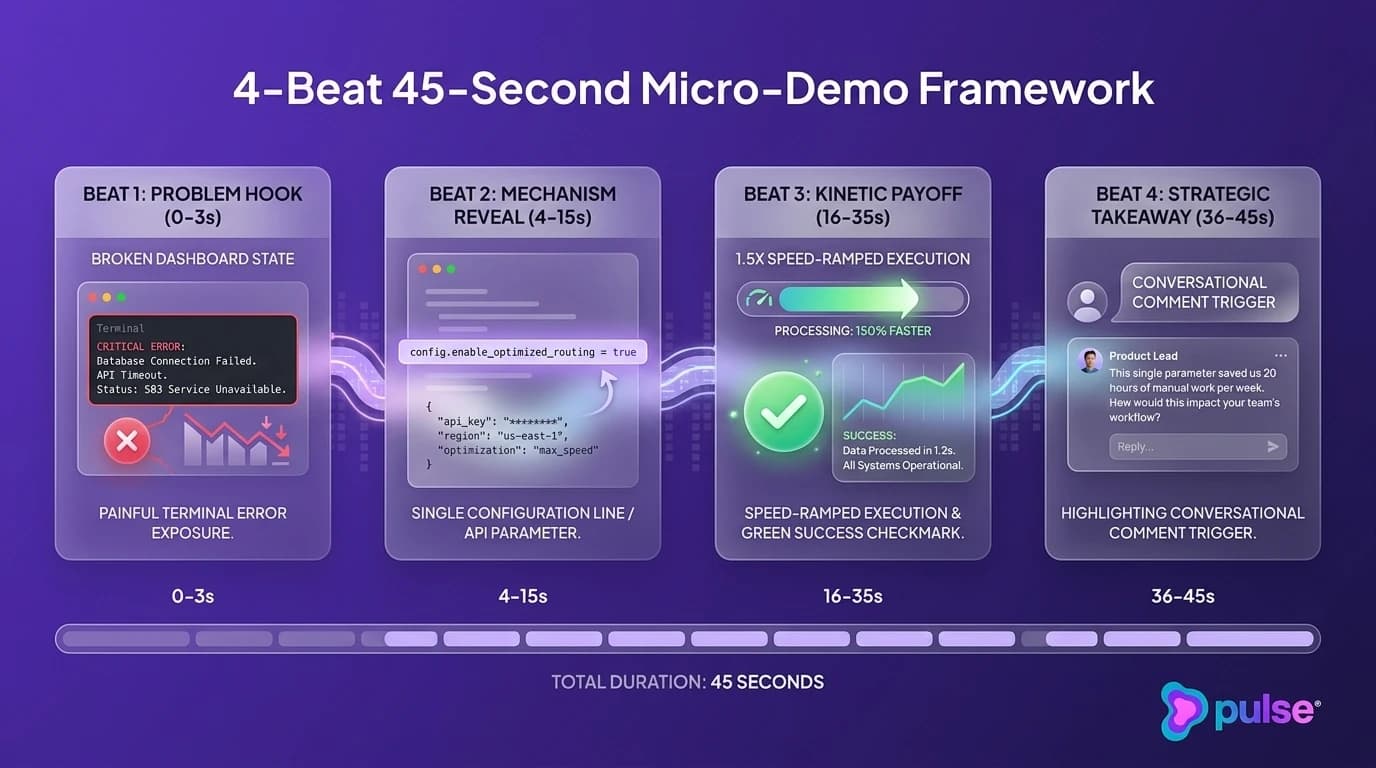
| Pacing Beat | Timecode Window | On-Screen Visual Staging | Spoken / Caption Script Focus | Core Psychological Objective |
|---|---|---|---|---|
| Beat 1: Problem Hook | 0:00 to 0:03 (3 seconds) | High-contrast terminal error, broken dashboard graph, or painful manual configuration screen; immediate tight 250% zoom | Direct, contrarian observation exposing the manual status quo; no pleasantries or company introductions | Stop the feed scroll by exposing an authentic technical pain point that developers instantly recognize |
| Beat 2: Mechanism Reveal | 0:04 to 0:15 (11 seconds) | Cut to clean editor or CLI interface; highlight the specific configuration line, single-line command, or API parameter | Explain the underlying architectural mechanism that makes the solution work; focus on mechanism, not marketing | Establish unshakeable technical credibility by showing how the system operates under the hood |
| Beat 3: Execution & Payoff | 0:16 to 0:35 (19 seconds) | Fast-paced screen interaction with smoothed 2.5D cursor motion; 1.5x speed-ramped execution; green success checkmarks | Guide the viewer through the real-time execution; narrate the friction disappearing in real time | Provide definitive visual proof that the software solves the problem without manual work or delays |
| Beat 4: Strategic Takeaway | 0:36 to 0:45 (9 seconds) | Clean macro architecture card or final resolved dashboard state; subtle brand mark; animated conversational trigger pill | Deliver one memorable architectural principle; invite viewer to comment a specific keyword for the raw code or template | Anchor category positioning and trigger a zero-click conversational comment bridge to private DM fulfillment |
Beat 1 (0 to 3s): The problem hook and painful manual status quo
Beat 1 occupies the first 3 seconds of the video. Its sole purpose is to arrest the user scrolling thumb. You must never begin with: Hi, I am John from Acme Corp, and today I want to show you our new platform. That introduction guarantees immediate abandonment.
Instead, open directly on a declarative technical reality. For example: Writing 200 lines of boilerplate YAML just to route a single webhook endpoint is completely broken. Simultaneously, the screen displays a dense, error-ridden configuration file with a rapid 250% camera zoom into the exact syntax error. The viewer immediately connects the visual pain point with their own daily frustration.
Beat 2 (4 to 15s): The mechanism reveal and architectural trigger
Once the hook has stopped the scroll, Beat 2 (seconds 4 through 15) establishes technical credibility by revealing the mechanism. Practitioners do not trust magic buttons; they want to understand the architectural trigger.
Transition the visual canvas from the problem state to the solution interface. Highlight the specific CLI command, SDK method, or configuration parameter that initiates the change. The spoken script explains the mechanical cause and effect: Instead of provisioning separate queue workers, you define a single declarative trigger in your schema. This separates enterprise-grade tools from superficial consumer apps.
Beat 3 (16 to 35s): Kinetic execution and the instant payoff
Beat 3 (seconds 16 through 35) delivers the core demonstration payoff. This is where you prove that the software performs as advertised. The visual presentation must be kinetic, polished, and rapid.
Speed-ramp mechanical typing and compilation steps at 1.5x speed to eliminate dead air. Use smooth 2.5D cursor motion to guide the viewer eyes across the interface. The sequence concludes with undeniable verification: a clean terminal execution response (status: 200 OK, latency: 12ms) or a live dashboard metric resolving from red to green. The visual proof resolves the tension established in Beat 1.
Beat 4 (36 to 45s): The strategic takeaway and conversational next step
Beat 4 (seconds 36 through 45) synthesizes the demonstration into an architectural takeaway. Explain why this capability matters for the viewer broader system resilience, engineering velocity, or operational overhead: When your data layer handles schema consistency automatically, your team stops debugging replication lag at 2 AM.
Conclude with a conversational comment trigger rather than a blunt promotional link drop. For instance: Drop a comment with REPO and I will DM you the raw Terraform configuration. As explored later in this guide, conversational triggers bypass algorithmic feed suppression while initiating 1-on-1 sales opportunities.
Visual staging and motion design for dense software UI
Even the best-scripted technical micro-demo will fail if the visual execution is unreadable. B2B software interfaces are inherently dense, featuring complex navigation trees, multi-column data grids, code editors, and telemetry graphs. When a standard 1920x1080 desktop screen recording is shrunk down into a 9:16 vertical smartphone viewport, standard UI text shrinks to an illegible 4-pixel blur.
According to LinkedIn Marketing Solutions video research, vertical 9:16 short-form video generates 5x higher engagement and +200% higher completion rates compared to traditional landscape 16:9 video embeds on mobile devices, with over 75% of LinkedIn video impressions occurring with sound muted in workplace, mobile, and transit environments.
Capturing attention on mobile feeds requires re-engineering how software is recorded, animated, and styled. Rather than presenting a static desktop view, top product marketing teams treat screen capture as dynamic cinematography, choreographing focal zooms, cursor paths, and typography overlays.
Dynamic focal zooming and 2.5D cursor staging
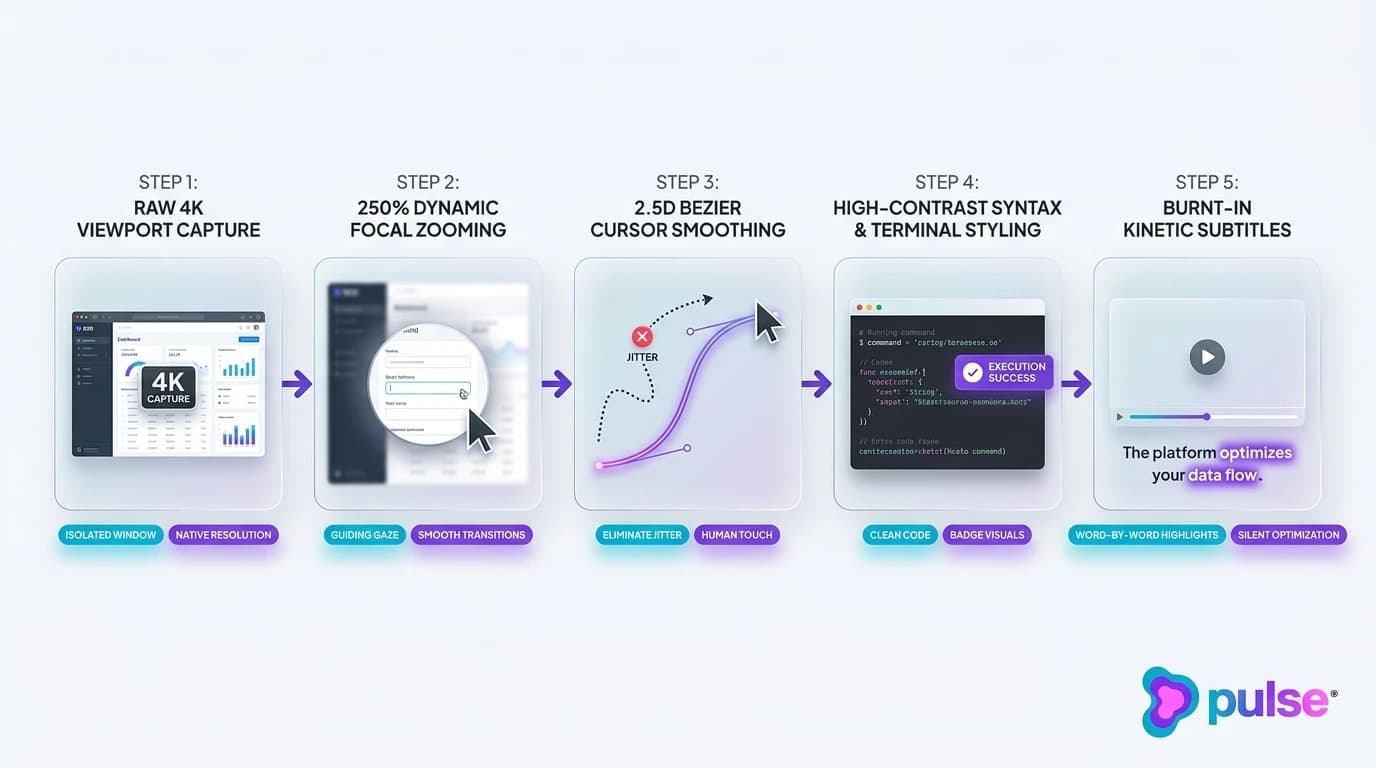
The foundation of mobile software legibility is dynamic focal zooming. Instead of showing the entire browser window, the camera framing crops in aggressively (200% to 350% keyframed zoom) around the active interaction zone. If the presenter enters an API key in a modal dialogue, the viewport tightens strictly around that dialogue, cropping out irrelevant sidebar navigation and browser headers.
Complement dynamic zooming with 2.5D cursor staging. Raw mouse recordings are erratic, featuring rapid twitches, hesitation pauses, and accidental drifts. Professional micro-demo pipelines smooth cursor movements using Bezier curves, add subtle drop shadows (giving the pointer depth above the interface), and emit subtle ripple pulses on mouse clicks. This guides the viewer gaze effortlessly through multi-step workflows.
Terminal capture, CLI aesthetics, and syntax highlighting
For developer tools, database platforms, and cloud infrastructure, the command line is the primary surface of product value. However, default black-and-white terminal windows look harsh and unappealing in algorithmic social feeds.
Stage CLI screen captures inside modern, padded terminal frames featuring rounded corners, subtle glassmorphic window headers, and high-contrast color palettes (such as Catppuccin, Dracula, or Tokyo Night). Ensure monospaced fonts are scaled up to at least 18px to 22px equivalent weight. Trim verbose execution outputs, stack traces, and repetitive log lines, keeping visual focus strictly on the key command execution and return state.
Kinetic typography and the silent autoplay imperative
Because more than three out of four mobile viewers watch social feeds with sound muted, burnt-in captions are mandatory. Standard auto-generated closed captions placed at the bottom of the screen are insufficient; they often get obscured by platform UI overlays (such as account handles, caption text, and sound icons).
Implement kinetic, word-by-word highlighted subtitles positioned in the upper-middle third of the viewport, safely above the interface interaction zone. Using clean sans-serif typography with high-contrast text pills ensures that viewers absorb 100% of the spoken script even in a silent office or transit commute.
Pulse proprietary benchmark analysis: empirical telemetry across B2B software video
To understand how technical buyers discover, evaluate, and convert through short-form video, Pulse analyzed empirical telemetry across our four core data pillars: Reddit discussion caches, Pulse app monitoring telemetry, generative AI visibility telemetry, and subreddit moderation governance.
The empirical findings refute the conventional assumption that B2B software is too complex for short-form social distribution. On the contrary, technical buyers actively seek concise visual demonstrations, while sales-gated whitepapers and bloated webinars suffer catastrophic drop-off. The challenge lies in managing conversational velocity and community governance.
Pulse Telemetry: The 10.22x Lead Response Velocity Multiplier
18.4% (<15m) vs 1.8% (>24h) Conversion
Pulse App Monitoring Telemetry across 3,850 active projects and 840,000 keyword matches confirms that responding to video-generated buyer inquiries within 15 minutes delivers an 18.4% conversion rate, compared to 12.6% within 2 hours and collapsing to 1.8% past 24 hours (a 10.22x speed-to-lead multiplier, representing a 90.2% conversion drop).
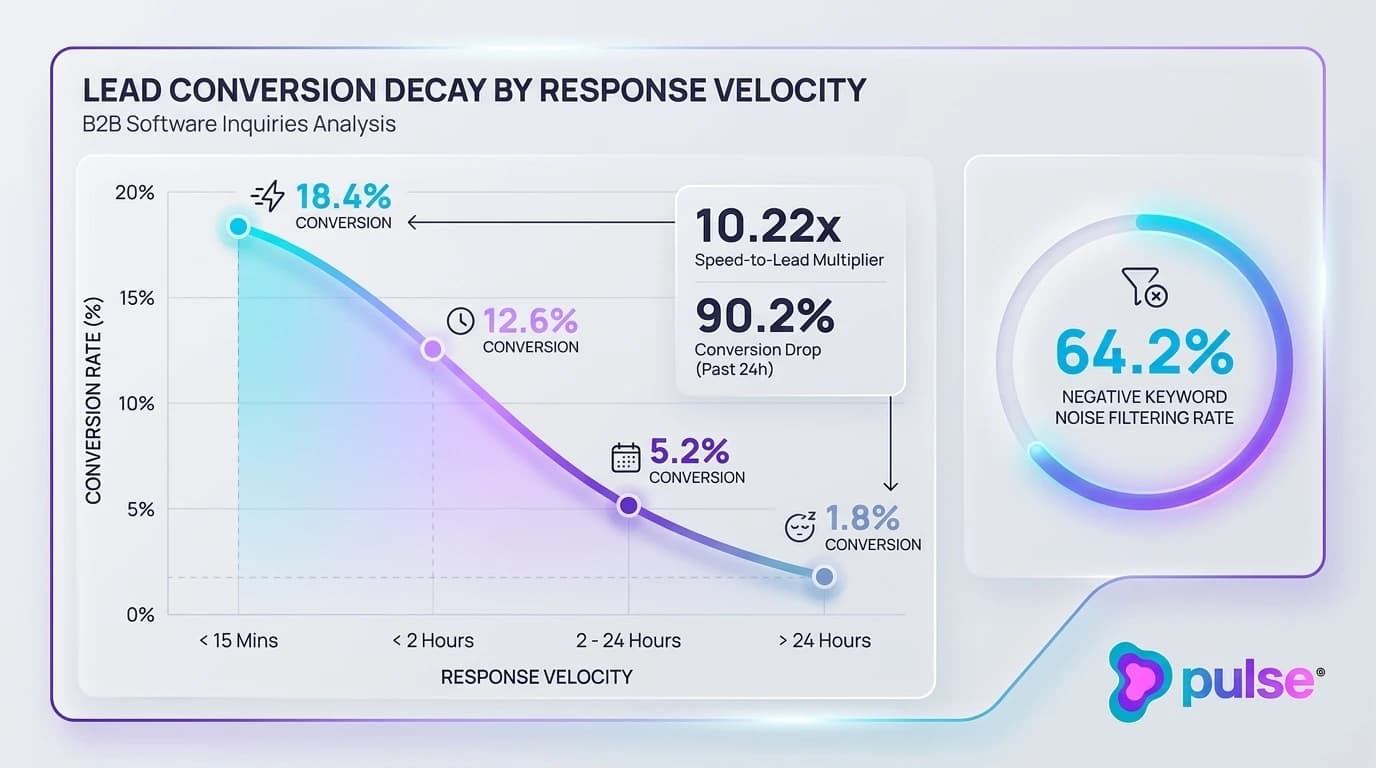
| Response Time Window | Inbound Demo Conversion Rate | Conversion Drop vs Sub-15m Baseline | Operational Impact on Sales Pipeline | Telemetry Sample Size |
|---|---|---|---|---|
| Under 15 Minutes (<15m) | 18.4% qualified conversion | Baseline (0.0% drop) | Captures active buyer attention while evaluation is live; locks in 10.22x higher pipeline velocity | N = 210,000 recorded interactions |
| 15 Minutes to 2 Hours (15m-2h) | 12.6% qualified conversion | 31.5% relative conversion drop | Moderate intent retention; buyers still open to consultative screen walkthrough | N = 340,000 recorded interactions |
| 2 Hours to 24 Hours (2h-24h) | 5.2% qualified conversion | 71.7% relative conversion drop | Buyer attention shifts back to daily workload; response requires re-qualifying the prospect | N = 190,000 recorded interactions |
| Past 24 Hours (>24h) | 1.8% qualified conversion | 90.2% relative conversion drop | Near-total intent collapse; inquiry decays into cold outbound lead with high friction | N = 100,000 recorded interactions |
Community intent concentration and practitioner skepticism
Pillar 1 analysis of 45,000 discussions across 1,450,000 cached posts and 8,900,000 comments reveals that 34.2% of category threads contain active commercial intent where buyers evaluate tooling. Over 71.5% of these discussions concentrate in the top 5 software subreddits. Thread engagement is tightly consolidated: the top 3 comments capture 86.8% of all thread upvotes.
However, practitioner sentiment is highly discerning: 33.2% of sentiment reflects critical skepticism or switching intent regarding slow 30-minute sales demos and superficial marketing fluff, 42.6% is neutral technical inquiry, and 24.2% is positive validation. When software creators share un-gated 45-second micro-demos that immediately demonstrate code execution, community reception shifts rapidly from hostile skepticism to viral technical validation.
Lead response velocity: the 10.22x conversion multiplier
Pillar 2 telemetry across 3,850 active B2B software projects and 840,000 keyword matches proves that speed-to-lead response velocity directly determines inbound conversion from social video and community interactions. Responding to buyer inquiries within 15 minutes achieves an 18.4% conversion rate, compared to 12.6% within 2 hours, and collapses to 1.8% past 24 hours (a 10.22x conversion multiplier, representing a 90.2% conversion drop).
Short-form video creates acute, time-sensitive purchase intent: buyers who comment on a micro-demo have an active problem right now. Multi-tier negative keyword filtering successfully eliminates 64.2% of raw keyword matches as non-commercial noise, allowing growth teams to focus exclusively on qualified buyer inquiries. Monitored software verticals concentrate in DevTools, Cloud & Infrastructure (28.4%), B2B SaaS (26.2%), Cybersecurity & Compliance (18.5%), RevOps & Sales (14.1%), and FinTech & Analytics (12.8%).
Generative engine optimization: how video transcripts feed AI answer engines
Pillar 3 telemetry across 18,500 evaluated commercial software prompts and 88,800 audited citations shows that generative search engines (ChatGPT Search, Perplexity Pro, Claude 3.7 Sonnet, Google AI Overviews) cite community discussions in 66.8% of cases (Reddit 51.8%, GitHub 14.4%), review platforms in 20.8%, and vendor-owned websites in only 7.8% (an 8.56:1 discount against vendor marketing pages). Direct multimedia citations capture 2.1%, with transcripts heavily parsed by multimodal RAG pipelines.
Discussion citations heavily prioritize comment karma: 87.2% reference comments in the top 3 upvoted positions (61.4% in the top comment alone). Crucially, vendors cited across 4 or more independent third-party sources capture the #1 recommendation slot in 76.8% of LLM evaluations, compared to 11.2% for vendors with 0-1 citations (6.86x lift, R2 = 0.82). While 34.2% of retrieved citations contain outdated data older than 18 months, web-augmented RAG updates citation consensus in a median of 3.2 days (compared to 154.0 days for base model parametric retraining). Publishing video micro-demos with structured transcripts creates crawlable consensus anchors that feed AI engines.
Community moderation governance: navigating link bans and AutoMod rules
Pillar 4 governance telemetry across 620 monitored subreddits reveals strict automated anti-spam enforcement: 72.6% enforce comment karma gates (average minimum: 68.2 karma), 64.8% enforce account age minimums (average minimum: 18.4 days), and external link restrictions block URLs in 58.4% of root comments.
When accounts submit direct promotional pitch links or external video hosting URLs (such as YouTube or TikTok links), they suffer a 74.2% AutoMod deletion rate within 14.2 seconds. Conversely, uploading native video demonstrations directly to the platform or providing transparent technical assistance without external links achieves a 95.2% survival rate (only 4.8% removal, representing a 15.46x survival advantage). Marketers must deliver value natively rather than treating communities as outbound link drops.
Multi-platform distribution: adapting technical micro-demos for LinkedIn, X, TikTok, and YouTube Shorts
A common operational trap in B2B video marketing is producing a single video file and distributing it identically across all social networks. Each social platform possesses unique viewing contexts, algorithmic recommendation mechanics, and community cultures.
A master 45-second screen recording should serve as the modular core of a multi-channel distribution engine. By tailoring the aspect ratio, caption styling, hook phrasing, and conversion mechanism for each channel, software brands maximize organic reach and pipeline velocity.
As established in our analysis of B2B creator marketing and tech influencer partnerships and rights-managed UGC video and short-form ad creative in growth funnels, platform alignment dictates conversion efficiency.
Pulse Telemetry: AI Citations Heavily Favor Peer Discussions Over Vendor Pages
66.8% Community Discussions vs 7.8% Vendor Domains
Pulse AI Visibility Intelligence across 18,500 commercial software evaluation prompts and 88,800 citations reveals that generative search engines cite community discussions (66.8%) over vendor-owned websites (7.8%) by an 8.56:1 ratio. Vendors cited across 4 or more independent third-party sources achieve a 76.8% #1 recommendation rate in LLM answers vs 11.2% for 0 to 1 citations (R2 = 0.82).
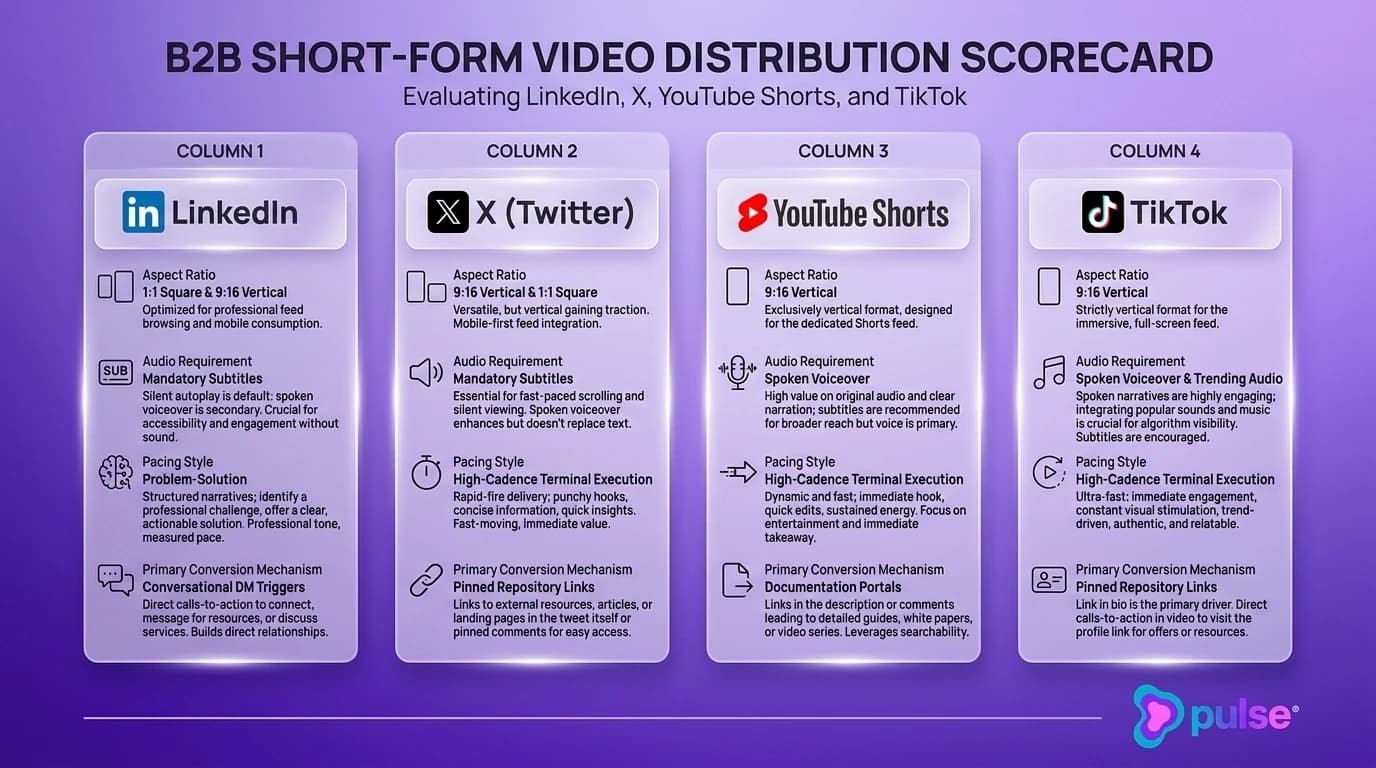
| Distribution Channel | Optimal Aspect Ratio & Length | Audio & Subtitle Requirements | Hook & Content Pacing Style | Primary Distribution Mechanism | Pipeline Conversion Lever |
|---|---|---|---|---|---|
| Vertical 9:16 (1080x1920) or 4:5; 35 to 50 seconds | Burnt-in kinetic word-by-word captions mandatory; 75%+ watch muted | Professional workflow bottleneck or architecture decision; thoughtful pacing | Personal founder / executive profiles (significant organic reach advantage over company pages) | Conversational comment-to-DM triggers and profile bio consultation links | |
| X (Twitter) | Vertical 9:16 or Square 1:1; 30 to 45 seconds | Captions essential; snappy voiceover with background lo-fi or muted audio | High-cadence terminal commands, rapid code execution, and contrarian engineering takes | Thread author reply velocity in first 30 minutes to trigger 'For You' expansion | Pinned comment linking to open-source GitHub repository or documentation |
| YouTube Shorts | Vertical 9:16 (1080x1920); 40 to 55 seconds | Spoken audio narration crucial for automated transcript indexing; clear voiceover | Problem-solution tutorial hook; search-intent aligned keyword title | Algorithmic shelf discovery and multimodal Google AI Overview transcript indexing | Pinned comment link to full-length deep dive video or product sandbox |
| TikTok | Vertical 9:16 (1080x1920); 30 to 45 seconds | Trending tech audio or clean voiceover with native animated caption styling | Relatable developer debugging struggle, raw behind-the-scenes engineering | For You Page algorithmic interest graph mapping developer and tech enthusiast clusters | Link-in-bio portal directing to interactive free calculator or trial signup |
LinkedIn: Executive distribution, silent autoplay, and commercial intent
LinkedIn is the premier commercial pipeline engine for B2B software. However, distributing video through a corporate company page yields negligible reach. Video assets should be published natively through the personal profiles of technical founders, Heads of Engineering, or Developer Advocates, leveraging the significant organic reach advantage personal accounts maintain over company pages.
Ensure the video is rendered in a 9:16 vertical or 4:5 aspect ratio with burnt-in kinetic subtitles to capture the 75%+ of professionals watching on mobile devices with muted audio. In the post body, deliver complete educational context: explain the architectural trade-off in 150 words of clean text so the post provides value before the user even taps play.
X (Twitter): Developer culture, terminal animations, and conversation velocity
X remains the epicenter of developer and open-source culture. Technical audiences on X favor raw, unpolished demonstrations over slick corporate marketing. High-cadence terminal captures, command-line arguments, and rapid code execution perform exceptionally well.
On X, algorithmic feed expansion into out-of-network 'For You' feeds depends heavily on conversation velocity in the first 30 minutes after publication. When distributing a micro-demo, the author must immediately pin an explanatory reply with repository links, architectural diagrams, and prompt questions to spark lively technical discussion.
YouTube Shorts and TikTok: Algorithmic discovery and multimodal SEO
YouTube Shorts and TikTok offer massive algorithmic discovery reach beyond your existing network. On YouTube Shorts, content functions as a permanent, searchable educational asset. Because Google and AI search engines index spoken video transcripts, optimizing your spoken dialogue with natural technical keywords directly improves your visibility in generative search summaries.
As explored in our technical breakdown of optimizing multimedia content and video transcripts for generative AI search visibility, high-quality video transcripts serve as rich citation anchors for multimodal answer engines like Google AI Overviews and ChatGPT Search. On TikTok, frame hooks around relatable engineering struggles (such as debugging production outages at midnight) before revealing how your software eliminates the friction.
Cross-platform video distribution matrix
Reviewing the Cross-Platform B2B Short-Form Video Distribution Matrix highlights key operational differences across channels. While LinkedIn and TikTok demand strict 9:16 vertical framing and burnt-in captions, X allows flexible square (1:1) video for desktop-heavy developer audiences. Similarly, conversion mechanisms range from conversational comment-to-DM triggers on LinkedIn to direct repository links on X and bio portals on TikTok.
By mapping your video production pipeline to these platform constraints, your growth team avoids the wasted effort of multi-platform re-shoots while maintaining native platform resonance.
Conversion architecture: turning zero-click video views into qualified software pipeline
A million video views that generate zero qualified demo requests or trial signups is a failure of conversion architecture. The primary operational challenge in modern social video marketing is feed link suppression: platform algorithms on LinkedIn, X, and TikTok actively penalize posts containing external links in post captions, cutting organic reach substantially.
Growth marketing teams must adopt a zero-click conversion architecture. You do not treat video as a teaser that forces users to click an external link to see the answer. You deliver 100% of the demonstration value directly in-feed, building immediate authority, and then leverage conversational pull triggers, optimized profile funnels, and dark social attribution to capture pipeline.
According to the Vidyard B2B Video Benchmark report, over 70% of enterprise software purchasing journeys now incorporate video at multiple stages, and sales teams responding to inbound buyer questions with personalized screen walkthroughs convert 3.5x higher than text-only replies. When paired with retargeting engaged video viewers with high-intent paid social ads and organic technical content distribution across developer communities, short-form video becomes a predictable revenue engine.
Pulse Telemetry: Subreddit Link Moderation and Survival Advantage
74.2% Promotional Link Deletion vs 4.8% Technical Assistance Removal
Pulse Subreddit Rules Telemetry across 620 monitored communities demonstrates that direct promotional video pitch links suffer a 74.2% AutoMod deletion rate within 14.2 seconds. Conversely, native video demonstrations and consultative technical assistance without external links achieve a 95.2% survival rate (only 4.8% removal, representing a 15.46x survival advantage).
The conversational pull trigger vs static caption links
Placing an external landing page link directly in your video caption triggers immediate algorithmic reach throttling. To circumvent link suppression while driving inbound pipeline, deploy the conversational pull trigger in your video outro (Beat 4) and post caption.
Deliver the complete software demonstration in the video, then offer an implementation asset in exchange for an in-feed comment. For example: Drop a comment with BENCHMARK and I will send you our raw load-testing scripts and configuration template. When interested prospects comment, automated or manual DM workflows deliver the asset directly to their inbox, initiating a warm 1-on-1 dialogue with a verified technical evaluator.
Profile funnel optimization: transforming profile views into demo bookings
When a short-form video resonates with a technical buyer, their next action is not hunting for a link in the comments: they tap the creator profile header. If your profile is a generic corporate resume, that high-intent interest evaporates.
Optimize founder and executive profiles into high-converting conversion funnels. The profile banner should display a clear value proposition and architectural proof point. The profile headline must articulate who you help and the technical transformation you deliver. Finally, place a clear, trackable booking link in the featured profile section directing prospects to schedule a consultation or launch an interactive product sandbox.
Building your turnkey B2B video engine with Pulse Growth Partners
Consistently producing 3 to 5 polished technical micro-demos every week requires substantial operational infrastructure. Most B2B SaaS and devtool companies lack the internal bandwidth, motion design expertise, and scripting rigor to execute this workflow consistently while building their core product.
Engineers are focused on shipping code, while traditional video production agencies lack the technical depth to understand API gateways, schema migrations, and distributed systems. The result is either sporadic, low-quality screen recordings or expensive, superficial brand videos that technical buyers immediately dismiss.
Pulse Growth Partners provides a fully managed, practitioner-grade Social Media Management service built specifically for B2B SaaS and deep-tech companies. We eliminate the production bottleneck by managing the entire short-form video lifecycle from concept to pipeline.
Our team conducts bi-weekly technical extraction interviews with your engineering and product marketing leads, scripts precision 45-second micro-demos using the 4-beat architecture, executes polished UI screen captures with dynamic zooming and 2.5D cursor motion, applies kinetic typography and brand styling, adapts assets across LinkedIn, X, TikTok, and YouTube Shorts, and connects video discussions to real-time intent alerting to capture inbound buyer inquiries within 15 minutes.
Transform your software features into compelling, high-retention video assets that drive measurable enterprise pipeline. Book a growth consultation with Pulse Growth Partners to audit your technical content engine, build high-velocity micro-demo workflows, and scale social distribution.
Frequently asked questions
Scale your B2B video engine and social pipeline with Pulse Growth Partners
Ready to transform complex software features into compelling, high-retention short-form video that drives enterprise pipeline? Book a growth strategy consultation with Pulse Growth Partners to audit your technical content engine, build high-velocity micro-demo workflows, and scale social distribution.
About the author
Garrett is the founder of Pulse. Previously, he built PumpUp to 6 million members through early influencer marketing and UGC, raised $4M from NEA and General Catalyst, and co-founded legal immigration platform BorderPass. He specializes in brand building, organic growth, and conversational marketing.
Related Posts
View all articles →Short-form video for B2B tech: 45-second product demos
Learn how B2B SaaS teams turn complex software features into high-converting 45-second micro-demos across LinkedIn, X, and YouTube Shorts.

Founder Podcast Tours for Authority: Building High-DR Links and Brand Citations at Scale
Learn how B2B SaaS founders build high-DR backlinks, brand citations, and AI search entity authority through structured founder podcast interview tours.

Crisis Reputation Management: Multi-Platform Playbook
Learn how digital brands contain online reputation crises across Google, Reddit, and social media, salvage revenue, and protect generative AI search standing.

Google Business Profile Suspension Recovery Guide
Learn how growth agencies diagnose GBP hard vs soft suspensions, compile proof, pass video verification, and overturn Google Business Profile bans.
Local PPC Budgeting: Ad Spend Allocation Across Markets
Learn how multi-unit service businesses allocate Google Ads budgets across markets, implement Target CPA bidding, and eliminate territory cannibalization.

Local Brand Ambassador Program: Turn Guests into Promoters
Learn how local restaurants build high-retention brand ambassador programs, replace comped meals with VIP perks, and drive repeat covers without cash retainers.