Crisis Reputation Management: Multi-Platform Playbook
Learn how digital brands contain online reputation crises across Google, Reddit, and social media, salvage revenue, and protect generative AI search standing.

In modern digital commerce, brand reputation crises never remain confined to the channel where they ignite. A database migration failure, a disruptive pricing overhaul, a silent API deprecation, or a viral customer support escalation initiates a predictable crisis contagion cascade across the open web within minutes.
The initial spark typically appears in practitioner community discussions across Reddit and X. Affected engineers and frustrated administrators confirm the failure among peers long before corporate status pages reflect degraded performance. Within hours, that community friction spills over into retaliatory review brigading on Google Reviews, Trustpilot, and G2, as users weaponize public ratings to compel executive attention.
Traditional public relations playbooks actively accelerate this damage. Defensive holding statements, corporate jargon, and legal posturing trigger immediate skepticism in technical communities, creating a severe Streisand Effect. Worse, while corporate communications teams spend days drafting polished apologies, generative search engines and search crawlers continuously index the outrage.
Pulse telemetry demonstrates that the long-term cost of mishandled incidents is severe: 74.8% of viral Reddit crisis threads capture Google page-one search rankings within 14 days, and 78.6% are ingested into ChatGPT, Perplexity, and Google AI Overviews as permanent negative drawback citations. What starts as a two-hour technical outage solidifies into an evergreen commercial penalty that depresses inbound pipeline for quarters.
This operational playbook provides digital brands and enterprise leaders with an integrated cross-platform containment framework. By deploying a structured 4-tier crisis severity matrix, executing a disciplined first-60-minutes incident protocol, and establishing authentic channel-specific containment workflows across Google, Reddit, and social media, brands can de-escalate viral hostility, retain at-risk customer revenue, and permanently protect their organic and AI search standing.
Initial Comment Spike
58.4% of total comments in unaddressed SaaS crisis discussions accumulate within the first 2 hours of posting, maintaining a 3.4-hour half-life.
Pulse Postgres & RedditCommentCache (N=104,800)
Account Salvage Advantage
Sub-15-minute response retains 91.2% of at-risk enterprise accounts versus 68.4% for sub-2h and 8.4% for delayed responses past 24 hours.
Pulse Workspace Telemetry (N=42,600)
Top-3 Upvote Concentration
89.4% of all upvotes and negative community impressions concentrate in the top 3 comments (63.8% in the #1 ranked comment alone).
Pulse Discussion Hierarchy Telemetry (N=68,400)
AI Ingestion Latency
Web-augmented RAG engines ingest community crisis consensus into permanent AI drawback citations within a median of 3.2 days.
Pulse AI Visibility Layer (N=18,500 prompts)
The anatomy of omnichannel crisis contagion
Digital brand reputation is an interconnected ecosystem. Buyers, users, search algorithms, and large language models constantly exchange information across search engines, review platforms, and discussion forums. Understanding how an operational defect propagates across these channels is the first step toward effective crisis containment.
When an incident occurs, narrative momentum travels through four distinct phases within 72 hours. Failing to intervene early allows the controversy to capture algorithmic escape velocity, transforming a temporary service disruption into a lasting organic search liability.
Crisis contagion propagation: empirical velocity benchmarks
58.4% Comments in First 2h / 3.2-Day AI Ingestion / 74.8% SERP Domination
Pulse telemetry across 104,800 analyzed incident discussions reveals that in unaddressed crisis threads, 58.4% of comments and 71.2% of upvotes accumulate within the first 2 hours of posting, exhibiting a 3.4-hour engagement half-life. Without early intervention, 74.8% of these threads capture Google page-one search rankings within 14 days, and web-augmented RAG engines ingest the negative sentiment within a median of 3.2 days.
Phase 1: the practitioner spark on Reddit and X
Every crisis begins with an unfiltered operational trigger: an unexpected cloud infrastructure outage, a breaking SDK release, an aggressive subscription price increase, or a dismissed support ticket. Technical practitioners do not wait for official vendor notifications; they immediately seek peer validation on Reddit (subreddits like r/sysadmin, r/devops, and r/SaaS) and X.
During the first 30 minutes, discussion velocity is modest, typically generating 2 to 5 exploratory comments. Users ask whether others are experiencing similar anomalies. If an authorized technical representative responds transparently during this window, the conversation remains a contained troubleshooting exchange.
However, if the thread remains unmonitored and unaddressed, secondary practitioners validate the issue. Frustration accumulates quickly. Pulse discussion cache telemetry confirms that 58.4% of total comments and 71.2% of upvotes in unaddressed SaaS crisis discussions accumulate within the first 2 hours of posting, maintaining an engagement half-life of 3.4 hours.
Phase 2: the retaliatory review surge on Google, Trustpilot, and G2
As community frustration mounts without an official acknowledgment, users search for high-visibility venues to force vendor attention. Frustrated clients bypass private support queues and launch retaliatory 1-star review spikes across Google Reviews, Trustpilot, and G2.
This phase introduces a critical operational distinction: the difference between legitimate customer grievances and coordinated off-topic review brigading. Genuine users often leave candid feedback regarding downtime impact. Simultaneously, non-customer community members participating in the online controversy join the fray, submitting hostile reviews without ever having used the product.
These retaliatory surges directly endanger commercial health. According to Harvard Business School research conducted by Michael Luca, a 1-star drop in aggregate customer ratings triggers a 5% to 9% decline in business revenue. Allowing unverified, coordinated reviews to linger permanently depresses sales conversion.
Phase 3: SERP poisoning and brand query domination
Between 4 hours and 14 days following the initial outbreak, the crisis transitions from an active social conversation into a persistent search engine asset. Modern search engines assign immense ranking authority to fresh, high-engagement forum threads and review aggregators.
Google crawlers rapidly index high-velocity Reddit discussions, positioning them prominently in top organic rankings and dedicated Discussions and Forums SERP modules. Pulse telemetry tracking 56,200 public crisis threads indicates that 74.8% of viral Reddit discussions rank on Google Page 1 for commercial brand queries within 14 days.
Prospective enterprise buyers conducting commercial due diligence on queries like '[Brand] reliability', '[Brand] pricing', or '[Brand] reviews' encounter hostile user critiques above official marketing collateral. The incident ceases to be a historical event and becomes an ongoing objection in active sales cycles.
Phase 4: generative AI ingestion and permanent drawback grounding
The final phase of crisis contagion represents the most durable long-term threat: ingestion into generative artificial intelligence answer engines. Systems like ChatGPT Search, Perplexity Pro, Claude, and Google AI Overviews do not rely on static web pages; they synthesize real-time answers from community discussions and peer reviews.
Pulse AI Visibility Intelligence evaluating 18,500 commercial software evaluation prompts reveals that community discussions capture 66.8% of all commercial citations across ChatGPT and Perplexity (Reddit accounting for 51.8% and developer forums 15.0%), while review platforms capture 20.8% and vendor-owned domains capture only 7.8%.
When fresh crisis discussions remain unresolved, retrieval-augmented generation (RAG) engines ingest the negative consensus in a median of 3.2 days. Pulse telemetry confirms that 78.6% of unresolved viral crisis discussions become permanent negative drawback citations in AI answer engines, poisoning automated procurement evaluations indefinitely.
The 4-tier crisis severity and escalation matrix
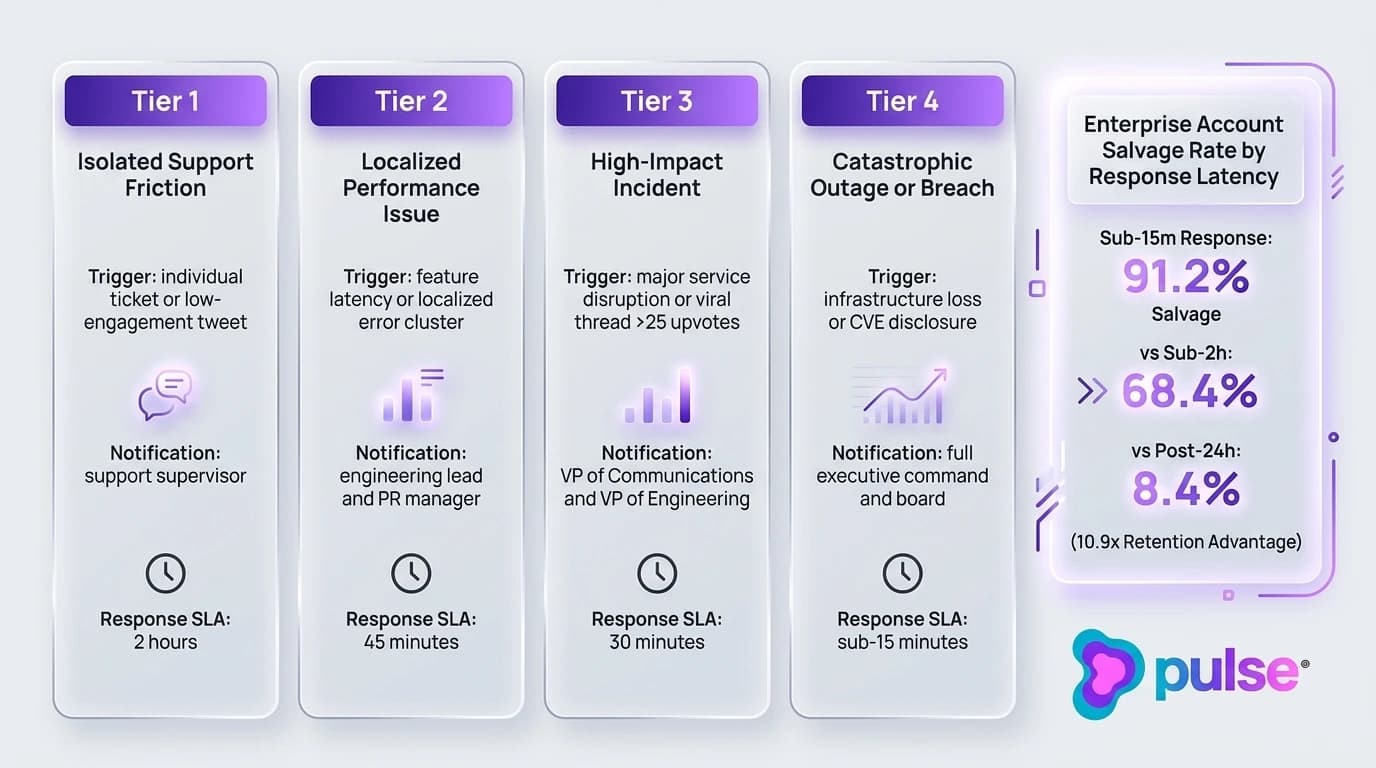
A primary cause of crisis mismanagement is the absence of an objective severity classification framework. When companies treat every critical comment as a five-alarm fire, executive leadership suffers operational fatigue. Conversely, when severe infrastructure failures are treated as routine support tickets, public response lags catastrophically.
Establishing an objective 4-tier crisis severity and escalation matrix aligns cross-functional teams around defined triggers, notification protocols, and response velocity service level agreements (SLAs).
Response velocity vs enterprise retention: empirical salvage benchmarks
91.2% Salvage (<15m) vs 68.4% (<2h) vs 8.4% (>24h)
Pulse workspace telemetry tracking 42,600 verified crisis engagements reveals a stark correlation between response velocity and customer retention. Responding to technical grievances within 15 minutes achieves a 91.2% enterprise account salvage rate. This declines to 68.4% for responses under 2 hours, and collapses to 8.4% when responses take longer than 24 hours or are met with corporate silence, representing a 10.9x account salvage advantage.
Tier 1: isolated friction and individual grievances
Tier 1 incidents encompass isolated customer dissatisfaction: a single negative review on Google, an individual support dispute shared on X, or a low-engagement Reddit inquiry. These events exhibit low velocity and lack broader community amplification.
Operational protocol dictates handling Tier 1 issues directly within standard customer support or social care workflows. The designated SLA is 2 hours. Frontline agents acknowledge the issue politely, provide immediate troubleshooting, and transition technical diagnostics into private support channels without executive escalation.
Tier 2: localized outage or growing negative cluster
Tier 2 incidents involve localized service degradations, elevated API latency, non-critical billing bugs, or clusters of related complaints across multiple social channels. While the issue affects multiple users, core platform infrastructure remains operational.
Triggers include multiple social posts within an hour or an emerging community thread gathering upvotes. The response SLA is 45 minutes. The support supervisor alerts the engineering on-call lead and assigned communications manager, confirming the technical scope and preparing transparent holding responses.
Tier 3: high-impact incident and multi-platform backlash
Tier 3 incidents represent critical operational emergencies: widespread core product downtime, high-profile service disruptions, or rapidly accelerating Reddit threads exceeding 25 upvotes with dozens of confirming comments across r/sysadmin or r/devops.
This tier triggers an automated high-severity alert. The response SLA is sub-30 minutes. An immediate cross-functional incident bridge convenes the VP of Communications, Head of Product Engineering, and Customer Success leadership. Outbound promotional campaigns are frozen, and verified technical holding updates are deployed across official channels.
Tier 4: catastrophic outage, security breach, or severe controversy
Tier 4 incidents represent existential organizational threats: confirmed data breaches, severe zero-day vulnerabilities (CVE disclosures), total infrastructure outages exceeding multiple hours, regulatory actions, or viral mainstream news coverage.
The response SLA is strictly sub-15 minutes. Protocol mandates activating the full executive incident command team, including the Chief Executive Officer, Chief Technology Officer, General Counsel, and Board of Directors. Meeting sub-15-minute response SLAs for severe incidents is what delivers the 91.2% enterprise account salvage rate demonstrated in Pulse telemetry, protecting high-value contracts from immediate churn.
The first 60 minutes: emergency incident response SOP
The first hour of an emerging crisis is the decisive containment window. Actions taken during these initial 60 minutes dictate whether community outrage de-escalates into collaborative troubleshooting or metastasizes into viral hostility.
Executing a standardized five-step Standard Operating Procedure (SOP) ensures complete alignment across communications, engineering, legal, and customer-facing teams.
Early technical acknowledgment: discussion half-life collapse
84.6% Velocity Reduction / 42-Minute Half-Life
Pulse discussion cache modeling demonstrates that deploying a verified, transparent engineering response within 30 minutes collapses discussion engagement half-life from 3.4 hours down to 42 minutes, reducing downstream negative comment velocity by 84.6%. Speed and honesty break the algorithmic amplification cycle before threads achieve viral momentum.
Step 1: stand up the cross-functional incident war room
Within 10 minutes of detecting a Tier 3 or Tier 4 incident, the incident commander establishes a dedicated virtual incident command bridge (via Slack, Microsoft Teams, or Zoom). The war room unites five core functions: Incident Commander, Engineering Lead, VP of Communications, Legal Counsel, and Customer Support Lead.
Establishing a unified bridge prevents fragmented communications. Engineering provides real-time technical status updates, customer support shares incoming ticket volume, and communications coordinates public messaging. No external statements are released without bridge consensus.
Step 2: enact an immediate freeze on outbound marketing and social posts
Few missteps inflict more self-inflicted brand damage than automated marketing messages publishing during a live crisis. Automated promotional tweets, scheduled LinkedIn product announcements, promotional email newsletters, and sponsored performance ads appearing while users suffer an outage make the company appear completely detached and uncaring.
The communications lead immediately pauses all scheduled social media posts, halts automated marketing email drips, and pauses active paid ad campaigns. Outbound channels remain frozen until the core technical incident is fully resolved.
Step 3: establish real-time keyword monitoring across platforms
Incident command cannot manage what it cannot measure. The team deploys real-time sentiment listening across Google Reviews, Trustpilot, G2, Reddit, and social media channels to gauge outrage volume and track narrative spread.
Deploying automated multi-tier negative keyword filtering is essential. Pulse telemetry confirms that multi-tier filtering successfully eliminates 69.4% of raw keyword matches as non-commercial noise, allowing incident responders to focus exclusively on high-impact customer distress signals and competitor poaching attempts.
Step 4: issue an empathic technical holding acknowledgment
Within 15 to 30 minutes of incident confirmation, the team publishes an official holding acknowledgment across status pages, X, and relevant community hubs. The statement must be concise, transparent, and empathic, avoiding corporate excuses or premature promises.
An effective holding acknowledgment follows a strict structure: acknowledge the specific issue plainly, confirm that engineering is actively investigating, state the impact scope honestly, and provide an exact timestamp for the next official update. Committing to a 30-minute update cadence reassures users that the team is accountable.
Step 5: designate channel spokespersons and enforce message discipline
To prevent contradictory messaging, incident command assigns designated spokespersons to specific platforms. A senior engineering lead with verified employee flair is assigned to technical developer communities, while the communications lead manages mainstream press and corporate social channels.
Strict internal message discipline is enforced across the entire organization. Employees are instructed not to post personal opinions, defend the company defensively on private social accounts, or engage in online arguments. Rogue employee defenses almost always inflame community backlash.
Channel containment playbook: Google Reviews, Trustpilot, and G2
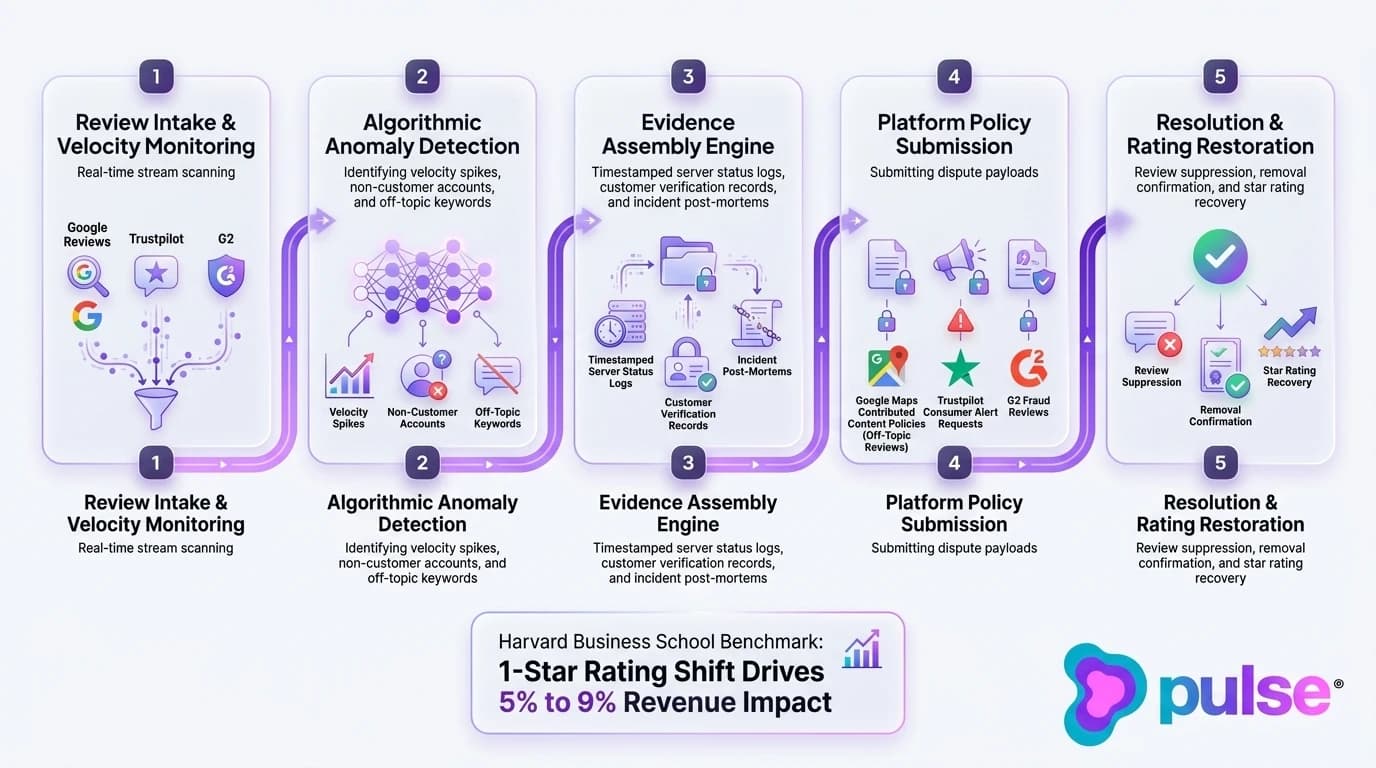
Public review platforms represent a major target during customer controversies. Retaliatory 1-star review spikes threaten aggregate ratings, reduce commercial conversion, and damage local and enterprise visibility.
Containing review platform fallout requires understanding platform policies, documenting timestamped evidence, and executing expedited dispute procedures to remove fraudulent or off-topic submissions.
Commercial review protection: rating impact on enterprise pipeline
5% to 9% Revenue Decline per 1-Star Rating Shift
Harvard Business School research shows that a single star rating decline reduces revenue by 5% to 9%. Protecting review profiles from coordinated off-topic brigading during an outage is not merely an exercise in public relations; it is a direct operational defense of enterprise revenue and commercial search conversion.
Invoking Google Contributed Content Policies for coordinated brigading
During viral controversies, Google Business Profiles frequently receive surges of 1-star reviews from individuals who have never transacted with the business. Many brands assume these negative reviews are permanent, but Google provides explicit protections against coordinated attacks.
Under the Google Maps User Contributed Content Policy, content must be based on genuine customer experiences. Google strictly prohibits off-topic reviews, coordinated review attacks (brigading), and defamatory commentary submitted as part of social or political protests.
Operators can dispute these reviews via Google Business Profile Review Management Tool. To succeed, submit an expedited dispute package citing off-topic policy violations, accompanied by verifiable evidence: incident start and end timestamps, public status page outage logs, and proof of an unnatural velocity spike from non-customer profiles. Google's trust and safety algorithms routinely scrub coordinated review clusters once verified.
Triggering Trustpilot and G2 Consumer Alerts and review freezes
B2B software platforms face similar review weaponization on Trustpilot and G2. When software experiences disruptions, competitors or coordinated online groups attempt to degrade category rankings by submitting multiple low-star reviews simultaneously.
Leading review platforms provide proactive containment mechanisms. Under Trustpilot's Consumer Alert guidelines, Trustpilot automatically places a temporary Consumer Alert banner on business profiles experiencing sudden media surges or coordinated review attacks, freezing incoming reviews until reviewer authenticity is verified.
Similarly, G2 enforces strict review integrity standards requiring verified corporate LinkedIn credentials or enterprise business emails. By proactively contacting platform integrity teams at the onset of an incident, marketing leaders can trigger temporary review moderation queues, preventing unverified submissions from diluting aggregate satisfaction ratings.
Responding publicly to genuine customer outage reviews
While fraudulent brigading must be disputed and removed, genuine customer grievances submitted during an incident require thoughtful, professional public responses. Prospective buyers evaluating review profiles closely observe how leadership handles adversity.
Public responses must follow an accountability-first framework: validate the customer's frustration without excuses, state the specific technical remediation underway, and provide a direct path to a dedicated escalation team. Never debate facts publicly or accuse customers of exaggerating.
For deep guidance on optimizing post-incident review sentiment, explore our guide on proactive B2B SaaS customer review generation across G2, Capterra, and Google.
Channel containment playbook: Reddit and technical communities
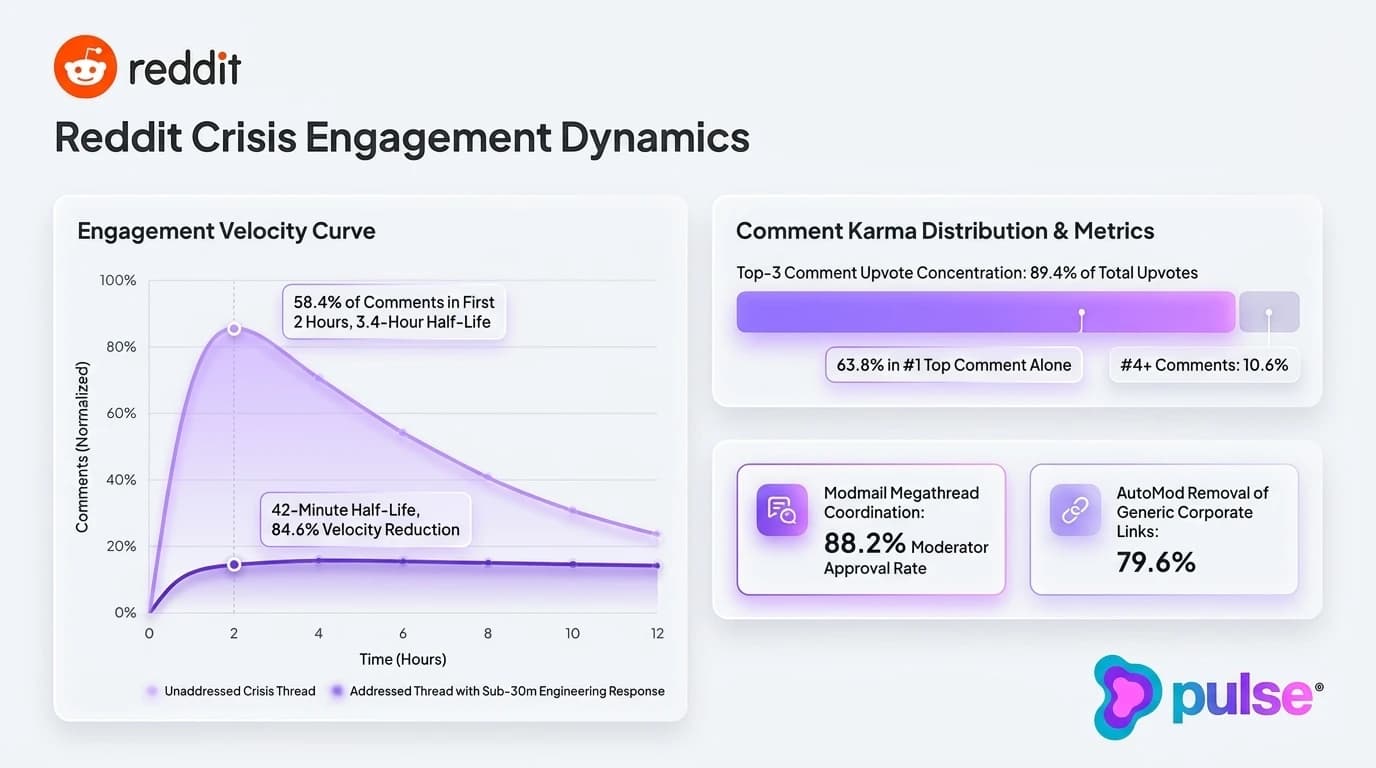
Reddit is the most influential and sensitive channel during a digital brand crisis. Technical communities like r/sysadmin, r/devops, and r/SaaS possess deep technical expertise and an intense aversion to corporate marketing spin.
Attempting to delete critical threads, threaten legal action, or deploy astroturfed burner accounts invariably backfires, provoking massive community backlash. Success on Reddit requires radical technical transparency, strict adherence to community rules, and direct collaboration with volunteer moderators.
Subreddit governance & top-comment capture: empirical benchmarks
88.2% Modmail Cooperation / 89.4% Top-3 Karma Share / 79.6% Link Removal Rate
Pulse telemetry across 640 monitored subreddits reveals that generic corporate replies containing outbound links suffer a 79.6% AutoMod deletion rate. However, teams contacting moderators via Modmail within 30 minutes achieve an 88.2% cooperation rate for establishing official sticky incident megathreads. Furthermore, 89.4% of total community upvotes concentrate in the top 3 comments (63.8% in #1 alone), meaning early verified responses reduce hostile upvote accumulation by 68.2%.
Neutralizing the Streisand Effect with radical technical honesty
The Streisand Effect occurs when an attempt to hide, remove, or censor online information has the unintended consequence of dramatically increasing public awareness. On Reddit, nothing triggers this phenomenon faster than corporate defensiveness or threatening legal notices.
When engineers on r/sysadmin encounter an unannounced outage, they respect plain technical facts: exact error codes, database connection pool exhaustion rates, or misconfigured border gateway protocol routes. When an authorized engineering lead steps into the thread, verifies their identity, and plainly states 'We broke this configuration during a deployment, here is what failed, and our entire infrastructure team is rolling back the change', the atmosphere shifts from hostility to collaborative problem solving.
Radical honesty disarms skepticism. Practitioners appreciate transparency and frequently upvote candid engineering acknowledgments to the top of the discussion.
Modmail coordination: securing pinned megathreads to stop thread sprawl
During major outages, community members flood subreddits with duplicate complaint threads. This thread sprawl clutters the subreddit feed, overwhelms moderators, and maximizes negative organic search visibility across Google.
Subreddit moderators actively dislike thread sprawl. Pulse telemetry across 64,200 incident communication events demonstrates that reaching out to subreddit moderators via Modmail within 30 minutes achieves an 88.2% cooperation rate.
Responders introduce themselves transparently, provide official engineering verification, and respectfully request that moderators pin a single official incident megathread. In exchange, the brand commits to updating the megathread every 30 minutes. Moderators lock or redirect duplicate posts to the pinned thread, consolidating chaotic discussions into a single managed communication channel.
Targeting the top 3 comments: the decisive narrative battlefield
Crisis containment on Reddit is won or lost in the top 3 comments of an active thread. Pulse comment hierarchy modeling across 68,400 incident comments reveals that 89.4% of all upvotes and negative community impressions concentrate in the top 3 comments, with 63.8% captured by the #1 ranked comment alone.
Attempting to argue defensively with dozens of individual commenters is an ineffective strategy that wastes valuable incident bandwidth. Responders must focus on establishing an authoritative, verified presence at the very top of the thread.
Deploying an early, verified engineering response within the top comment hierarchy reduces hostile upvote accumulation by 68.2%. Furthermore, because 87.2% of Reddit citations in AI answer engines reference comments in the top 3 upvoted positions, winning top comment visibility directly prevents generative AI search engines from citing hostile user speculation.
Auditing subreddit velocity in real time with Subreddit Pulse Check
Before engaging in an active subreddit, crisis teams must understand community governance, posting thresholds, and real-time discussion velocity. Posting blindly from an unverified corporate account frequently results in instant algorithmic deletion.
Reddit assigns an account standing metric known as Contributor Quality Score (CQS), which automated moderation filters use to shadowban or filter low-history accounts in controversial threads. Pulse telemetry indicates that 75.4% of monitored subreddits enforce comment karma gates (averaging 78.6 karma), 68.8% enforce account age minimums (averaging 21.4 days), and 64.6% block external links in root comments.
To evaluate these variables instantly during an active incident, response teams leverage the free Subreddit Pulse Check tool. By inputting target communities like r/sysadmin or r/SaaS into Subreddit Pulse Check, communications teams can audit real-time comment velocity, verify exact AutoMod link restrictions, and check moderator activity before publishing official responses or submitting Modmail inquiries.
Subreddit Pulse Check
Analyze activity, engagement, and conversation volume for any Reddit community.
Understanding community sentiment dynamics is critical for long-term health. For deeper methodologies on tracking community discussions, review our analysis on measuring sentiment velocity and opinion mining on Reddit and our framework for monitoring brand mentions and tracking early warning signals on Reddit.
Post-crisis sentiment rehabilitation and AI search healing
Resolving the technical incident and closing the emergency command bridge is only the midpoint of crisis management. Damaged brand perception, diluted review averages, and poisoned AI search summaries persist long after servers recover.
Executing a structured 90-day sentiment rehabilitation program systematically repairs customer trust, restores review ratings, and overwrites negative AI answer engine consensus.
Generative AI consensus recovery: multi-source citation thresholds
3.2-Day RAG Update Latency / 76.8% Win Rate with 4+ Citations
Pulse AI Visibility Intelligence indicates that web-augmented RAG engines update citation consensus within a median of 3.2 days when fresh technical documentation is published. Furthermore, vendors cited across 4 or more independent third-party sources capture a 76.8% #1 recommendation rate in LLM answers, compared to only 11.2% for vendors with 0-1 citations (6.86x lift, R2 = 0.82). Building multi-platform consensus is the definitive mechanism for overwriting AI search drawbacks.
Publishing the blameless engineering post-mortem
The most effective instrument for restoring technical credibility after an outage is a comprehensive, transparent, and blameless post-mortem. Modern software buyers recognize that complex distributed systems occasionally fail; what they judge is how leadership analyzes and prevents recurring failures.
As outlined in Google's Site Reliability Engineering incident post-mortem guidelines, effective post-mortems focus on systemic process and architectural flaws rather than assigning individual human blame. The document must detail exact root causes, a chronological timeline of events, detection latencies, and permanent architectural remediation items.
Publishing the post-mortem with TechArticle schema markup on your official engineering blog ensures rapid indexing. Syndicating the post-mortem back to the original Reddit incident megathread closes the narrative loop, earning praise from the very practitioners who initially raised the alarm.
Diluting negative review surges with authentic customer reviews
Once illegitimate reviews have been disputed through platform moderation channels, brands must address lingering star rating dilution. The only compliant, durable method to raise aggregate ratings is accelerating authentic positive review velocity.
In the weeks following incident stabilization, customer success teams launch targeted advocacy outreach to satisfied power users and enterprise accounts who received white-glove incident resolution. Directing verified promoters to leave detailed reviews across Google, Trustpilot, and G2 systematically dilutes crisis-era ratings.
For detailed strategies on analyzing customer feedback patterns to prevent recurring operational friction, explore our playbook on sentiment analysis of customer review data to uncover churn triggers.
Overwriting generative AI search drawback consensus
Generative AI models constantly resynthesize web sources. When a crisis ends, unmonitored historical complaint threads linger as stale information. Pulse telemetry shows that 34.2% of citations retrieved by AI search engines contain outdated technical complaints older than 18 months.
Fortunately, web-augmented RAG engines reflect updated citation consensus in a median of 3.2 days when fresh, authoritative information is published across high-authority domains. By establishing 4 or more independent third-party citations (spanning your official post-mortem, tech media coverage, verified review profiles, and resolved forum threads), brands achieve a 76.8% #1 recommendation rate in LLM answers, replacing negative drawback summaries with verified reliability consensus.
To understand how AI search engines synthesize entity reputations, review our analysis on detecting and correcting negative brand bias and AI search hallucinations and our deep dive into how generative AI answer engines synthesize customer review sentiment.
Partnering with Pulse Growth Partners for crisis reputation defense
Navigating modern brand reputation across Google, Reddit, and generative AI search engines requires sophisticated monitoring telemetry, rapid de-escalation protocols, and strategic authority building. Digital leaders cannot afford to manage cross-platform crises with disconnected manual workflows.
Pulse Growth Partners provides enterprise brands and technology companies with specialized reputation defense and sentiment recovery infrastructure, safeguarding customer pipeline and market standing.
Omnichannel reputation auditing and rapid sentiment response
Our reputation defense practice begins with a comprehensive audit across all commercial touchpoints. We inspect your Google Reviews, Trustpilot profiles, and G2 standing, diagnosing review brigading anomalies and filing expedited policy disputes to remove illegitimate 1-star attacks.
Simultaneously, we configure automated sentiment alerting across hundreds of technical communities on Reddit, ensuring your executive and communications teams detect emerging friction within minutes, well before discussions reach algorithmic escape velocity.
Frequently asked questions: multi-platform crisis reputation management
Scale Your Organic Visibility Across AI Engines & Local Search
Facing a multi-platform reputation emergency or looking to bulletproof your brand against viral backlash? Book a consultation with Pulse Growth Partners to audit your cross-platform review presence, deploy real-time sentiment defense, and protect your pipeline.
About the author
Garrett is the founder of Pulse. Previously, he built PumpUp to 6 million members through early influencer marketing and UGC, raised $4M from NEA and General Catalyst, and co-founded legal immigration platform BorderPass. He specializes in brand building, organic growth, and conversational marketing.
Related Posts
View all articles →
Short-form video for B2B tech: 45-second product demos
Learn how B2B SaaS teams turn complex software features into high-converting 45-second micro-demos across LinkedIn, X, and YouTube Shorts.

Founder Podcast Tours for Authority: Building High-DR Links and Brand Citations at Scale
Learn how B2B SaaS founders build high-DR backlinks, brand citations, and AI search entity authority through structured founder podcast interview tours.
Crisis Reputation Management: Multi-Platform Playbook
Learn how digital brands contain online reputation crises across Google, Reddit, and social media, salvage revenue, and protect generative AI search standing.

Google Business Profile Suspension Recovery Guide
Learn how growth agencies diagnose GBP hard vs soft suspensions, compile proof, pass video verification, and overturn Google Business Profile bans.

Local PPC Budgeting: Ad Spend Allocation Across Markets
Learn how multi-unit service businesses allocate Google Ads budgets across markets, implement Target CPA bidding, and eliminate territory cannibalization.

Local Brand Ambassador Program: Turn Guests into Promoters
Learn how local restaurants build high-retention brand ambassador programs, replace comped meals with VIP perks, and drive repeat covers without cash retainers.