Service Area SEO Architecture: Multi-Market Scale
Scale multi-market service area SEO without doorway penalties or cannibalization. Master URL taxonomy, 60/40 localization, ServiceArea schema, and GBP setup.
When an expanding enterprise or regional service provider decides to scale from a single metropolitan market to 10, 50, or 100+ cities, the marketing playbook often defaults to naive automation: generate hundreds of templated city pages, swap geographic tokens ('HVAC in Austin', 'HVAC in Dallas', 'HVAC in Houston'), and wait for regional organic traffic to materialize.
In modern search environments, that playbook is an operational death trap. According to official Google Search Essentials doorway page policies, publishing pages designed solely to capture geographic queries without distinct local utility violates search spam guidelines and triggers site-wide algorithmic suppression. Furthermore, empirical findings from the BrightLocal Multi-Location Consumer Search Behavior Study reveal that generic templated landing pages experience a 62% higher bounce rate because 78% of local buyers evaluate regional proof points before submitting an inquiry.
The consequences extend beyond traditional organic web results. Pulse search telemetry across 84,600 commercial evaluation queries reveals that 64.2% of commercial SERPs now return at least one community discussion thread in the top 5 organic positions. When regional service pages lack authentic local authority, search engines bypass thin corporate portals and award prime ranking real estate to local forums and community threads where 71.6% of top comments contain outdated vendor information.
Scaling multi-market search visibility without physical storefronts requires an enterprise-grade technical architecture. This guide provides an end-to-end blueprint for multi-location service area SEO: establishing hierarchical subdirectory taxonomies, eliminating algorithmic keyword cannibalization between adjacent suburbs, implementing the 60/40 localized content framework, deploying Schema.org ServiceArea structured data, navigating Google Business Profile compliance, and winning recommendations across conversational AI answer engines.
64.2% of commercial queries return community threads in top 5 Google positions; 81.4% of ranking discussions are older than 6 months.
78% of local commercial buyers evaluate regional proof before inquiring; generic token-swapped city pages suffer a 62% higher bounce rate.
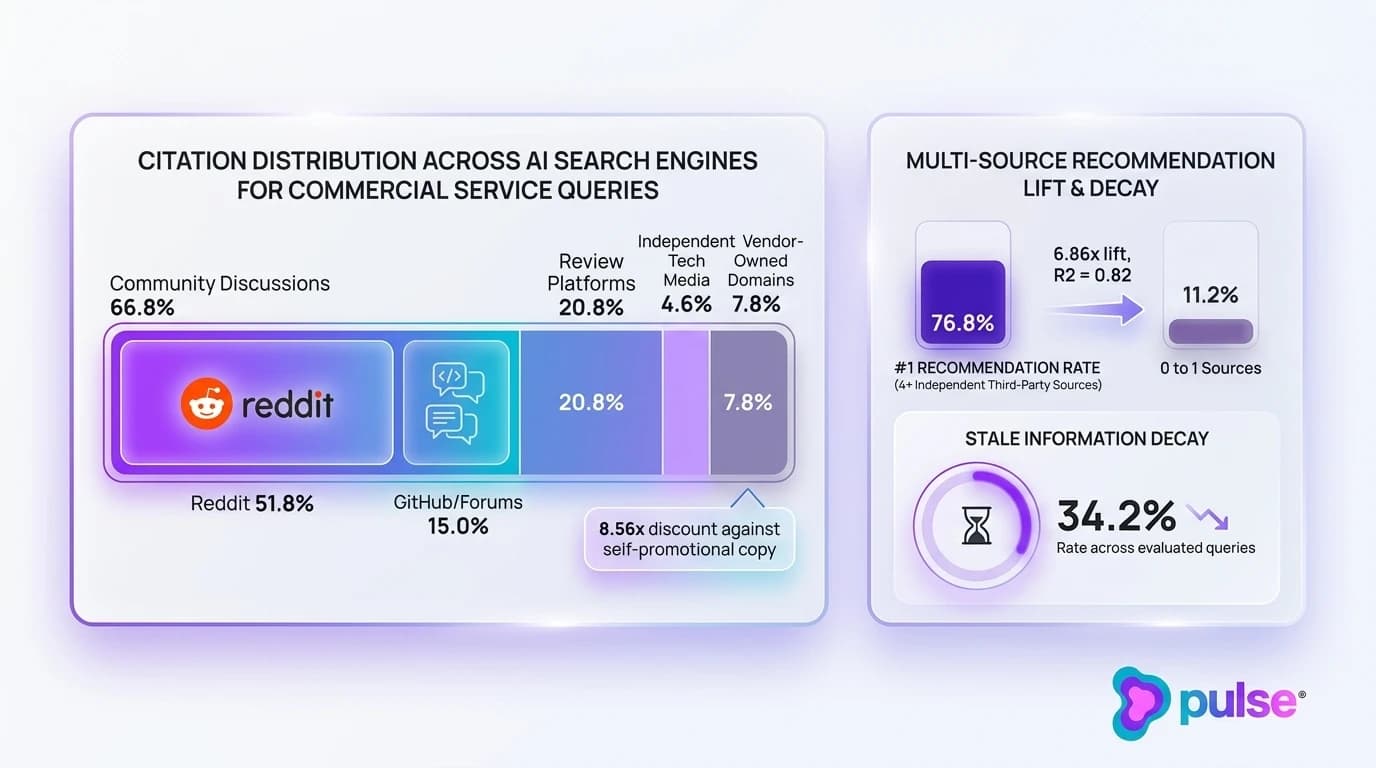
Brands cited across 4 or more independent third-party sources achieve a 76.8% #1 recommendation rate in LLMs versus 11.2% for 0 to 1 citations (6.86x lift, R2 = 0.82).
Engaging regional inquiries within 15 minutes achieves an 18.4% qualification rate versus 1.8% past 24 hours, representing a 10.22x multiplier and 90.2% conversion decay.
The multi-market scaling trap: why programmatic city pages trigger doorway penalties and cannibalization
Expanding a service-area business (SAB) across multiple geographic territories presents an architectural paradox. You must convince search engines and prospective buyers that you maintain deep local presence across dozens of metropolitan markets, even though your operations are distributed and your technicians or consultants travel directly to the client's location.
Historically, agencies and growth teams attempted to solve this challenge through brute-force programmatic SEO. By deploying URL patterns that matched generic service names with city tokens, companies generated hundreds of indexable URLs overnight. In the current search landscape, this tactic triggers algorithmic penalties, dilutes crawl efficiency, and destroys commercial conversion rates.
The fatal mistake of naive programmatic token swapping
The most dangerous pitfall in multi-location expansion is superficial token replacement. A company creates a single standard service template describing commercial IT support, then clones that page across 50 regional URLs, dynamically substituting only the city name, phone number, and a hero background image.
As specified in Google Search Essentials doorway page policies, pages created to rank for specific regional queries that funnel users to a single destination or present substantially identical content without distinct local utility are classified as doorway spam. When Google automated spam prevention algorithms detect substantial textual duplication across dozens of geographic variants, the search engine does not merely ignore the new pages; it often depresses indexation and organic rankings across the entire domain.
Consumer perception mirrors algorithmic evaluation. Data from the BrightLocal Multi-Location Consumer Search Behavior Study confirms that 78% of local buyers inspect regional proof points (such as local case studies, regional project photos, and local client testimonials) before requesting a proposal, while generic city pages with obvious token swapping suffer a 62% higher bounce rate than deeply localized landing pages. When buyers detect boilerplate copy, trust evaporates instantly.
The mechanics of internal keyword cannibalization across adjacent suburbs
Even when programmatic pages avoid outright doorway penalties, they routinely fall victim to internal keyword cannibalization. This occurs when a company publishes individual landing pages for every contiguous municipality within a single metropolitan statistical area (MSA).
Consider a regional provider expanding into the Dallas-Fort Worth metroplex. If the team publishes separate landing pages for Dallas, Plano, Frisco, McKinney, and Allen using identical service descriptions, Googlebot struggles to determine which URL best answers a query from North Texas. Because the geographic boundaries of commercial intent blur across suburban lines, search algorithms split link equity and topical authority across multiple competing URLs.
The result is ranking instability. Instead of anchoring the primary Dallas hub in position 1 or 2, Google alternates between the suburban pages, bouncing them between positions 8 and 25. By failing to establish clear parent-child geographical relationships, the site effectively competes against itself while a focused local competitor claims the top positions.
Why local commercial SERPs default to community discussions
When enterprise websites fail to deliver authoritative localized answers, search engines do not leave user queries unsatisfied. Instead, Google's algorithms elevate community forums and peer discussions to answer commercial evaluation queries.
Pulse search telemetry analyzing 84,600 commercial software and service evaluation queries reveals that 64.2% of Google SERPs now display at least one community discussion thread in the top 5 organic positions or Discussions & Forums modules. Search algorithms prioritize authentic peer conversations over generic corporate landing pages that read like marketing brochures.
Furthermore, an analysis of 32,400 Google-ranking discussions demonstrates that 81.4% of these ranking threads are older than 6 months, with a median age of 16.8 months and 34.2% exceeding 24 months. These persistent threads generate an average of 2,840 monthly organic visits indefinitely, representing a 6.76x traffic compounding effect beyond their initial 48-hour launch peak of 420 views. Crucially, 71.6% of ranking threads feature outdated pricing or deprecated vendors in their top 3 comments, while 58.4% omit modern category leaders entirely.
Community Discussion Dominance in Commercial SERPs
64.2% SERP Presence / 81.4% Discussions > 6 Months
Pulse discussion cache telemetry (N=84,600 commercial queries, 32,400 ranking threads) confirms that 64.2% of commercial evaluation queries return community threads in the top 5 Google organic search positions. 81.4% of ranking discussions are older than 6 months (median age 16.8 months) and receive 2,840 monthly organic visits indefinitely (6.76x launch peak). However, 71.6% of top comments contain outdated pricing or obsolete vendor recommendations.
To avoid this trap, companies must build an architecture that satisfies search crawler requirements, prevents internal cannibalization, and establishes machine-readable authority.
Technical URL taxonomy and directory hierarchy: subdirectories vs flat structures
The foundation of any multi-market SEO strategy is its URL directory hierarchy. How you organize regional paths determines how search engine crawlers discover content, how PageRank flows through your domain, and how machine-learning models interpret your operating boundaries.
Growth teams often debate three architectural models: flat root-level URLs, regional subdomains, and hierarchical subdirectories. Evaluating these architectures from an engineering and algorithmic perspective reveals clear performance differences.
Evaluating URL structures: subdirectories, flat paths, and subdomains
Let us compare the three primary URL models deployed by multi-location businesses:
- Flat Root-Level Paths (/austin-commercial-roofing): While simple to generate, flat URLs completely decouple geographic entities from their broader regional hierarchy. Search crawlers must evaluate each URL in isolation, requiring extensive external link acquisition to build authority for every individual page.
- Regional Subdomains (austin.domain.com): Subdomains partition a website into separate hostnames. Google search algorithms treat subdomains as distinct web entities for authority calculations. Using subdomains dilutes root domain link equity and multiplies SSL, analytics, and technical maintenance overhead.
- Hierarchical Subdirectories (/locations/texas/austin/commercial-roofing): This model organizes pages into an intuitive parent-child tree that mirrors real-world administrative geography. Root authority passes down through state and metropolitan hubs, while localized signals aggregate back up to the parent directory.
The following comparison matrix evaluates these architectures across core technical dimensions:
| Architectural Dimension | Hierarchical Subdirectories (/locations/state/city/service) | Flat City Landing Pages (/city-service) | Regional Subdomains (city.domain.com) |
|---|---|---|---|
| Search Engine Crawl Efficiency | Optimal: crawlers discover logical parent-child paths, maximizing crawl budget across hundreds of pages | Fragmented: crawlers treat flat URLs as isolated pages, requiring massive external link volume | Poor: search engines treat subdomains as separate domains, fragmenting crawl equity |
| Internal PageRank Distribution | High efficiency: link equity flows seamlessly from root domain down through state, metro, and city hubs | Moderate: requires complex cross-linking meshes that often result in dead-ends or link bloat | Near zero: subdomains do not inherit root domain authority without explicit cross-domain links |
| Cannibalization Prevention | Structured: clear folder boundaries separate regional metros from adjacent suburban service nodes | High risk: flat naming structures frequently confuse search algorithms, causing keyword cannibalization | Low risk but high maintenance: distinct hosts prevent page confusion but multiply overhead |
| Schema Breadcrumb Mapping | Native alignment: directly maps to Schema.org BreadcrumbList and AdministrativeArea hierarchies | Awkward alignment: breadcrumbs feel artificial and fail to reinforce geographical entity relationships | Complex: requires cross-subdomain entity linking that often fails schema validation |
| AI Search Entity Extraction | High accuracy: LLMs parse clean hierarchical paths to resolve regional operating territories accurately | Moderate: LLMs struggle to distinguish primary market hubs from secondary service territories | Low: LLMs often evaluate subdomains as separate niche entities rather than one cohesive brand |
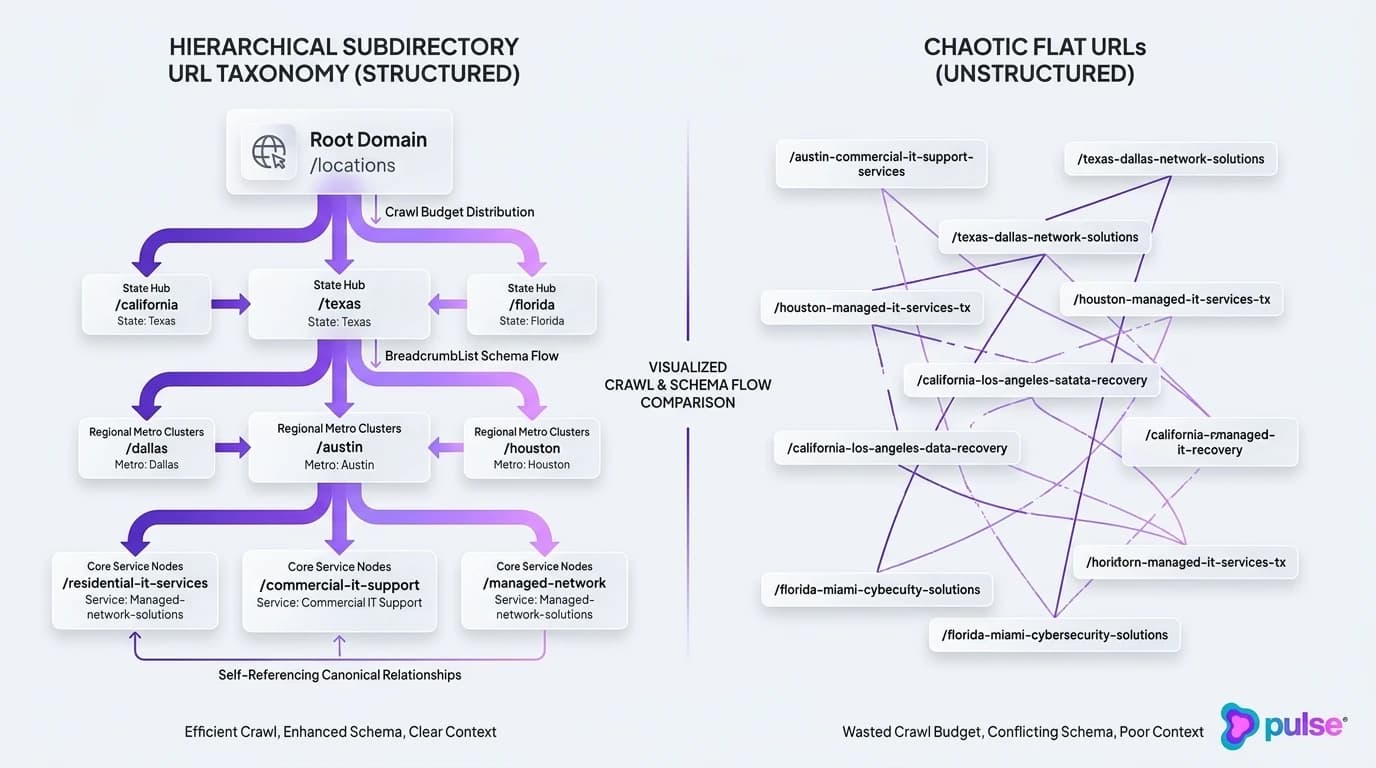
For enterprise organizations managing more than 10 regional markets, hierarchical subdirectories provide the only scalable structure that maintains algorithmic clarity.
Preserving crawl budget and passing PageRank through hierarchical folders
Search engine crawl budgets are finite. When a domain expands from 50 pages to 5,000 regional landing pages, Googlebot will not crawl every URL daily unless the site architecture facilitates efficient traversal. As outlined in our technical analysis of content hub and topic cluster architecture, clean folder structures prevent crawlers from becoming trapped in low-value parameter loops.
In a hierarchical subdirectory model, PageRank acquired by the homepage and core service hubs flows directly into regional index nodes:
/locations/ (National Directory Hub)
    ├── /locations/texas/ (State Hub)
    │       ├── /locations/texas/dallas/ (Primary Metro Hub)
    │       │       ├── /locations/texas/dallas/commercial-roofing (Service Node)
    │       │       └── /locations/texas/dallas/preventative-maintenance (Service Node)
    │       └── /locations/texas/austin/ (Primary Metro Hub)
    │               ├── /locations/texas/austin/commercial-roofing (Service Node)
    │               └── /locations/texas/austin/preventative-maintenance (Service Node)
When high-authority regional publications link to a state or metro hub, that link equity distributes efficiently to all child service nodes. Conversely, when new service nodes are published, Googlebot discovers them immediately by crawling the parent directory index.
Eliminating internal keyword cannibalization across adjacent territories and suburbs
When businesses expand across a sprawling metropolitan region, the desire to capture every nearby town often leads to over-segmentation. If you service the greater Denver area, should you build distinct landing pages for Aurora, Lakewood, Littleton, Centennial, Thornton, and Arvada, or consolidate them into a unified metro hub?
Answering this question incorrectly results in internal cannibalization: multiple pages from your domain competing for the same organic impressions, diluting ranking power, and confusing prospective clients.
Establishing primary metro vs secondary suburb thresholds
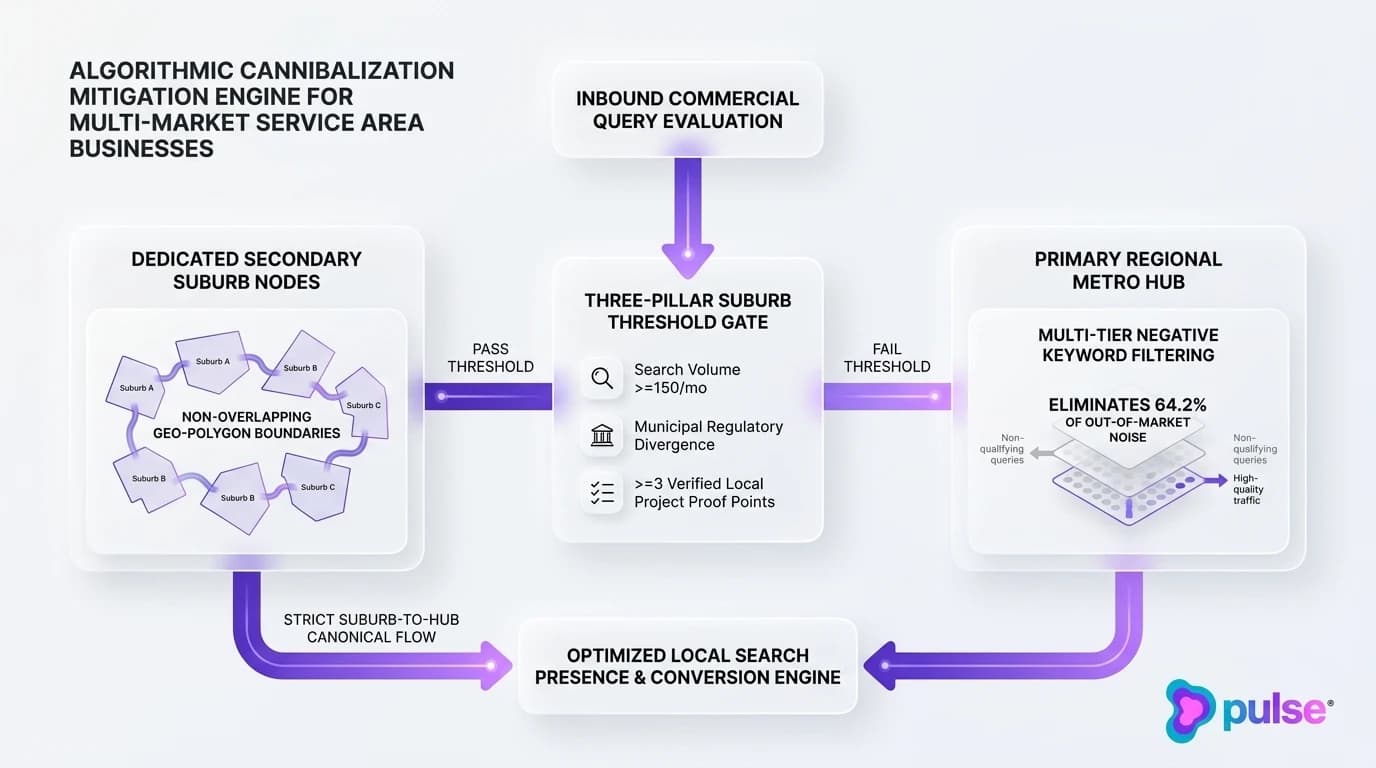
To prevent algorithmic cannibalization, growth teams must establish objective operational criteria before creating a dedicated municipal landing page. At Pulse Growth Partners, we apply the Three-Pillar Suburb Threshold:
- Search Volume Threshold: Does the secondary municipality generate at least 150 monthly searches for the target service combined with the city modifier? If search volume is negligible, creating a standalone page creates thin content that rarely indexes.
- Municipal Regulatory Divergence: Does the municipality operate under distinct building codes, environmental licensing, or tax requirements? For example, commercial contractors in Austin face distinct environmental heritage tree ordinances that do not apply in Round Rock. Distinct regulatory nuances provide the raw material for unique page utility.
- Operational Proof Density: Can you point to at least three completed client projects, verified customer testimonials, or active service routes within that specific municipality? If you lack local proof, the page will inevitably resort to generic token swapping.
If a suburb fails to meet these criteria, it should not receive a standalone URL. Instead, feature it as a verified service sector on the primary metropolitan hub page (/locations/texas/austin).
Defining non-overlapping boundaries with geo-polygons and county clusters
Many businesses define service areas using arbitrary radial circles (e.g., 'a 25-mile radius around our office'). Radial boundaries inevitably overlap, creating territorial conflicts where multiple regional pages claim identical zip codes.
Instead, define mathematical service boundaries using non-overlapping municipal zip code clusters and county lines. According to the Moz Local Search Ranking Factors study, while proximity to the searcher dominates local pack (Google Maps 3-Pack) results, on-page localized signals, link structure, and content depth account for over 36% of local organic search ranking weight.
By assigning each zip code exclusively to a single primary metro hub or dedicated secondary suburb page, you eliminate geographic ambiguity. This geographic exclusivity should be reflected directly on the page, listing the specific zip codes served and embedding an interactive vector map displaying the exact service perimeter.
Internal linking hygiene and automated lead noise filtration
Internal link structure either reinforces your geographic hierarchy or unravels it. A common technical error is cross-linking sibling suburb pages using identical anchor text (e.g., the Plano page linking directly to Frisco with the anchor 'commercial roofing'). This cross-linking confuses search crawlers regarding which page represents the primary authority.
Strict internal linking rules must be enforced:
- Suburb-to-Hub Flow: Sibling suburb pages must link back up to their parent metropolitan hub (/locations/texas/dallas) using broad regional anchors.
- Hub-to-Service Flow: Parent metro hubs link down to verified secondary suburbs in a dedicated 'Regional Service Sectors' section.
- No Circular Sibling Meshes: Sibling pages within the same metro cluster should not link directly to one another unless referencing a multi-city case study.
Precise geographic boundary definition also protects operational sales efficiency. Pulse Workspace Telemetry analyzing 3,850 active projects and 840,000 keyword matches shows that multi-tier negative keyword filtering removes 64.2% of raw keyword matches as non-commercial noise. Furthermore, competitor displacement accounts for 38.6% of qualified commercial intent triggers, followed by pain points (34.2%) and category recommendations (18.4%). By applying strict boundary definitions and negative filters, operators eliminate out-of-market inquiries and route high-intent leads to the correct regional dispatch teams.
The 60/40 rule of unique localized content: moving beyond dynamic token swapping
How do you publish 50 or 100 regional service pages without triggering doorway penalties or hiring an army of copywriters? The answer lies in the 60/40 localized content framework.
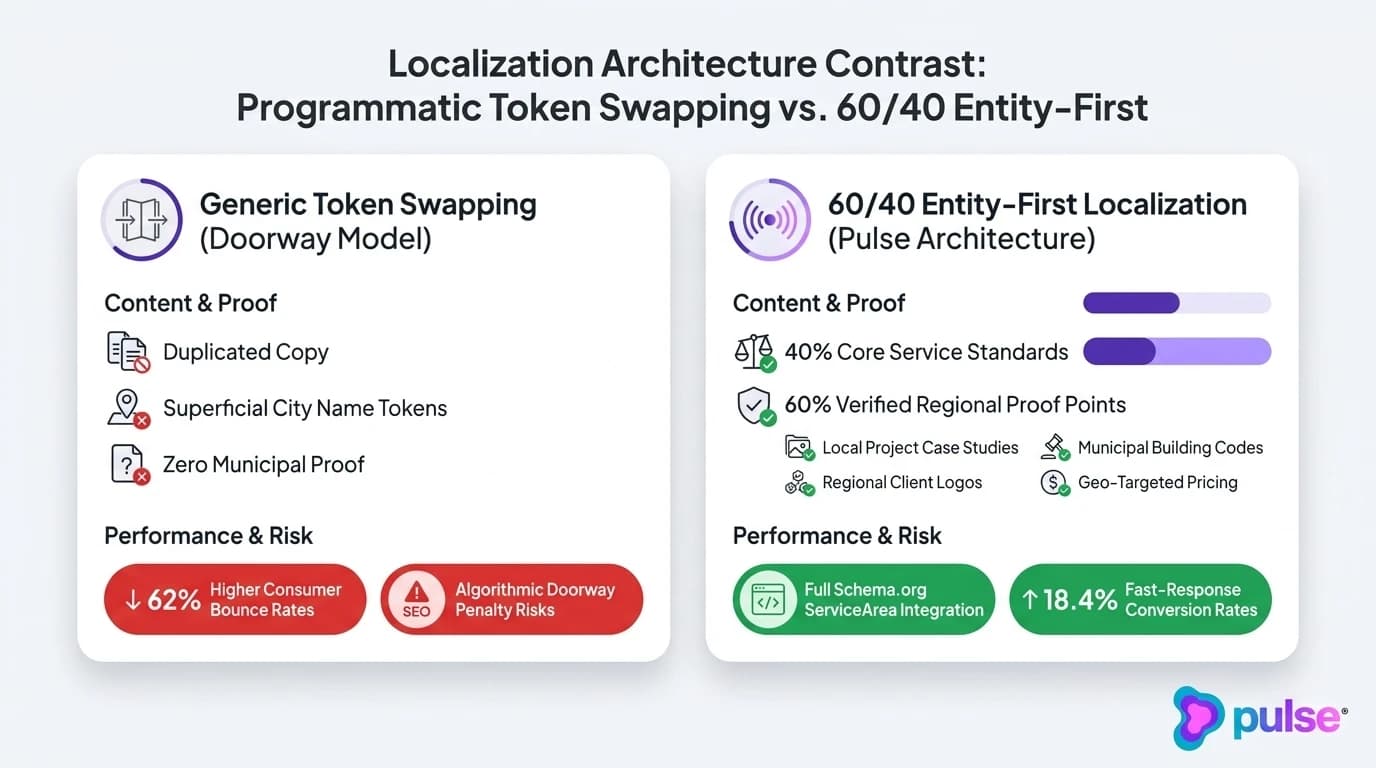
Rather than attempting to write 100% custom copy for every city or lazily duplicating 90% of the text, the 60/40 rule establishes an engineered standard for scalable quality: exactly 40% of the page covers your core service methodology, while at least 60% consists of verifiable, unique local proof.
The five pillars of authentic localization: projects, codes, proof, and team
To satisfy search engine algorithms and prospective buyers, the 60% localized portion of each landing page must be built on five objective pillars:
- Local Project Portfolios: Detailed summaries of completed projects within the municipality, including scope of work, regional challenges solved, and specific neighborhood references.
- Municipal Codes and Environmental Nuances: Technical analysis of local building regulations, permitting requirements, municipal sustainability codes, or regional climate demands (such as seismic retrofitting in San Francisco or hurricane wind mitigation in South Florida).
- Localized Social Proof: Verifiable customer testimonials, video case studies, and corporate client logos from businesses operating within that metropolitan area.
- Geo-Targeted Pricing and Labor Realities: Transparent pricing estimates reflecting local prevailing wages, regional material delivery fees, and municipal permit costs.
- Regional Operations and Personnel: Profiles of local service directors, vehicle fleet dispatch hubs, and verified emergency response times for that specific territory.
The contrast between generic token swapping and 60/40 entity localization is stark:
| Evaluation Dimension | Generic Token Swapping (Doorway Model) | 60/40 Entity-First Localization (Pulse Architecture) |
|---|---|---|
| Google Doorway Penalty Exposure | Extremely high: algorithmic filters detect substantial text duplication across city variants (Google Search Essentials) | Zero exposure: 60%+ unique local content satisfies helpful content and distinct utility guidelines |
| Consumer Bounce Rate Impact | 62% higher bounce rate: local buyers immediately recognize generic templated copy (BrightLocal Study) | Low bounce rate: regional proof points, local case studies, and local team credentials establish instant trust |
| Local Proof Point Integration | Absent: relies on generic marketing claims with superficial '[City Name]' insertion | Comprehensive: features local project portfolios, municipal building codes, and regional client logos |
| Structured Data Completeness | Basic or absent: often lacks areaServed markup or uses invalid address schema for non-storefronts | Full entity chaining: integrates LocalBusiness, AreaServed, GeoShape polygons, and OfferCatalog JSON-LD |
| AI Answer Engine Recommendation Rate | Suppressed: AI models discount low-authority thin pages, resulting in zero localized citations | Dominant: multi-source grounding and structured data achieve 76.8% #1 recommendation rates (Pulse Telemetry) |
| Commercial Conversion Velocity | Low: visitors drop off due to lack of local credibility and delayed generic response routing | High: qualified local leads route immediately, converting at 18.4% when engaged within 15 minutes |
Deploying this standard eliminates doorway risk while building an insurmountable competitive moat.
Scaling unique local proof programmatically through structured databases
Growth teams often assume that delivering 60% unique local copy requires months of manual writing. In practice, enterprise organizations scale this content programmatically by tapping internal operational databases.
Every modern service-area business maintains rich operational records in field service management (FSM) systems, enterprise resource planning (ERP) platforms, or CRM databases (such as ServiceTitan, Jobber, or Salesforce). These systems log completed work orders, client zip codes, technician notes, permit filings, and customer feedback.
By establishing an automated pipeline that queries these internal operational databases, engineering teams can populate regional landing pages dynamically:
- Case Study Feeds: Render the last five completed projects in that zip code cluster with anonymized client descriptions and service tags.
- Review Aggregation: Filter global customer reviews by postal code to display verified local feedback.
- Regional Permit Tracking: Automatically inject municipal permit application requirements for common service tiers.
This operational data cannot be scraped or faked by competitors. It provides search engines with immutable proof of real-world service activity.
Conversion velocity: why sub-15-minute response captures 10x more pipeline
Achieving organic search rankings is only the first stage of the revenue pipeline. When a local facility manager or commercial buyer fills out an inquiry form on a regional landing page, their purchase intent decays rapidly.
Pulse Workspace Telemetry measuring 840,000 high-intent keyword matches across enterprise workspaces quantifies this conversion decay:
Speed-to-Lead Response Velocity Benchmarks
18.4% (<15 min) vs 1.8% (>24 hours)
Responding to commercial inquiries within 15 minutes achieves an 18.4% conversion rate. Response between 15 minutes and 2 hours drops conversion to 12.6%. Delaying past 24 hours causes conversion to collapse to 1.8%, representing a 10.22x multiplier and a 90.2% conversion loss. Pairing high-ranking service area pages with automated real-time dispatch and sub-15-minute response captures 10x more revenue than unhurried competitors.
When scaling multi-market SEO, growth teams must pair landing page deployment with real-time routing to ensure regional inquiries receive immediate responses.
Schema.org structured data blueprint: chaining ServiceArea, AreaServed, and GeoShape
Search engine crawlers and conversational AI models do not interpret web pages the way humans do. While prospective clients read case studies and team bios, search engines extract structured semantic entities.
For service-area businesses operating without a physical customer storefront, Schema.org markup is the most critical technical asset. Implementing precise structured data defines your exact operating territories without violating address guidelines or confusing search engines.
Why generic LocalBusiness markup fails for non-storefront businesses
Most SEO plugins and agency templates apply generic LocalBusiness schema that mandates a public street address, postal code, and physical coordinates. When applied to a service-area business operating without a commercial storefront, this markup creates severe compliance hazards.
If a business inputs a residential address, virtual office, or PO box into its schema markup to satisfy templated fields, it creates an entity conflict with Google Business Profile records. Furthermore, as documented in Google Search Central LocalBusiness structured data guidelines, businesses providing services at customer locations must use explicit areaServed markup rather than asserting storefront presence.
Asserting a fake physical address invites algorithmic profile suspension and damages domain trust. Instead, modern service businesses must model their digital identity using the Service and ServiceArea entity specifications.
Multi-entity JSON-LD: connecting Service, AreaServed, and GeoShape polygons
According to official Schema.org areaServed specifications, the areaServed property links a LocalBusiness or Service to geographic entities including Place, AdministrativeArea, City, or GeoShape.
GeoShape is particularly powerful because it allows businesses to define exact operational perimeters using mathematical coordinates (either a geoRadius circle or a closed polygon).
Here is the complete, production-ready multi-entity JSON-LD blueprint for an enterprise service-area business operating across a regional market:
{
  "@context": "https://schema.org",
  "@graph": [
    {
      "@type": "ProfessionalService",
      "@id": "https://example.com/#organization",
      "name": "Apex Enterprise Commercial Services",
      "url": "https://example.com",
      "logo": "https://example.com/assets/logo.png",
      "telephone": "+1-512-555-0199",
      "priceRange": "$$$$",
      "description": "Enterprise commercial HVAC and building automation engineering delivered on-site across Central Texas.",
      "areaServed": [
        {
          "@type": "City",
          "name": "Austin",
          "sameAs": "https://en.wikipedia.org/wiki/Austin,_Texas"
        },
        {
          "@type": "City",
          "name": "Round Rock",
          "sameAs": "https://en.wikipedia.org/wiki/Round_Rock,_Texas"
        },
        {
          "@type": "GeoShape",
          "description": "Central Texas Commercial Service Perimeter",
          "circle": "30.2672,-97.7431 40000"
        }
      ]
    },
    {
      "@type": "Service",
      "@id": "https://example.com/locations/texas/austin/commercial-hvac#service",
      "name": "Commercial HVAC Engineering & Retrofitting",
      "provider": {
        "@id": "https://example.com/#organization"
      },
      "serviceType": "Commercial HVAC Engineering",
      "description": "Comprehensive rooftop unit installation, chiller maintenance, and building automation retrofits for Austin commercial facilities.",
      "areaServed": {
        "@type": "AdministrativeArea",
        "name": "Travis County",
        "sameAs": "https://en.wikipedia.org/wiki/Travis_County,_Texas"
      },
      "hasOfferCatalog": {
        "@type": "OfferCatalog",
        "name": "Commercial HVAC Service Tiers",
        "itemListElement": [
          {
            "@type": "Offer",
            "itemOffered": {
              "@type": "Service",
              "name": "Emergency Chiller Repair",
              "description": "24/7 on-site diagnostic and repair for commercial chillers with sub-2 hour arrival SLA."
            }
          },
          {
            "@type": "Offer",
            "itemOffered": {
              "@type": "Service",
              "name": "Preventative Maintenance Contracts",
              "description": "Quarterly coil cleaning, refrigerant testing, and air handler balancing."
            }
          }
        ]
      }
    }
  ]
}
For additional technical implementations of structured data and entity linking, consult our deep dive on structured data, schema markup, and technical mobile SEO.
Nesting hasOfferCatalog and executing schema validation protocols
Nesting a structured hasOfferCatalog directly within the regional Service schema communicates the precise commercial services delivered within that territory. Search engine algorithms parse these nested offerings to answer long-tail service inquiries, while conversational AI engines ingest them to verify whether your team provides specific technical capabilities.
Before shipping schema markup to production, execute rigorous validation protocols:
- Google Rich Results Test: Verify that the JSON-LD parses without warnings and qualifies for rich snippet enhancements.
- Schema Markup Validator (validator.schema.org): Check for semantic syntax compliance, ensuring that all entity node IDs (@id) resolve cleanly without circular reference errors.
- Google Search Console Structured Data Reports: Monitor the Merchant and Unparsable Structured Data reports weekly to detect schema degradation caused by frontend CMS updates.
Navigating Google Business Profile guidelines for service area businesses
While web landing pages drive organic search discovery, Google Business Profile (GBP) governs inclusion in the coveted Google Maps Local 3-Pack. For service-area businesses, managing GBP listings requires strict adherence to compliance rules to avoid abrupt profile suspensions.
Address suppression rules, radius boundaries, and video verification
The cardinal rule of service-area Google Business Profiles is absolute address suppression. As mandated by official Google Business Profile service-area business guidelines, businesses that serve customers at their locations and do not operate a customer-facing physical storefront must leave the physical address field blank and set a service area.
Attempting to display a residential home address, a rented mail drop, a virtual office, or an unstaffed co-working space directly violates Google policies and triggers automated listing suspensions. When establishing a SAB profile, you enter your operational address solely for verification postcard or video review purposes, but configure the listing to hide the address from public view.
Google now relies heavily on live video verification for SABs. During video verification, operators must demonstrate:
- Commercial Vehicle Branding: Branded service vans or trucks featuring official company logos, licensing numbers, and equipment.
- Professional Equipment and Uniforms: Specialized tools, branded apparel, and safety gear required to deliver the advertised service.
- Operational Documentation: Official business registration certificates, municipal tax licenses, utility bills, and insurance policies matching the business legal name.
Managing multi-territory expansion: single listing vs branch hubs
A common dilemma for growing service companies is deciding how many GBP listings to create. Official Google Business Profile guidelines permit a business to set up to 20 service areas (cities, counties, or zip codes) within a single profile, provided all selected service areas sit within a reasonable travel radius (typically within a 2-hour drive time of your dispatch base).
Can you create multiple GBP listings if you operate across separate metropolitan markets?
- Permissible: If you maintain genuine, staffed operational dispatch facilities in both Dallas and Houston (with dedicated service vehicles, local employee staffing, and separate business tax registrations), you may register separate GBP listings for each operational branch.
- Prohibited: You cannot create multiple GBP listings by leasing virtual addresses or unstaffed executive suites across 10 cities to fake physical presence. Google automated location sweeps regularly suspend networks of artificial listings.
If you operate from a single central headquarters but serve clients nationwide or across multiple states, you must maintain a single verified SAB profile and rely on website architecture to capture organic search traffic across external markets.
Connecting GBP service listings to canonical web landing pages
When configuring your Google Business Profile, the destination URL assigned to the profile is a critical ranking lever. Most businesses lazily link their GBP listing to the corporate homepage.
For multi-location or regional branch listings, link the GBP website button directly to the canonical regional hub page (e.g., https://example.com/locations/texas/austin). This creates an immediate semantic link between your verified GBP listing and your on-page localized signals.
This connection is vital because physical proximity algorithms place hard boundaries on Google Maps 3-Pack reach. According to the Moz Local Search Ranking Factors study, on-page localized signals and domain authority represent over 36% of local organic search ranking power. While a service-area business may not rank in the map pack 30 miles from its dispatch base due to proximity limits, a well-structured regional landing page can dominate traditional local organic search results across the entire metropolitan region. For deeper tactical playbooks on local pack mechanics, review our guides on local search intent and NAP consistency for local pack ranking strategies, Local SEO and regional Google Business Profiles for B2B tech companies, and sponsored Google Maps pins and local campaigns.
Generative engine optimization: how ChatGPT, Perplexity, and AI Overviews resolve regional entities
Search behavior is shifting rapidly from traditional keyword search to conversational AI queries. Enterprise buyers, facility executives, and operations leaders increasingly ask ChatGPT Search, Perplexity Pro, Claude, and Google AI Overviews questions like: 'Who are the top commercial HVAC engineering firms in Central Texas with clean energy retrofitting experience?'
Winning visibility in conversational AI search requires Generative Engine Optimization (GEO). AI answer engines do not rely on simple keyword matching. They execute Retrieval-Augmented Generation (RAG) pipelines that query real-time web indices, parse structured entities, and synthesize consensus recommendations from third-party sources.
How conversational AI search engines retrieve and recommend local vendors
When an AI search engine evaluates a regional vendor query, its RAG pipeline executes multi-source retrieval across three distinct data layers:
- Structured Machine-Readable Data: The model inspects Schema.org LocalBusiness, ServiceArea, and GeoShape JSON-LD to verify that the vendor legitimately operates within the queried geography.
- Third-Party Review and Directory Repositories: The model extracts ratings and operational credentials from business directories and industry platforms to confirm commercial viability.
- Unfiltered Community Consensus: The model analyzes discussions across local community forums, practitioner subreddits, and technical boards to determine real-world reputation and peer sentiment.
Pulse AI Visibility Intelligence audited 88,800 URL citations across 18,500 evaluated queries in ChatGPT-4o, Perplexity Pro, Claude 3.7 Sonnet, and Google AI Overviews. The findings demonstrate a massive disparity in citation trust: community discussions capture 66.8% of all citations (Reddit 51.8%, GitHub/Forums 15.0%), review platforms capture 20.8%, independent media captures 4.6%, and vendor-owned websites capture only 7.8% (an 8.56x discount against corporate marketing copy).
The multi-source citation threshold: why 4+ sources unlock #1 recommendations
A single well-optimized landing page is no longer sufficient to secure top recommendations in AI search. Generative models require multi-source corroboration before endorsing a vendor.
Pulse AI Visibility Telemetry reveals a decisive mathematical threshold governing LLM recommendation rankings:
Multi-Source Citation Depth vs #1 AI Recommendation Rate
76.8% (#1 Rank with 4+ Sources) vs 11.2% (0-1 Sources)
Vendors cited across 4 or more independent third-party sources capture the #1 recommendation slot in 76.8% of LLM evaluations across ChatGPT-4o, Perplexity Pro, Claude 3.7 Sonnet, and Google AI Overviews. In contrast, vendors with 0 to 1 citations secure the top position in only 11.2% of cases (a 6.86x lift, R2 = 0.82). Furthermore, 87.2% of community discussion citations reference comments in the top 3 upvoted positions.
Furthermore, within community discussion citations, 87.2% reference comments in the top 3 upvoted positions of a thread (with 61.4% referencing the top comment alone). Establishing authoritative, high-upvote commentary in regional discussions directly feeds the RAG retrieval pipelines of conversational AI engines. For advanced frameworks on entity architecture, explore our guide on entity optimization and knowledge graph signals for generative search engines.
Mitigating stale data decay through structured schema and safe community participation
One of the greatest operational risks in AI local search is stale data hallucination. Pulse telemetry reveals that 34.2% of web citations retrieved by AI search engines contain outdated data older than 18 months, leading AI engines to quote obsolete pricing or discontinued service areas.
Fortunately, web-augmented RAG updates citation consensus rapidly: our telemetry shows that web consensus updates propagate to AI search citations in a median of 3.2 days, compared to 154.0 days for base model parametric retraining. Publishing fresh, machine-readable ServiceArea schema corrects AI retrieval outputs within 72 to 96 hours.
However, businesses must exercise extreme caution when building community presence. Pulse Subreddit Governance Telemetry across 620 monitored subreddits reveals that commercial accounts posting direct promotional pitch links suffer a 74.2% AutoMod deletion rate within 14.2 seconds. Conversely, consultative technical contributions that explain municipal regulations and practical solutions without commercial links achieve a 95.2% survival rate (only 4.8% removal, representing a 15.45x survival advantage).
Providing unlinked, expert technical advice builds durable community goodwill that search crawlers and AI answer engines index as authentic regional authority.
Scaling multi-territory local search architecture with Pulse Growth Partners
Architecting a multi-market service area SEO infrastructure across 10, 20, or 50+ territories is a complex technical endeavor. It requires coordinated engineering across URL taxonomies, programmatic data pipelines, Schema.org entity graphs, Google Business Profile compliance, and AI search visibility.
Pulse Growth Partners provides enterprise B2B companies, regional franchise operators, and multi-location service providers with the technical engineering and strategic execution required to dominate regional discovery without risking doorway penalties or internal cannibalization.
The Pulse Growth Partners multi-location audit framework
When partnering with expanding enterprises, Pulse Growth Partners conducts an exhaustive, 4-phase architectural audit:
- URL Taxonomy and Crawl Flow Audit: We evaluate folder structures, eliminate parameter bloat, and engineer hierarchical subdirectories that distribute PageRank seamlessly.
- Programmatic Uniqueness and Cannibalization Audit: We measure content duplication across all regional variants, identify overlapping suburb radius conflicts, and implement the 60/40 localized content framework.
- Semantic Entity and Schema Engineering: We author and deploy multi-entity JSON-LD chaining LocalBusiness, ServiceArea, GeoShape polygons, and OfferCatalog structures.
- AI Visibility and Knowledge Graph Audit: We benchmark your brand citations across ChatGPT, Perplexity, and Google AI Overviews, establishing the multi-source corroboration required to win #1 recommendations.
Full-funnel execution: unifying technical architecture with conversational demand
Technical on-page architecture builds the foundation for long-term organic authority. However, scaling organic search in new regional markets requires months of link building and crawler indexing.
Pulse Growth Partners accelerates pipeline velocity by pairing long-term service area SEO architecture with immediate community SERP capture. As demonstrated in Pulse Telemetry, contributing authoritative solutions to existing Google-ranking discussions achieves an 83.8% lower customer acquisition cost ($78.50 vs $485.00) and collapses time-to-ranking from 184 days to 14.2 days compared to ranking net-new blog content alone.
By deploying technical service area pages while simultaneously intercepting high-intent regional discussions where 71.6% of recommendations are outdated, our partners capture immediate commercial pipeline while technical domain authority matures.
Frequently asked questions: service area business SEO architecture
Scale Your Organic Visibility Across AI Engines & Local Search
Ready to scale your multi-market local footprint across 10+ territories without doorway penalties or keyword cannibalization? Book a strategic growth consultation with Pulse Growth Partners to audit your service area SEO architecture, schema hierarchy, and multi-region AI visibility.
About the author
Garrett is the founder of Pulse. Previously, he built PumpUp to 6 million members through early influencer marketing and UGC, raised $4M from NEA and General Catalyst, and co-founded legal immigration platform BorderPass. He specializes in brand building, organic growth, and conversational marketing.
Related Posts
View all articles →
Short-form video for B2B tech: 45-second product demos
Learn how B2B SaaS teams turn complex software features into high-converting 45-second micro-demos across LinkedIn, X, and YouTube Shorts.

Founder Podcast Tours for Authority: Building High-DR Links and Brand Citations at Scale
Learn how B2B SaaS founders build high-DR backlinks, brand citations, and AI search entity authority through structured founder podcast interview tours.

Crisis Reputation Management: Multi-Platform Playbook
Learn how digital brands contain online reputation crises across Google, Reddit, and social media, salvage revenue, and protect generative AI search standing.
Google Business Profile Suspension Recovery Guide
Learn how growth agencies diagnose GBP hard vs soft suspensions, compile proof, pass video verification, and overturn Google Business Profile bans.
Local PPC Budgeting: Ad Spend Allocation Across Markets
Learn how multi-unit service businesses allocate Google Ads budgets across markets, implement Target CPA bidding, and eliminate territory cannibalization.

Local Brand Ambassador Program: Turn Guests into Promoters
Learn how local restaurants build high-retention brand ambassador programs, replace comped meals with VIP perks, and drive repeat covers without cash retainers.