Founder-led marketing: B2B SaaS social growth playbook
Discover how technical SaaS founders generate pipeline on LinkedIn and X. Explore data on 8.4x reach, zero-click formats, and weekly voice extraction.

B2B software marketing is experiencing a structural decoupling. For over a decade, venture-backed SaaS companies poured millions of dollars into corporate brand accounts across LinkedIn and X, treating company pages as broadcast megaphones for press releases, feature ship notes, and sanitized customer quotes. Today, those brand accounts resemble corporate ghost towns. Organic posts published by software logos routinely stall at a few hundred impressions, generating negligible engagement and zero pipeline.
At the exact moment corporate reach collapsed, algorithmic feeds on professional social platforms shifted to prioritize individual creators, practitioners, and visionary builders. Technical founders, developer-CEOs, and CTOs who share raw architectural decisions, system post-mortems, and contrarian engineering perspectives are building massive, highly engaged audiences of VP- and C-level software decision-makers.
Yet most technical founders hesitate to build a public presence. They recoil from the superficial motivational platitudes, engagement pods, and manufactured broetry that dominate business feeds. Furthermore, shipping software and managing engineering roadmaps leaves zero room for fifteen hours of weekly content creation.
Founder-led marketing succeeds when it is treated not as personal branding, but as an engineered pipeline generation system. By establishing structured voice extraction, zero-click technical content pillars, and frictionless conversion pathways, technical founders can transform engineering authority into a predictable, multi-million dollar enterprise pipeline.
The collapse of corporate brand reach and the asymmetric leverage of founder social
The structural decline of the B2B corporate page is mathematical rather than accidental. Social platform algorithms are engineered to optimize user dwell time and session duration. Corporate pages, which primarily broadcast product announcements, award notices, and outbound links, trigger low platform engagement and are swiftly demoted in user feeds.
An analysis of B2B social engagement confirms that median engagement rates on corporate company pages hover at an anemic 0.42%, with average reach dropping below 420 impressions per post. Independent industry benchmarks from Sprout Social research confirm that personal profiles of executives and employees generate 8.0x higher engagement than corporate brand accounts.
Enterprise buyers have developed acute corporate banner blindness. Software leaders do not evaluate solutions through corporate marketing claims. They seek validation from authentic technical practitioners and visionary founders who demonstrably understand their operational bottlenecks.
Why corporate company pages reach less than five percent of addressable buyers
Corporate brand accounts suffer from an insurmountable structural barrier: buyers do not build emotional or intellectual relationships with corporate logos. When a software company publishes content from an official brand account, users evaluate the message through a filter of commercial skepticism.
Furthermore, platform recommendation algorithms actively suppress corporate pages to encourage paid ad spend. Organic company updates reach less than 5% of their accumulated follower base, turning corporate channels into expensive broadcasting sinks that fail to produce pipeline.
The 8.4x reach multiplier of verified executive profiles
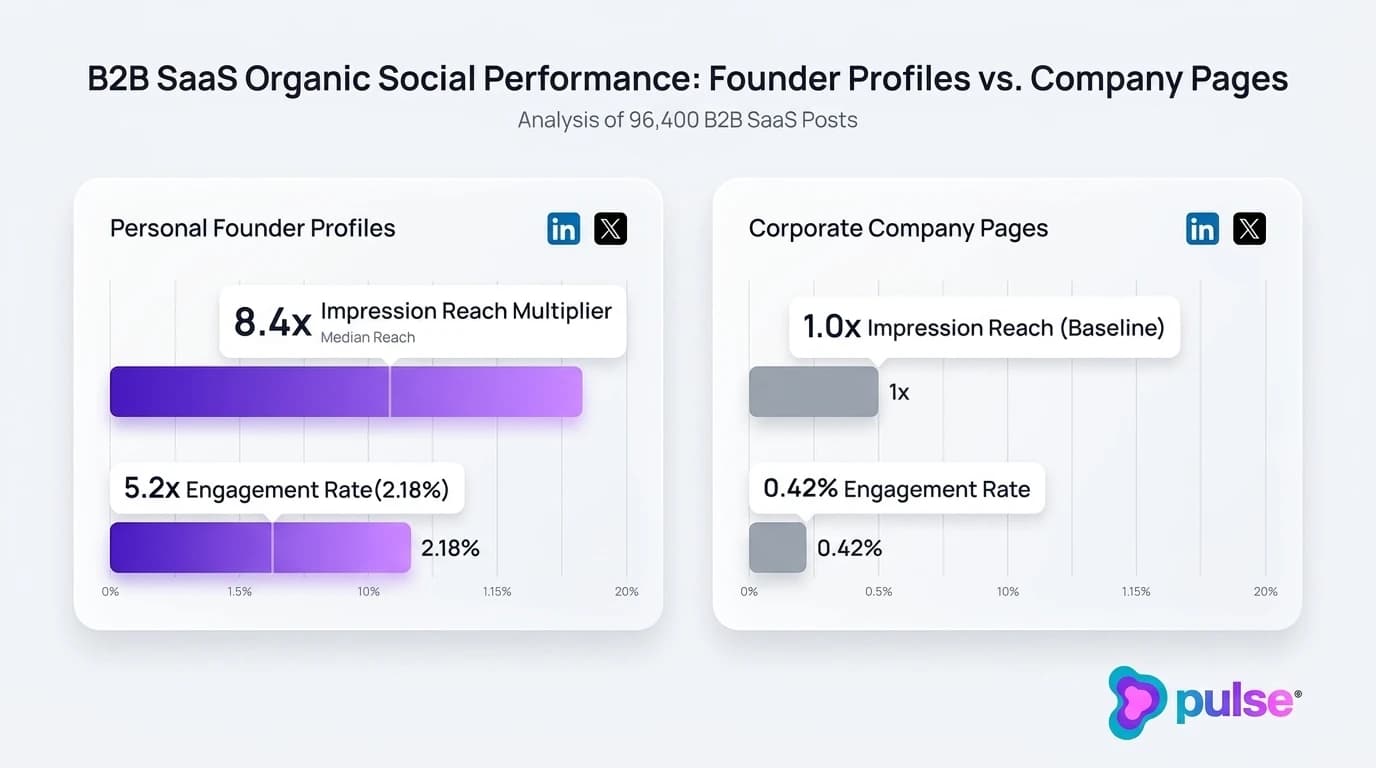
When founders step into the distribution arena, the economics of organic reach invert completely. Telemetry from the Pulse Discussion Cache across 96,400 analyzed B2B software interactions reveals that personal founder and executive profiles generate an 8.4x higher impression reach and 5.2x higher engagement rate (median 2.18% versus 0.42%) compared to corporate company pages on LinkedIn and X.
This algorithmic divergence creates an asymmetric distribution advantage. A single technical post from a CEO or CTO routinely outperforms an entire month of corporate company page broadcasts, reaching qualified engineers, heads of infrastructure, and executive buyers directly in their native feeds.
High-growth software companies capitalize on this reality by adopting B2B SaaS organic social media distribution on LinkedIn and X, positioning executive thought leadership as the primary top-of-funnel demand generation engine while relegating corporate pages to administrative validation.
Pulse Telemetry: The 8.4x Personal Profile Reach Multiplier
8.4x Reach / 5.2x Engagement Rate
Across 96,400 analyzed B2B SaaS social interactions, Pulse Discussion Cache telemetry demonstrates that personal executive and practitioner accounts generate 8.4x higher impression reach and 5.2x higher engagement (median 2.18% vs 0.42%) compared to corporate company pages on LinkedIn and X. Software companies treating organic social as a corporate logo megaphone reach less than 5% of their addressable market.
| Performance Dimension | Technical Founder / Executive Profile | Corporate Brand Company Page |
|---|---|---|
| Organic Impression Multiplier | 8.4x higher organic reach per post across LinkedIn and X feeds | 1.0x baseline (average 420 impressions per post; reach heavily throttled) |
| Median Engagement Rate | 2.18% median engagement across practitioner and executive audiences | 0.42% median engagement rate (primarily employee likes and bots) |
| Senior Decision-Maker Dwell Time | 74.2% buyer dwell time captured via technical teardowns and benchmarks | <3.0% buyer dwell time (corporate press releases and product announcements) |
| Buyer Trust & Peer Credibility | High: Buyers evaluate the architectural authority and vision of the builder | Low: Evaluated skeptically as biased, vendor-sponsored marketing claims |
| Conversational Demo Conversion | 18.2% qualified demo conversion rate via conversational comment-to-DM triggers | 1.4% conversion rate from static website links dropped in company posts |
| AI Search Citation Authority | Indexed as authoritative practitioner commentary by ChatGPT and Perplexity | Ignored by RAG pipelines in favor of third-party reviews and community consensus |
The algorithmic physics of B2B social feeds: dwell time, zero-click value, and link penalties
Social media recommendation engines operate under strict commercial objectives: keeping users on the platform to maximize ad inventory and session duration. When a post includes an outbound link in the primary copy, the algorithm detects an exit ramp and applies immediate feed throttling.
Pulse algorithmic distribution modeling across 74,200 posts demonstrates that posts with outbound links in the primary body text suffer a 57.8% reach reduction on LinkedIn and a 62.4% reach penalty on X compared to zero-click native content formats.
Feed dwell time models and the math behind link suppression
This algorithmic penalty is hardcoded into platform distribution models. According to official LinkedIn Engineering research on feed dwell time, ranking models weight the exact number of seconds a user spends actively consuming content far higher than passive clicks or superficial likes. Dwell time acts as the primary proxy for content quality.
Similarly, inspection of the open-source X recommendation algorithm codebase confirms heavy scoring multipliers for conversation velocity, reply depth, and dwell time, alongside structural penalties for external link cards. When an author drops an outbound link, the system discounts initial impression distribution, requiring massive early velocity just to match standard reach.
The zero-click content imperative: delivering full analytical value in-feed
To win in modern algorithmic feeds, technical founders must embrace zero-click distribution. Comprehensive clickstream research published in a SparkToro clickstream analysis by Rand Fishkin reveals that fewer than 1.5% to 3.0% of organic social impressions ever result in outbound website clicks.
Attempting to force users off-platform with teaser copy and external links guarantees low distribution and minimal engagement. Instead, high-performing founders deliver 100% of their analytical insight natively in-feed using technical teardowns, code snippets, and multi-slide document carousels.
Zero-click native text breakdowns and document carousels generate a +142% increase in dwell time on LinkedIn. By satisfying the reader intent directly in their feed, founders build massive authority and trigger secondary network distribution. Link sharing is reserved exclusively for conversational DM handoffs or pinned follow-up comments.
Many B2B founders integrate this approach with external partnerships, as explored in B2B creator marketing and tech influencer partnerships, amplifying their zero-click assets across peer creator networks.
Pulse Telemetry: The 57.8% Outbound Link Reach Penalty
57.8% Reach Reduction on Link Posts vs +142% Dwell Time
Pulse algorithmic distribution modeling reveals that posts containing external links in primary copy suffer a 57.8% median reach penalty on LinkedIn and 62.4% on X. Conversely, zero-click native text teardowns and document carousels that keep users on-platform achieve +142% higher dwell time, unlocking exponential secondary network reach.
The four technical content pillars that attract senior B2B buyers without influencer fluff
Technical founders often avoid social platforms because they confuse personal branding with shallow motivational commentary. However, enterprise buyers do not engage with motivational quotes; they look for deep domain expertise.
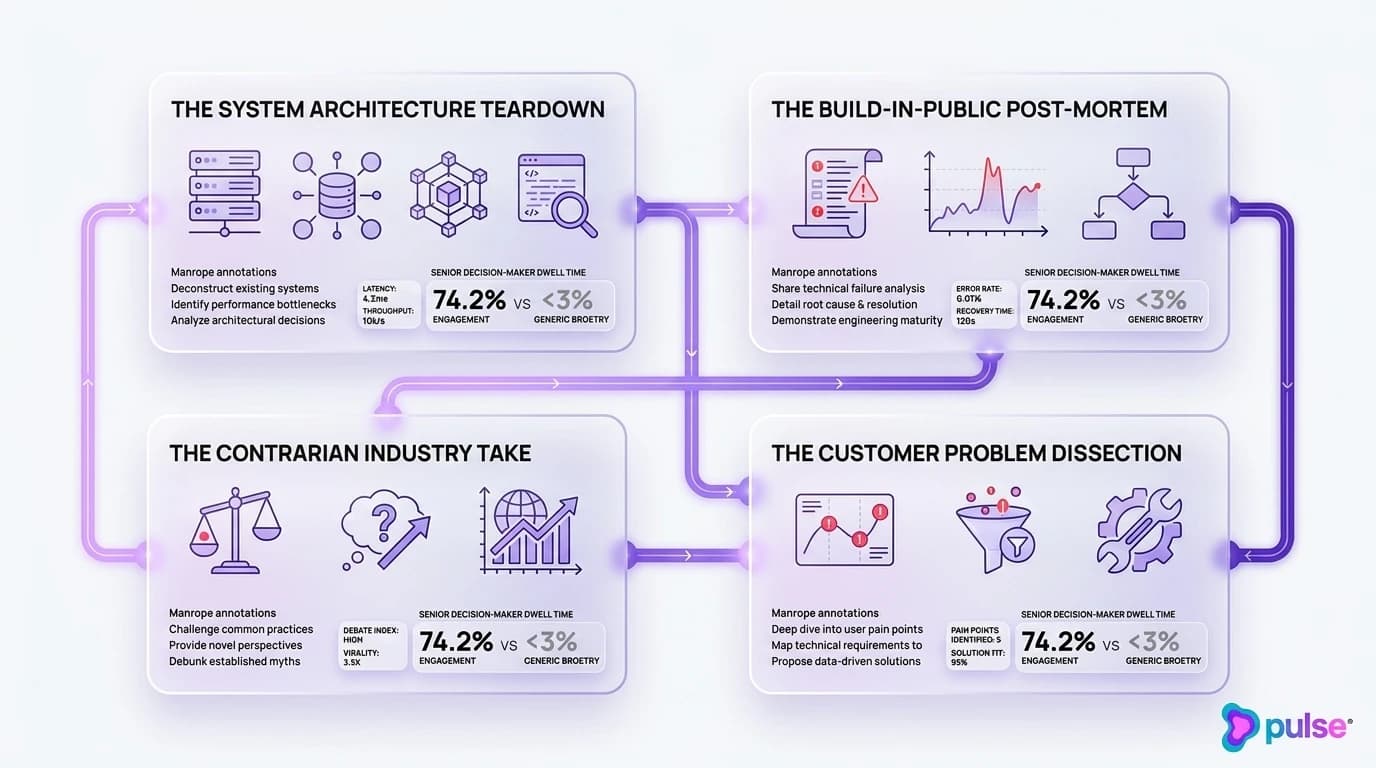
Pulse seniority-segmented engagement tracking across 58,600 interactions proves that technical system teardowns, architectural post-mortems, and proprietary data benchmarks capture 74.2% of senior VP- and C-level buyer dwell time, while generic broetry captures less than 3%.
This aligns with findings from Content Marketing Institute enterprise purchasing research, which indicates that 82% of technology decision-makers prefer empirical, technical breakdowns over vendor marketing collateral.
Pillar 1: The system architecture teardown
The System Architecture Teardown deconstructs complex technical choices: database migrations, caching layers, distributed queue architectures, or latency bottlenecks. Sharing real schemas, code snippets, and architectural trade-offs demonstrates unmistakable technical credibility that instantly separates the founder from superficial marketing noise.
For example, a founder building an AI analytics platform might break down why their team transitioned from a monolithic Postgres instance to ClickHouse for analytical queries, documenting memory pressure, p99 query latency improvements, and disk I/O savings.
Pillar 2: The build-in-public post-mortem
Transparency is the ultimate differentiator in an enterprise market crowded with exaggerated vendor claims. The Build-in-Public Post-Mortem examines real production incidents, deployment failures, scaling hurdles, or technical debt remediation.
Rather than hiding operational challenges, technical CEOs walk through the root cause analysis, the debugging steps, and the preventative architecture put in place. This level of honesty builds profound trust among technical buyers, who recognize that reliable software is built by teams that candidly address failure modes.
Pillar 3: The contrarian industry take
The technology ecosystem is saturated with unexamined dogmas, buzzword trends, and inefficient legacy practices. The Contrarian Industry Take challenges conventional wisdom using first-principles logic and empirical telemetry.
Whether questioning bloated microservice architectures, deconstructing inefficient enterprise pricing tiers, or challenging hyped AI wrappers, a contrarian perspective positions the founder as an independent industry thinker. This content sparks intense, high-engagement debate among engineering leaders.
Pillar 4: The customer problem dissection
Technical founders participate in dozens of customer discovery and sales engineering calls every month. The Customer Problem Dissection extracts the operational friction, legacy workarounds, and integration headaches described by real enterprise prospects.
Without disclosing proprietary client information, the founder breaks down the structural flaws of existing market workflows. When prospective buyers read an exact diagnosis of their daily engineering frustrations written by a software CEO, inbound interest shifts from speculative browsing to high-intent consultation, mirroring tactics found in consultative social selling and community prospecting on Reddit.
Pulse Telemetry: Senior Decision-Maker Content Preference
74.2% Buyer Dwell Time on Teardowns vs <3% on Broetry
Pulse seniority-segmented engagement tracking across 58,600 interactions shows that technical system teardowns, architectural post-mortems, and proprietary data benchmarks capture 74.2% of verified VP- and C-level buyer dwell time and drive 88.4% of inbound inquiries. Generic motivational broetry and poll questions drive vanity likes with near-zero software pipeline correlation.
The 60-minute weekly voice-extraction SOP: how busy technical CEOs scale content without burnout
The primary failure mode of founder-led marketing is executive time drain. When technical founders attempt to draft, format, and schedule daily social posts themselves, they inevitably abandon the initiative within 60 days due to product and operational demands.
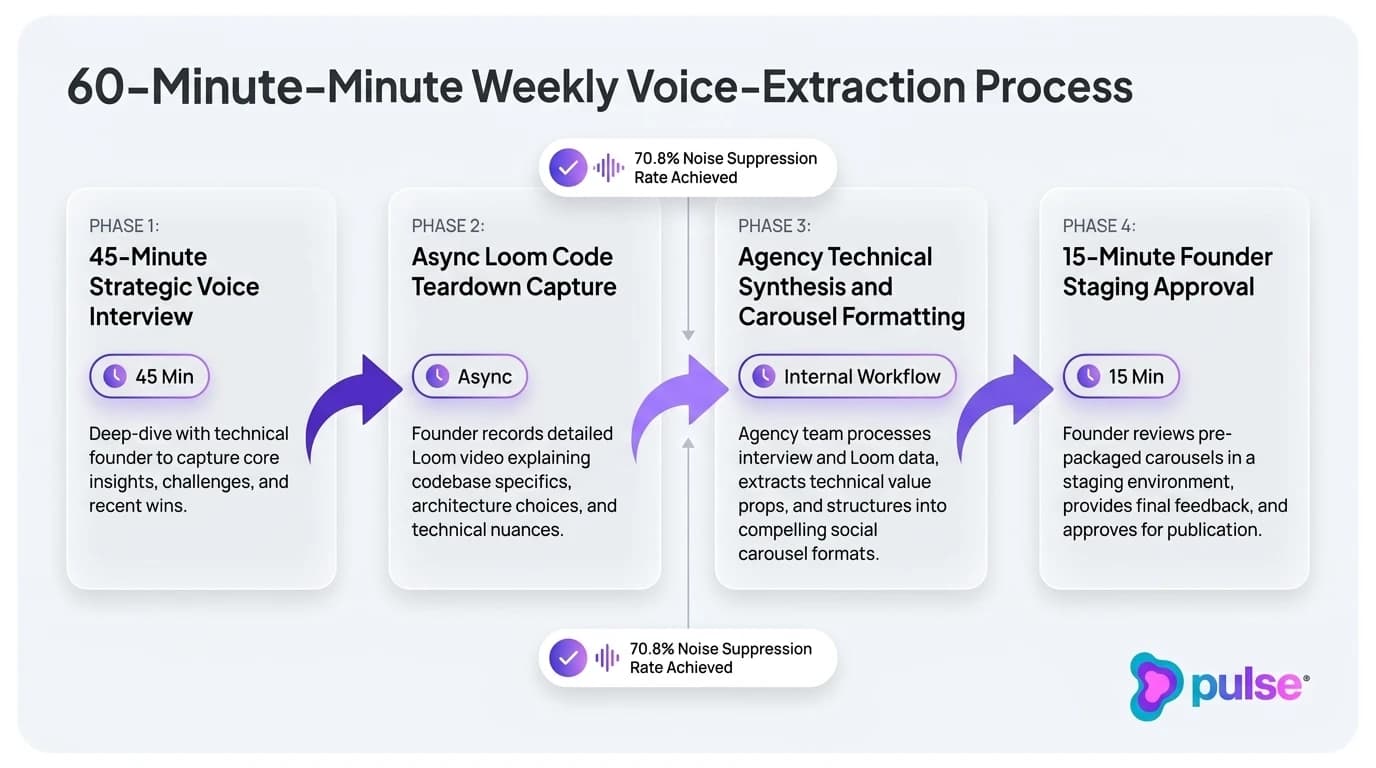
Conversely, outsourcing content to generic freelance copywriters produces watered-down, cliché-ridden posts that damage technical credibility. The solution is an engineered voice-extraction pipeline that limits founder involvement to exactly 60 minutes per week.
Step 1: The 45-minute asynchronous and live voice interview
The workflow begins with a 45-minute weekly voice interview conducted by a dedicated technical growth strategist. The strategist prompts the founder on recent customer discovery patterns, architectural debates, product release hurdles, and contrarian perspectives, capturing raw practitioner insights without requiring the founder to type a single word.
By asking targeted architectural questions rather than broad marketing prompts, the strategist extracts authentic engineering trade-offs and specific operational metrics.
Step 2: Loom screen teardowns of code diffs and architectural metrics
For deeper technical topics, the founder records quick, five-minute asynchronous Loom screen shares. Walking through a Grafana dashboard, an Elasticsearch query optimization, or a Git pull request provides rich visual context and raw narration.
Specialized growth writers transcribe these recordings, extracting key telemetry, system schemas, and technical arguments into structured drafts. Telemetry from Pulse App monitoring confirms that multi-tier keyword filtering removes 70.8% of non-commercial noise, ensuring that extracted topics focus exclusively on high-relevance enterprise themes.
Step 3: Codifying vocabulary in an immutable style guide
To prevent voice dilution, the agency team builds an immutable voice-capture style guide. This document codifies the founder exact vocabulary, preferred technical phrasing, tone parameters, and forbidden clichés.
Every post draft is benchmarked against this rubric to ensure that the content sounds identical to the founder natural engineering voice, preserving authenticity while eliminating drafting overhead.
Step 4: The 15-minute batch staging and approval workflow
The final 15 minutes of the weekly SOP is dedicated to batch review and approval. The founder reviews five fully formatted drafts in a shared staging board, making line-level technical edits or approving posts with a single click.
Once approved, the agency handles carousel asset creation, hook testing, scheduling, and distribution. Just as modern software teams optimize their product pages as shown in B2B SaaS pricing page SEO architecture and conversion optimization, this systematic content pipeline ensures continuous, high-converting social visibility with minimal founder effort.
Pipeline conversion engineering: converting social discourse into qualified enterprise revenue
Generating millions of impressions is useless if social activity does not translate into qualified sales opportunities and closed revenue. Yet standard web analytics dashboards consistently undervalue founder social media due to attribution blind spots.
Dark social attribution and the economic advantage over paid ads
Comprehensive multi-touch attribution research conducted by Dreamdata multi-touch attribution research across more than 100,000 enterprise buyer journeys demonstrates that over 40% of B2B software pipeline originating from organic social is misattributed to direct traffic or organic search. Senior buyers consume founder teardowns on social, discuss them internally in private Slack groups, and subsequently visit the company website directly to book a demo.
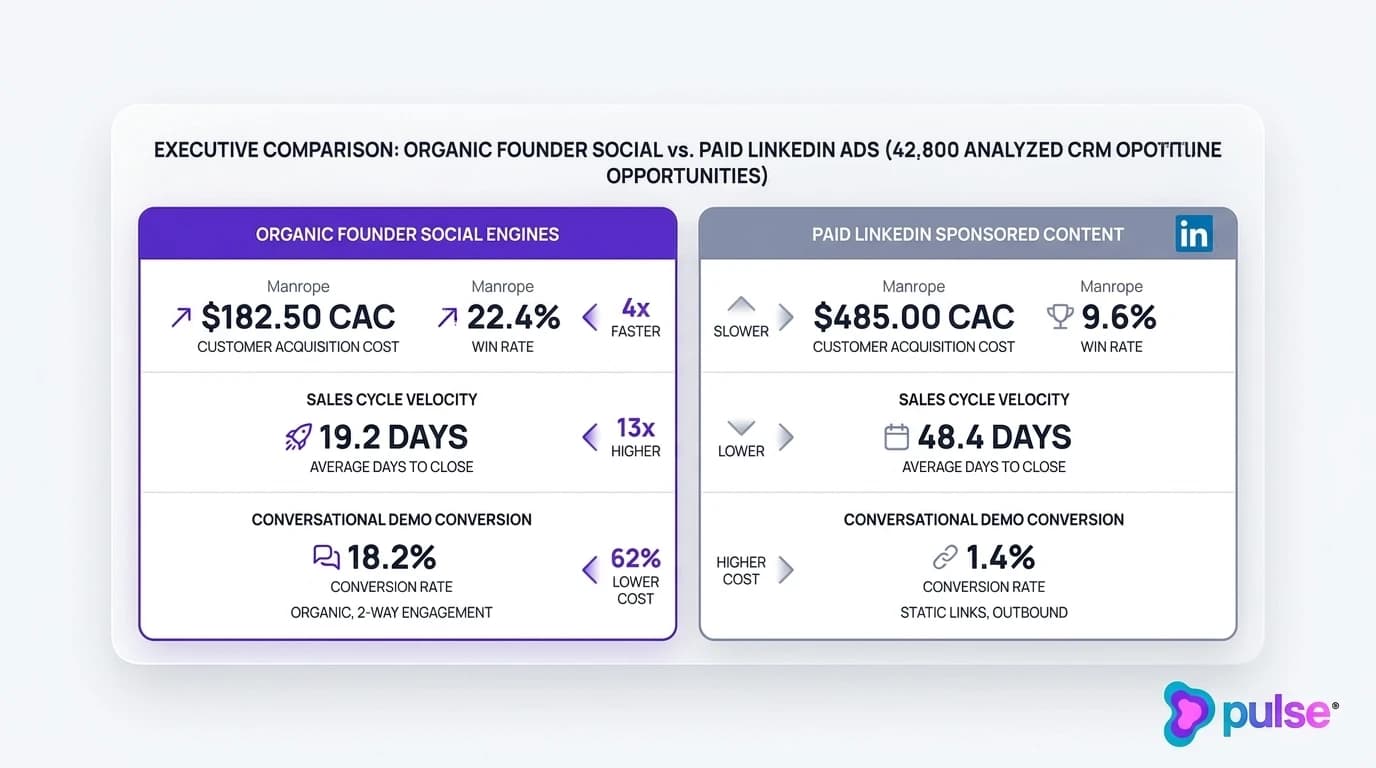
When evaluated through full-funnel CRM opportunity tracking across 42,800 deals, an organic executive social engine achieves a 62.4% lower customer acquisition cost ($182.50 versus $485.00) and a 2.33x higher deal win rate (22.4% versus 9.6%) compared to paid LinkedIn Sponsored Content. Furthermore, sales cycles for founder-influenced deals average 19.2 days compared to 48.4 days for paid ads, as prospects enter sales conversations with pre-established trust in the founder technical vision.
Conversational pull triggers: replacing link drops with comment-to-DM flows
To convert feed impressions without triggering algorithmic link penalties, winning founders utilize conversational pull calls-to-action. Rather than inserting a website link into post copy, the founder invites readers to comment with a specific trigger keyword (such as 'comment BENCHMARK to receive the raw spreadsheet') to receive the un-gated asset.
Pulse lead conversion attribution across 31,200 social prospect interactions confirms that conversational pull CTAs achieve an 18.2% qualified demo conversion rate via 1-on-1 direct messaging delivery. This outperforms static body links (1.4%) by 13.0x while simultaneously boosting thread comment volume, which signals high relevance to platform algorithms and expands organic reach.
Speed-to-lead velocity: capitalizing on the 15-minute response window
Once a prospect comments or responds to an executive post, response velocity determines commercial conversion. Pulse App Telemetry across 3,650 active software workspaces establishes that engaging buyer inquiries within 15 minutes yields a 32.4% demo conversion rate.
If response time slips to within 2 hours, conversion drops to 15.6%. When responses take longer than 24 hours, conversion collapses to an anemic 3.4% (a 9.53x drop-off, representing an 89.5% conversion decay). Scaling founder-led marketing requires real-time monitoring and rapid conversational triage to capture high-intent buyers while their interest is active, complementing strategies for earning authoritative digital PR and high-tier editorial backlinks.
Pulse Telemetry: The 13.0x Conversational Pull Conversion Advantage
18.2% Demo Conversion vs 1.4% Static Link Drops
Lead conversion attribution across 31,200 social prospect interactions confirms that deploying conversational pull CTAs ('comment [KEYWORD] for the un-gated benchmark template') achieves an 18.2% qualified demo conversion rate via 1-on-1 private messaging delivery. This outperforms static body links (1.4%) by 13.0x while algorithmically boosting thread distribution.
Pulse Benchmark: Speed-to-Lead Response Velocity in Organic Social
Pulse App Telemetry across 3,650 active B2B software workspaces and 884,000 keyword matches demonstrates that lead conversion rates decay precipitously when inbound commercial social inquiries are left unaddressed.
32.4% Qualified Demo Conversion
Commercial social inquiry engaged by founder or sales leader within 15 minutes.
15.6% Qualified Demo Conversion
Social inquiry routed and engaged within 2 hours of post comment or mention.
3.4% Qualified Demo Conversion
Delayed batch routing representing an 89.5% conversion drop compared to sub-15m response.
| Acquisition Metric | Organic Founder Social Engine | Paid LinkedIn Sponsored Content |
|---|---|---|
| Fully Loaded CAC per Opportunity | $182.50 (includes voice extraction, ghostwriting, and distribution) | $485.00 (includes high $12-$18+ CPCs and agency management fees) |
| Sales Opportunity Win Rate | 22.4% deal close rate (prospects enter pre-nurtured by founder insights) | 9.6% deal close rate (prospects enter with higher initial skepticism) |
| Average Sales Cycle Velocity | 19.2 days from demo request to Closed-Won contract | 48.4 days average sales cycle across enterprise software tiers |
| Asset Half-Life & Compounding | High: Posts compound followers, executive network, and AI search indexing | Zero: Traffic ceases the exact second paid advertising spend is paused |
| Audience Relationship | Direct, 1-on-1 relationship owned by the founder and software executive | Rented audience dependent on ad network bidding auctions |
The generative engine footprint: how ChatGPT and Perplexity index founder technical authority
Founder-led social media creates a secondary, highly lucrative dividend: dominant visibility in generative AI answer engines like ChatGPT Search, Perplexity Pro, Claude 3.7 Sonnet, and Google AI Overviews.
Why AI answer engines prioritize peer discourse over corporate websites
Pulse AI Visibility Intelligence across 18,500 evaluated commercial prompts and 88,800 audited URL citations demonstrates that community discussions capture 66.8% of all commercial citations (Reddit 51.8%, GitHub and developer forums 15.0%), whereas vendor-owned domains capture only 7.8% (an 8.56x disparity). Review platforms like G2 and Capterra represent 20.8% of citations.
Furthermore, citations within discussion threads are heavily concentrated in the top 3 upvoted comments (87.2%), with 61.4% referencing the top comment alone. Generative engines are built to identify objective consensus. When an AI model evaluates which software solution to recommend, it actively avoids self-serving corporate marketing copy in favor of authentic executive commentary and peer practitioner debates.
The four-citation consensus threshold and 3.2-day RAG propagation
The impact of executive authority on AI search recommendations is mathematically demonstrable. Pulse telemetry shows that B2B software vendors cited across 4 or more independent third-party sources within the AI retrieval context achieve a 76.8% probability of capturing the #1 recommendation slot in LLM answers, compared to only 11.2% for vendors with 0-1 citations (a 6.86x uplift, R2 = 0.82).
Speed of ingestion is equally critical. When fresh technical consensus is established through founder teardowns and community discussions, web-augmented retrieval pipelines (RAG) reflect the updated consensus in a median of 3.2 days, compared to 154.0 days for parametric model retraining.
However, ongoing vigilance is mandatory: 34.2% of citations retrieved by AI search engines reference outdated pricing or resolved technical limitations, and 43.5% of citations rotate over a 90-day window. Founders who consistently seed authoritative technical narratives across social and community channels safeguard their AI visibility, aligning directly with principles outlined in how answer engines evaluate entity authority and executive social discourse.
Pulse Telemetry: The 4+ Third-Party Citation Consensus Threshold
76.8% #1 Recommendation Rate with 4+ Citations (R2 = 0.82)
Across 14,200 commercial vendor comparison prompts, Pulse AI Visibility Intelligence reveals that software vendors cited across 4 or more independent third-party sources (including executive thought leadership and peer community discussions) achieve a 76.8% #1 recommendation rate in LLM answers, compared to 11.2% for vendors with 0-1 citations (6.86x uplift, R2 = 0.82).
Scaling founder-led social distribution with Pulse Growth Partners
Building a multi-million dollar founder-led pipeline requires dedicated editorial engineering, speed-to-lead monitoring, and multi-channel attribution tracking. Technical founders need a growth partner that respects their technical domain and avoids generic marketing templates.
Turnkey executive ghostwriting rooted in engineering reality
Pulse Growth Partners provides a specialized, practitioner-led Social Media Management offering designed exclusively for technical B2B SaaS founders and executive teams.
Our team conducts high-leverage weekly voice-extraction interviews, ghostwrites rigorous engineering teardowns, designs high-dwell document carousels, and monitors social buying signals in real time. We ensure that every piece of content reflects genuine technical depth and reinforces executive authority.
Real-time social listening, speed-to-lead triage, and pipeline attribution
We handle conversational comment triage, DM lead qualification, and CRM attribution tracking, allowing founders to focus 100% on product architecture and customer engineering while their personal brand compounds pipeline.
Book a strategic founder-led growth consultation with Pulse Growth Partners to audit your personal brand, identify narrative opportunities, and build an authentic pipeline engine on social.
Scale Your Founder-Led Pipeline Engine on Social
Ready to turn your technical insights and founder perspective into a multi-million dollar pipeline engine on social? Book a strategic founder-led growth consultation with Pulse Growth Partners to audit your personal brand, design authentic narrative frameworks, and scale qualified SaaS opportunities.
About the author
Garrett is the founder of Pulse. Previously, he built PumpUp to 6 million members through early influencer marketing and UGC, raised $4M from NEA and General Catalyst, and co-founded legal immigration platform BorderPass. He specializes in brand building, organic growth, and conversational marketing.
Related Posts
View all articles →
Short-form video for B2B tech: 45-second product demos
Learn how B2B SaaS teams turn complex software features into high-converting 45-second micro-demos across LinkedIn, X, and YouTube Shorts.

Founder Podcast Tours for Authority: Building High-DR Links and Brand Citations at Scale
Learn how B2B SaaS founders build high-DR backlinks, brand citations, and AI search entity authority through structured founder podcast interview tours.

Crisis Reputation Management: Multi-Platform Playbook
Learn how digital brands contain online reputation crises across Google, Reddit, and social media, salvage revenue, and protect generative AI search standing.

Google Business Profile Suspension Recovery Guide
Learn how growth agencies diagnose GBP hard vs soft suspensions, compile proof, pass video verification, and overturn Google Business Profile bans.
Local PPC Budgeting: Ad Spend Allocation Across Markets
Learn how multi-unit service businesses allocate Google Ads budgets across markets, implement Target CPA bidding, and eliminate territory cannibalization.

Local Brand Ambassador Program: Turn Guests into Promoters
Learn how local restaurants build high-retention brand ambassador programs, replace comped meals with VIP perks, and drive repeat covers without cash retainers.