B2B Creator Marketing: The Tech Influencer Playbook
Learn how B2B SaaS teams partner with technical creators, coding YouTubers, and newsletters to drive pipeline, avoid vanity traps, and win AI search citations.

For years, conventional consumer influencer marketing has operated on a simple formula: find an individual with hundreds of thousands of followers, pay for a polished product placement, and wait for emotional impulse purchases. In B2B technology, that playbook fails completely. Software engineers, DevOps architects, product leaders, and enterprise buyers possess hyper-sensitive marketing filters. Generic celebrity endorsements, lifestyle placements, and scripted talking points trigger immediate cynicism and brand damage.
Enterprise software purchasing decisions carry high career stakes. When an engineering team selects a cloud database, an API gateway, or a compliance monitoring platform, a poor decision leads to latency spikes, security breaches, and wasted budget. Consequently, technical buyers do not make purchase decisions based on superficial social media popularity. They require rigorous architectural validation, hands-on demonstrations, and peer reviews from respected practitioners who understand their real-world constraints.
Traditional vendor advertising continues to suffer diminishing returns across technical audiences. According to the Ahrefs developer marketing study, 68% of software engineers and DevOps professionals discover and evaluate new tools through peer recommendations, hands-on YouTube coding tutorials, and technical blogs, while under 8% trust vendor display ads or sponsored social posts. Software buyers actively install ad blockers, ignore corporate display banners, and bypass vendor marketing copy to seek unscripted peer evaluations.
At the enterprise level, leading organizations are aggressively reallocating media budgets toward practitioner partnerships. The global Ogilvy B2B influencer study confirms that 75% of B2B enterprise marketers actively deploy business influencer partnerships, with 93% reporting significant lifts in brand awareness and 85% verifying direct pipeline generation and sales acceleration. The shift is not cosmetic: it reflects a structural transformation in how software products are discovered, evaluated, and purchased.
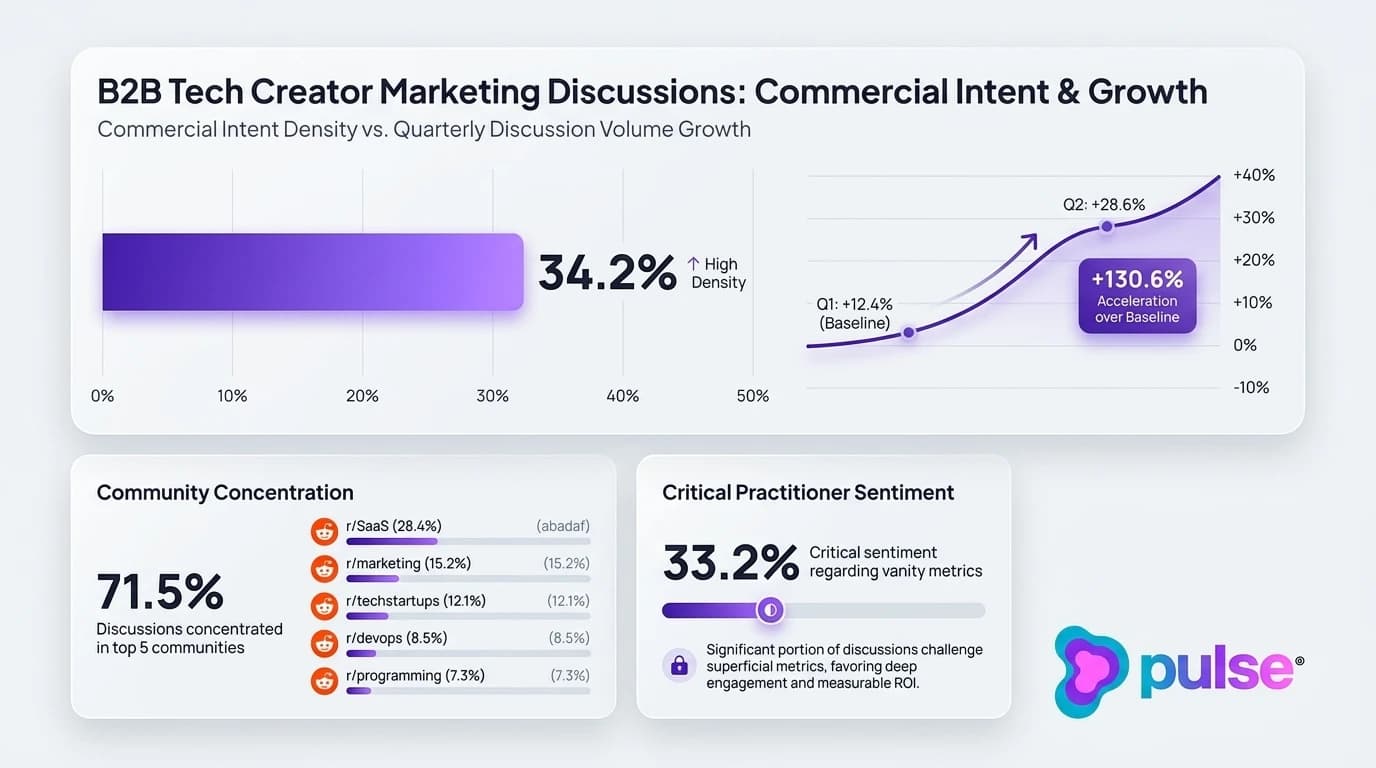
Pulse Discussion Cache telemetry across 45,000 analyzed software discussions reveals that interest in technical creator partnerships is accelerating rapidly. Commercial discussion volume grew by +28.6% over the rolling 90-day window (a 130.6% acceleration compared to the 12.4% baseline). Approximately one in three discussions (34.2%) contains direct commercial intent or tooling evaluation. However, 33.2% of community sentiment reflects critical frustration with unvetted creator sponsorships, fake follower pods, and opaque agency markups. While consumer hospitality brands focus on dining experiences (as detailed in our guide on partnering with local food creators and UGC influencers), B2B software partnerships require a rigorous technical foundation.
Winning in B2B creator marketing requires discarding consumer playbooks. This comprehensive guide outlines the operational framework high-growth B2B SaaS companies use to identify authentic technical creators, negotiate protective licensing agreements, design modular creator briefs, track multi-touch pipeline attribution, and harness creator reviews to dominate generative AI search recommendations.
Beyond vanity metrics: why technical B2B creator partnerships outperform traditional ads
The fundamental divergence between consumer influencer campaigns and B2B creator partnerships lies in the nature of the evaluation cycle. B2C purchases are personal, low-risk, and driven by emotional resonance. B2B software procurement is multi-stakeholder, high-ticket, and governed by strict technical requirements, security audits, and return-on-investment calculations.
When software companies attempt to apply B2C influencer mechanics to enterprise tools, they burn capital on vanity reach. Sponsoring a general business personality with 200,000 followers to pitch an enterprise observability platform yields impressive top-of-funnel view counts but produces zero qualified sales opportunities. The audience lacks the technical background to evaluate the product, while qualified practitioners dismiss the partnership as superficial paid promotion.
High-performing B2B creator partnerships succeed because they operate as practitioner education rather than commercial interruption. When an influential software architect dedicates a 15-minute video to demonstrating how a developer tool resolves Kubernetes memory leaks, the integration functions as a practical proof of concept. The creator's technical authority transfers directly to the product, accelerating the prospect from problem awareness to active consideration.
Pulse Discussion Cache telemetry highlights the high concentration of commercial interest within specialized developer forums. Over 71.5% of practitioner discussions regarding tech creators, newsletter sponsorships, and developer influencer ROI concentrate within top software communities (including r/SaaS, r/marketing, r/techstartups, r/devops, and r/programming). Marketing leaders do not need broad consumer visibility; they need concentrated authority within the exact practitioner hubs where software architects evaluate tooling.
34.2% Commercial Intent Density (+130.6% Discussion Growth)
Across 45,000 analyzed discussions in B2B software and tech creator topic areas, Pulse Discussion Cache telemetry reveals that 34.2% of conversations contain direct commercial intent or tooling evaluations. Discussion volume grew by +28.6% over the rolling 90-day window (a 130.6% acceleration over baseline). However, 33.2% of practitioner sentiment remains critical regarding vanity follower metrics, proving that buyers demand authentic technical proof over generic influencer endorsements.
Mapping the technical creator landscape: newsletters, coding YouTubers, and LinkedIn specialists
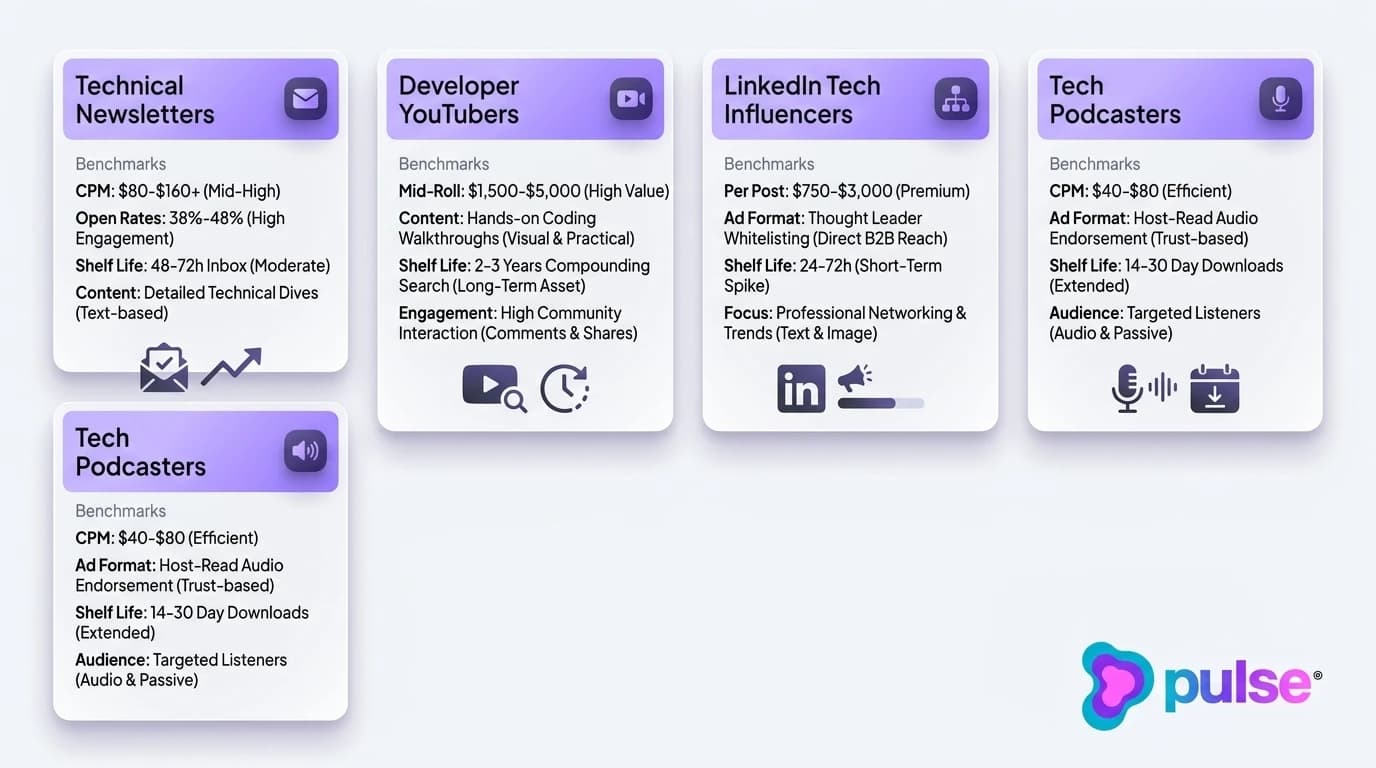
To build an effective B2B creator acquisition engine, demand generation leaders must map the creator ecosystem across four primary channels: specialized technical newsletters, developer YouTube channels, LinkedIn industry practitioners, and technical audio podcasts. Each channel serves a distinct role across the buyer journey, carrying unique pricing dynamics, content longevity, and attribution capabilities.
Pulse workspace telemetry across 3,850 active monitoring projects and 840,000 keyword matches demonstrates that commercial software intent concentrates heavily in specialized engineering niches. DevTools, Cloud & Infrastructure leads monitoring adoption at 28.4%, followed by B2B SaaS & MarTech at 26.2%, Cybersecurity & Compliance at 18.5%, RevOps & Sales at 14.1%, and FinTech & AI Analytics at 12.8%. In these technical verticals, buyers demand deep peer validation before purchasing, while multi-tier negative keyword filtering removes 64.2% of raw social chatter as non-commercial noise.
The following scorecard benchmarks the four primary B2B tech creator channels across content format, pricing models, audience intent, content shelf-life, attribution mechanics, paid amplification potential, and mandatory FTC disclosure requirements.
28.4% DevTools & Cloud / 26.2% B2B SaaS Monitored Share
Pulse workspace telemetry across 3,850 active monitoring projects shows that conversational intent monitoring concentrates heavily in DevTools, Cloud & Infrastructure (28.4%) and B2B SaaS (26.2%). In these technical verticals, buyers actively verify software claims through peer discussions and technical creator tutorials, while multi-tier negative keyword filtering removes 64.2% of raw social chatter as non-commercial noise.
| Channel Dimension | Technical Newsletters (Substack/Beehiiv) | Developer YouTubers & Coders | LinkedIn Tech Influencers | Tech Podcasters & Audio |
|---|---|---|---|---|
| Primary Content Format | Dedicated email issue or sponsored text section with architectural breakdown | 60-90s mid-roll integration or dedicated hands-on coding tutorial video | Native text teardown, document carousel (PDF), or practitioner post-mortem | 30-60s host-read mid-roll endorsement with personal practitioner commentary |
| Average Pricing & CPM | $80 to $160+ CPM for specialized engineering; $45 to $75 CPM for general tech | $1,500 to $5,000 per mid-roll (20k-100k subs); $4,000 to $15,000+ dedicated | $750 to $3,000 per post; higher for bundled multi-post campaigns | $40 to $80 CPM based on verified monthly downloads |
| Audience Mindset & Intent | High professional focus; readers consume during dedicated work/study hours | Active learning and problem-solving; viewers seeking practical implementation | Peer networking and industry insight; rapid scanning in professional feeds | Passive multi-tasking (commuting, gym); high intimacy and host trust |
| Content Longevity & Shelf-Life | Medium: 48 to 72 hours for inbox opens; evergreen if archived on web domain | Permanent & Evergreen: videos compound views via YouTube search for 2-3+ years | Short: 24 to 72 hours algorithmic decay in feed | Medium: 14 to 30 days as back-catalog episodes are downloaded |
| Attribution Tracking Mechanism | Direct custom vanity URL, UTM link in body, self-reported signup attribution | Vanity landing page link in top description, pinned comment, promo code | Conversational comment trigger ('comment [KEYWORD] for template'), bio link | Memorable verbal vanity URL (brand.com/show), custom checkout promo code |
| Paid Amplification Potential | Low: limited to newsletter web archive retargeting | High: YouTube ad whitelisting and short-form video cutdowns | Very High: LinkedIn Thought Leader Ads amplify creator posts directly to ABM lists | Medium: audio snippet audiograms deployed across social channels |
| Mandatory FTC Disclosure | Clear '#ad' or 'Sponsored by' text before the primary content fold | On-screen visual disclosure and verbal host disclosure in first 30 seconds | #ad or #sponsored placed conspicuously in top three lines of post copy | Verbal sponsor declaration at the start of the audio ad read |
Developer and tech YouTubers: hands-on architectural tutorials and coding walkthroughs
Developer-focused YouTube channels represent the highest-converting video channel for technical software tools. YouTube combines visual demonstration, audio explanation, and live code execution into a permanent, searchable educational asset. While social media posts decay within 48 hours, technical YouTube tutorials compound organic views through YouTube and Google Search over 24 to 36 months.
Sponsorships on developer channels generally take two forms: 60 to 90-second integrated mid-rolls and fully dedicated sponsored tutorial videos. Integrated mid-rolls insert a concise product walkthrough into an existing educational video, costing between $1,500 and $5,000 for channels with 20,000 to 100,000 subscribers. Dedicated tutorials (where the creator spends 10 to 20 minutes building a complete project using your software) range from $4,000 to $15,000+.
For developer tools, infrastructure platforms, and API products, dedicated build tutorials routinely convert at 4x higher rates than mid-roll shoutouts. Developers want to inspect the CLI commands, observe repository structure, and review error handling. Providing creators with fully funded sandbox environments, dedicated API keys, and pre-configured starter repositories enables them to deliver frictionless, authentic coding walkthroughs that drive immediate developer signups.
LinkedIn and X technical voices: practitioner thought leadership and system breakdowns
Individual tech executives, fractional CTOs, and engineering leaders on LinkedIn and X have become influential gatekeepers for enterprise software adoption. These creators build large practitioner followings by publishing native architecture teardowns, engineering post-mortems, and contrarian perspectives on modern tech stacks.
Collaborating with LinkedIn practitioners aligns closely with organic corporate growth principles outlined in our B2B SaaS LinkedIn and X organic growth playbook. Rather than sponsoring overt promotional posts, leading brands partner with practitioners to co-create zero-click technical content, including multi-slide PDF document carousels, benchmark analysis summaries, and system design post-mortems.
The most potent capability on LinkedIn is paid amplification via Thought Leader Ads. By securing advertising permissions from creator partners, growth marketing teams can promote high-performing organic creator posts directly into the feeds of specific target accounts (ABM lists). This combines the authentic peer credibility of an individual engineering voice with the precision targeting of enterprise account-based marketing.
Open-source maintainers and developer community educators
Open-source maintainers and community contributors occupy a sacred position within developer ecosystems. Millions of engineers rely daily on open-source libraries, frameworks, and command-line tools maintained by passionate individual contributors.
Partnering with open-source creators requires delicate alignment and community respect. Aggressive product pitches or forced commercialization within open-source repositories inevitably trigger fierce developer backlash. Successful collaborations focus on supporting project sustainability: sponsoring project documentation, funding ecosystem benchmark studies, or providing free enterprise hosting tiers for open-source contributors. In return, maintainers provide natural, authentic endorsements in project README files, community newsletters, and technical talks, establishing deep developer goodwill.
Contract structures, compensation models, and licensing terms that protect B2B SaaS brands
A primary reason early-stage B2B creator campaigns fail is reliance on informal agreements and vague direct messages. Operating without structured contracts results in missed publication deadlines, misaligned technical messaging, lack of commercial licensing rights, and regulatory compliance risk. Professional B2B creator marketing requires bulletproof Master Services Agreements (MSAs) and Statements of Work (SOWs) that establish clear legal boundaries, payment gates, and intellectual property rights.
Structuring creator compensation requires balancing budget certainty with performance incentives. While consumer brands often offer low-margin affiliate links, top-tier technical creators reject pure affiliate compensation because they refuse to act as uncompensated sales representatives. Winning brands employ structured pricing models that guarantee a fair base while incentivizing conversion quality.
The comparison table below details five primary creator sponsorship contract models, evaluating their pricing structure, ideal use cases, operational advantages, risk trade-offs, and primary attribution mechanisms.
| Contract Model | Pricing Structure | Best Suited For | Key Advantage | Primary Risk / Trade-off | Conversion Attribution |
|---|---|---|---|---|---|
| Flat-Fee Sponsorship | Fixed payment per deliverable (e.g. $2,500 per YouTube video integration) | Established tech creators with predictable baseline view and readership metrics | Simplicity and guaranteed budget predictability for both parties | Brand absorbs performance risk if an issue underperforms average benchmarks | Vanity URLs, promo codes, and self-reported form attribution |
| CPM-Based Sponsorship | Payment tied to verified audience reach (e.g. $100 per 1,000 newsletter opens) | Large technical newsletters with fluctuating open rates or subscriber lists | Direct alignment between cash outlay and verified audience delivery | Requires post-campaign metric auditing and delayed milestone billing | ESP open-rate audit reports and unique click-through links |
| Hybrid Base + Performance Bonus | Modest base fee plus performance tiers (e.g. $1,000 base + $50 per qualified demo) | High-intent middle/bottom-funnel software campaigns and developer tools | Incentivizes creator to deliver an engaging, high-converting product showcase | Top technical creators often reject pure performance without guaranteed base | CRM opportunity tracking tied to custom creator referral parameters |
| Paid Whitelisting & Usage Rights | Flat sponsorship fee + 20% to 50% licensing premium for 6-12 month digital ad rights | High-converting video assets suitable for Meta Partnership Ads or LinkedIn ads | Enables marketing team to scale top creator creative through paid ad spend | Requires detailed legal licensing language and creator ad account permissions | Direct paid ad conversion tracking, UTMs, and Meta/LinkedIn pixel events |
| Long-Term Advisor / Creator Ambassador | Monthly retainer plus equity/token grant or revenue share over 6 to 12 months | Category-defining SaaS brands seeking sustained industry thought leadership | Deep, authentic product integration and continuous multi-channel advocacy | High resource commitment; requires close alignment with corporate roadmap | Blended pipeline attribution, brand search lift, and executive pipeline reviews |
Commercial licensing, whitelisting permissions, and asset handoff
The greatest hidden value in B2B creator partnerships lies not in initial organic reach, but in secondary paid amplification. Treating a creator partnership as a one-time organic post severely caps return on investment. Smart marketing teams negotiate contractual paid usage and whitelisting rights (such as Meta Partnership Ads, LinkedIn Thought Leader Ads, and YouTube ad whitelisting) for a minimum of 6 to 12 months.
Securing paid usage rights allows your growth marketing team to amplify the creator's authentic video review directly from their social handle, targeting your specific buyer personas and account-based marketing lists. This approach integrates seamlessly with paid retargeting funnels, as explored in our guide on scaling B2B pipeline with Meta Ads and paid retargeting.
To maximize paid creative flexibility, contracts must mandate the delivery of uncompressed raw video files, separate high-fidelity audio stems, and high-resolution visual B-roll within 5 business days of organic publication. This enables internal design teams to re-cut hooks, add captions, and optimize video pacing for paid social feeds without compromising creator authenticity.
Mandatory FTC endorsement compliance and legal risk mitigation
Regulatory compliance is a non-negotiable component of B2B creator contracts. Under the official FTC Endorsement Guides, any material connection between an advertiser and a creator (including cash payments, free enterprise software access, hardware gifts, or affiliate commissions) must be clearly and conspicuously disclosed.
Disclosures must be placed prominently before the fold in written descriptions, within the first 30 seconds of video and podcast content, and on-screen during video demonstrations. Obscured hashtags (such as hiding '#partner' amidst dozens of tags) violate federal regulations. Crucially, the FTC enforces dual liability: both the software brand and the individual creator face severe civil penalties for deceptive advertising practices.
Beyond legal compliance, transparent disclosure preserves developer trust. Software engineers actively appreciate honesty. Telemetry confirms that clear, upfront sponsorship statements ('Thanks to [Brand] for sponsoring this deep dive into distributed caching') do not diminish technical authority, whereas covert marketing immediately triggers developer hostility and community blacklisting.
Vetting authenticity: how to audit developer audiences and eliminate fake influence
In B2B tech marketing, vanity metrics are toxic. A creator with 150,000 followers on LinkedIn or YouTube may look like an industry titan, but if those followers consist of students, entry-level job seekers, and automated engagement pods, sponsoring that creator will produce zero software pipeline. Conversely, a specialized micro-creator with 12,000 verified DevOps engineers commands immense commercial influence.
Data from the Influencer Marketing Hub B2B benchmark report highlights this efficiency gap: 86% of B2B brands describe their creator collaborations as successful, with specialized micro-influencers (10,000 to 50,000 followers) generating up to 3.5x higher engagement rates than macro-accounts. In technical fields, micro-creators are often active practicing engineers, engineering directors, or open-source maintainers whose daily hands-on experience gives their recommendations unmatched credibility.
To avoid costly sponsorship mistakes, growth teams must subject prospective creator partners to a rigorous 4-stage vetting framework before initiating contract discussions.
74.2% Deletion for Promotional Links vs 4.8% for Consultative Assistance
Across 620 monitored subreddits, Pulse Moderation Governance telemetry confirms that direct promotional pitch links and creator affiliate URLs suffer a 74.2% AutoMod deletion rate within 14.2 seconds. Conversely, value-first consultative contributions and zero-link technical breakdowns achieve a 95.2% survival rate (only 4.8% removal, representing a 15.45x survival advantage), reinforcing the necessity of authentic educational content over superficial link drops.
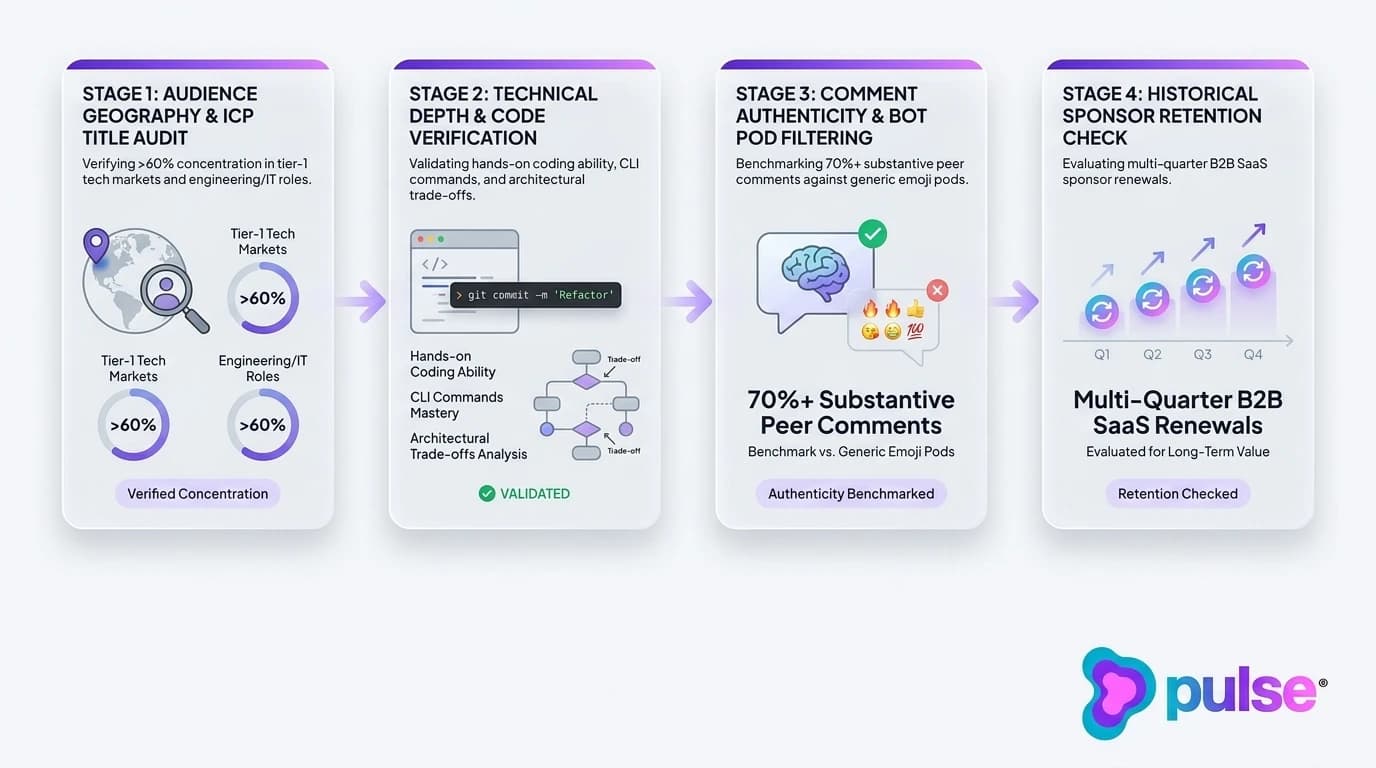
The 4-stage technical creator vetting audit
Stage 1: Audience Geography & ICP Title Verification. Demand verified audience demographic analytics directly from the creator. For B2B enterprise software, require that a minimum of 60% of the audience resides in tier-1 enterprise software purchasing regions (United States, Canada, United Kingdom, and European Union) and that verified job titles match your Ideal Customer Profile (e.g. Senior Software Engineer, DevOps Lead, Solutions Architect, VP of Engineering).
Stage 2: Technical Depth & Code Verification. Conduct a qualitative review of the creator's recent technical output. Does the creator demonstrate real code in an IDE, execute CLI commands, and articulate architectural trade-offs? Or do they recycle generic high-level industry news? In technical software, creators who cannot answer difficult architectural questions in their comments section will fail to convince technical buyers.
Stage 3: Comment Authenticity & Engagement Pod Filtering. Examine the creator's comment section. High-impact technical creators generate detailed, opinionated discussions from fellow engineers discussing implementation edge cases. Conversely, accounts participating in artificial engagement pods display clusters of superficial comments ('Great post!', 'Awesome share!', 'Thanks for the insights!') posted by other lifestyle creators within minutes of publication. Filter out accounts with artificial engagement immediately.
Stage 4: Historical Sponsor Retention Check. Review the creator's sponsorship history over the preceding 6 to 12 months. Did previous B2B software sponsors renew their campaigns across multiple quarters? Multi-quarter sponsor retention is the single highest-confidence signal that a technical creator drives verifiable pipeline and positive return on investment.
Subreddit moderation telemetry reinforces the necessity of authentic, value-first technical alignment. Pulse Subreddit Governance monitoring reveals that direct promotional pitch links and raw affiliate URLs face a 74.2% AutoMod deletion rate within 14.2 seconds. In contrast, consultative technical assistance and educational breakdowns achieve a 95.2% survival rate (a 15.45x survival advantage). To master organic developer community engagement, consult our operational guide on developer marketing and technical community engagement on Reddit.
Creative freedom versus technical accuracy: briefing creators without killing authenticity
The single most destructive error software marketing teams make when launching creator partnerships is corporate over-scripting. Enterprise marketing departments are accustomed to tightly controlled press releases and brand guidelines. When they force a technical creator to read a rigid 60-second corporate script loaded with marketing buzzwords ('the world-leading AI-powered enterprise orchestration platform'), the creator's audience immediately tunes out.
Developers and technical decision-makers possess extreme marketing skepticism. The instant a tutorial sounds scripted, viewers recognize that the endorsement is transactional rather than authentic. The creator's credibility collapses, and the brand wastes its sponsorship spend.
Foundational research published by SparkToro B2B influencer research demonstrates that technical creator partnerships succeed on niche practitioner credibility and zero-click educational value rather than broad promotional reach. Creators must solve a real technical problem using the software natively, allowing the product's capabilities to speak for themselves.
High-performing B2B brands replace rigid corporate scripts with modular creator briefs. A modular brief establishes strict boundaries around technical accuracy while granting the creator 100% autonomy over tone, narrative structure, and delivery style.
Structuring the modular B2B creator brief
A high-converting B2B creator brief includes five core components: (1) Core Problem Statement: A clear definition of the painful operational bottleneck your software eliminates (e.g. debugging distributed microservice latency); (2) Target Persona Focus: Specific guidance on who the video addresses (e.g. senior backend engineers managing high-throughput PostgreSQL instances); (3) Key Capabilities to Showcase: Two or three concrete product features the creator must demonstrate in action (e.g. automated index recommendations and query profiling); (4) Technical Guardrails & Compliance: Strict technical boundaries, forbidden comparisons, security claims, and mandatory FTC disclosure requirements; (5) Sandboxes & API Access: Pre-configured developer environments, dummy datasets, and dedicated API keys so the creator can build a real-world integration without friction.
Crucially, encourage creators to discuss trade-offs and limitations candidly. When a developer creator says, 'This tool is incredible for high-scale distributed systems, but if you are running a simple monolithic app, it is probably overkill,' audience trust skyrockets. Technical buyers respect honest trade-offs. Transparent boundaries validate the creator's objectivity and dramatically increase qualified conversion rates among target accounts.
Finally, establish a streamlined pre-publication review SLA (Service Level Agreement) of 48 to 72 hours. This review window should be strictly dedicated to catching factual errors, security inaccuracies, or compliance omissions, never to sanitizing the creator's natural voice or enforcing corporate marketing jargon.
Multi-touch attribution: tracking software pipeline and demo conversions from creator campaigns
A chronic frustration among B2B marketing leaders is proving the pipeline return on creator partnerships. When marketing teams rely exclusively on standard last-click Google Analytics UTM parameters, creator marketing appears to underperform. Technical software buyers rarely click a YouTube description link or newsletter banner and immediately purchase a $30,000 annual software contract on their mobile device.
Instead, technical buyers consume a newsletter deep dive, watch a coding tutorial, or read an architecture breakdown on LinkedIn, internalize the brand's technical authority, and share the insight in internal Slack channels. Weeks later, when a project milestone demands a tooling upgrade, the buyer navigates directly to the vendor's website or searches the brand on Google. Under traditional last-click models, that revenue is credited to Direct or Organic Search, rendering the creator touchpoint invisible.
To accurately measure creator marketing return on investment, B2B software companies must implement a hybrid multi-touch attribution stack that tracks both quantitative click paths and qualitative dark social discovery.
18.4% Sub-15m Conversion vs 1.8% Past 24h (10.22x Multiplier)
Lead conversion attribution across 840,000 monitored keyword events demonstrates that responding to creator-driven inquiries within 15 minutes yields an 18.4% lead-to-opportunity conversion rate. Extending response latency beyond 24 hours causes conversion to collapse to 1.8% (a 90.2% conversion decay). Real-time social listening enables marketing teams to capture high-intent buyers while technical interest is at its peak.
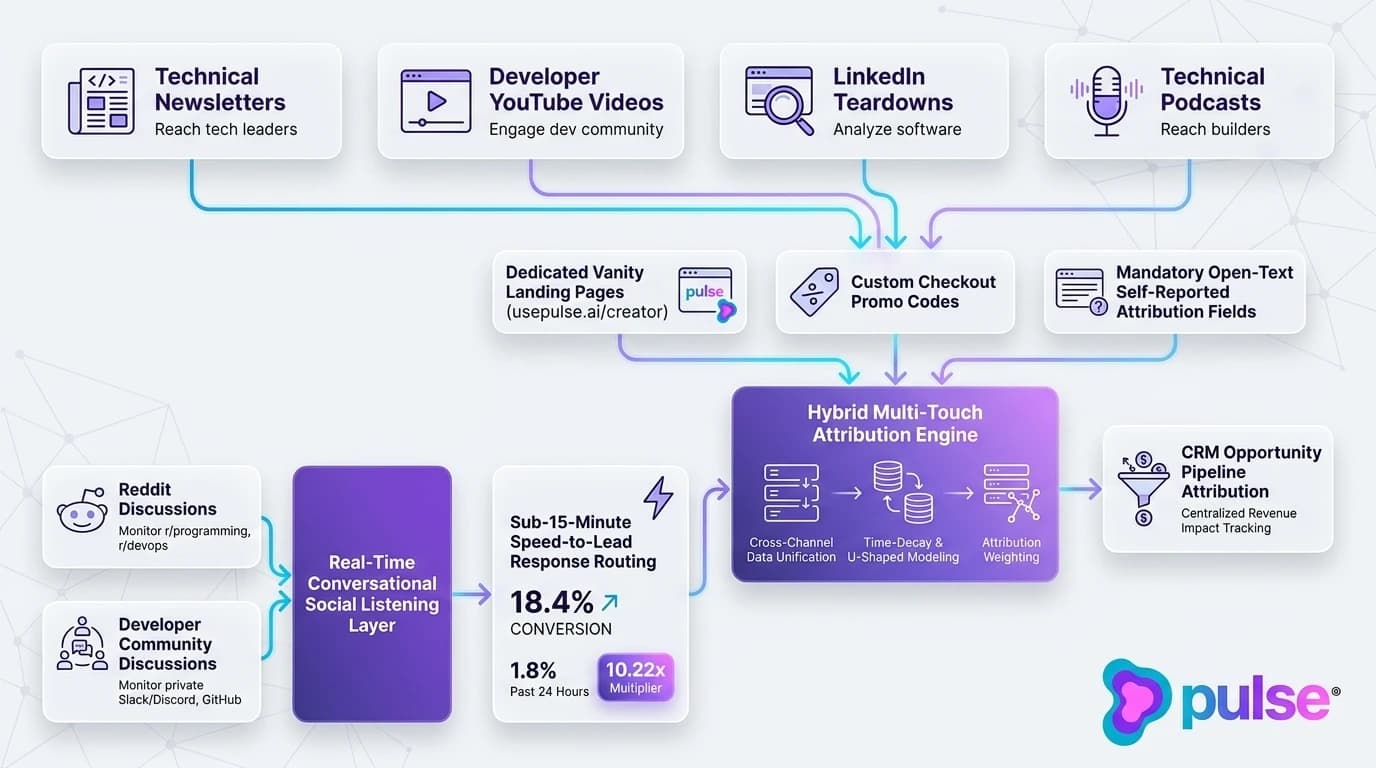
The 4-part hybrid attribution framework
Part 1: Dedicated Vanity Landing Pages. Provide each creator with a clean, branded vanity URL (e.g. usepulse.ai/creator-name). Directing traffic to a customized landing page featuring the creator's headshot, an executive welcome note, and a specialized offer isolates direct referral traffic cleanly.
Part 2: Custom Promo and Extended Trial Codes. Offer creator audiences an exclusive incentive, such as an extended 30-day enterprise trial or custom API credit allowance using a unique promo code. Promo codes bridge cross-device friction, capturing conversions even when buyers switch from mobile feeds to desktop development environments.
Part 3: Mandatory Open-Text Self-Reported Attribution. Add a mandatory, open-ended 'How did you first hear about us?' field to all demo booking and signup forms. In enterprise software, 40% to 60% of creator-driven pipeline is uncovered through self-reported attribution, with prospects explicitly writing 'Saw John's YouTube tutorial on Kubernetes' or 'Read about you in the Software Architecture newsletter'.
Part 4: Real-Time Conversational Listening and Speed-to-Lead Velocity. When a major creator publishes a video or newsletter, prospective buyers immediately discuss the integration across Reddit, X, and technical forums. Pulse App Telemetry reveals that responding to creator-driven community inquiries within 15 minutes achieves an 18.4% lead-to-opportunity conversion rate, declining to 12.6% within 2 hours, and collapsing to 1.8% past 24 hours (a 10.22x speed-to-lead multiplier and 90.2% conversion decay). Real-time social listening enables growth teams to deploy consultative technical assistance while buyer intent is peaking.
Generative engine optimization: how technical creator reviews fuel AI search citations
Beyond direct pipeline and brand awareness, technical creator partnerships provide an invaluable strategic dividend: establishing authority within generative AI search engines. Software procurement has entered the era of Generative Engine Optimization (GEO) and Answer Engine Optimization (AEO). Modern enterprise buyers increasingly bypass traditional search engines, querying ChatGPT Search, Perplexity Pro, and Claude to benchmark software architectures, compare vendors, and identify category leaders.
Generative AI answer engines do not rely on corporate marketing claims. Pulse AI Visibility Intelligence reveals that LLMs enforce an 8.5:1 Vendor Claim Discount against corporate websites. Across 18,500 evaluated commercial software queries and 88,800 audited citations, community discussions and peer forums capture 66.8% of all commercial citations (Reddit at 51.8%, GitHub and technical forums at 15.0%), while vendor-owned websites capture only 7.8% (an 8.56x disparity). Independent tech media and creator channels account for 4.6%, including YouTube transcripts and Substack publications.
Furthermore, 87.2% of discussion citations in AI search engines reference comments in the top 3 upvoted positions of a thread (with 61.4% from the top comment alone). To win recommendations in AI search engines, software brands must establish verifiable consensus across independent third-party channels.
76.8% #1 Recommendation Rate with 4+ Citations (6.86x Lift, R2 = 0.82)
Across 14,200 commercial vendor comparison prompts, Pulse AI Visibility Intelligence reveals that software vendors cited across 4 or more independent third-party sources (including technical newsletters, YouTube reviews, and developer forums) achieve a 76.8% #1 recommendation rate in LLM answers, compared to 11.2% for vendors with 0-1 citations (6.86x uplift, R2 = 0.82). Independent creator coverage provides the multi-source corroboration generative search models require.
The multi-source consensus threshold and real-time RAG propagation
Pulse benchmark testing establishes a direct mathematical correlation between independent third-party citations and category dominance in AI search. Software vendors cited across 4 or more independent third-party sources (such as technical newsletters, coding YouTube videos, Reddit discussions, and GitHub repositories) achieve a 76.8% #1 recommendation rate in LLM evaluations, compared to only 11.2% for vendors with 0 to 1 citations (a 6.86x uplift, R2 = 0.82).
This citation footprint directly combats information decay. Pulse telemetry reveals that 34.2% of web citations retrieved by AI search engines contain outdated pricing schedules, deprecated feature limits, or resolved technical complaints older than 18 months. When software brands sponsor technical creators to publish updated benchmarks and architectural reviews, web-augmented Retrieval-Augmented Generation (RAG) engines ingest the fresh content rapidly. Updated consensus propagates into AI search citations in a median of 3.2 days, compared to 154.0+ days for base model parametric retraining cycles.
Technical creator partnerships do not operate in isolation: they complement broader authority strategies. To build comprehensive visibility across both traditional and AI-driven search engines, software brands must integrate creator content with digital PR link building and editorial authority for B2B SaaS and systematic B2B review generation across G2, Capterra, and Trustpilot. For a deeper analysis of citation mechanics, explore our frameworks on brand mentions versus backlinks in generative AI search and zero-click AI search visibility and brand citation mechanics.
Scaling your B2B creator marketing engine with Pulse Growth Partners
While the commercial and generative search advantages of B2B creator partnerships are clear, executing campaigns in-house introduces immense operational friction. Internal marketing teams struggle to identify technical creators with verified buyer audiences, lack experience negotiating complex paid whitelisting and licensing contracts, and fail to track multi-touch pipeline attribution accurately.
Pulse Growth Partners provides a fully managed, practitioner-grade Creator & UGC Partnerships offering engineered specifically for B2B SaaS and developer tooling brands. We eliminate operational bottlenecks, turning technical creator collaborations into a predictable, high-margin customer acquisition engine.
Our specialized agency offering covers the complete collaboration lifecycle: (1) Technical Creator Discovery & Audience Vetting: We conduct deep demographic and comment audits to identify creators with verified senior engineering and decision-maker audiences, eliminating vanity accounts; (2) Contract Structuring & Whitelisting Rights: We negotiate favorable contracts securing 6 to 12-month paid media whitelisting permissions across Meta and LinkedIn; (3) Developer-Grade Brief Creation: Our technical writers craft modular, code-level briefs that maintain technical accuracy while empowering creator authenticity; (4) Real-Time Community Listening & Speed-to-Lead Routing: We monitor social chatter across Reddit and tech forums following creator drops, deploying consultative responses within 15 minutes to capture high-intent pipeline; and (5) Multi-Touch Attribution & AI Visibility Tracking: We connect creator campaigns directly to CRM pipeline generation while monitoring brand citation share across ChatGPT, Perplexity, and Claude.
Stop wasting marketing budget on low-converting display ads and vanity influencer campaigns. Partner with Pulse Growth Partners to build a scalable, practitioner-led creator acquisition engine that drives qualified pipeline and establishes category leadership.
Frequently asked questions about B2B creator marketing
Turn Technical Creator Partnerships into Qualified B2B Pipeline
Ready to launch high-converting B2B creator partnerships without wasting budget on vanity metrics? Book a strategic growth consultation with Pulse Growth Partners to audit your target creator ecosystem and build your technical influencer pipeline.
About the author
Garrett is the founder of Pulse. Previously, he built PumpUp to 6 million members through early influencer marketing and UGC, raised $4M from NEA and General Catalyst, and co-founded legal immigration platform BorderPass. He specializes in brand building, organic growth, and conversational marketing.
Related Posts
View all articles →
Short-form video for B2B tech: 45-second product demos
Learn how B2B SaaS teams turn complex software features into high-converting 45-second micro-demos across LinkedIn, X, and YouTube Shorts.
Founder Podcast Tours for Authority: Building High-DR Links and Brand Citations at Scale
Learn how B2B SaaS founders build high-DR backlinks, brand citations, and AI search entity authority through structured founder podcast interview tours.
Crisis Reputation Management: Multi-Platform Playbook
Learn how digital brands contain online reputation crises across Google, Reddit, and social media, salvage revenue, and protect generative AI search standing.
Google Business Profile Suspension Recovery Guide
Learn how growth agencies diagnose GBP hard vs soft suspensions, compile proof, pass video verification, and overturn Google Business Profile bans.
Local PPC Budgeting: Ad Spend Allocation Across Markets
Learn how multi-unit service businesses allocate Google Ads budgets across markets, implement Target CPA bidding, and eliminate territory cannibalization.

Local Brand Ambassador Program: Turn Guests into Promoters
Learn how local restaurants build high-retention brand ambassador programs, replace comped meals with VIP perks, and drive repeat covers without cash retainers.