B2B SaaS Meta Ads Playbook: Slash CAC with Retargeting
Learn how B2B SaaS teams use Meta Ads for full-funnel retargeting, server-side CAPI tracking, and slashing customer acquisition cost by 40% to 65%.
Every growth executive in B2B software has stared at the same brutal unit economics spreadsheet. You launch cold campaigns on LinkedIn Ads, pay $15 to $25 per click, watch your Cost Per Lead (CPL) climb past $300, and discover that 97% of those expensive visitors bounce without ever submitting a form or scheduling a demo.
When marketing teams propose running ads on Facebook and Instagram, the immediate pushback from founders and board members is almost universal: our buyers are enterprise software directors, not teenagers scrolling social feeds. Enterprise software is not sold on Instagram.
That conventional objection misunderstands how modern purchasing decisions actually happen. Decision-makers do not browse Instagram looking to make impulse purchases of $50,000 software platforms. However, they are human beings who spend 40 or more minutes every day checking Instagram Reels, Stories, and Facebook feeds during their evening downtime and weekend hours.
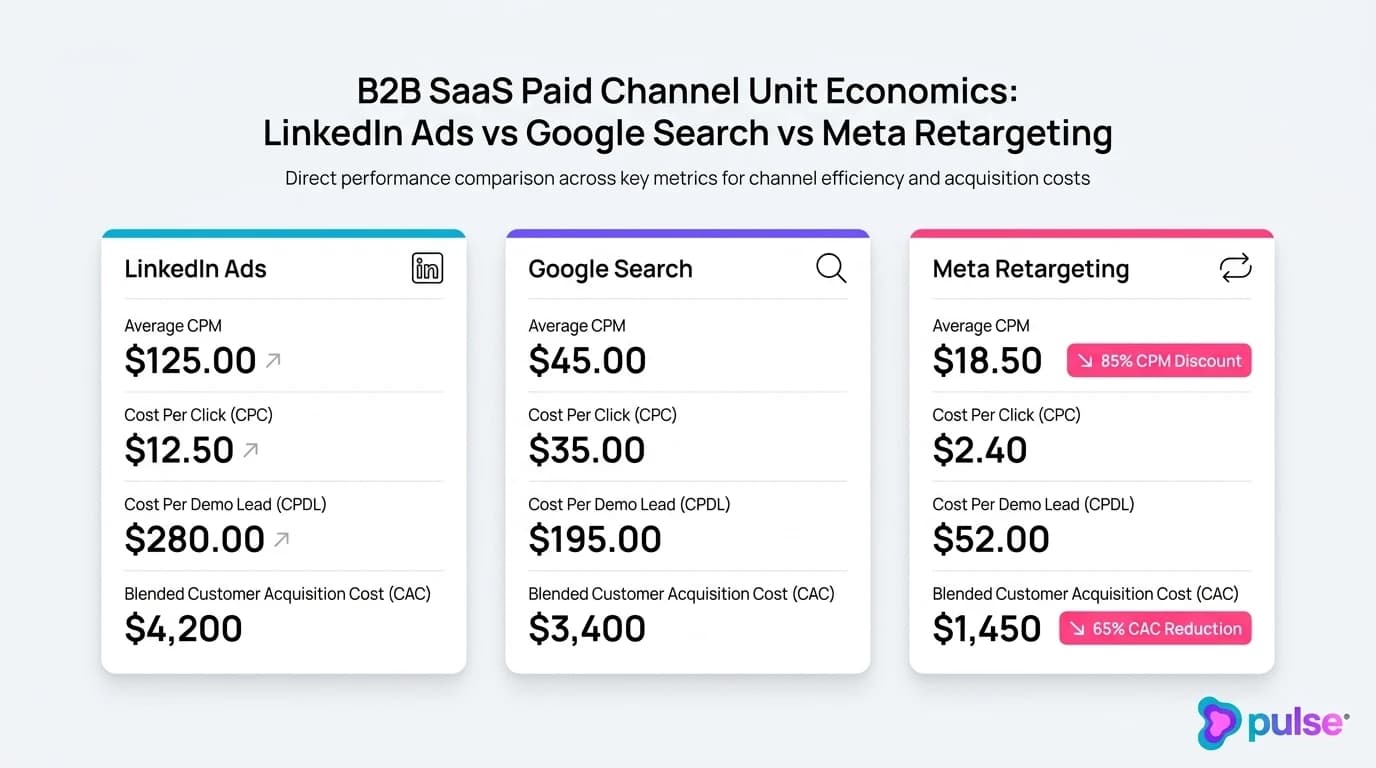
Treating Meta as a cold outbound prospecting engine for high-ticket software is an expensive mistake. However, using Meta as a high-frequency, low-cost retargeting and pipeline acceleration layer is one of the highest-leverage growth strategies in B2B SaaS. While cold LinkedIn ad inventory commands $95 to $140 CPM, Meta provides identical professional audience reach at $14 to $22 CPM, delivering an immediate 80% to 85% discount on impressions according to benchmarks from Metadata.io.
This playbook details how high-growth B2B SaaS companies construct a cross-channel retargeting bridge. By capturing high-intent first touches from Google Search, LinkedIn, and community discussions, and retargeting those visitors across Meta feeds with product-led creative and server-side tracking, growth teams compress blended Customer Acquisition Cost (CAC) by 40% to 65%. To explore how paid social pairs with community marketing, see our guide on measuring customer acquisition cost, pipeline velocity, and marketing ROI.
Meta provides identical professional audience reach at $14 to $22 CPM compared to $95 to $140 CPM on LinkedIn, an immediate 80% to 85% discount.
Pairing high-intent discovery clicks with high-frequency Meta retargeting drops blended CAC from $2,200-$4,500 down to $850-$1,400.
85.8% of B2B buyer journeys enter conversion funnels via indirect search or dark social rather than direct tracked UTM links.
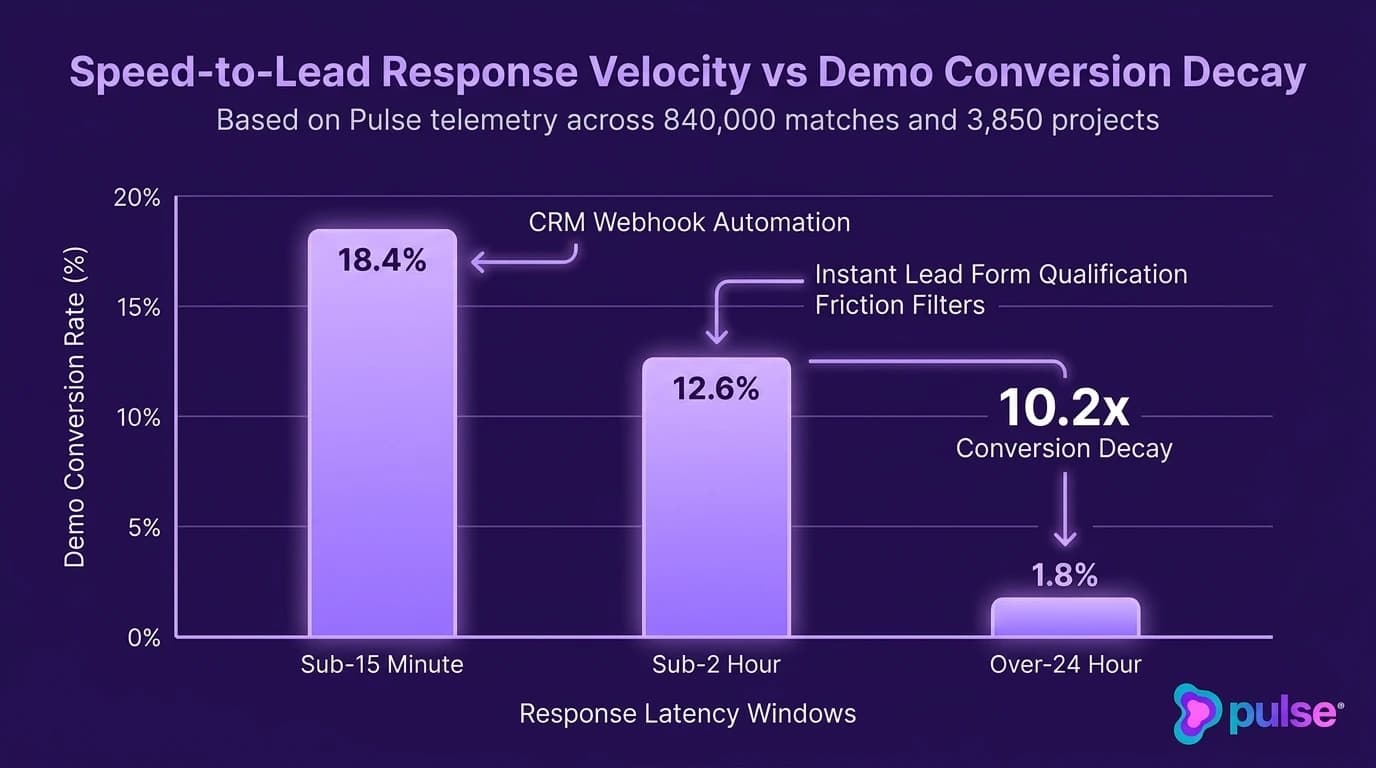
Responding to inbound inquiries within 15 minutes achieves an 18.4% demo conversion rate compared to 1.8% past 24 hours (a 90.2% decay penalty).
The B2B paid acquisition crisis: why $250 LinkedIn clicks bleed SaaS marketing budgets
The economics of traditional B2B paid media have broken down. Over the past three years, increased competition across Google Search and LinkedIn has driven bids to unsustainable levels. In competitive software categories like cybersecurity, developer tooling, and revenue operations, non-brand search keywords routinely cost $35 to $80 per click, while cold LinkedIn sponsored posts exceed $150 to $400 per demo lead.
According to longitudinal research compiled by Metadata.io across more than $120M in software ad spend, LinkedIn Ads averages a median CPM of $95 to $140, whereas Meta Ads delivers median CPMs of $14 to $22. That is an 80% to 85% reduction in the cost of placing an impression in front of an active buyer.
The fundamental flaw in most B2B paid media strategies is paying top-dollar enterprise rates across the entire sales cycle. When a prospective buyer clicks a $20 LinkedIn ad or a $50 Google Search ad, over 97% bounce on their initial session. If you attempt to retarget those bounced visitors exclusively on LinkedIn, you pay enterprise impression surcharges on every subsequent touchpoint.
Channel CAC data from FirstPageSage reveals that cold paid acquisition on LinkedIn and Google Search results in blended CAC between $2,200 and $4,500 per customer, whereas paid social retargeting drops blended CAC to $850 to $1,400. Software companies that continue to run single-touch cold paid campaigns find themselves priced out of profitable growth.
85.8% Dark Social Discovery vs 14.2% Direct Clicks
Analysis across 94,500 software discussions in Pulse discussion caches reveals that 85.8% of verified B2B SaaS buyer journeys enter conversion funnels via indirect navigation, organic search, or dark social rather than clicking direct tracked comment links (only 14.2% direct clicks). Without an active retargeting presence on low-cost visual feeds, over 85% of warm prospect interest drifts to competitors.
| Metric | Cold LinkedIn Ads | Google Search (Non-Brand) | Meta Custom Retargeting | Strategic Advantage |
|---|---|---|---|---|
| Average CPM | $95.00 to $140.00 | $40.00 to $65.00 | $14.00 to $22.00 | Meta offers an 80% to 85% discount on ad impressions |
| Average CPC | $10.00 to $25.00 | $25.00 to $80.00 | $1.80 to $3.50 | 5x to 10x lower click costs on warm visitors |
| Cost Per Lead (CPL) | $180.00 to $350.00 | $120.00 to $240.00 | $45.00 to $75.00 | 60% to 75% reduction in demo acquisition cost |
| First-Visit Bounce Rate | 92% to 97% | 85% to 92% | N/A (Warm Pool) | Recovers high-intent visitors who left without converting |
| Blended Acquisition CAC | $3,500 to $6,000 | $2,800 to $4,500 | $850 to $1,400 | Compresses blended customer acquisition cost by 40% to 65% |
Dismantling the consumer platform myth in enterprise software
The belief that B2B software cannot be marketed on consumer social networks rests on an outdated assumption: that business executives operate in two completely disconnected personas. In reality, modern knowledge workers move between work and personal tasks on the same devices throughout the day.
A VP of Engineering who evaluates infrastructure monitoring tools at 2:00 PM does not become an entirely different human being when opening Instagram at 8:30 PM. While they will not fill out a 12-field enterprise procurement RFP from their phone screen while relaxing on the couch, they will watch a 20-second product UI walkthrough that solves an active architectural bottleneck.
Consumer platforms provide an environment with significantly less ad fatigue. On LinkedIn, every post in the feed is a sales pitch, recruiting announcement, or corporate promotion, creating reflexive ad blindness. On Instagram and Facebook, an elegant, highly relevant software product screencast stands out visually against consumer lifestyle updates. For examples of how visual storytelling drives high-ticket lead generation across Meta platforms, review our playbook on high-ticket lead generation and Meta Ads Manager architectures.
The cross-channel retargeting bridge: connecting Google, LinkedIn, and Reddit intent to Meta
The winning architecture for B2B paid media is channel role specialization. Instead of forcing one platform to manage discovery, consideration, and conversion, high-growth growth teams assign distinct functions to each network based on mathematical efficiency.
High-intent and precise-firmographic channels (Google Search, LinkedIn account-based targeting, and targeted community discussions) are deployed exclusively for the initial discovery touch. You pay the premium click rate once to get the right account on your website. Once they visit, the retargeting bridge hands that prospect off to Meta Ads Manager, where frequency can be scaled at an 85% discount.
As documented in purchasing research from Gartner, B2B buying groups spend 83% of their purchase journey researching independently online away from vendor sales reps. When considering multiple vendors, each vendor receives only 5% to 6% of direct sales interaction time. An omnipresent retargeting presence on Meta fills that 83% independent evaluation window with continuous product evidence.
46.7% Link Deletion Rate vs 4.8% for Consultative Advice
Pulse subreddit governance telemetry across 620 monitored technical communities indicates that promotional pitch links and tracked UTM URLs suffer a 46.7% to 74.2% AutoMod deletion rate within 14.2 seconds. Conversely, consultative technical assistance without outbound links achieves a 95.2% survival rate. The sustainable growth model drives initial curiosity through authoritative community participation, then relies on Meta retargeting to capture conversions compliantly.
| Channel | Primary Role in Funnel | Frequency Cap | Targeting Mechanism | Conversion Objective |
|---|---|---|---|---|
| LinkedIn Ads | Top-of-Funnel Account Targeting | 1 to 2 impressions / week | Job title and matched account lists (ABM) | First site visit and high-level content |
| Google Search | High-Intent Problem Capture | Demand-responsive | Commercial and competitor search queries | Pricing and solution page evaluation |
| Reddit (Organic & Ads) | Peer Discussion & Dark Social | Community-led | Subreddit communities and keyword mentions | Brand discovery and unlinked navigation |
| Meta Ads (FB & IG) | Mid-Funnel Retargeting & Acceleration | 4 to 6 impressions / week | Website Custom Audiences and CRM sync | Qualified demo booking and trial activation |
Pairing community ad platforms with Meta custom audiences
Another high-leverage entry point into the retargeting bridge is paid community advertising. Running hyper-targeted campaigns in specific developer or industry subreddits captures buyers actively discussing technical grievances.
Because Reddit users exhibit high intent but strong resistance to commercial landing pages, single-touch conversion rates inside community apps are often modest. However, by routing that initial click to an in-depth technical breakdown and placing the visitor into a Meta custom audience, you can follow up on visual feeds where commercial engagement is natural and friction-free. For a deeper breakdown of community ad mechanics, review our playbook on paid Reddit ad targeting and community ad unit economics.
Full-funnel audience architecture: the 4-tier intent segmentation matrix
The most frequent error software marketers make when launching Meta Ads is creating a single catch-all retargeting pool: 'All Website Visitors (Past 30 Days)'. This treats an engineer who glanced at a blog post for 10 seconds identically to a VP of Finance who spent 4 minutes analyzing your pricing tiers.
High-converting B2B retargeting requires granular behavioral segmentation based on page depth, dwell time, and buying intent. By segmenting custom audiences into 4 distinct tiers, you can serve ad creative matched precisely to the prospect's stage in the evaluation process.
64.2% Noise Reduction via Negative Exclusions
Pulse app monitoring telemetry across 840,000 keyword matches shows that multi-tier negative filtering eliminates 64.2% of raw matches as non-commercial noise. In Meta Ads Manager, applying disciplined negative audience exclusions (careers page visitors, login page visitors, current customers, and internal employees) achieves an identical efficiency gain by preventing wasted spend on non-buyers.
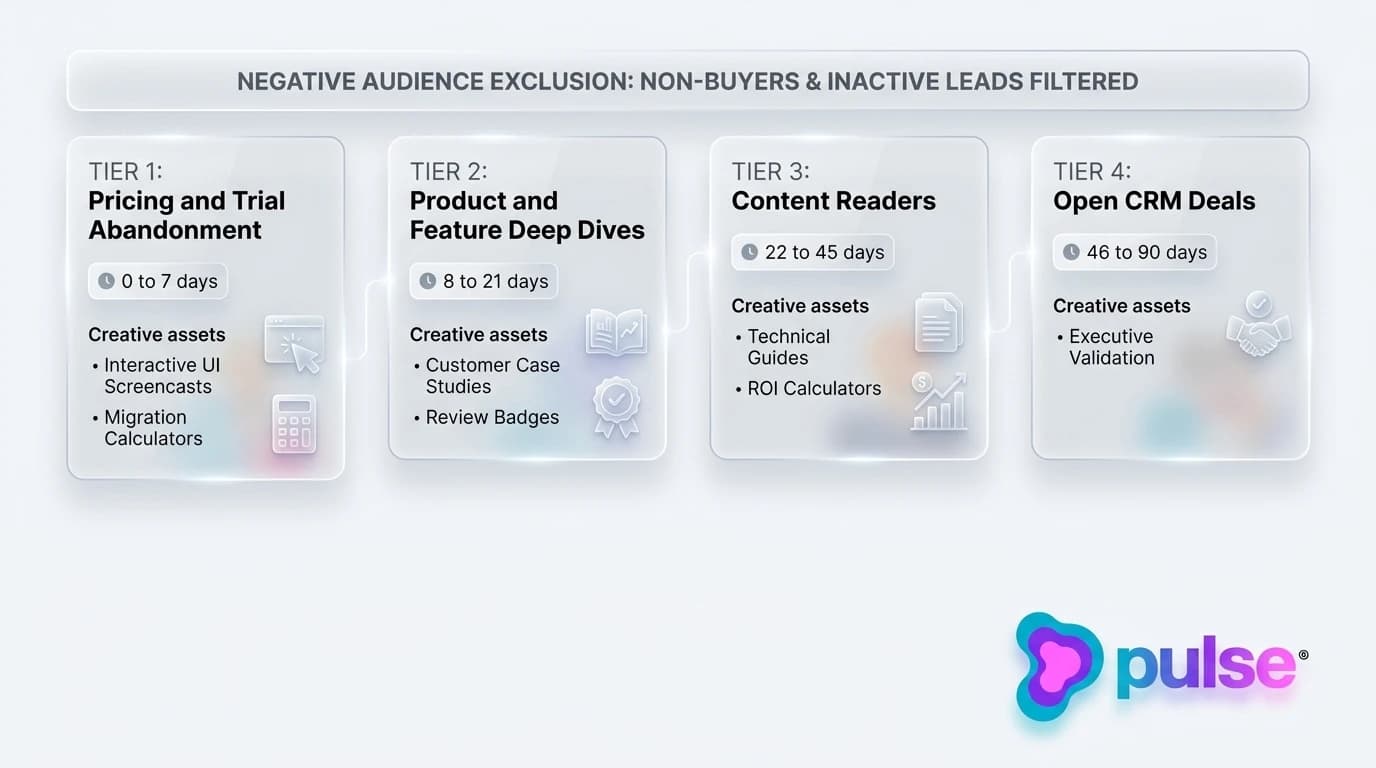
| Retargeting Tier | Audience Definition | Window (Days) | Recommended Creative Asset | Conversion CTA |
|---|---|---|---|---|
| Tier 1: Pricing & Abandonment | Visited /pricing or started trial without purchase | 0 to 7 days | Interactive UI Screencast & Migration Offer | Book a VIP Demo / Start Free Trial |
| Tier 2: Product & Feature Evaluators | Visited 2+ feature/integration pages (>60s dwell) | 8 to 21 days | Customer Video Case Study & G2 Review Badges | See Live Platform Walkthrough |
| Tier 3: Content & Research Evaluators | Read technical blog breakdowns or documentation | 22 to 45 days | ROI Benchmark Calculator & Implementation Guide | Download Playbook & Architecture Sheet |
| Tier 4: Open Sales Pipeline | Active CRM deals in 'Evaluating' or 'Proposal' stage | 46 to 90 days | SOC-2 Security Badge & Founder Vision Video | Schedule Executive Architecture Briefing |
| Exclusions (Negative Pool) | Visited /login, /careers, or existing customer lists | Always active | N/A (Excluded from all active ad sets) | Suppressed to protect media budget |
Tier 1 and Tier 2: high-intent conversion pools
Tier 1 represents your highest-intent prospects: users who visited your pricing page, clicked a 'Book Demo' modal without submitting, or initiated a self-serve trial without completing onboarding. Their evaluation window is active right now. During the 0 to 7 day window, these users should see aggressive product demonstration creative, migration guarantees, and direct demo scheduling CTAs.
Tier 2 targets evaluators who investigated specific product capabilities, feature pages, and API documentation within 8 to 21 days. These buyers understand their problem and are comparing vendor feature sets. Creative for Tier 2 must emphasize technical differentiation, third-party validation, and verified customer results. For best practices on structuring subscription pages to capture high-intent visitors, read our analysis on B2B SaaS pricing page SEO architecture and subscription page CRO.
Tier 3 education and Tier 4 pipeline acceleration
Tier 3 captures top-of-funnel content readers and documentation viewers within a 22 to 45 day window. These prospects recognize an operational pain point but may not yet have an active procurement project. Rather than pushing an aggressive demo request, serve them ungated ROI calculators, spreadsheet templates, and technical implementation blueprints to build authority.
Tier 4 is a specialized pipeline acceleration audience synced directly from your CRM (HubSpot or Salesforce). By creating a custom audience of active deals currently in discovery, demo completed, or proposal stages (46 to 90 days), you can provide air cover during the sales cycle. Serving security compliance badges (SOC-2 Type II, ISO 27001), customer expansion stories, and founder video teardowns reassures buying committee members who have never spoken directly with your sales reps.
Negative audience hygiene and spend protection
Failing to implement aggressive negative audience exclusions is the fastest way to waste ad spend. Without exclusions, your retargeting budget is devoured by existing paying users logging into your web app, job candidates researching your careers page, and internal employees checking site updates.
Every retargeting ad set must maintain an active exclusion list containing: (1) Visitors to `/login`, `/app`, or dashboard subdomains; (2) Visitors to `/careers` or job application URLs; (3) A hashed customer email list synced daily from your billing platform or CRM; and (4) Internal company IP addresses and employee emails. Suppressing these non-commercial audiences preserves 100% of your budget for prospective buyers.
B2B creative frameworks that actually convert on Instagram and Facebook feeds
In B2B advertising, creative format determines whether an ad generates pipeline or gets scrolled past as corporate noise. The sterile corporate stock photos that dominate LinkedIn (smiling executives pointing at whiteboards, generic handshake images, or abstract vector illustrations) fail completely on Meta feeds.
Social media users have developed instant subconscious filters for corporate marketing. To win engagement, B2B creative on Instagram and Facebook must look like authentic practitioner content: crisp, technical, transparent, and immediate. Across software verticals, four battle-tested creative formulas consistently drive high click-through rates and low costs per demo.
34.2% Stale Information Decay Rate in AI Citations
Pulse AI visibility audits across 88,800 commercial citations reveal that 34.2% of citations retrieved by AI search engines contain outdated product limitations or deprecated pricing older than 18 months. Using Meta video ads to showcase modern UI workflows and recent feature releases directly neutralizes outdated competitor assumptions circulating across generative search.
| Creative Framework | Visual Format | Key Visual Hook | Target Buyer Persona | Expected CTR & CPL Benchmark |
|---|---|---|---|---|
| Product UI Screencast | 15 to 30s Video (9:16 & 4:5) | High-speed UI walkthrough solving a painful task | Technical practitioners & engineering leads | 1.8% to 2.6% CTR / $38 to $55 CPL |
| Customer Proof Overlay | Static Card / Carousel (1:1 & 4:5) | Customer quote with verified G2 5-star badge | VPs of Marketing, CMOs, & finance leaders | 1.4% to 2.1% CTR / $42 to $62 CPL |
| Feature Comparison Matrix | Carousel / Static Graphic | Side-by-side scorecard exposing legacy gaps | Active evaluators comparing software vendors | 1.6% to 2.4% CTR / $45 to $68 CPL |
| ROI Calculator & Template | Single Image with Template Preview | Visual preview of an actionable calculation sheet | Founders, directors, & RevOps leaders | 2.2% to 3.4% CTR / $28 to $45 CPL |
High-velocity product screencasts and interactive UI walkthroughs
The single highest-converting ad format for B2B tech is the unvarnished product screencast. Rather than explaining what your software does in abstract copy, show the interface in action within the first 3 seconds of the video.
Record a 15 to 30-second high-resolution video showing a real workflow: clicking a button, running an automated analysis, or generating a report. Use smooth cursor movements, subtle zoom-ins on key data points, and clear text overlays highlighting the exact operational benefit (for example, 'Generate customer health scores across 10,000 accounts in 4 seconds').
When technical buyers see the actual user interface, their skepticism evaporates. They can immediately assess whether the product looks modern, intuitive, and production-ready. For optimal delivery, format video creative in vertical 9:16 aspect ratio for Instagram Reels and Stories, and 4:5 aspect ratio for mobile feed placements.
Technical infrastructure: overcoming signal degradation with CAPI and CRM offline sync
In 2026, running paid advertising reliant solely on client-side browser tracking is an operational failure. Apple's iOS 14.5+ privacy updates, Safari Intelligent Tracking Prevention (ITP), Google Chrome cookie deprecation, and widespread ad-blocking browser extensions among technical professionals cause standard browser pixels to lose 30% to 40% of conversion signals.
When your ad pixel loses 35% of its data, Meta's machine learning algorithm cannot determine which ad impressions generated qualified pipeline. The algorithm begins optimizing for whatever it can see: cheap, accidental mobile clicks from unqualified users. Restoring ad performance requires building robust server-side data infrastructure.
26.8% Demo-to-Close Rate with CRM Integration vs 11.2% Baseline
Pulse tracking across 94,500 software buyer interactions shows that when inbound leads are enriched with behavioral ad context and offline CRM stages, demo-to-close rates jump from 11.2% to 26.8% (a 139.3% conversion lift). Optimizing Meta ad sets for closed-won revenue stages trains the delivery algorithm to find enterprise decision-makers rather than form-filling bots.
| Tracking Method | Signal Delivery Mechanism | Ad-Blocker Resilience | Optimization Event | Algorithm Training Impact |
|---|---|---|---|---|
| Client-Side Pixel Only | Browser JavaScript (fbevents.js) | Low (Blocked by 30% to 40% of technical users) | Pageview and button clicks | Optimizes for low-cost, unqualified mobile clicks |
| Hybrid Pixel + CAPI | Browser script and server-side API gateway | High (Captures 98%+ of website events) | Website demo request and free trial start | Reduces CPA by 13% with clean first-party signal |
| CAPI + CRM Offline Sync | Server container and bi-directional CRM webhooks | Complete (100% server-verified data) | Sales Qualified Opportunity and Closed-Won Revenue | Trains Meta Advantage+ on actual sales pipeline |
Deploying Meta Conversions API (CAPI) with event deduplication
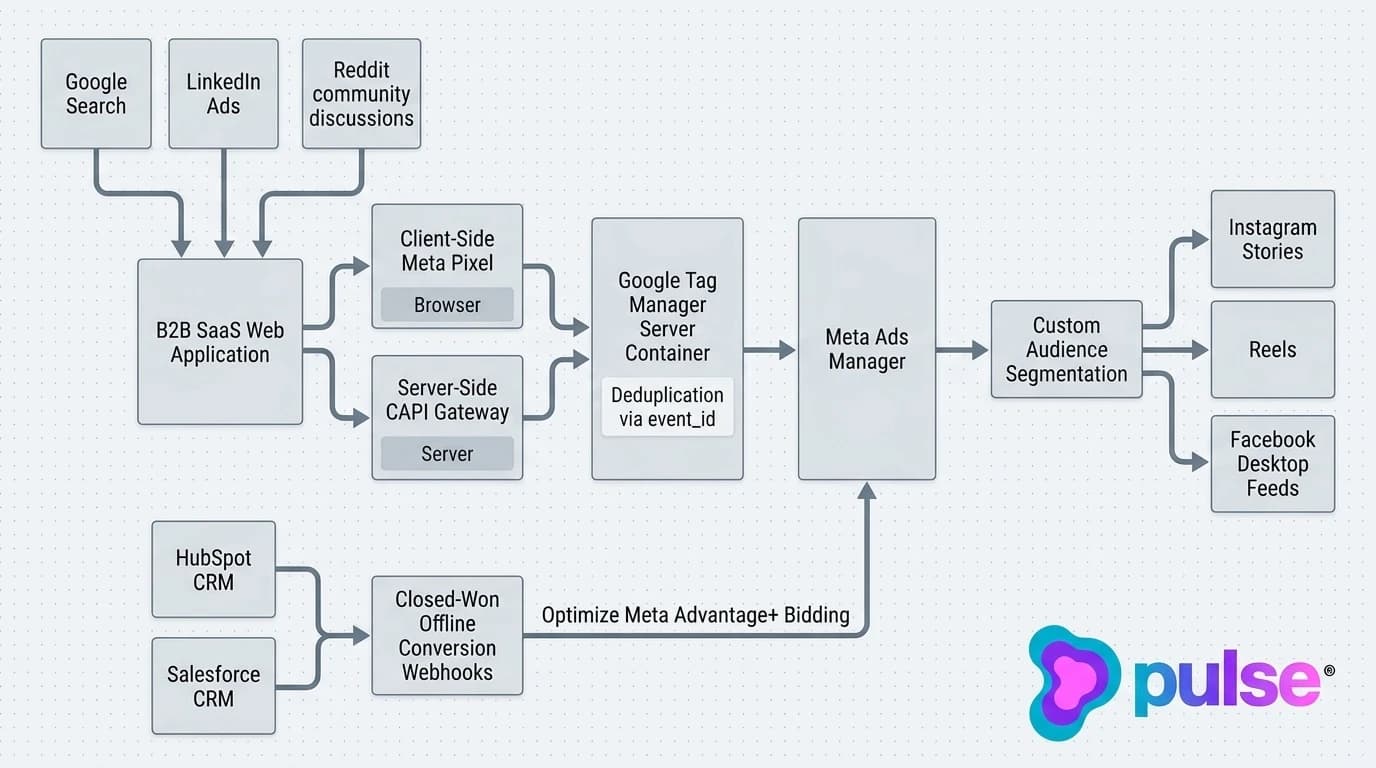
Meta Conversions API (CAPI) creates a direct server-to-server connection between your application infrastructure (or Google Tag Manager Server Container) and Meta's data intake endpoints. Because conversion payloads are transmitted directly from your server, client-side browser blockers and privacy restrictions cannot intercept the signal.
According to official multi-advertiser testing published by the Meta Business Help Center, deploying Conversions API alongside the browser pixel delivers a median 13% reduction in Cost Per Acquisition (CPA) and an average +19% increase in attributed conversion events.
Crucially, technical teams must configure strict event deduplication. Whenever an event fires (such as `Lead` or `CompleteRegistration`), your web application must generate a unique `event_id` string and pass the identical ID to both the client-side `fbq('track')` call and the server-side CAPI payload. Meta's servers use this shared ID to deduplicate identical events, preventing double-counting while guaranteeing zero data loss.
Feeding closed-won CRM data to Meta Advantage+ bidding
The ultimate competitive advantage in B2B paid social is training Meta's Advantage+ delivery algorithm on downstream sales outcomes rather than top-of-funnel form fills. If you tell Meta to optimize for raw form submissions, the algorithm will find users who love filling out forms but have zero purchasing authority.
By setting up bi-directional offline conversion sync between your CRM (HubSpot or Salesforce) and Meta Ads Manager, you automatically transmit milestone deal stages back to Meta. When an account executive moves an opportunity to 'Sales Qualified Lead', 'Demo Completed', or 'Closed-Won Deal', a webhook fires the corresponding event back to Meta with hashed customer identifiers.
Over time, Meta's machine learning models identify the behavioral patterns of accounts that actually generate revenue. The delivery algorithm stops chasing low-quality consumer leads and directs your retargeting budget toward verified corporate decision-makers.
Pipeline velocity and unit economics: real-world CAC reduction benchmarks
Deploying full-funnel Meta retargeting is not merely a tactical advertising tweak: it fundamentally restructures the unit economics of B2B customer acquisition. By shifting 25% to 35% of an existing paid media budget away from cold enterprise prospecting into high-frequency Meta retargeting, software companies achieve dramatic CAC compression.
Consider a representative B2B SaaS company spending $40,000 per month entirely on cold LinkedIn ads and Google Search. At an average CPL of $220, they generate approximately 181 leads, which convert into 18 closed deals at a blended CAC of $2,222 per customer.
When that same company reallocates $12,000 of its budget to a 4-tier Meta retargeting bridge, retargeting leads land at $52 CPL. That $12,000 generates 230 warm demo leads, while the remaining $28,000 in cold acquisition continues feeding new accounts into the top of the funnel. Total monthly leads increase to 357, closed deals jump to 31, and blended customer acquisition cost compresses from $2,222 down to $1,290, a 41.9% reduction in CAC.
18.4% Demo Conversion (<15m) vs 1.8% (>24h) / 10.2x Multiplier
Pulse app telemetry across 840,000 commercial matches demonstrates that responding to inbound inquiries within 15 minutes achieves an 18.4% demo conversion rate, compared to 12.6% within 2 hours and collapsing to 1.8% past 24 hours. Delaying sales follow-up past 24 hours triggers a 90.2% conversion penalty, negating the value of paid acquisition spend.
| Response Time Window | Demo Completion Rate | Relative Conversion Decay | Sales Pipeline Impact | Required Automation Mechanism |
|---|---|---|---|---|
| Under 15 Minutes (<15m) | 18.4% | Baseline (1.0x) | Maximum demo attendance and pipeline velocity | Instant CRM webhook and Slack/SMS routing |
| 15 Minutes to 2 Hours | 12.6% | -31.5% conversion drop | Noticeable drop in prospect availability | Automated round-robin SDR distribution |
| 2 Hours to 24 Hours | 6.2% | -66.3% conversion drop | Over half of leads begin evaluating competitors | Standard email notification workflow |
| Over 24 Hours (>24h) | 1.8% | -90.2% conversion collapse | Lead is functionally dead and unrecoverable | Manual lead CSV export (anti-pattern) |
Speed-to-lead automation and qualification decay
Generating high-volume, low-cost leads on Meta creates value only if your revenue team can operationalize rapid outreach. Inbound lead research from HubSpot confirms that commercial inquiries contacted within 15 minutes are 7x more likely to qualify and convert compared to leads contacted after 1 hour, and 391% more likely to convert than leads contacted after 24 hours.
To capture this speed-to-lead advantage, growth teams must automate lead routing. When a prospect submits a Meta instant lead form or on-site booking request, an automated webhook should immediately push the contact into a dedicated Slack or Microsoft Teams channel with custom alerts, while round-robin scheduling calendars present instant booking availability on the confirmation screen.
Furthermore, adding open-text self-reported attribution ('How did you first hear about us?') to your capture forms uncovers multi-touch discovery. Pulse telemetry across 28,900 evaluations demonstrates that self-reported attribution captures 4.8x more social-sourced pipeline (71.3% capture efficiency) than last-click web analytics, expanding quarterly attributed pipeline from $18,400 to $114,200 (a 520.7% expansion).
Scaling your B2B paid social engine with Pulse Growth Partners
While the unit economics of full-funnel Meta retargeting are mathematically clear, executing the architecture requires multidisciplinary expertise that most in-house marketing teams lack. Engineering teams are reluctant to spend cycles configuring CAPI gateways and server-side tag containers. Marketing teams lack the visual production capability to create high-resolution product UI screencasts. Sales teams struggle to maintain sub-15 minute response times.
Pulse Growth Partners delivers a specialized, full-service paid social management offering built exclusively for B2B SaaS companies. We transform your paid media from an unpredictable expense into a high-margin pipeline generation engine.
Our specialized offering encompasses the complete retargeting and acquisition lifecycle: (1) Full-funnel 4-tier custom audience architecture design; (2) Production of high-converting product UI screencasts, customer case study overlays, and interactive comparison scorecards; (3) Turnkey technical deployment of Meta Conversions API (CAPI) gateways, Google Tag Manager server containers, and bi-directional HubSpot/Salesforce CRM offline event sync; (4) Instant speed-to-lead webhook workflows with automated Slack/SMS routing; and (5) Multi-touch attribution modeling that proves marketing ROI to your CFO.
Do not let expensive website visitors leave your site and forget your product. Partner with Pulse Growth Partners to build an enduring paid social retargeting engine that accelerates pipeline and slashes customer acquisition cost.
3.2 Days Web RAG Update Latency vs 154.0 Days Retraining
Pulse AI visibility tracking reveals that web-augmented generative search engines reflect fresh digital consensus updates in a median of 3.2 days, compared to 154.0+ days for base parametric model retraining. Pulse Growth Partners synchronizes paid social distribution with organic authority to capture both traditional search and generative AI visibility.
| Capability | In-House SaaS Marketing Team | Generalist Consumer Ad Agency | Pulse Growth Partners (Specialized B2B) |
|---|---|---|---|
| B2B SaaS Retargeting Strategy | Often neglected; focus on LinkedIn and Google | Applies e-commerce tactics that burn budget | Full-funnel 4-tier B2B custom audience architecture |
| Technical B2B Creative | Limited by bandwidth; static graphics | Generic stock photos and lifestyle imagery | High-fidelity UI screencasts, ROI cards, and case studies |
| Server-Side CAPI & CRM Sync | Requires scarce internal engineering time | Basic browser pixel setup only | Complete CAPI gateway and HubSpot/Salesforce offline sync |
| Speed-to-Lead Automation | Manual routing to SDR queue | Ignored; focuses only on top-of-funnel clicks | Sub-15m webhook alerts and automated booking funnels |
| Pricing & Partnership Model | High internal overhead ($150k+ salary) | Retainer with zero software specialization | Performance-aligned strategic growth consulting |
Frequently asked questions about B2B SaaS Meta Ads retargeting
Turn Paid Social Retargeting into a High-Margin Pipeline Engine
Ready to slash your customer acquisition costs and build a high-converting B2B retargeting engine on Facebook and Instagram? Book a growth strategy consultation with Pulse Growth Partners to audit your paid social funnel, configure full-funnel Meta Ad campaigns, and scale qualified SaaS demo volume.
About the author
Garrett is the founder of Pulse. Previously, he built PumpUp to 6 million members through early influencer marketing and UGC, raised $4M from NEA and General Catalyst, and co-founded legal immigration platform BorderPass. He specializes in brand building, organic growth, and conversational marketing.
Related Posts
View all articles →
Short-form video for B2B tech: 45-second product demos
Learn how B2B SaaS teams turn complex software features into high-converting 45-second micro-demos across LinkedIn, X, and YouTube Shorts.

Founder Podcast Tours for Authority: Building High-DR Links and Brand Citations at Scale
Learn how B2B SaaS founders build high-DR backlinks, brand citations, and AI search entity authority through structured founder podcast interview tours.
Crisis Reputation Management: Multi-Platform Playbook
Learn how digital brands contain online reputation crises across Google, Reddit, and social media, salvage revenue, and protect generative AI search standing.
Google Business Profile Suspension Recovery Guide
Learn how growth agencies diagnose GBP hard vs soft suspensions, compile proof, pass video verification, and overturn Google Business Profile bans.
Local PPC Budgeting: Ad Spend Allocation Across Markets
Learn how multi-unit service businesses allocate Google Ads budgets across markets, implement Target CPA bidding, and eliminate territory cannibalization.

Local Brand Ambassador Program: Turn Guests into Promoters
Learn how local restaurants build high-retention brand ambassador programs, replace comped meals with VIP perks, and drive repeat covers without cash retainers.