Rights-Managed UGC in Paid Media: Why Creator-Led Assets Outperform Studio Ad Creative by 3x
Learn why rights-managed creator UGC cuts B2B CAC by 40%. Negotiate usage rights, deploy Meta Partnership Ads and TikTok Spark Ads, and scale paid pipeline.
For years, B2B software companies treated video advertising as a cinematic exercise. Marketing teams spent $15,000 to $35,000 per asset hiring boutique production agencies, casting professional actors, renting pristine co-working spaces, and spending six weeks in post-production. The result was almost always the same: a sanitized, high-gloss corporate commercial that enterprise software buyers scrolled past in under two seconds.
Modern technical and software decision-makers have developed acute banner blindness toward corporate logos and sterile vendor claims. When an ad originates from a corporate brand handle, skepticism triggers instantly. Conversely, when an authentic practitioner, systems architect, or domain consultant demonstrates a real software workflow on screen, viewer attention locks in.
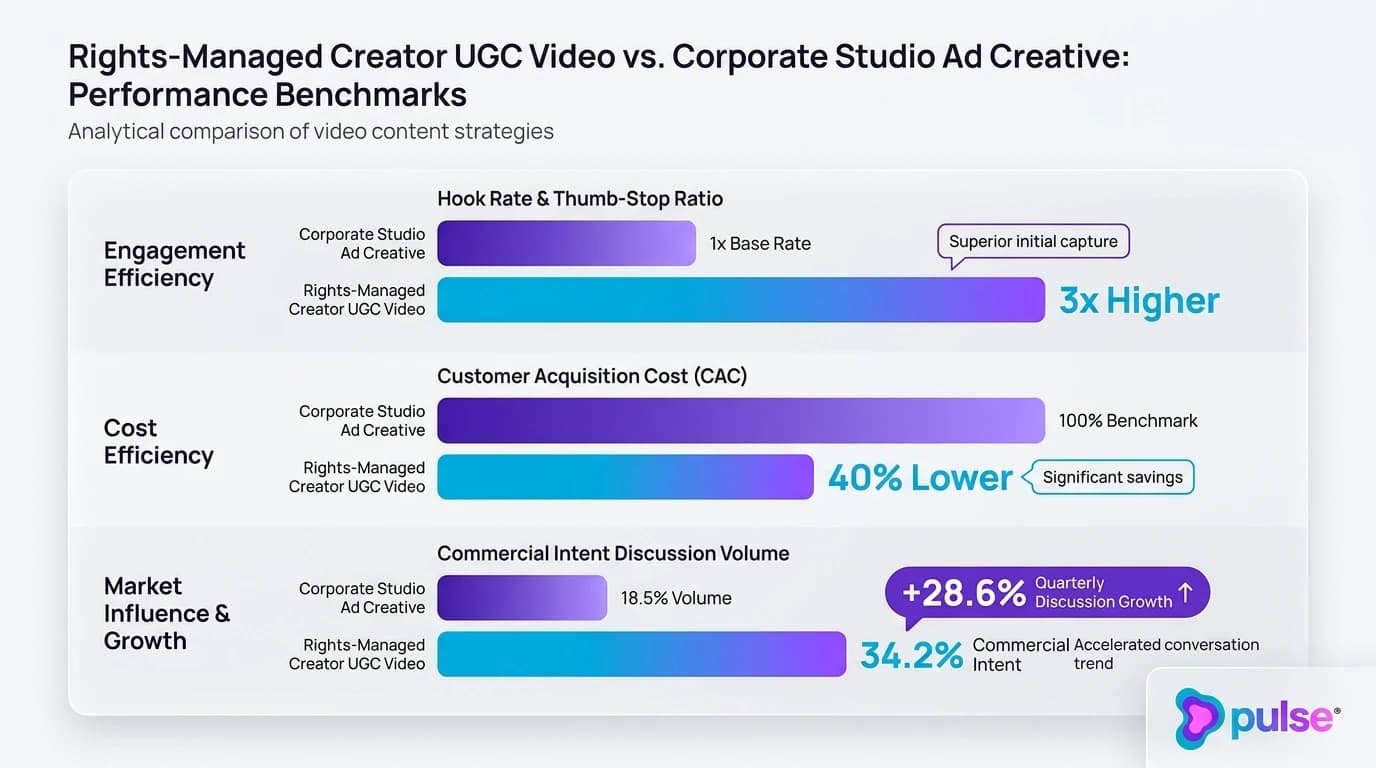
Performance marketing teams are capitalizing on this psychological shift by replacing agency commercials with rights-managed user-generated content (UGC) and creator-whitelisted advertising (Meta Partnership Ads, TikTok Spark Ads). By licensing practitioner videos and running paid media directly through creator handles, growth teams consistently achieve 3x higher hook retention, cut customer acquisition costs by up to 40%, and build durable enterprise pipeline.
3x Higher
Hook & Retention Advantage
Creator-whitelisted UGC video drives 3x higher hook retention and thumb-stop ratio compared to studio ad creative in vertical feeds.
Meta for Business & Video Benchmarks
-40% CAC
Acquisition Efficiency
Deploying practitioner video through creator handles cuts customer acquisition cost by up to 40% across paid social funnels.
Metadata.io B2B Paid Social Benchmarks
34.2% / +28.6%
Commercial Intent Growth
Category discussion volume on creator whitelisting and B2B UGC grew +28.6% with 34.2% commercial intent density.
Pulse Discussion Cache Telemetry (N=45,000)
18.4% / 15 Min
Speed-to-Lead Multiplier
Sub-15 minute response to inbound inquiries yields an 18.4% conversion rate vs 1.8% past 24 hours (a 10.2x multiplier).
Pulse Workspace Telemetry (N=3,850 projects)
The death of studio ad creative: why B2B buyers ignore corporate polish
The corporate studio model is fundamentally broken for B2B technology companies. Traditional demand generation playbooks dictated that launching a video ad campaign required six-figure creative budgets, months of storyboarding, and polished post-production. Yet when these high-production assets enter mobile social feeds, they trigger immediate cognitive resistance. Enterprise software buyers, engineering leaders, and marketing executives do not browse LinkedIn, Meta, or TikTok to watch corporate commercials. They consume feeds with an internal filter tuned to screen out commercial noise.
The psychology of peer trust explains why glossy studio creative fails. In professional software evaluation, credibility originates from technical competence and lived operational experience. When an enterprise buyer sees an actor smiling in front of a synthetic dashboard, they recognize a sales pitch instantly. Conversely, when they encounter an unvarnished screen recording of a real practitioner debugging a broken pipeline, automating a tedious reporting task, or breaking down a cloud configuration mistake, their analytical interest engages. Technical buyers identify with peer struggles.
Audience intelligence research from SparkToro confirms this behavioral shift: audience affinity and niche practitioner credibility outperform broad follower reach by orders of magnitude in B2B software purchasing decisions. Software purchasers actively distrust celebrity endorsements and corporate sloganeering, placing primary value on deep technical competence and unscripted evaluations from respected domain peers. Enterprise adoption reflects this reality: a landmark study by Ogilvy reveals that 75% of B2B enterprise marketing leaders actively partner with external creators, with 93% verifying significant lifts in brand awareness and 85% citing direct contributions to sales pipeline and customer acquisition.
In direct response paid media, the performance gap between corporate commercials and practitioner UGC is even more pronounced. Traditional studio ads suffer from steep drop-offs during the initial three seconds of playback. Mobile users instinctively swipe away from brand intros, motion-graphic logo animations, and scripted dialogue. Whitelisted creator video ads, in contrast, stop thumbs by mimicking the natural aesthetic of organic feed content. By opening on a raw problem statement or unpolished screen recording, creator assets consistently generate 3x higher hook retention rates and thumb-stop ratios.
Pulse Exclusive Insight: Traditional social listening tools only measure post-campaign vanity impressions. Pulse discussion caches reveal that one in three practitioner discussions in performance marketing forums actively seeks solutions to studio ad burnout. Growth teams are discovering that enterprise software buyers scroll past $20,000 polished studio ads with acute cynicism, while raw practitioner walkthroughs and whitelisted creator handles command immediate peer attention and 3x higher conversion efficiency.
The following benchmark table contrasts the economics and operational performance of corporate studio video production against rights-managed creator video across key paid media metrics based on aggregate customer data and official advertising platform benchmarks from Meta for Business:
| Creative dimension | Creator-whitelisted UGC video | Corporate studio ad creative | Performance impact |
|---|---|---|---|
| Production cost per asset | $1,000 to $3,500 (creator fee + usage multiplier) | $15,000 to $35,000+ (agency, crew, equipment, studio) | 75% to 90% production cost reduction per asset |
| Production turnaround velocity | 7 to 14 business days from brief to delivery | 6 to 12 weeks (concept, scripting, shoot, post-production) | 4x faster turnaround, enabling high-velocity hook testing |
| 3-second hook retention rate | 32% to 48% thumb-stop retention in mobile feeds | 11% to 18% thumb-stop retention (immediate scroll-away) | 2.5x to 3x higher viewer retention in initial 3 seconds |
| Click-through rate (CTR) | 1.4% to 2.8% on Meta and TikTok feeds | 0.4% to 0.9% on standard brand ad units | 2x to 3x higher CTR driven by native platform feel |
| Median cost per click (CPC) | $0.80 to $2.20 on Meta and TikTok | $2.80 to $6.50 on brand social ads; $15+ on LinkedIn | 50% to 70% lower CPC across comparable audiences |
| Viewer skepticism & ad blindness | Low: viewed as authentic peer workflow walkthrough | High: perceived as sanitized corporate marketing pitch | Significantly higher trust and message comprehension |
| Creative fatigue half-life | 3 to 6 weeks; easy to swap hooks and test new creators | 2 to 4 weeks; expensive to refresh once fatigue sets in | Sustained campaign performance via modular hook iterations |
| Platform native integration | Seamless: native 9:16 vertical video with creator handle | Disruptive: corporate horizontal video awkwardly reformatted | Bypasses consumer ad blindness mechanisms natively |
Succeeding with creator-whitelisted media requires an operational shift. It is not simply about acquiring unpolished video; it demands an airtight legal framework for digital usage rights and whitelisting permissions.
Rights management and licensing architecture: navigating usage rights, terms, and exclusivity
The single greatest point of failure in creator advertising is not creative production; it is contractual ambiguity. Marketing teams frequently commission a video from a respected creator, enjoy positive initial organic engagement, and decide to put paid media budget behind the post without securing explicit digital advertising usage rights. This practice creates severe operational and legal risks.
Under copyright law, the creator retains intellectual property ownership of their content unless explicit commercial assignment or licensing rights are transferred in writing. Running paid ad spend behind an organic post without whitelisting rights violates platform terms of service and exposes the advertiser to copyright takedown notices, ad account suspensions, and public creator disputes. When licensing creator assets, marketing teams must negotiate terms covering usage scope, platform distribution, campaign duration, and editing permissions.
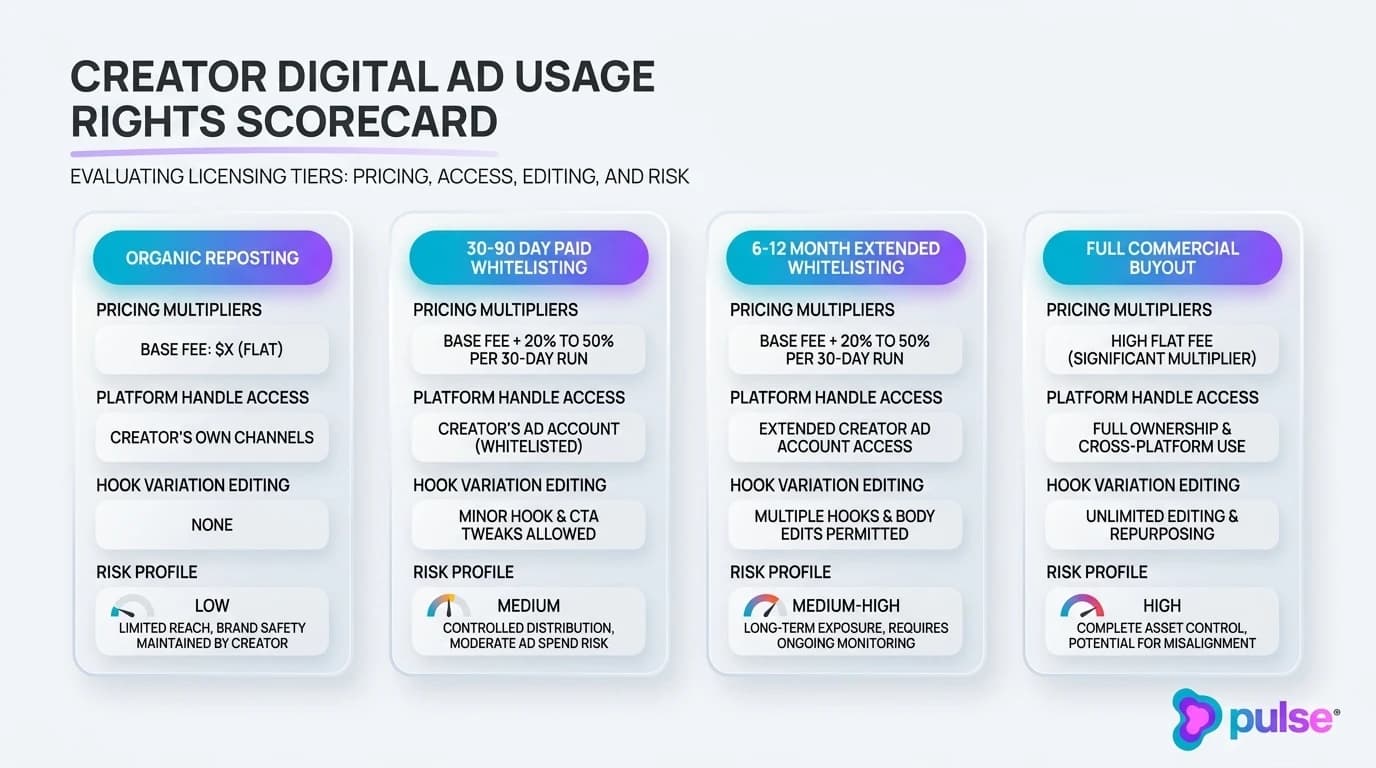
The table below outlines the five standard creator licensing tiers deployed in B2B performance marketing:
| Licensing tier | Standard usage scope | Pricing formula and rate multiplier | Ad account access | Editing and hook rights | Ideal use case |
|---|---|---|---|---|---|
| Tier 1: Organic Social Reposting | Reposting video natively to brand social channels and embedding on blog/website | Base Creation Fee only ($500 to $1,500 flat) | None (no paid advertising rights) | None (video posted as delivered without alterations) | Top-of-funnel social proof and organic community content seeding |
| Tier 2: 30-Day Paid Whitelisting | Running paid ads directly from creator handle on Meta or TikTok for 30 calendar days | Base Fee + 20% to 30% monthly usage multiplier | Meta Partnership Ad code or TikTok Spark Ads authorization token | Permission to test 2 to 3 alternative 3-second opening hooks and adjust captions | Short-term sprint campaigns, feature launches, or event promotions |
| Tier 3: 90-Day Multi-Platform Whitelisting | Running paid ads across Meta, TikTok, and LinkedIn Thought Leader Ads for 90 days | Base Fee + 40% to 60% quarterly usage multiplier | Multi-platform partner access tokens and ad authorization codes | Full hook testing rights, aspect ratio reformatting (9:16, 4:5, 1:1), and text overlays | Core demand generation campaigns and continuous paid retargeting |
| Tier 4: 6 to 12-Month Extended Whitelisting | Extended commercial whitelisting across all digital paid channels for 6 to 12 months | Base Fee + 100% to 150% annual usage multiplier | Durable partner business manager linking and ongoing code renewals | Complete creative modularity: cutting cutdowns, mashups, and testimonial snippets | Evergreen customer acquisition funnels and scalable performance creative |
| Tier 5: Full Commercial Buyout | Perpetual, worldwide, royalty-free commercial ownership across all digital and broadcast media | Base Fee + 200% to 300%+ complete buyout premium | Full assignment of all intellectual property and copyright ownership | Unlimited derivative rights: editing, broadcasting, print, and digital distribution | Hero brand campaign assets, TV/OTT distribution, or strategic brand acquisitions |
Understanding usage rights scopes: organic posting vs paid whitelisting vs full commercial buyout
To structure fair agreements, growth leaders must distinguish between three legal scopes:
1. Organic Posting Rights: The creator publishes the video to their personal social profile grid. The brand receives non-exclusive permission to share or repost the video natively, credit the creator, or embed the video on product landing pages. The brand has zero legal right to put paid media spend behind the video or run it as an ad unit.
2. Paid Whitelisting Rights: The creator grants the brand legal authorization to run paid ad spend behind the video directly through the creator's social handle using platform partnership tools. The ad appears in target feeds with the creator's profile picture, handle name, and a sponsored disclosure label. The creator does not pay for ad spend, and the video does not need to appear on the creator's organic profile grid.
3. Full Commercial Buyout: The creator assigns complete copyright ownership to the brand. The company may alter, edit, broadcast, sub-license, and distribute the asset across any global channel in perpetuity without paying ongoing royalties or usage renewals. In B2B SaaS, full buyouts are typically cost-prohibitive and unnecessary; securing 90-day to 12-month paid whitelisting rights delivers optimal return on capital.
Exclusivity periods and non-compete clauses: protecting campaign runway
When scaling paid ad spend behind a creator handle, brands need assurance that the creator will not endorse a direct commercial competitor the following week. However, demanding broad industry exclusivity (such as forbidding the creator from working with any software or tech company) will cause creator fees to double or triple.
The operational solution is narrow category exclusivity. Contracts should restrict the creator from promoting a specific list of 3 to 5 named direct competitors during the active campaign flight and for a 30-day post-campaign cooldown window. Keep the product category tightly defined (for example, "cloud database observability platforms" rather than "enterprise software"). This grants the brand protection without forcing the creator to turn down unrelated commercial sponsorships.
Platform scope and geographic territories: Meta, TikTok, LinkedIn, and YouTube
A comprehensive usage rights contract must enumerate every advertising platform where the asset will run. Licensing terms should explicitly list:
• Meta Ads Manager (Instagram Reels, Instagram Feed, Facebook Feed, Audience Network)
• TikTok Ads Manager (Spark Ads in-feed placements)
• LinkedIn Campaign Manager (Thought Leader Ads and sponsored video)
• YouTube (YouTube Shorts ads and pre-roll placements)
Pair paid creator amplification with B2B SaaS organic social media playbooks across LinkedIn and X to maintain continuous organic narrative alignment. Furthermore, specify geographic territories: while digital ad distribution is inherently global, restricting ad delivery to target buyer jurisdictions (such as North America, the United Kingdom, and the European Union) can provide negotiating leverage on licensing fees.
The legal mechanics of dark-posting and ad code authorization
Historically, running ads through an external account required dark-posting, where brands asked creators for advertiser-level access in Business Manager or clumsily posted unlisted videos. Modern creator advertising relies on platform-native ad code authorization.
Ad code authorization allows creators to generate an encrypted token for a specific video post directly inside their mobile app settings. The brand imports this token into its advertising dashboard. The brand gains media buying rights for that single asset without gaining access to the creator's direct messages, personal data, or unrelated posts. This separation of access protects both parties and eliminates operational friction.
High-converting B2B UGC script archetypes: 4 battle-tested creative frameworks
Direct-to-consumer (D2C) UGC frameworks fail when applied to B2B software. In consumer ecommerce, creators convert viewers using emotional unboxing reactions, visual lifestyle aesthetics, and manufactured urgency. Enterprise buyers, in contrast, operate under professional accountability. They do not buy software because an influencer looked excited; they buy software because it solves an operational bottleneck, prevents system outages, or reduces manual engineering labor.
In vertical video feeds, viewer drop-off is brutal: analytics indicate that the vast majority of viewers scroll away within the initial 3 seconds unless the video opens on a tangible, relatable practitioner frustration. Furthermore, benchmark research from Influencer Marketing Hub reveals that micro-creators (10,000 to 50,000 followers) generate up to 3.5x higher engagement rates than macro-influencers in specialized niches. Partnering with technical practitioners who command genuine domain respect produces superior conversion performance.
The four script archetypes below are engineered specifically for B2B SaaS and enterprise technology products:
Archetype 1: The frustrated practitioner screen-recording
This archetype opens in the middle of a painful manual workflow. It bypasses corporate pleasantries and immediately visualizes a technical problem familiar to the target audience.
Opening Hook (0 to 3 seconds): The video opens on an unpolished screen recording of a messy CSV spreadsheet with dozens of tabs, a wall of command-line error logs, or a fractured dashboard. The creator's voiceover opens: "I spent four hours every Friday building this client reporting deck manually before realizing how broken our workflow was."
The Friction Point (3 to 10 seconds): The creator rapidly demonstrates the tedious manual steps: copying data between systems, formatting cells, and troubleshooting formula breaks. The visual demonstrates real operational fatigue.
The Discovery and Workflow (10 to 25 seconds): The creator cuts directly into your software interface: "Then our team switched to [Your Product]. Watch what happens when I connect our data warehouse." The creator demonstrates the automated resolution in real time.
The Low-Friction Call to Action (25 to 30 seconds): The video concludes with a direct, practical CTA: "If your team is still doing this by hand, grab their free tier or book a walk-through at the link below."
Archetype 2: The 'don't make this mistake' contrarian warning
Technical professionals are motivated by risk mitigation. This framework hooks the viewer by exposing a costly trap common among peer organizations.
Opening Hook (0 to 3 seconds): The creator looks directly at the camera: "Stop paying $400 per seat per month for [Legacy Enterprise Suite] if your engineering team only touches these three features."
The Economic Breakdown (3 to 12 seconds): The creator outlines the hidden costs of legacy software: bloated licensing contracts, mandatory annual renewals, and months of professional services overhead.
The Modern Alternative (12 to 25 seconds): The creator introduces your platform as the modern, focused alternative, demonstrating how quickly a team can deploy core functionality without enterprise bloat.
The Call to Action (25 to 30 seconds): "Check your current bill against their pricing calculator at the link below before your next contract renewal."
Archetype 3: The side-by-side workflow speed test
Visual proof overcomes cognitive skepticism faster than verbal claims. This framework utilizes a split-screen layout with an active digital timer running on screen.
Opening Hook (0 to 3 seconds): Split screen with a visible digital timer. Left side: "Doing [Complex Workflow] the old manual way." Right side: "Doing it with [Your Product]." The timer starts running.
The Execution Race (3 to 18 seconds): On the left, the user clicks through dozens of nested menus, manual imports, and data verifications. On the right, your software executes the entire workflow via automated templates or one-click integrations. The right side finishes at 0:14 seconds with a green confirmation badge, while the left side is still loading at 1:45.
The Key Insight (18 to 26 seconds): The creator highlights the cumulative productivity impact: "Over a team of ten engineers, that is 25 hours saved every sprint."
The Call to Action (26 to 30 seconds): "Test the automation on your own stack; link is right below."
Archetype 4: The unvarnished feature deep-dive
Senior technical buyers respect unvarnished technical detail. When partnering with technical influencers and software YouTubers, allow them to speak to peers in authentic engineering language.
Opening Hook (0 to 3 seconds): High-density technical hook: "Here is our exact production setup for monitoring microservice latency across Kubernetes clusters without instrumenting custom agents."
The Architecture Walkthrough (3 to 20 seconds): The creator walks through real configuration files, terminal commands, and system architecture. They demonstrate how the tool handles edge cases, error spikes, and production failovers rather than showing a sanitized demo environment.
The Honest Trade-off (20 to 25 seconds): The creator provides balanced analysis, pointing out what the tool does exceptionally well and where it fits in an enterprise tech stack.
The Call to Action (25 to 30 seconds): "Read their architecture whitepaper or spin up a sandbox instance at the link below."
Operational setup: deploying Meta Partnership Ads and TikTok Spark Ads
The primary operational bottleneck in creator advertising is administrative friction between brand media teams and external creators. Historically, advertisers asked creators for account passwords, added them to complex Business Managers, or exchanged raw video files over unorganized cloud drives. These practices invite security vulnerabilities and delay campaign execution.
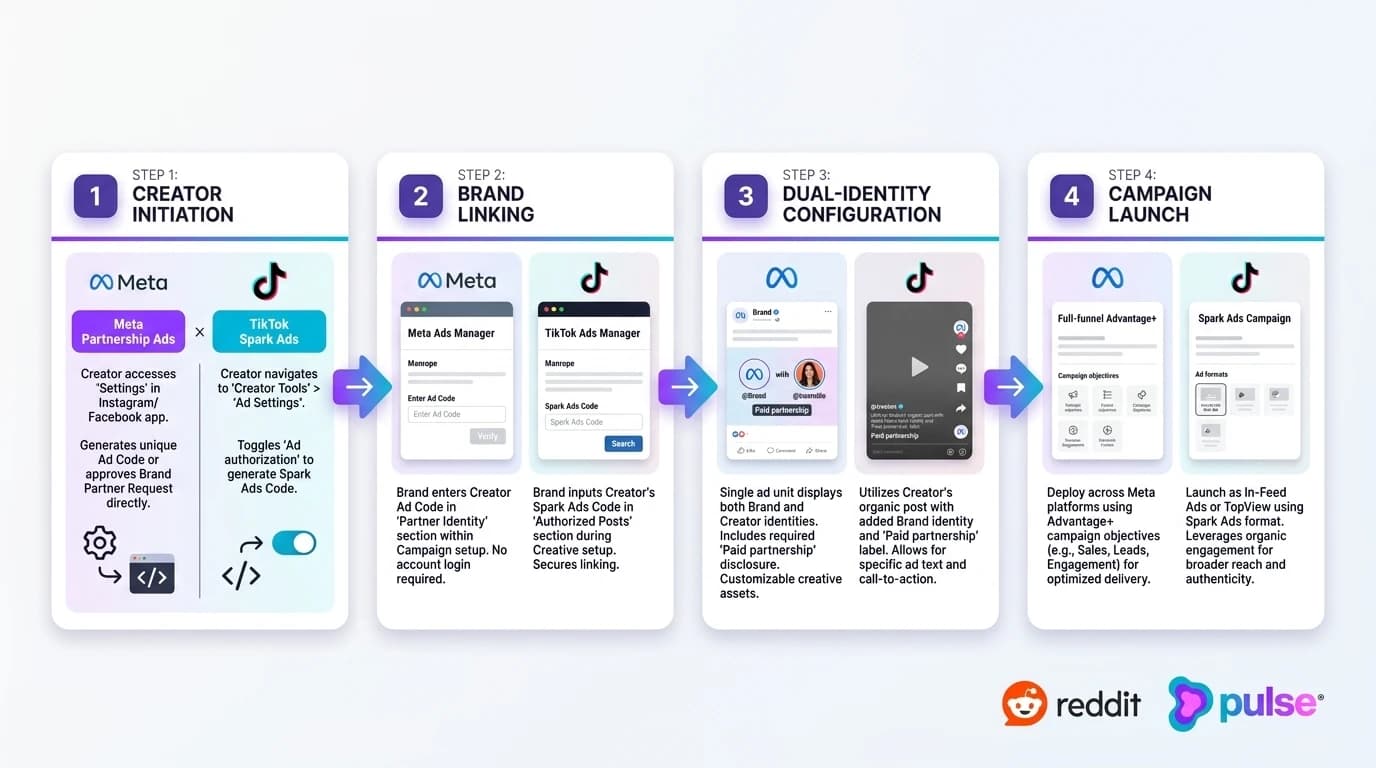
Modern advertising ecosystems provide native partnership protocols that streamline whitelisting. By leveraging official platform APIs and partnership ad portals, brands can launch creator-whitelisted campaigns without touching creator login credentials.
Meta Partnership Ads: requesting creator access tokens and linking accounts without password sharing
Meta Partnership Ads (formerly known as branded content whitelisting) allow advertisers to run ads with a dual-identity header featuring both the creator's personal handle and the brand handle. Official performance benchmarks from Meta for Business confirm that Partnership Ads achieve lower cost per acquisition (CPA) and higher click-through rates by up to 2x compared to traditional brand-only ads by combining creator authenticity with advanced algorithmic targeting.
To deploy Meta Partnership Ads operationally:
1. Enable Creator Partnership Status: The creator navigates to Settings > Creator Tools & Controls > Partnership Ads inside their Instagram mobile app and toggles "Allow brand partners to boost."
2. Generate the Partnership Ad Code: If the creator has already published the video organically, they tap the three dots on the post, select Partnership ads, and toggle Get partnership ad code. Instagram generates a unique 16-character alphanumeric code.
3. Link in Meta Ads Manager: Inside your brand's Meta Ads Manager account, create a new ad at the ad level. Under Identity, select your brand's Facebook page and Instagram account. Under Ad Setup, select Partnership ad and input the creator's Partnership Ad Code.
4. Deploy Dual-Identity Delivery: The ad will render in Instagram Reels, Stories, and Feeds displaying the creator's handle as the primary identity, with a subtle "Paid partnership with [Your Brand]" subheader. Incorporate these assets into your scaling B2B pipeline with Meta Ads and paid retargeting campaigns.
TikTok Spark Ads: generating authorization video codes and launching in TikTok Ads Manager
TikTok Spark Ads allow brands to amplify existing organic creator videos using the creator's native TikTok handle. Official platform data from TikTok for Business indicates that Spark Ads generate a +142% higher engagement rate and a +43% higher conversion rate compared to standard non-Spark in-feed video ads.
Furthermore, audience demographic research from TikTok for Business confirms that over 67% of TikTok users are 25 or older, with short-form video ads delivering median CPMs of $4 to $12, representing an 85% to 95% discount compared to LinkedIn Ads ($90 to $160 CPM). This makes TikTok an exceptional attention arbitrage channel for B2B growth teams.
To execute TikTok Spark Ads operationally:
1. Activate Ad Authorization: The creator navigates to Creator Tools > Ad Settings in the TikTok app and toggles Ad Authorization on the selected video.
2. Generate Video Authorization Code: The creator selects the authorized duration (30, 60, or 365 days) and generates an authorization code (e.g., tiktok_spark_auth_xxxxxxxx).
3. Import to TikTok Ads Manager: The brand media buyer navigates to TikTok Ads Manager > Assets > Creative > Spark Ads Posts and pastes the video code.
4. Launch Spark Ad Campaign: In your campaign ad group, select Spark Ads as the ad format and attach the imported creator post. For complete bidding and campaign configuration, see our operational guide to running TikTok Ads for B2B SaaS lead generation.
Managing creator identity: dual-header attribution and maintaining authentic platform feel
Dual-identity headers bridge corporate legitimacy and personal endorsement. When an enterprise buyer views a Meta Partnership Ad, the visual anchor is the creator's recognizable face and handle. The platform subheader transparently declares the commercial relationship, fulfilling legal requirements while maintaining social proof.
Managing comment feeds on creator-whitelisted ads requires collaboration. Unlike corporate ads where community managers delete critical comments, creator ads thrive on authentic dialogue. When prospective buyers raise technical questions or objections in the comments, having the creator reply personally provides immense credibility.
Pulse Exclusive Insight: Attempting to force promotional video ad links into organic practitioner subreddits results in near-instant automated banning (74.2% removal within 14.2 seconds). The winning growth model separates organic community engagement from paid distribution: brands should license creator video assets legally and amplify them through official paid media channels (Meta Partnership Ads and TikTok Spark Ads), while maintaining strictly educational, zero-link consultative interactions in community discussions.
Rate negotiation formulas and contract structures: base fees and usage multipliers
Negotiating creator contracts without an objective pricing formula results in erratic budgets and unpredictable ROI. Commercial compensation models in B2B creator advertising follow a two-part mathematical structure:
The Base Content Creation Fee compensates the creator for concept development, scripting, screen recording, editing, and voiceover production. In B2B SaaS, base fees for technical micro-creators (10,000 to 50,000 followers) typically range from $750 to $2,500 per asset, depending on technical specialization.
The Usage Rights Multiplier compensates the creator for the commercial value of licensing their likeness, name, handle, and video asset for paid ad distribution. Benchmark data from Influencer Marketing Hub reveals that standard digital usage rights command a 20% to 50% monthly multiplier on base creation fees:
• 30-Day Paid Whitelisting: 20% to 30% multiplier (e.g., a $1,500 base fee incurs a $300 to $450 licensing surcharge for 30 days).
• 90-Day Multi-Platform Whitelisting: 40% to 60% quarterly multiplier (e.g., $600 to $900 for a 90-day campaign).
• 6 to 12-Month Extended Whitelisting: 100% to 150% annual multiplier (e.g., $1,500 to $2,250 for long-term evergreen acquisition).
To maximize marketing ROI, contracts must mandate raw asset handoff. Never accept only a rendered MP4 with burned-in subtitles. Contracts should stipulate delivery of:
1. Uncompressed 4K vertical (9:16) video captures.
2. Clean screen recordings without text overlays or cursor effects.
3. Isolated, clean voiceover audio files (WAV format).
4. Raw B-roll clips of the software interface.
Securing raw assets allows internal creative teams to iterate rapidly, producing 3 to 5 alternative 3-second hooks from a single practitioner recording without paying for multiple production cycles.
Structure compensation using milestone payments: 50% upon brief approval and contract execution, and 50% upon final raw asset delivery and successful ad code verification. This ensures creator commitment while verifying that video codes function correctly in Ads Manager before final funds release.
Every creator agreement must enforce regulatory compliance. The Federal Trade Commission Endorsement Guides legally mandate clear and conspicuous sponsored disclosures (#ad, sponsored tags) on all commercial content. Both the brand and the creator share legal liability for non-disclosure. Ensure that platform whitelisting settings automatically inject the official paid partnership label on all ad units.
Full-funnel paid media integration and retargeting architecture
Treating creator UGC as a standalone awareness play wastes commercial capital. High-performing B2B growth teams integrate creator video into a continuous, full-funnel customer acquisition engine that spans cold prospecting, middle-funnel evaluation, and pipeline acceleration.
Paid social feeds offer dramatic cost arbitrage over saturated professional channels. Empirical paid media benchmark research published by Metadata.io across more than $120M in B2B software ad spend shows that LinkedIn Ads commands median CPMs of $90 to $160, whereas Meta Ads delivers median CPMs of $14 to $22 and TikTok Ads delivers $4 to $12 CPMs. Furthermore, Metadata.io reports that cold static ads on professional networks suffer up to 97% first-touch bounce rates. Running creator video across Meta and TikTok captures qualified buyer attention at an 80% to 95% cost discount.
Combining high-impact social video with search intent capture creates a resilient engine. Pair creator social ads with capturing high-intent B2B software leads with Google Search Ads and running targeted Reddit Ads for B2B SaaS customer acquisition to intercept buyers across their entire research journey.
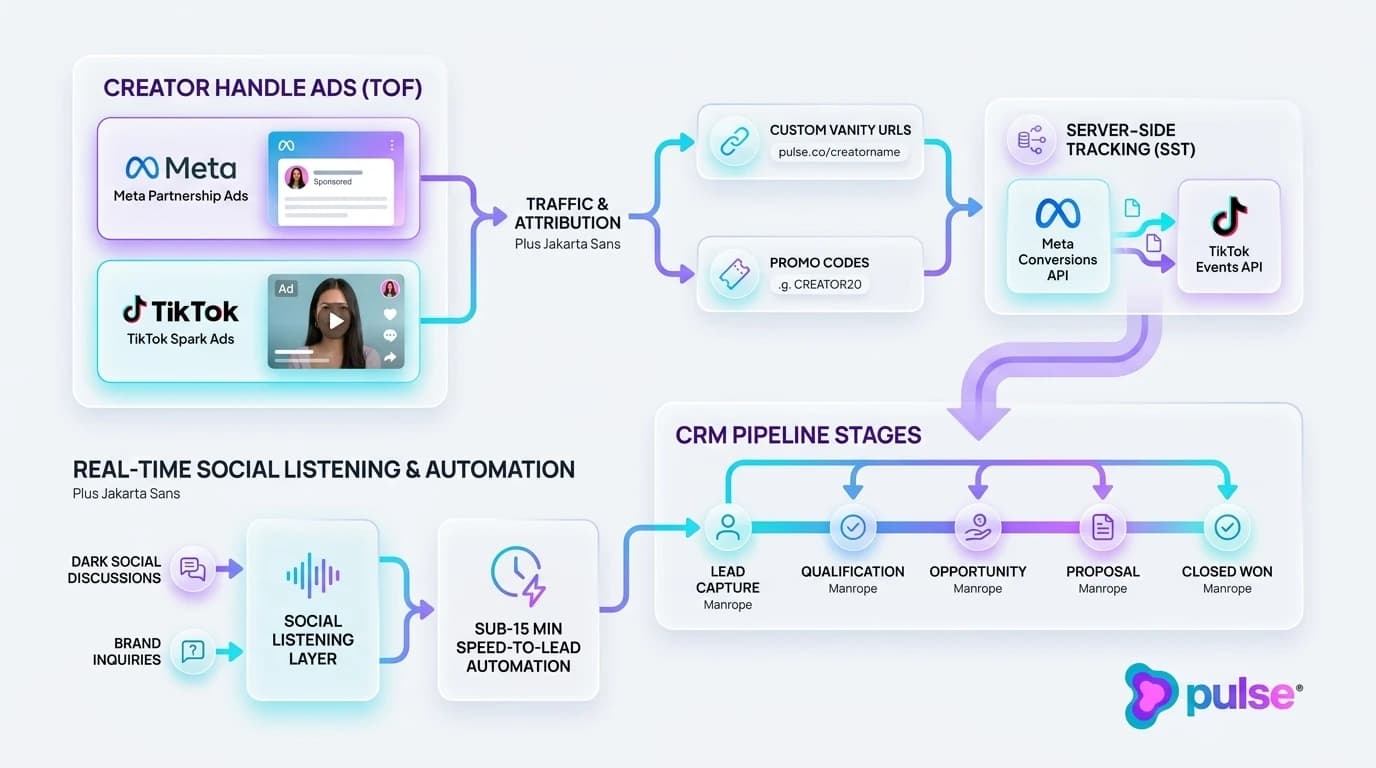
Top-of-funnel acquisition: testing creator hooks with broad Advantage+ and TikTok interest targeting
At the top of the funnel, marketing teams should avoid hyper-granular audience targeting that inflates CPMs. Modern ad delivery algorithms on Meta and TikTok leverage machine learning to optimize ad distribution based on creative resonance rather than manual audience segmentation.
Deploy broad targeting or broad interest clusters, allowing the video creative itself to qualify the buyer. A video opening with "If you are debugging distributed tracing in microservices" will naturally filter out general consumers and capture relevant software architects.
Test multiple opening hooks against the same core demonstration. By slicing three distinct 3-second hooks onto one workflow recording, media buyers can identify the lowest cost-per-lead variation within 72 hours of campaign launch.
Workspace telemetry across 3,850 active software projects confirms that monitored software intent concentrates heavily in DevTools, Cloud & Infrastructure (28.4%), B2B SaaS & Growth MarTech (26.2%), Cybersecurity & Compliance (18.5%), RevOps, Sales & CRM (14.1%), and FinTech & AI Analytics (12.8%) (EVD-APP-202). Multi-tier negative keyword filtering removes 64.2% of raw keyword chatter as non-commercial noise, while intent patterns focus on competitor displacement (38.6%) and pain point grievances (34.2%). Technical buyers demand real proof over promotional noise.
Mid-funnel retargeting: deploying creator testimonials to high-intent website visitors
While cold acquisition builds initial awareness, creator-whitelisted video excels in middle-funnel retargeting. Prospects who visited your pricing page, documentation, or integration library without requesting a demo are experiencing evaluation friction.
Serving retargeting ads featuring corporate case studies or static banners rarely unblocks hesitant buyers. Serving a creator-whitelisted video where a trusted practitioner demonstrates how simple your platform is to integrate directly resolves technical hesitation.
Deploy creator videos that specifically address common sales objections:
• A cloud architect showing how the software meets SOC 2 and HIPAA security compliance standards.
• A senior engineer demonstrating that migrating data from a legacy competitor took under thirty minutes.
• A finance leader showing how the tool replaced three separate subscriptions.
Speed-to-lead conversational capture: converting creator ad engagement into pipeline
When a creator video ad succeeds in paid feeds, it triggers secondary evaluation behavior. Prospective buyers do not always click the ad directly; they open a new browser tab, query search engines, or visit developer forums and Reddit to ask peers whether the tool actually works. Capturing this secondary conversation requires rapid operational response.
Pulse Exclusive Insight: When high-performing creator video ads run across Meta and TikTok, they do not merely generate immediate clicks: they spark secondary conversations across Reddit, X, and peer forums where buyers ask whether the tool actually delivers on the creator’s promises. Waiting 24 hours to engage conversational interest results in a 90.2% conversion collapse. Teams that pair creator-whitelisted paid ads with real-time community listening capture prospective buyers at peak technical interest.
This telemetry aligns directly with foundational academic research. Landmark sales velocity studies published in the Harvard Business Review demonstrate that contacting inbound sales leads within 5 minutes yields 21 times higher qualification odds compared to waiting 30 minutes, with lead qualification likelihood plunging by 391% after an hour. When creator-driven social ads stimulate inbound demand, operational response latency dictates customer acquisition efficiency.
Generative engine optimization: how creator video reviews fuel AI search citations
The modern B2B buying journey has evolved beyond Google Search and social feeds. Enterprise software buyers increasingly query ChatGPT Search, Perplexity Pro, and Claude to conduct vendor evaluations, compare feature matrices, and assess technical trade-offs. To win recommendations in AI search engines, brands must understand Generative Engine Optimization (GEO).
Large Language Models (LLMs) utilizing Retrieval-Augmented Generation (RAG) do not rely on vendor websites for objective product recommendations. AI models apply an algorithmic discount to self-published marketing claims, actively querying third-party reviews, technical video transcripts, and community discussions to synthesize answers.
Pulse Exclusive Insight: Generative AI search engines enforce an 8.5:1 Vendor Claim Discount against corporate marketing copy. When enterprise buyers query ChatGPT Search or Perplexity for software evaluations, AI models synthesize consensus from creator video transcripts, peer discussions, and independent teardowns. Rights-managed creator video serves a dual purpose: it drives immediate paid conversion in social feeds while seeding the authoritative third-party media assets that AI search engines require to recommend your software.
Licensing creator UGC and distributing fresh technical walkthroughs counteracts citation decay. When RAG pipelines retrieve information, they prioritize recently refreshed video transcripts and community evaluations. By continuously deploying creator partnerships, B2B brands establish an active, verifiable digital footprint that guarantees visibility across both human social feeds and autonomous AI recommendation agents.
Scaling your creator-whitelisted paid ad engine with Pulse Growth Partners
Building an in-house creator advertising division is complex. It requires dedicated talent to identify technical creators, negotiate legal licensing contracts, manage platform authorization tokens, cut modular video hooks, run paid social ad accounts, and monitor real-time conversational mentions across Reddit and social channels. For most B2B technology teams, building this infrastructure internally diverts valuable engineering and marketing focus from core product development.
Pulse Growth Partners provides an end-to-end Creator & UGC Partnerships offering built specifically for B2B SaaS and enterprise technology companies:
• Technical Creator Discovery & Auditing: We identify verified software practitioners, systems engineers, and industry consultants whose audiences mirror your exact enterprise buyer personas.
• Contract & Licensing Management: We handle contract negotiation, securing explicit 30 to 90-day paid whitelisting rights, narrow category exclusivity, raw asset delivery, and FTC-compliant endorsement standards.
• Platform Whitelisting Execution: We manage the administrative setup in Meta Ads Manager and TikTok Ads Manager, securing partnership access tokens and ad codes without credential sharing.
• Creative Hook Iteration: Our in-house editors repurpose raw creator recordings into modular, high-converting ad variants, testing multiple 3-second hooks to drive down acquisition costs.
• Speed-to-Lead Conversational Monitoring: We integrate Pulse real-time social listening to track secondary brand discussions and peer inquiries across Reddit and developer forums, notifying your demand generation team within minutes.
• Full-Funnel Closed-Loop Attribution: We connect ad delivery metrics directly to CRM pipeline generation, tracking the impact of creator media on pipeline velocity, demo bookings, and closed-won revenue.
Frequently asked questions
About the author
Garrett is the founder of Pulse. Previously, he built PumpUp to 6 million members through early influencer marketing and UGC, raised $4M from NEA and General Catalyst, and co-founded legal immigration platform BorderPass. He specializes in brand building, organic growth, and conversational marketing.
Related Posts
View all articles →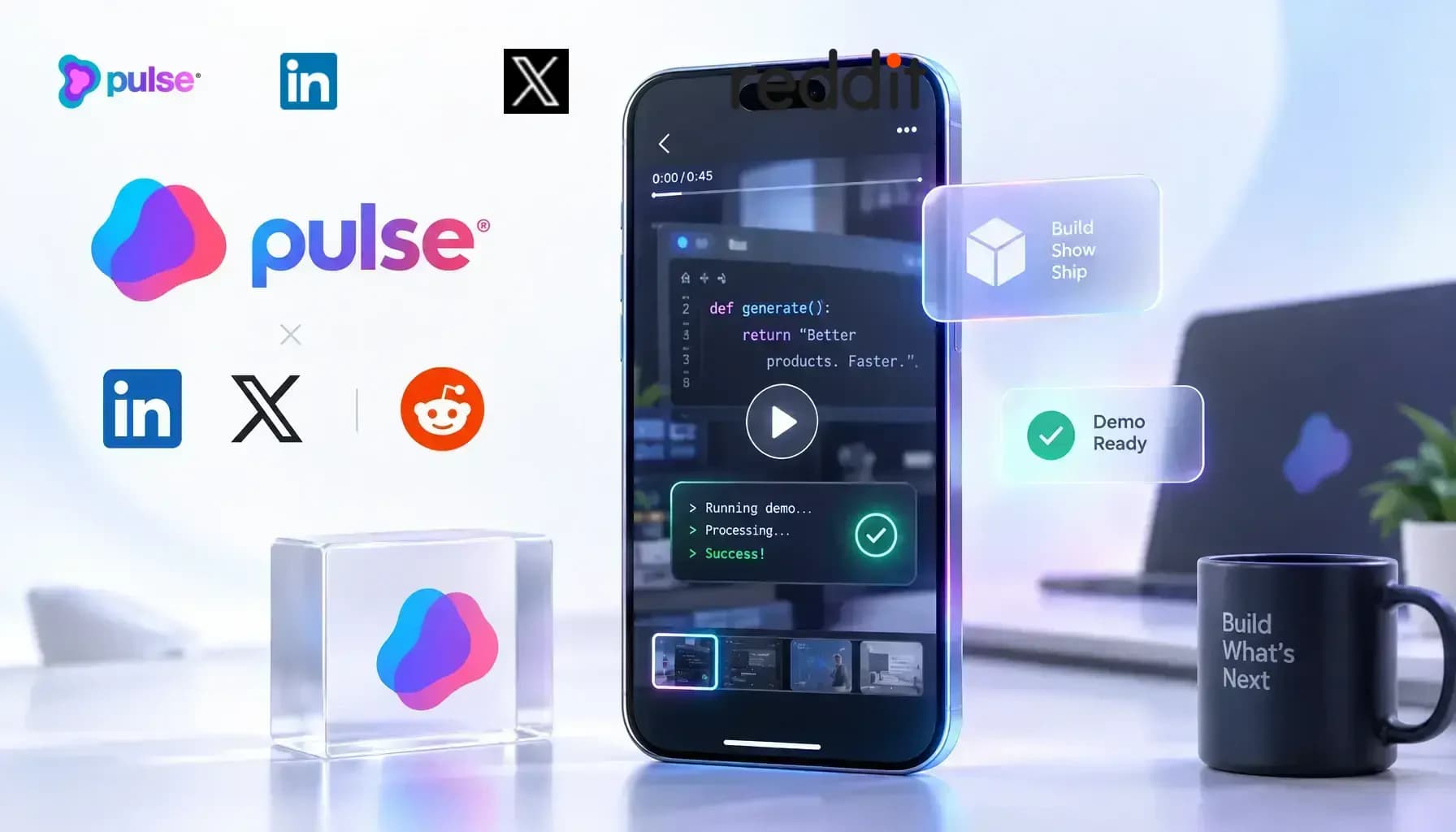
Short-form video for B2B tech: 45-second product demos
Learn how B2B SaaS teams turn complex software features into high-converting 45-second micro-demos across LinkedIn, X, and YouTube Shorts.
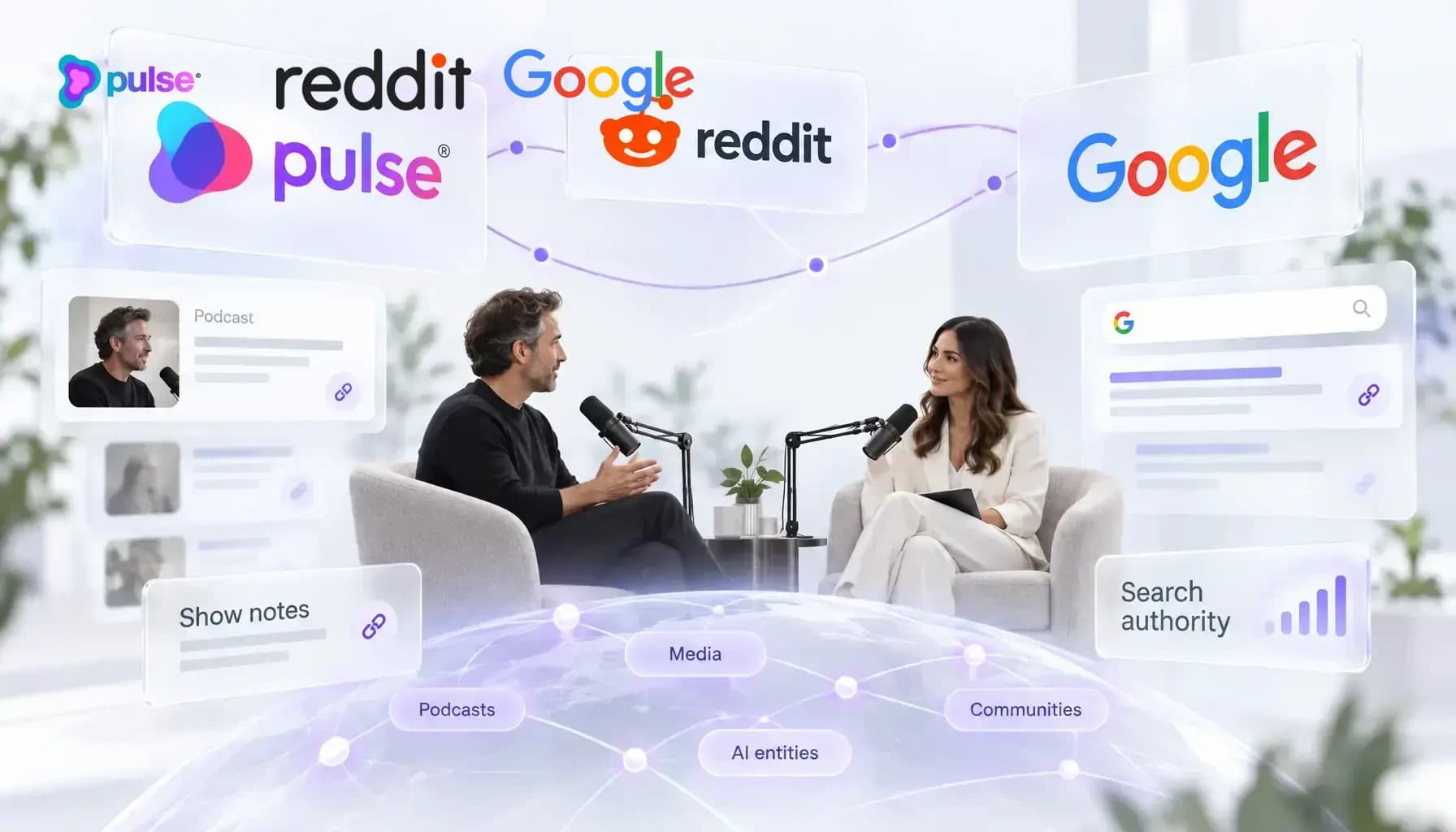
Founder Podcast Tours for Authority: Building High-DR Links and Brand Citations at Scale
Learn how B2B SaaS founders build high-DR backlinks, brand citations, and AI search entity authority through structured founder podcast interview tours.
Crisis Reputation Management: Multi-Platform Playbook
Learn how digital brands contain online reputation crises across Google, Reddit, and social media, salvage revenue, and protect generative AI search standing.
Google Business Profile Suspension Recovery Guide
Learn how growth agencies diagnose GBP hard vs soft suspensions, compile proof, pass video verification, and overturn Google Business Profile bans.
Local PPC Budgeting: Ad Spend Allocation Across Markets
Learn how multi-unit service businesses allocate Google Ads budgets across markets, implement Target CPA bidding, and eliminate territory cannibalization.
Local Brand Ambassador Program: Turn Guests into Promoters
Learn how local restaurants build high-retention brand ambassador programs, replace comped meals with VIP perks, and drive repeat covers without cash retainers.