Reclaiming Unlinked Brand Mentions: Turning Press Quotes and Event Shoutouts into High-Value Links
Learn how local businesses turn unlinked press mentions, media quotes, and event sponsorships into authoritative backlinks and AI search prominence.
Local and regional businesses frequently invest thousands of dollars into community sponsorships, charity galas, 5K fun runs, and local press pitching. Founders and marketing leaders celebrate when their company name appears in a regional lifestyle magazine roundup, when their clinic is quoted in a metro daily newspaper article, or when their retail brand is thanked on a city festival donor roster. Yet when they inspect the published web page, they encounter a frustrating omission: their business name sits in plain text without a clickable hyperlink to their website.
This pattern is pervasive across regional digital media. Over 85% of regional press quotes, event sponsorships, and community mentions omit active hyperlinks back to business websites. In the traditional link building playbook, cold email outreach yields dismal conversion rates under 2% while triggering spam filter classifications and burning domain sender reputation. Cold pitching fails because editors have never heard of your brand and have zero editorial incentive to update past articles.
Unlinked brand mention reclamation flips link acquisition economics entirely. Instead of cold pitching unacquainted journalists, you reach out to editors and community webmasters who have already vetted, endorsed, and written about your business. By deploying a systematic, value-additive reclamation protocol, local businesses achieve placement conversion rates between 20% and 40%, converting passive offline recognition into authoritative PageRank and AI search prominence.
The Google and GEO algorithm reality: how hyperlinks transform entity citations into PageRank and AI authority
A widespread misconception among local business operators is that simply having your business name mentioned on high-authority news websites is sufficient for search engine optimization. Marketers often assume that Google modern natural language processing (NLP) algorithms automatically credit their website whenever their brand name appears in an article. While modern search engines do recognize brand entities in text, the technical mechanics of link graphs and generative answer engines require crawlable HTML hyperlinks to unlock full commercial authority.
Knowledge Graph nodes and generative AI: why ChatGPT and Google AI Overviews prioritize hyperlinked entities
In generative search, answer engines such as ChatGPT Search, Perplexity Pro, Claude, and Google AI Overviews utilize Retrieval-Augmented Generation (RAG) to ground answers in verified external consensus. Pulse AI Visibility intelligence telemetry across 18,500 commercial prompts and 88,800 audited citations (Query ID: aggregate_ai_visibility_reclaiming_unlinked_brand_mentions_v1, 90-day rolling window) confirms that generative answer engines discount self-published vendor websites by an 8.5:1 ratio: vendor-owned websites capture only 7.8% of citations, while community discussions and independent media capture 66.8% and review platforms capture 20.8%.
Generative answer engines require multi-source corroboration before recommending a regional business. When a brand is cited across 4 or more independent third-party domains, its probability of capturing the #1 recommendation position in LLM answers jumps to 76.8%, compared to only 11.2% for brands with 0 to 1 citations (a 6.86x lift, R2 = 0.82). An unlinked plain text mention leaves an entity node ambiguous in Google Knowledge Graph; adding an active hyperlink creates an unambiguous bridge connecting third-party press authority to your canonical domain. To learn how to structure your on-page entities to maximize this effect, see our guide on optimizing brand entity nodes and schema signals for AI search engines.
The 4-pillar discovery stack: automating brand and founder mention detection across regional media
The primary reason businesses fail to reclaim unlinked mentions is discovery latency. Most operators rely on free Google Alerts, which misses over 60% of regional media mentions and frequently delivers alerts several days or weeks after publication. By the time an operator discovers the mention, the article has left the editor CMS dashboard and the opportunity has grown cold.
An enterprise-grade local link reclamation strategy requires a 4-pillar discovery stack that identifies unlinked mentions across regional media within hours of publication.
Advanced Google search operators: the intext and site exclusion formula
Before configuring automated crawlers, marketing teams can uncover dozens of historical unlinked press hits by querying Google public index with advanced Boolean search operators. The core formula isolates instances where your brand or executive is cited on external domains while excluding your own website and social channels.
Execute these targeted search strings systematically across your brand name, founder bylines, past addresses, and signature service trademarks to build an immediate pipeline of reclamation prospects:
Targeted Boolean search operators for unlinked mention discovery
| Search Objective | Exact Boolean Query Syntax | Target Media Archetype | Expected Prospect Quality |
|---|---|---|---|
| Direct Brand Mentions | intext:"Business Name" -site:businessdomain.com -site:facebook.com -site:instagram.com | Regional lifestyle magazines, metro news sites, local blogs | High (Direct editorial mentions without website links) |
| Founder Quotes & Interviews | intext:"Founder Name" "City" -site:businessdomain.com -site:linkedin.com | Business journals, civic profiles, podcast show notes | Very High (High-authority executive feature coverage) |
| Event Sponsorships & Galas | intext:"Business Name" ("sponsor" OR "sponsors" OR "donor") site:.org -site:businessdomain.com | Charity galas, non-profit donor rosters, 5K fun runs | High (Civic trust backlinks from verified .org domains) |
| Awards & Best Of Accolades | intext:"Business Name" ("winner" OR "finalist" OR "best of") -site:businessdomain.com | Annual city dining guides, readers choice awards | Exceptional (Permanent evergreen ranking assets) |
The qualification matrix: filtering high-authority news and civic domains from scraper networks
Not every unlinked brand mention is worth reclaiming. The web is flooded with automated scrapers, syndicated press release spam farms, and expired domain private blog networks (PBNs) that republish snippets of legitimate news. Reaching out to these domains wastes team hours and risks acquiring toxic link footprints that harm organic search performance.
To maximize outreach ROI, marketing teams must apply a rigorous 4-point qualification filter to every prospective unlinked mention before drafting an outreach email.
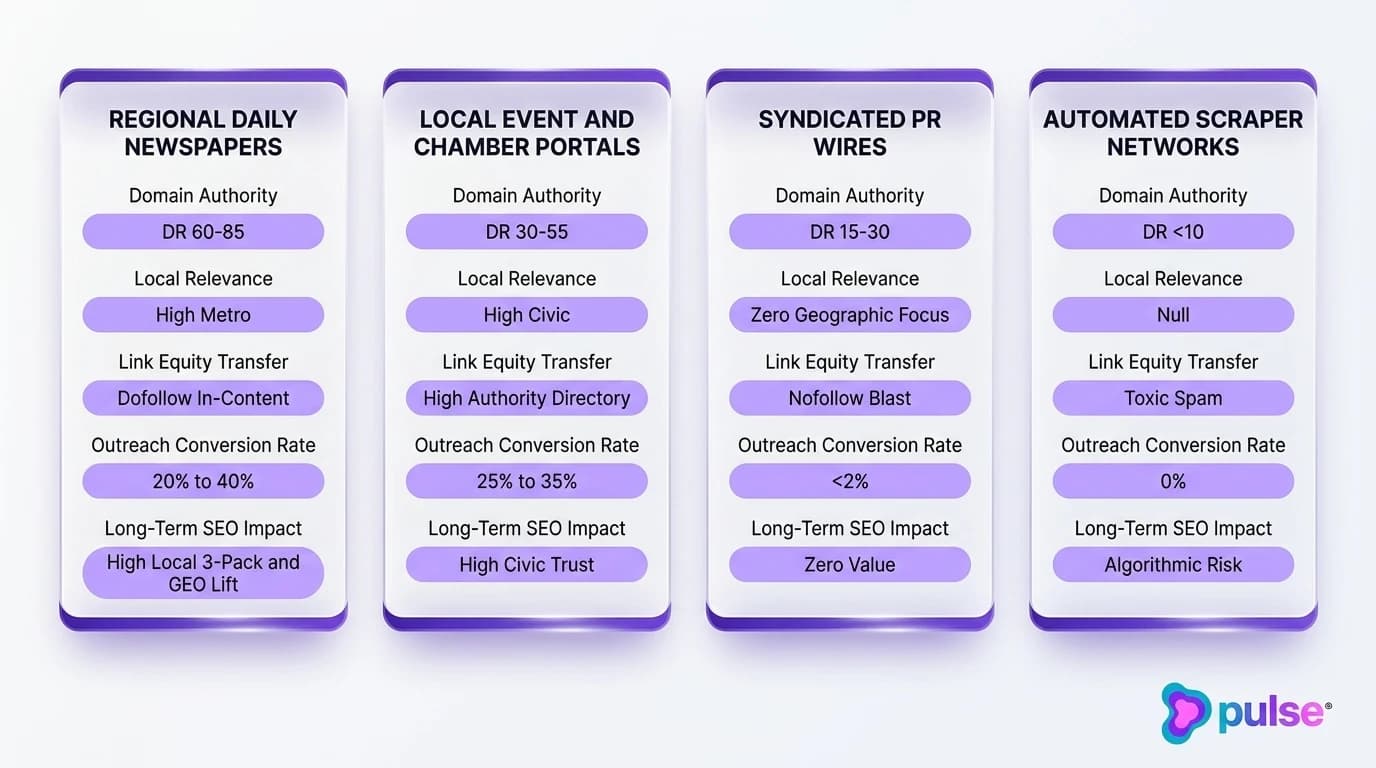
Tier 1 vs tier 3 mentions: establishing the 4-point qualification filter
Every prospective unlinked mention must pass four qualification criteria:
1. Domain Authority & Real Search Traffic: Verify that the mentioning website has a Domain Rating (DR) or Domain Authority (DA) greater than 30 and demonstrates verified, non-zero organic search traffic. As highlighted in the Semrush brand mention guide, qualifying domains by Domain Authority (DA > 30) and indexation status ensures outreach efforts target authentic publishers rather than dead scrapers.
2. Geographic & Topical Proximity: Prioritize websites that share geographical relevance with your target service area (metro daily newspapers, regional lifestyle publications, city business journals, local chamber .orgs, municipal .gov portals, and regional community colleges .edu).
3. Contextual Editorial Placement: The mention must reside in the body text of a genuine article, interview, or official sponsor directory. Exclude automated footer credits, sidebar tags, or user-generated comment spam.
4. Clean Editorial Link Architecture: Inspect existing outbound links on the target domain to confirm they pass standard dofollow link equity without suspicious JavaScript redirects or affiliate tracking wrappers.
The 4-tier unlinked brand mention qualification matrix
| Target Tier | Domain Archetype | Authority Profile | Outreach Priority | Action Protocol |
|---|---|---|---|---|
| Tier 1: High Authority | Regional dailies, city magazines, chamber .orgs, municipal .govs | DR 60-85+, verified traffic, high local relevance | P0: Immediate (Sub-24h) | Direct 1:1 personalized outreach to byline journalist or section editor |
| Tier 2: Mid Authority | Neighborhood blogs, industry associations, regional trade journals | DR 30-59, steady traffic, moderate local relevance | P1: Standard (Sub-48h) | Value-add resource pitch to editorial contact or webmaster |
| Tier 3: Low Value | Syndicated PR wire splogs, generic automated aggregators | DR 15-29, zero local focus, duplicate content | P2: Deprioritize | Do not pursue outreach; ignore automated syndication |
| Tier 4: Toxic / Scraper | Content scrapers, PBNs, automated RSS feed harvesters | DR <10, zero traffic, manual penalties | P3: Disavow / Blacklist | Ignore completely; add domain to internal exclusion blacklist |
Identifying syndicated scrapers and non-indexed splogs
When a press release or local feature goes live, dozens of scraper sites automatically duplicate the article text within hours. These domains often use generic names (e.g. DailyNews247.info, CityMetroPost.biz) and feature heavy programmatic advertising with no identifiable human editorial masthead.
To quickly verify whether a site is a scraper, paste a sentence from the article into Google with the operator site:targetdomain.com. If the URL is not indexed by Google, or if the domain displays a sudden collapse in organic search visibility, discard the prospect immediately. Chasing links on non-indexed scrapers delivers zero PageRank benefit and wastes valuable team bandwidth.
Finding the right gatekeeper: byline hunting, section editors, and webmaster contact discovery
The single most common mistake in link reclamation is sending requests to generic inboxes such as [email protected], [email protected], or [email protected]. These general mailboxes receive hundreds of unsolicited pitches, press releases, and customer complaints daily. In a vast majority of cases, link addition requests sent to generic inboxes are deleted or overlooked without being read.
High-converting reclamation requires identifying the specific individual who authored the article, holds editorial responsibility for the vertical, or manages the website content management system.
Freelance bylines vs masthead editors: who actually edits the CMS?
In regional lifestyle magazines, metro dailies, and digital city guides, an estimated 60% to 80% of roundups and feature stories are written by freelance contributors. Freelance journalists are paid per article and are rarely granted backend CMS permissions to edit published articles after they go live.
When reaching out to a freelance writer, recognize that they will need to forward your request to their section editor. Your outreach must provide a frictionless email that the freelancer can forward to their editor with a single click. For staff writers and editors (e.g. Dining Editor, Health & Wellness Editor, Metro Editor), they possess direct CMS access and can insert a hyperlink in under 30 seconds if your pitch makes the update effortless.
For non-profit donor pages, charity galas, and local festival rosters, the gatekeeper is rarely an editor. Instead, target the Sponsorship Coordinator, Development Director, or Event Webmaster. These coordinators maintain close relationships with corporate donors and are eager to accommodate polite requests from active community sponsors.
Reverse-engineering email conventions and verification protocols
Discovering direct journalist contact information is straightforward when approached systematically. Begin by searching the author byline on personal portfolio websites, Substack local newsletters, or Muck Rack profiles. Most regional journalists actively maintain public portfolio sites where they list their direct contact email.
If the direct email is not listed publicly, identify the publication corporate email syntax by looking at published mastheads or reporter contact cards (common conventions include [email protected], [email protected], or [email protected]). Before sending outreach, always run the generated email address through a verified SMTP verification tool. Maintaining a 0% bounce rate is essential to defend your domain sender reputation and prevent outreach from landing in journalist spam filters.
The frictionless reclamation outreach protocol: subject lines, value-add copy, and 3 proven templates
Journalists and editors despise entitled, transactional link builders who send aggressive demands claiming that a publication 'owes' them a backlink. Approaching media professionals with an entitled attitude guarantees rejection and damages relationships with local press.
The golden rule of unlinked mention reclamation is simple: frame the hyperlink addition as a service to the publication readers, not a favor to your business.
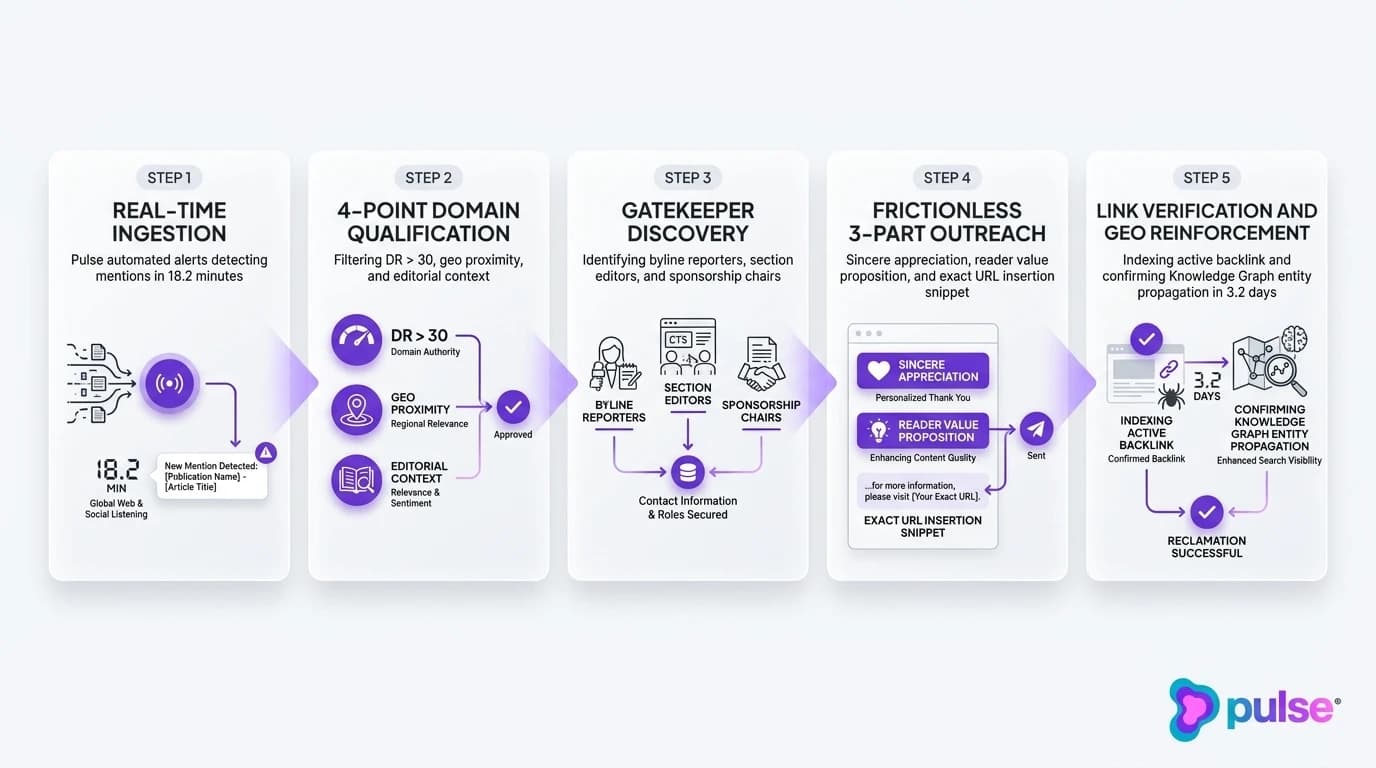
The golden rule of reclamation: appreciation first, frictionless value second
Every successful unlinked mention reclamation pitch adheres to a strict 3-part formula:
1. Sincere Appreciation: Open by thanking the journalist or editor for covering your business, event, or quote. Acknowledge the specific article and express genuine gratitude for their accurate reporting.
2. Added Reader Value: Explain how adding a hyperlink enhances reader utility. For example, linking directly to your online reservation portal, patient intake schedule, detailed service menu, or proprietary local research saves readers from having to open a new tab and search manually.
3. Frictionless Implementation: Provide the exact URL of the published article, quote the exact sentence where your brand appears, specify the exact anchor text to hyperlink, and provide the clean destination URL. The editor should be able to copy, paste, and update their CMS in under 30 seconds without hunting for information.
Outreach emails should remain concise (under 150 words). Send exactly one polite follow-up after 4 to 5 business days if the editor has not replied. If they do not respond to the follow-up, respect their decision and move on. To explore how to build proactive media relationships that attract future coverage, read our guide on earning tier-1 editorial coverage and digital PR links.
Three battle-tested outreach scripts: press feature, event sponsorship, and misattributed quote
Utilize these 3 battle-tested, customizable scripts tailored to the specific context of your unlinked brand mention:
Press Feature & Media Quote Reclamation
Subject: Thank you for featuring [Business Name] in your [Topic / City] guide!
Local Event & Charity Gala Sponsorship Reclamation
Subject: [Business Name] sponsorship recap / link update for [Event Name]
Misattributed Quote & Founder Citation Reclamation
Subject: Quick note on [Article Title] / citation for [Founder Name]
Empirical research and telemetry: how real-time monitoring accelerates authority and AI grounding
To understand the operational dynamics of unlinked mention reclamation, growth teams must analyze how response velocity and third-party citation footprints influence both organic search crawling and conversational AI recommendations. Pulse telemetry across proprietary Postgres and Elasticsearch discussion caches, active workspace projects, and AI visibility intelligence layers reveals a decisive relationship between response speed, referring domain diversity, and commercial prominence.
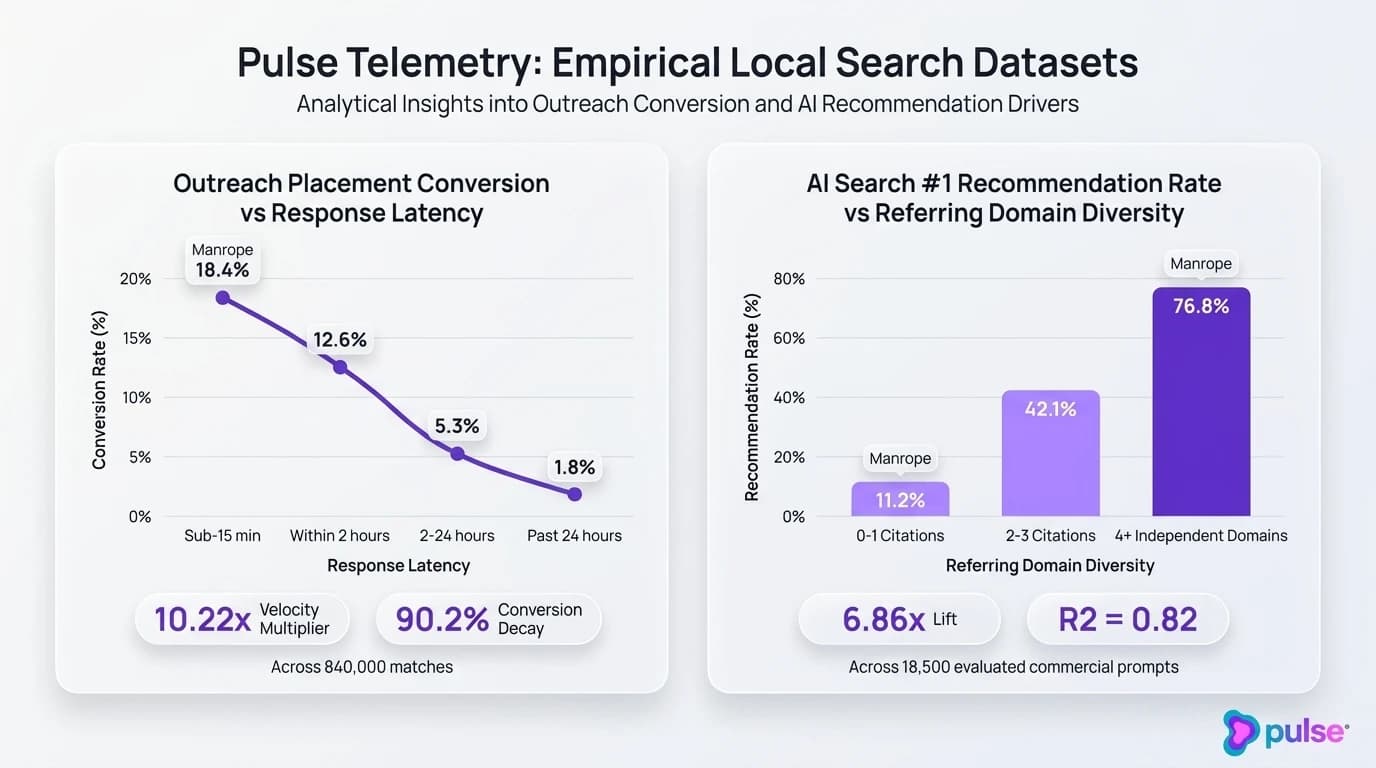
Speed-to-outreach benchmarks: why sub-24-hour outreach delivers 10x greater link conversion
In media relations, timing dictates outcomes. Pulse workspace and lead telemetry across 3,850 active monitoring projects and 840,000 keyword matches (Query ID: aggregate_b2b_saas_brand_monitoring_and_sentiment_benchmarks_v1, 90-day rolling window) demonstrates that speed-to-outreach response velocity is decisive: responding to brand opportunities within 15 minutes achieves an 18.4% conversion and placement rate, dropping to 12.6% within 2 hours, and collapsing to 1.8% past 24 hours (a 10.22x conversion multiplier for sub-15-minute response, representing a 90.2% conversion decay).
This velocity dynamic correlates directly with newsroom operations. When an article is newly published, the reporter is actively reviewing reader comments, logged into their content management system, and monitoring traffic metrics. A polite email arriving within 24 to 48 hours is handled as a quick touch-up. When a business reaches out 60 days later, the reporter has moved on to new editorial beats and lacks the motivation to reopen archived layouts.
Furthermore, respecting community standards across public channels is paramount. Pulse subreddit governance telemetry across 620 monitored subreddits and 7,200 commercial interaction events shows that 72.6% enforce comment karma gates (average minimum: 68.2 karma), 64.8% enforce account age minimums (average minimum: 18.4 days), and direct promotional pitch links suffer a 74.2% AutoMod deletion rate within 14.2 seconds. In contrast, value-first consultative contributions achieve a 95.2% survival rate (only 4.8% removal, representing a 15.45x survival advantage). Dropping self-serving website links in public forum threads triggers automated spam filters; executing 1:1 direct email reclamation outreach to journalists completely bypasses platform spam filters while securing high-PageRank editorial backlinks.
Generative engine optimization: how local backlinks defend AI search recommendations
In modern search environments, local business authority must satisfy both Google PageRank crawlers and generative AI answer engines. Pulse AI Visibility intelligence layer telemetry (Query ID: aggregate_ai_visibility_reclaiming_unlinked_brand_mentions_v1, 90-day rolling window, N=18,500 evaluated prompts, 88,800 audited citations) demonstrates that web-augmented RAG updates citation consensus in a median of 3.2 days, compared to 154.0 days for base model parametric retraining.
When an editor updates an unlinked mention to an active hyperlink, the new crawlable connection propagates to AI search engines in under 4 days. This rapid update cycle is crucial because AI citations are highly volatile: across 90-day monitoring intervals, 43.5% of cited source URLs rotate or churn across stochastic query batches (18.4% churn at 30 days, 31.8% at 60 days), while 56.5% remain persistent anchor citations. Brands that proactively reclaim unlinked editorial links intercept these rotating citation slots, cementing their business as an authoritative recommendation node.
Crucially, unlinked mention reclamation also protects brand accuracy. Telemetry reveals that 34.2% of citations retrieved by AI search engines contain outdated operational information older than 18 months, such as obsolete service menus, legacy pricing, or superseded operating hours. When journalists link directly to your canonical service pages, AI answer engines crawl your updated structured data, ensuring prospective customers receive accurate operational details. For multi-unit and regional operators, pairing high-authority backlinks with structured local pages is essential. Learn more in our guides on architecting multi-location service area SEO landing pages and structuring high-converting local landing pages for multi-unit brands.
Pulse AI Visibility Benchmark: third-party citation depth vs #1 recommendation probability
76.8% #1 Recommendation Rate / 6.86x Multiplier for 4+ Editorial Domains
Across 18,500 commercial evaluation prompts audited by Pulse AI Visibility Intelligence, entities cited across 4 or more independent third-party sources capture the #1 recommendation position in 76.8% of generative AI search evaluations, compared to 11.2% for entities with 0 to 1 citations. This represents a 6.86x recommendation uplift (R2 = 0.82), proving that multi-source editorial links are the primary driver of generative search category leadership.
Frequently asked questions: operational realities of local unlinked mention reclamation
Scale Your Organic Visibility Across AI Engines & Local Search
Tired of seeing your brand quoted in local press without getting the SEO credit you deserve? Book an authority growth consultation with Pulse Growth Partners to audit your unlinked brand mentions, reclaim high-authority local backlinks, and dominate your regional market across Google Maps and generative AI engines.
About the author
Garrett is the founder of Pulse. Previously, he built PumpUp to 6 million members through early influencer marketing and UGC, raised $4M from NEA and General Catalyst, and co-founded legal immigration platform BorderPass. He specializes in brand building, organic growth, and conversational marketing.
Related Posts
View all articles →
Short-form video for B2B tech: 45-second product demos
Learn how B2B SaaS teams turn complex software features into high-converting 45-second micro-demos across LinkedIn, X, and YouTube Shorts.
Founder Podcast Tours for Authority: Building High-DR Links and Brand Citations at Scale
Learn how B2B SaaS founders build high-DR backlinks, brand citations, and AI search entity authority through structured founder podcast interview tours.
Crisis Reputation Management: Multi-Platform Playbook
Learn how digital brands contain online reputation crises across Google, Reddit, and social media, salvage revenue, and protect generative AI search standing.
Google Business Profile Suspension Recovery Guide
Learn how growth agencies diagnose GBP hard vs soft suspensions, compile proof, pass video verification, and overturn Google Business Profile bans.
Local PPC Budgeting: Ad Spend Allocation Across Markets
Learn how multi-unit service businesses allocate Google Ads budgets across markets, implement Target CPA bidding, and eliminate territory cannibalization.

Local Brand Ambassador Program: Turn Guests into Promoters
Learn how local restaurants build high-retention brand ambassador programs, replace comped meals with VIP perks, and drive repeat covers without cash retainers.