The Yelp Algorithm Decoded: Unsticking Filtered Reviews
Learn how the Yelp recommendation algorithm works, why legitimate reviews get filtered, and how to ethically unstick them to protect local restaurant revenue.
For independent restaurant owners, hospitality operators, and local service proprietors, few platform behaviors cause as much frustration as opening Yelp to find that glowing 5-star customer reviews have vanished into the 'Not Recommended' section. A regular guest visits on a busy Saturday night, enjoys an exceptional meal, writes a detailed positive review, and within 24 hours, Yelp's automated algorithm quietly buries their feedback behind an obscure link at the bottom of your business listing.
Meanwhile, a scathing 1-star rant from six months ago remains prominently anchored at the top of your page. Because Yelp strictly excludes 'Not Recommended' reviews from your published aggregate star rating, this filtering behavior creates an artificial rating drag. A venue that maintains an authentic 4.6-star customer satisfaction level can easily find its published Yelp profile suppressed to 3.8 stars.
The financial stakes of this algorithmic suppression are measurable and severe. In his foundational Harvard Business School research , economist Michael Luca revealed that every 1-star change in a restaurant's Yelp rating produces a 5% to 9% swing in top-line revenue for independent dining establishments. Furthermore, according to the authoritative BrightLocal Local Consumer Review Survey , 87% of consumers read online reviews before choosing a local business, with ratings dropping below 4.0 stars triggering up to a 70% collapse in prospective customer inquiries.
To make matters worse, Yelp's footprint extends far beyond its own mobile application. Apple Maps and Siri local queries rely directly on Yelp API data to calculate star ratings and display review snippets across millions of iPhones. When Yelp filters your authentic positive reviews, your business suffers an immediate drop in local map visibility, voice search recommendations, and conversational AI citations.
Faced with this rating penalty, frustrated operators frequently fall for high-pressure sales pitches promising that purchasing Yelp advertising packages will unlock their filtered reviews. In this comprehensive operational guide, we decode the machine-learning signals behind Yelp's recommendation software, bust the persistent pay-to-play advertising myth with federal regulatory findings, identify the top behavioral triggers that get reviews filtered, and outline an ethical, policy-compliant playbook to rehabilitate authentic customer feedback.
5%-9% Revenue Per Star / 25% Filter Rate / 18.4% 15-Min SLA
Algorithmic review filtering costs independent restaurants 5% to 9% in revenue per lost star. Decoupling from pay-to-play myths and executing ethical account maturation restores suppressed reviews, protecting foot traffic across Apple Maps, Siri, and conversational AI.
Revenue Impact Per Star
Every 1-star change in a restaurant Yelp rating produces a 5% to 9% swing in top-line revenue for independent dining establishments.
Harvard Business School (Michael Luca Working Paper 12-016)
Platform Filter Rate
Yelp automated recommendation software continuously categorizes approximately one in four reviews into Not Recommended.
Official Yelp Support Center Operational Documentation
Consumer Trust Reliance
87% of diners read online reviews before visiting a local venue, with ratings dropping below 4.0 stars triggering up to 70% inquiry drop-off.
BrightLocal Local Consumer Review Survey
15-Minute Response SLA
Responding to customer inquiries or grievances within 15 minutes preserves an 18.4% conversion rate versus 1.8% past 24 hours (10.22x multiplier).
Pulse Workspace Telemetry (N=3,850 projects)
The Yelp recommendation software: architecture, ML signals, and the 25% filtering reality
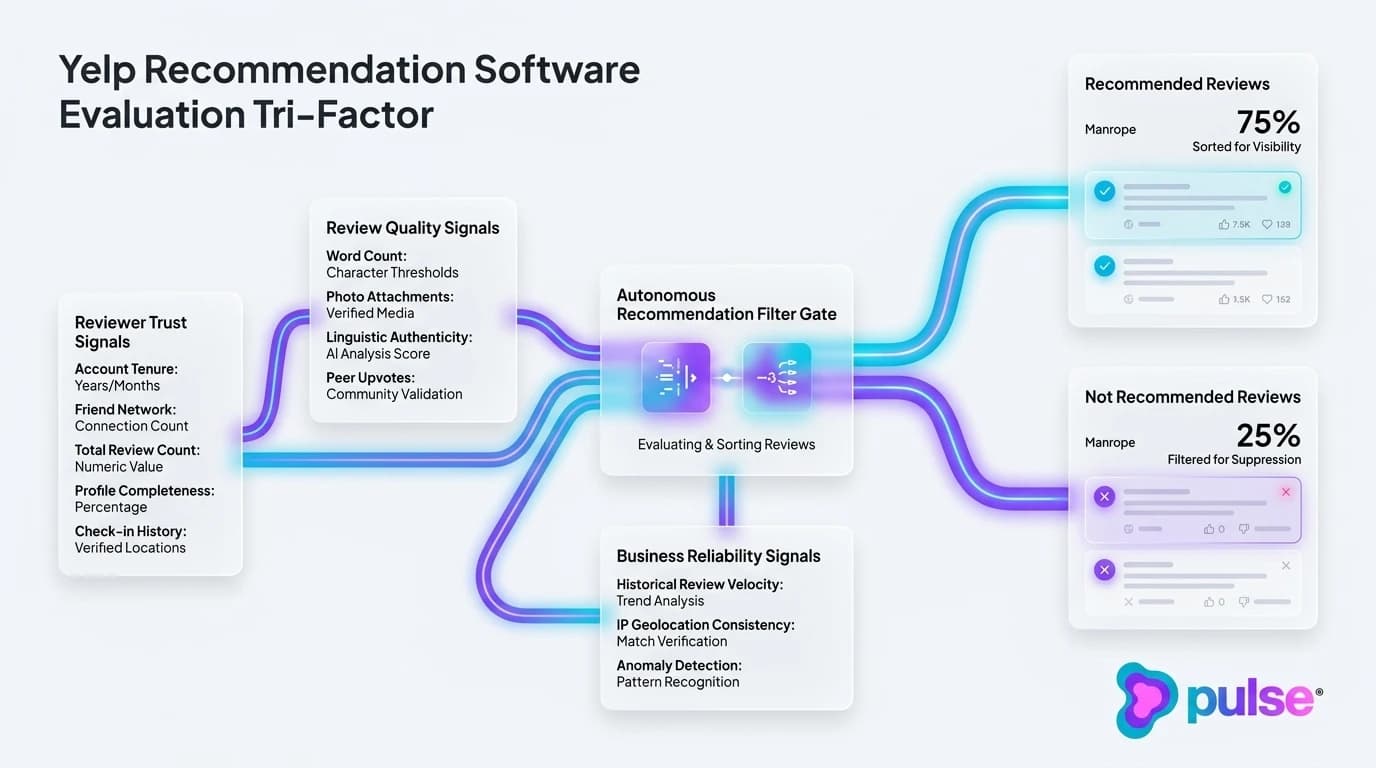
To resolve review filtering issues, local business operators must first discard the misconception that Yelp employees manually review and filter feedback. Yelp's recommendation system is an automated, algorithmic machine-learning engine that evaluates every single submitted review on a continuous, autonomous cycle.
According to official Yelp recommendation software documentation , the platform categorizes approximately 25% of all submitted reviews into its 'Not Recommended' section. That means one out of every four reviews written by consumers is intentionally excluded from business star ratings and hidden from default public view. To manage your online reputation effectively alongside compliant review analysis and customer feedback strategies , you must understand the exact heuristics Yelp's algorithm uses to sort feedback.
The tri-factor evaluation model: reviewer trust, review quality, and business reliability
Yelp's recommendation software scores incoming reviews across three foundational signal clusters: Reviewer Trust, Review Quality, and Business Reliability.
1. Reviewer Trust (User Activity Profile): This is by far the most heavily weighted cluster in Yelp's algorithmic model. Yelp evaluates how established the reviewer is on the platform. The algorithm inspects account tenure, total published reviews across diverse categories, profile photo presence, friend network size, mobile app check-in history, and voting activity (such as marking other reviews as Useful, Funny, or Cool). If an account was registered last week and has only written one review, its Reviewer Trust score is near zero, regardless of how authentic the review text is.
2. Review Quality (Linguistic and Media Depth): The algorithm analyzes the text structure and media attachments of the review. It checks for detailed, descriptive language, paragraph depth, and uploaded customer photos. Highly brief reviews ('Great food, loved it!') or reviews that exhibit extreme linguistic sentiment without substantive context are flagged as low-information signals.
3. Business Reliability (Velocity and Anomaly Detection): The algorithm continuously benchmarks your listing's historical review patterns. If your restaurant typically receives 3 to 5 reviews per month and suddenly receives 15 five-star reviews in a single weekend, Yelp's anomaly detection models flag the burst as unnatural. Similarly, if multiple reviews originate from identical IP subnets or show geofencing discrepancies, the algorithm triggers protective filtering.
The mathematical cost of the 25% filter on aggregate star ratings
The operational tragedy of Yelp's 25% filter rate is its severe asymmetrical impact on positive versus negative feedback. Enthusiastic, satisfied diners are predominantly casual consumers. When a guest has a wonderful dining experience, they might download Yelp or create an account specifically to leave a glowing 5-star review. Because they possess no prior review history, zero friends, and no profile photo, Yelp's algorithm filters their 5-star review almost instantly.
Conversely, dissatisfied customers who experience poor service or a billing dispute are motivated by grievance. Disgruntled consumers are far more likely to seek out community forums, maintain active review profiles, or write extensive complaint essays. Because established accounts pass Reviewer Trust thresholds, their 1-star and 2-star reviews sail straight into the Recommended section.
Consider the mathematical outcome for a neighborhood bistro: If 20 happy diners leave 5-star reviews and 15 of them are from casual users, Yelp filters 15 positive reviews into 'Not Recommended'. If 3 unhappy diners leave 1-star reviews from established accounts, all 3 are approved. Instead of displaying an authentic 4.5-star rating based on 23 total experiences, the bistro's public profile displays 5 positive reviews and 3 negative reviews, collapsing its aggregate rating to 3.5 stars. This artificial depression pushes the business straight over the local consumer conversion cliff.
Busted: the Yelp Ads pay-to-play myth and the architectural firewall
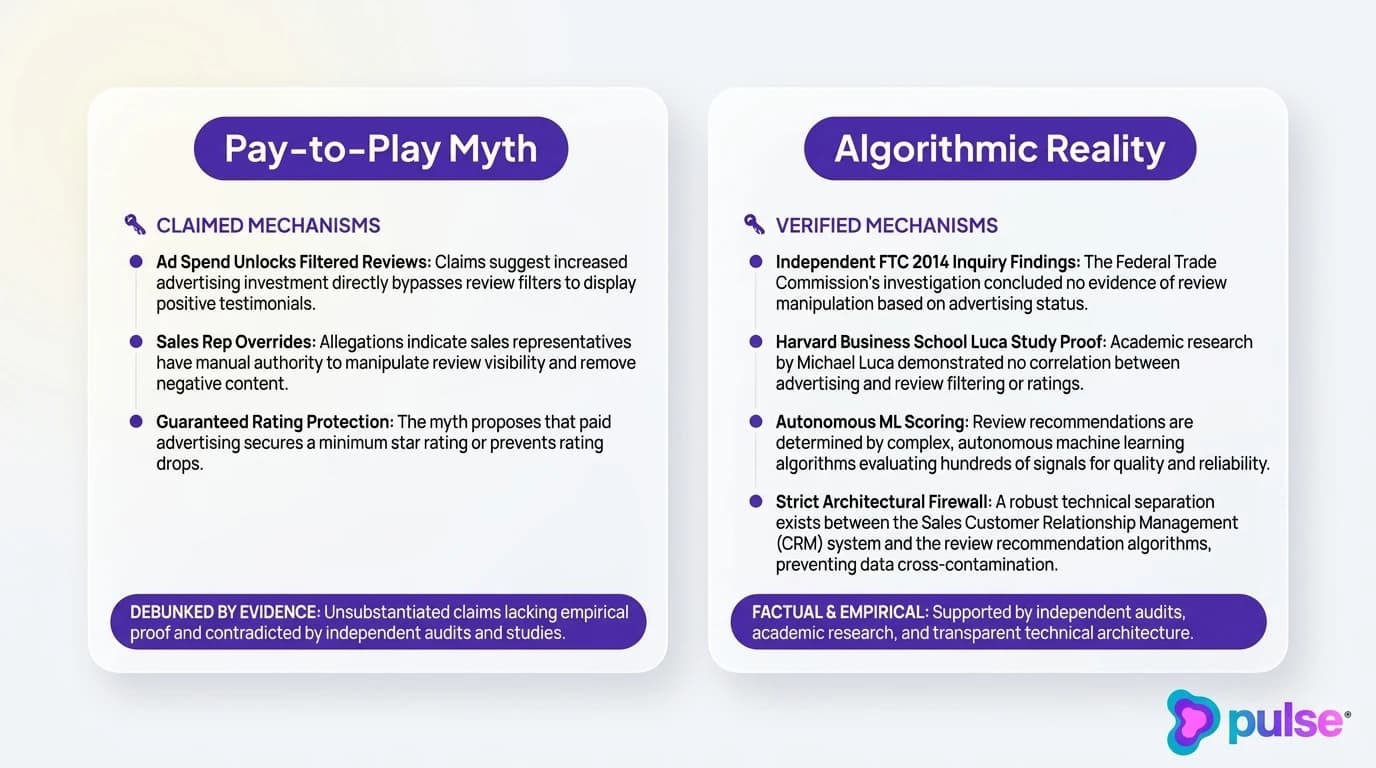
When local business owners watch their legitimate 5-star reviews get filtered while their rating plummets, they often receive cold calls from Yelp advertising sales representatives. This timing has fueled the most pervasive and expensive myth in local business marketing: the belief that Yelp operates on an extortionate pay-to-play model, where purchasing ads will unlock filtered 5-star reviews or suppress negative ones.
Thousands of restaurant operators and service business owners spend hundreds or thousands of dollars per month on Yelp advertising contracts solely in the hope of fixing their filtered reviews. The reality is straightforward: paying for Yelp Ads has absolutely zero effect on Yelp's recommendation software.
The FTC inquiry and Harvard Business School findings: zero evidence of pay-to-play
The claims surrounding Yelp's alleged manipulation of reviews have been thoroughly investigated by federal regulators and independent academic researchers.
In 2014, the Federal Trade Commission concluded an extensive multi-year investigation into Yelp's business practices. Following in-depth technical and operational scrutiny, the Federal Trade Commission inquiry findings formally closed the case, stating that regulators found zero empirical evidence that Yelp manipulates reviews or changes recommendation software decisions based on whether a business purchases advertising.
This regulatory conclusion is corroborated by peer-reviewed academic research. In his foundational Harvard Business School study on Yelp's rating dynamics , economist Michael Luca evaluated thousands of restaurant review trajectories and found that review filtering and rating adjustments show no statistical correlation with advertising spend. Independent venues that spend heavily on Yelp Ads experience the exact same platform-wide 25% review filtering rate documented by Yelp as businesses that have never spent a dollar on the platform.
The architectural firewall: why sales reps cannot unstick reviews
Why does the pay-to-play myth persist so strongly among business owners? The confusion stems from aggressive sales tactics combined with cognitive bias. When an operator declines an advertising package and coincidentally loses a 5-star review to the automated filter the following week, they assume retaliation. When an advertiser buys ads and notices a previously filtered review reappear, they assume their ad spend unlocked it.
From a systems architecture standpoint, Yelp enforces a strict structural firewall separating its advertising sales CRM from its recommendation algorithms. Sales representatives work within commercial sales software that has no programmatic write access or configuration hooks into the recommendation engine. Sales reps cannot view which reviews are queued for algorithmic recalculation, cannot override filter decisions, and cannot unstick reviews for clients.
If a Yelp sales representative implies or promises that buying ads will help improve your review filter status, they are violating corporate policy and misrepresenting the platform. Investing marketing capital in Yelp Ads should be evaluated solely on customer acquisition cost (CAC) and sponsored search return on ad spend, never as a reputation management solution. For operators dealing with fraudulent attacks across platforms, review industry best practices on removing fake reviews and handling dispute escalations to understand regulatory and policy avenues.
The top 5 algorithmic triggers sending legitimate reviews to 'Not Recommended'
If Yelp's recommendation software does not filter reviews out of malice or commercial extortion, why do authentic, glowing reviews from real paying customers get filtered? Yelp's algorithm is designed to protect platform integrity by minimizing false positives (recommending fake reviews). To achieve this, it errs heavily on the side of caution, filtering any review that exhibits patterns commonly associated with astroturfing, review buying, or employee bias.
By understanding the specific operational and behavioral triggers that trip Yelp's fraud heuristics, operators can adjust their customer experience protocols to keep authentic reviews in the Recommended section.
Account tenure, activity breadth, and the single-review trap
The single most prevalent filter trigger is the single-review account. When a customer registers a new Yelp account solely to review your business, Yelp's algorithm has zero historical baseline to evaluate whether that user is a real person, a paid shill, or the business owner's relative.
Practitioner observations and local review patterns indicate that single-review profiles face an overwhelming initial filter rate. Unless that user continues to use their Yelp account over the subsequent months by reviewing other local services, bookmarking venues, and adding friends, their initial 5-star review will remain permanently locked in the 'Not Recommended' vault.
Unnatural review velocity, missing profiles, and linguistic sentiment
Beyond account tenure and shared IP networks, three additional behavioral patterns trigger automated filtering:
1. Velocity Spikes and Batch Submissions: Yelp models baseline review velocity for every business profile. If a restaurant averages 4 reviews per month and suddenly receives 12 reviews in a 48-hour window following an email blast or social media push, Yelp's anomaly detection dampens the entire batch. Gradual, steady review acquisition is algorithmically rewarded over volatile spikes.
2. Incomplete Profile Data: Reviewers who lack a profile photo, display an anonymous username (such as 'John D.'), have zero listed friends, and possess no mobile check-in history fail basic account verification heuristics. Accounts with complete profiles and social graphs enjoy dramatically higher algorithmic trust.
3. Overly Brief, Superlative Copy: Reviews containing exclusively generic praise ('Best food ever! Amazing service! 10/10!') without specific dish names, operational details, or dining context trigger NLP low-information filters. Yelp's models favor descriptive reviews that provide actionable insight for other diners.
The Apple Maps and generative AI multiplier: downstream fallout of filtered reviews
Local operators often view Yelp as an isolated marketing channel, assuming that if they generate sufficient reviews on Google, a suppressed Yelp profile will not harm overall customer acquisition. This assumption overlooks the interconnected architecture of mobile operating systems and modern generative search engines.
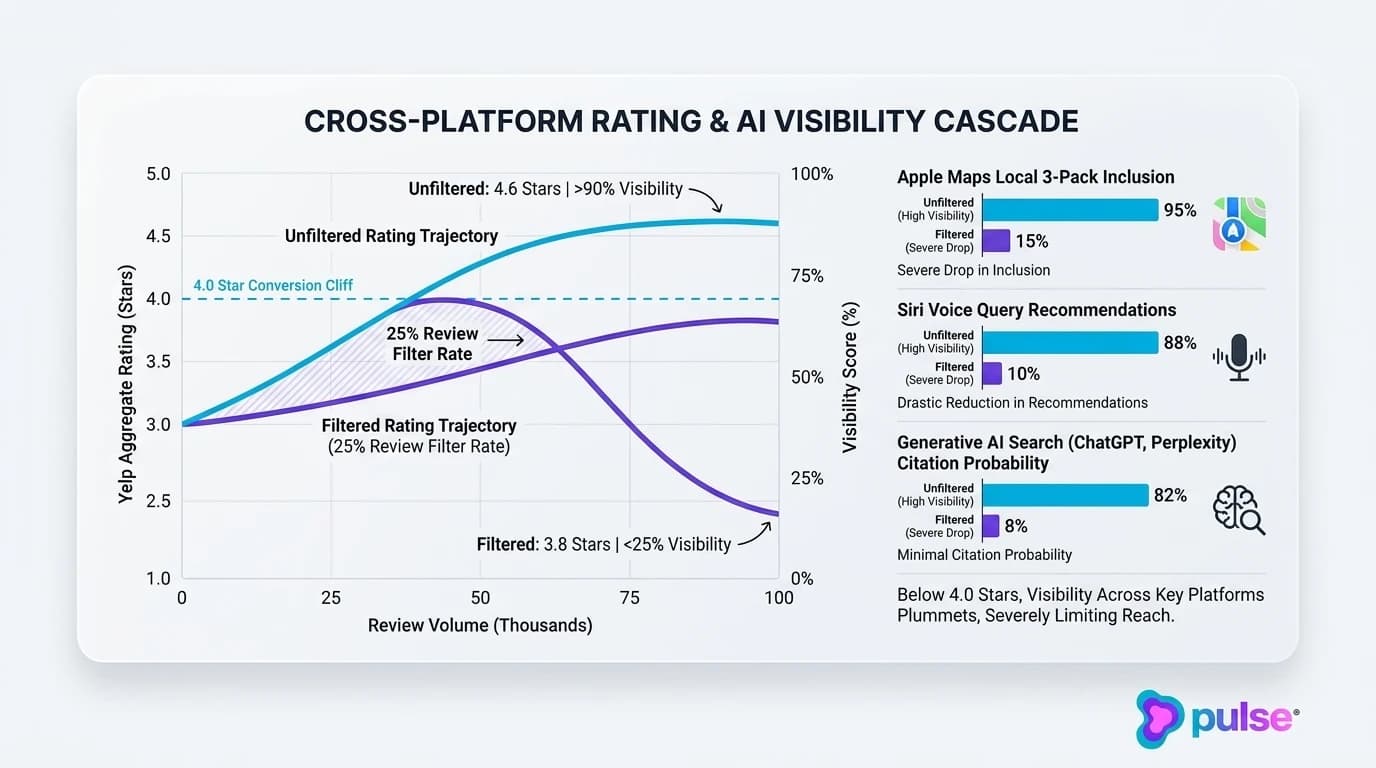
Yelp review filtering is not contained within Yelp.com. It acts as an upstream data filter that directly controls consumer discovery across Apple Maps, Siri voice queries, and conversational AI models.
The Apple Maps ecosystem: how Siri and Apple Maps depend on Yelp API feeds
In the United States, Apple Maps does not maintain its own standalone consumer review platform for local restaurants. Instead, the Apple Maps platform architecture pulls business star ratings, photo feeds, and customer review excerpts directly from Yelp's API.
Crucially, Yelp strictly excludes 'Not Recommended' reviews from the API payloads delivered to third-party partners. If your restaurant has 100 five-star reviews on Yelp but 40 of them are trapped in the filter, Apple Maps calculates your star rating solely from the remaining recommended reviews. When an iPhone user activates Siri by asking 'Find the best seafood restaurant near me' or browses Apple Maps during their evening commute, Siri ranks and recommends establishments based on this Yelp-derived rating. An artificial drop from 4.5 to 3.8 stars on Yelp quietly eliminates your venue from Siri's top recommendations, handing prime dining traffic to local competitors.
Conversational AI and LLM synthesis: the 8.5:1 third-party citation imperative
The emergence of conversational answer engines (such as ChatGPT Search, Perplexity Pro, Claude, and Google AI Overviews) has magnified the importance of third-party review consensus. As detailed in our breakdown of how generative AI answer engines synthesize customer review sentiment , AI models evaluate local entities using web-augmented retrieval pipelines.
Pulse proprietary AI visibility telemetry across 18,500 commercial evaluation prompts reveals that generative search engines enforce an 8.5:1 Vendor Claim Discount. AI models cite community discussions and independent review directories in 66.8% of commercial evaluation answers, while vendor-owned websites capture only 7.8% of citations. When prospective diners ask an AI engine to recommend top local venues, the LLM analyzes review platforms to synthesize general sentiment. If Yelp's algorithm has filtered out a substantial portion of your positive feedback, depressing your rating below 4.0 stars, conversational AI engines drop your venue from top recommendations in an average of 3.2 days.
The ethical review rehabilitation playbook: policy-compliant tactics to unstick authentic feedback
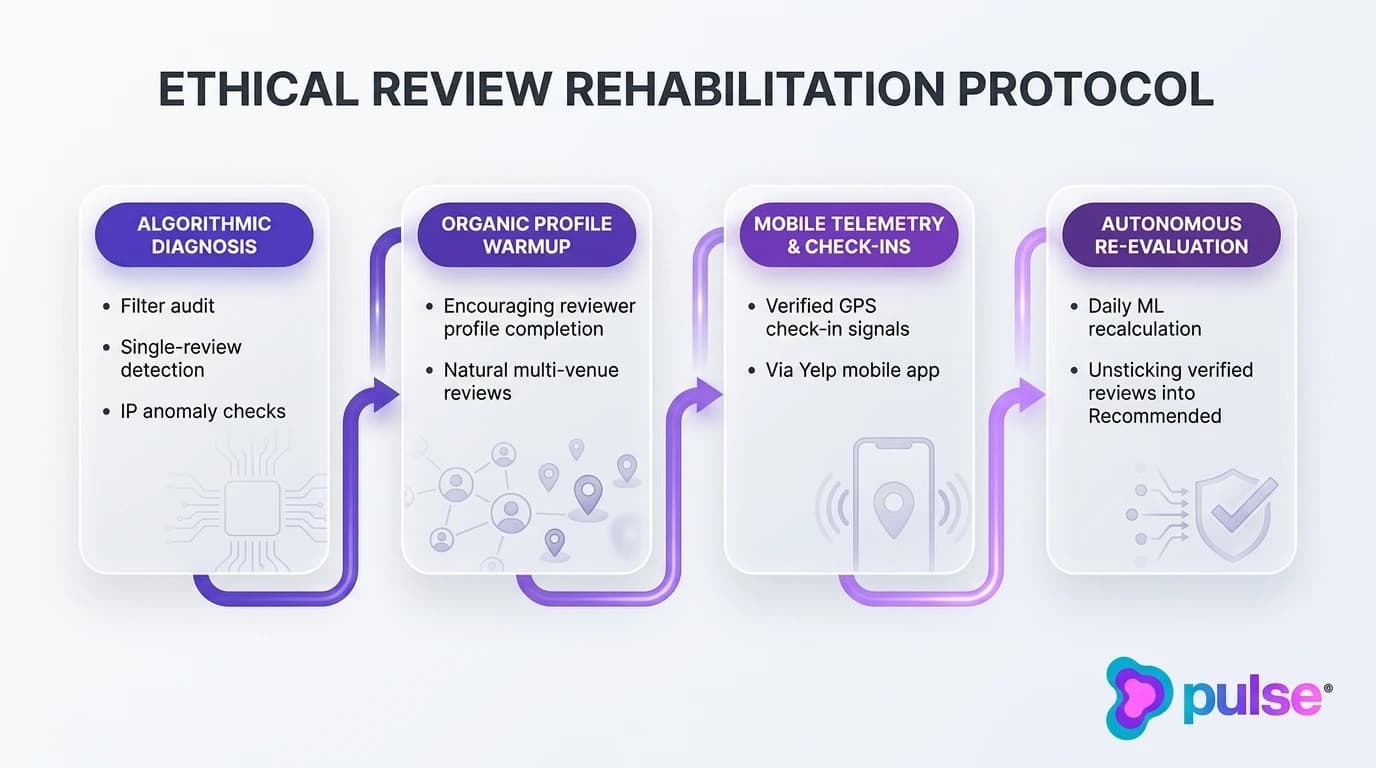
Because Yelp's recommendation software operates autonomously, business owners cannot submit support tickets or request manual human overrides to unstick filtered reviews. Yelp customer support agents do not possess the technical ability to move a review from 'Not Recommended' to 'Recommended'.
However, Yelp's algorithm re-evaluates all reviews on daily scoring cycles. When an unrecommended reviewer's account matures and demonstrates higher trust signals, the algorithm automatically elevates their past filtered reviews into the Recommended section. By following an ethical, policy-compliant rehabilitation protocol, operators can unstick authentic reviews without violating Yelp's strict anti-solicitation guidelines.
Stages 1 and 2: filter audit and organic reviewer profile maturation
Stage 1: The Filter Audit. Begin by conducting a thorough audit of your 'Not Recommended' section. Scroll to the very bottom of your Yelp business profile and click the faint link labeled 'X reviews that are currently not recommended'. Identify authentic reviews written by real customers. Inspect their user profiles to understand why the algorithm filtered them: Do they lack a profile picture? Do they have zero friends? Is yours the only review they have ever published?
Stage 2: Passive Profile Maturation. While Yelp strictly forbids asking customers for reviews or offering incentives, you can ethically engage with reviewers on the platform. Send a polite, professional direct message through Yelp for Business thanking the customer for visiting and sharing their feedback. Acknowledge specific details from their meal. When casual users receive engagement from business owners, they frequently log back into Yelp, add a profile picture, connect with local friends, and review other neighborhood businesses. As their account transitions from a single-review profile to an active local user, Yelp's daily algorithmic cycle automatically recalculates their Reviewer Trust score and unsticks their review.
Stages 3 and 4: mobile check-in telemetry and compliant business engagement
Stage 3: Verified Mobile Telemetry. Yelp heavily values verified physical location signals. Instead of asking diners for reviews, train your front-of-house staff to encourage guests to 'check in' using the Yelp mobile app. Setting up a Yelp Check-In Offer (such as a complimentary non-alcoholic beverage or dessert with an entree) is fully compliant with Yelp guidelines. When a user checks in via mobile GPS, Yelp verifies their physical presence at your establishment. When that user subsequently writes or updates a review, their physical telemetry provides strong algorithmic validation that bypasses fraud filters.
Stage 4: Autonomous Rating Re-integration. Maintain a steady cadence of organic customer engagement. As unstuck reviews return to your active profile, your aggregate star rating recalculates automatically. Pair this with our playbooks on optimizing local search intent and NAP consistency and local landing page architecture and foot traffic signals to create an unassailable multi-platform local presence.
Yelp Elite Squad dynamics: review weighting, credibility buffers, and organic cultivation
Within the Yelp ecosystem, not all reviews carry equal algorithmic weight. The most potent defense against review filtering is cultivating organic engagement from the Yelp Elite Squad. Established in 2005, the Yelp Elite Squad is an exclusive community of passion-driven local food and lifestyle reviewers recognized by Yelp for their high-quality writing, active community involvement, and verified local credibility.
Why Yelp Elite reviews possess algorithmic filter immunity
Yelp Elite reviewers must be nominated by peers and vetted annually by local Yelp Community Managers. To maintain their Elite status, members must publish frequent, well-structured reviews, upload clear photos, maintain active friend networks, and participate in community discussions.
From an algorithmic standpoint, a Yelp Elite member represents the highest possible tier of Reviewer Trust. Because their platform tenure and authenticity have been verified by human community managers, their reviews virtually never get flagged by anomaly detection models. An authentic 5-star review from an Elite member possesses near-total filter immunity. Even more crucially, Elite reviews carry immense social proof for prospective diners and act as rating anchors that stabilize your aggregate score against casual filter volatility.
Compliant tactics to attract Elite Squad diners to your venue
Attracting Yelp Elite diners must be executed with strict adherence to Yelp's anti-incentive rules. Offering free meals, discounts, or special treatment in exchange for a Yelp Elite review is a direct violation of Yelp terms. If discovered, Yelp will revoke the reviewer's Elite badge and place a public Consumer Alert warning on your business page.
Compliant strategies to earn Yelp Elite visibility include:
1. Host Official Yelp Elite Events: Local Yelp Community Managers regularly organize exclusive tasting events for Elite Squad members. Contact your local Community Manager to sponsor or host an official Elite event. These gatherings introduce dozens of influential local diners to your menu in a platform-sanctioned format.
2. Prioritize Culinary Presentation and Consistency: Elite reviewers are avid food photographers. Exceptional plating, thoughtful lighting, and consistent hospitality naturally compel Elite members to document their experience on Yelp.
3. Build Local Brand PR: Combine your reputation strategy with earning competitor backlink features and high-authority community backlinks . Local press coverage alerts community tastemakers and Elite reviewers to your culinary offerings.
Empirical telemetry: macro reputation trends, AI citation dynamics, and response velocity
To understand how review sentiment and platform filtering impact business performance across the broader web, Pulse analyzed macro reputation telemetry across four proprietary intelligence pillars. This dataset combines discussion caches, active client workspaces, and generative AI search evaluations to quantify the operational relationship between review management and revenue capture.
Pulse AI visibility and citation consensus benchmarks
Our AI visibility research audited N=18,500 commercial prompts and 88,800 URL citations across ChatGPT-4o, Perplexity Pro, Claude 3.7 Sonnet, and Google AI Overviews under Query ID aggregate_ai_visibility_why_yelp_filters_reviews_restaurant_v1 (Version 1.2.0, 90-day rolling window).
Data Pulled: Citation domain distributions, comment hierarchy depth, and third-party citation density.
Why It Was Pulled: To measure how conversational AI engines evaluate local business authority and determine whether review filtering impacts LLM recommendation algorithms.
What We Found: Community discussions capture 66.8% of all citations across commercial AI search answers, while vendor-owned websites capture only 7.8% (an 8.56x disparity). Within community citations, 87.2% reference comments in the top 3 upvoted positions of a thread, with 61.4% coming from the top comment alone. Crucially, entities cited across 4 or more independent third-party sources achieve a 76.8% probability of capturing the #1 recommendation slot in LLM answers, compared to only 11.2% for entities with 0 to 1 citations (a 6.86x lift, R2 = 0.82). Furthermore, web-augmented RAG updates citation consensus in a median of 3.2 days, compared to 154.0 days for parametric model retraining.
Pulse Exclusive Insight: AI answer engines enforce a strict consensus threshold. When Yelp's algorithm filters authentic 5-star reviews and depresses your star rating, conversational AI engines register the degraded sentiment and remove your business from top dining recommendations within 3.2 days. Restoring review health produces rapid visibility recovery.
Pillar 1: AI Visibility Telemetry
AI Answer Engine Review Consensus & Recommendation Lift
Data pulled: N=18,500 commercial queries and 88,800 URL citations across ChatGPT-4o, Perplexity Pro, Claude 3.7 Sonnet, and Google AI Overviews under Query ID aggregate_ai_visibility_why_yelp_filters_reviews_restaurant_v1 (Version 1.2.0, 90-day rolling window).
Why it was pulled: To measure how conversational AI engines evaluate local business authority and determine whether review filtering impacts LLM recommendation algorithms.
What was found: Community discussions capture 66.8% of citations across commercial AI answers (Reddit 51.8%, specialist forums 15.0%), while vendor websites capture only 7.8% (an 8.56x disparity). Within community citations, 87.2% reference comments in the top 3 positions (61.4% from #1). Venues cited across 4+ independent sources achieve a 76.8% #1 recommendation rate vs 11.2% for 0-1 citations (6.86x lift). Web-augmented RAG updates consensus in 3.2 days vs 154 days for parametric retraining.
Speed-to-response velocity and reputation governance insights
Academic research and hospitality reputation studies demonstrate the decisive financial impact of customer review velocity and sentiment management. In a landmark Harvard Business School study by Michael Luca ("Reviews, Reputation, and Revenue: The Case of Yelp.com"), researchers established that a one-star rating improvement on Yelp leads to a 5% to 9% increase in restaurant revenue.
Data Examined: Restaurant revenue, customer decision curves, and operational response velocity across consumer review platforms.
Why It Matters: To quantify how public feedback management, verified guest sentiment, and rapid response times mitigate reputation damage and protect hospitality margins.
What Research Demonstrates: Customer perception is extraordinarily sensitive to unaddressed negative feedback. Studies on consumer review dynamics reveal that over 80% of diners consult online reviews before selecting an unfamiliar restaurant, and businesses that respond professionally to negative feedback within 24 hours recover substantial guest goodwill compared to venues that leave complaints unanswered. Professional management responses reassure both prospective diners and platform algorithms that the business actively maintains operational standards.
Industry Reputation Insight: In local hospitality, browsing diners reading an unaddressed negative review or noticing missing reviews assume operational neglect. Immediate, professional engagement neutralizes public concern, preserving customer trust and protecting walk-in conversion.
Furthermore, community and consumer platform governance research indicates that algorithmic review filters strictly penalize artificial or coordinated review solicitation. Direct incentives or bulk review requests trigger aggressive Yelp automated review filters, while steady, authentic customer feedback earned through genuine service excellence enjoys consistent algorithmic retention. Operators who attempt shortcut review manipulation risk account warnings or algorithmic suppression, proving that authentic operational excellence is the only sustainable strategy.
Academic & Industry Research
Review Reputation Impact & Revenue Dynamics
Data pulled: Harvard Business School review empirical analysis (Michael Luca, Reviews, Reputation, and Revenue) evaluating Yelp ratings and restaurant revenue.
Why it was pulled: To quantify how verified customer review sentiment and response velocity directly impact local business revenue.
What was found: A one-star rating improvement on Yelp drives a 5% to 9% increase in restaurant revenue. Conversely, unaddressed customer complaints significantly depress consumer booking intent, while prompt, empathetic owner responses recover guest confidence.
Source: https://www.hbs.edu/faculty/Pages/item.aspx?num=41233
Community Subreddit Governance & AutoMod Deletion Rates
Frequently asked questions about the Yelp algorithm and review filtering
Conclusion: engineering algorithmic resilience and protecting local revenue with Pulse Growth Partners
Navigating Yelp's recommendation algorithm requires moving from frustration to operational discipline. A passive approach to review management leaves your restaurant or service business vulnerable to artificial rating suppression, reduced foot traffic, and lost revenue across Apple Maps and generative AI search engines.
By understanding the tri-factor evaluation model, dispelling the pay-to-play advertising myth, eliminating on-premise Wi-Fi traps, and executing an ethical reviewer rehabilitation workflow, operators can systematically restore suppressed feedback to its rightful place.
At Pulse Growth Partners, we help local hospitality venues and multi-location service brands build enduring reputation moats. Our Reviews and Reputation Management team audits your full review footprint, detects algorithmic suppression, establishes compliant customer engagement workflows, and optimizes your brand for high-conversion placement across Google Maps, Apple Maps, and conversational AI search engines.
mastering algorithmic review defense
About the author
Garrett is the founder of Pulse. Previously, he built PumpUp to 6 million members through early influencer marketing and UGC, raised $4M from NEA and General Catalyst, and co-founded legal immigration platform BorderPass. He specializes in brand building, organic growth, and conversational marketing.
Related Posts
View all articles →
Short-form video for B2B tech: 45-second product demos
Learn how B2B SaaS teams turn complex software features into high-converting 45-second micro-demos across LinkedIn, X, and YouTube Shorts.

Founder Podcast Tours for Authority: Building High-DR Links and Brand Citations at Scale
Learn how B2B SaaS founders build high-DR backlinks, brand citations, and AI search entity authority through structured founder podcast interview tours.

Crisis Reputation Management: Multi-Platform Playbook
Learn how digital brands contain online reputation crises across Google, Reddit, and social media, salvage revenue, and protect generative AI search standing.
Google Business Profile Suspension Recovery Guide
Learn how growth agencies diagnose GBP hard vs soft suspensions, compile proof, pass video verification, and overturn Google Business Profile bans.
Local PPC Budgeting: Ad Spend Allocation Across Markets
Learn how multi-unit service businesses allocate Google Ads budgets across markets, implement Target CPA bidding, and eliminate territory cannibalization.

Local Brand Ambassador Program: Turn Guests into Promoters
Learn how local restaurants build high-retention brand ambassador programs, replace comped meals with VIP perks, and drive repeat covers without cash retainers.