Competitor Backlink Gap Analysis: How to Systematically Intercept Your Competitor's Best Links
Discover how B2B SaaS companies systematically reverse-engineer competitor backlink graphs, execute link intersect audits, and intercept high-DA links.
In modern B2B SaaS growth, organic search authority represents the primary moat separating market leaders from trailing challengers. Yet software companies routinely burn hundreds of thousands of dollars on broad cold link building campaigns that generate sub-1.6% placement rates, alienate journalists, and risk algorithmic search penalties. Attempting to build category authority from scratch without competitive intelligence is an unnecessary operational gamble.
Your direct market competitors have already spent years of outreach and significant marketing capital discovering which industry publications, tech editors, resource curators, and niche directories are willing to link to your product category. Every referring domain pointing to your market rivals represents an empirical signal of editorial intent. By conducting a systematic competitor backlink gap analysis, growth teams can mathematically isolate shared referring domains, categorize backlink acquisition mechanisms, and intercept high-authority citations with tailored value propositions.
This playbook details the practitioner-grade framework used by high-growth software platforms to audit competitor backlink profiles, sanitize noise, and execute high-converting link interception campaigns. To understand how foundational link authority intersects with modern digital PR strategies, explore our comprehensive guide on earning tier-1 editorial backlinks through proprietary data journalism and benchmark reports.
The mathematics of link intersect: why competitor graph interception beats cold outreach
Traditional link building is fundamentally broken for B2B software companies. Marketing teams purchase commoditized email scrapers, assemble massive lists of generic marketing bloggers or technology writers, and blast automated templates begging for editorial inclusions. This spray-and-pray methodology fails because it ignores editorial intent: pitch recipients have never heard of the vendor, have never written about the niche, and have zero editorial incentive to revise published articles.
Competitor backlink gap analysis, commonly executed through link intersect modeling, shifts link acquisition from cold prospecting to contextual upgrading. Instead of asking whether an editor might be interested in your software vertical, you examine the public web graph to identify publishers who have already linked to two or more of your direct rivals. This overlap proves that the publisher actively curates resources within your commercial niche.
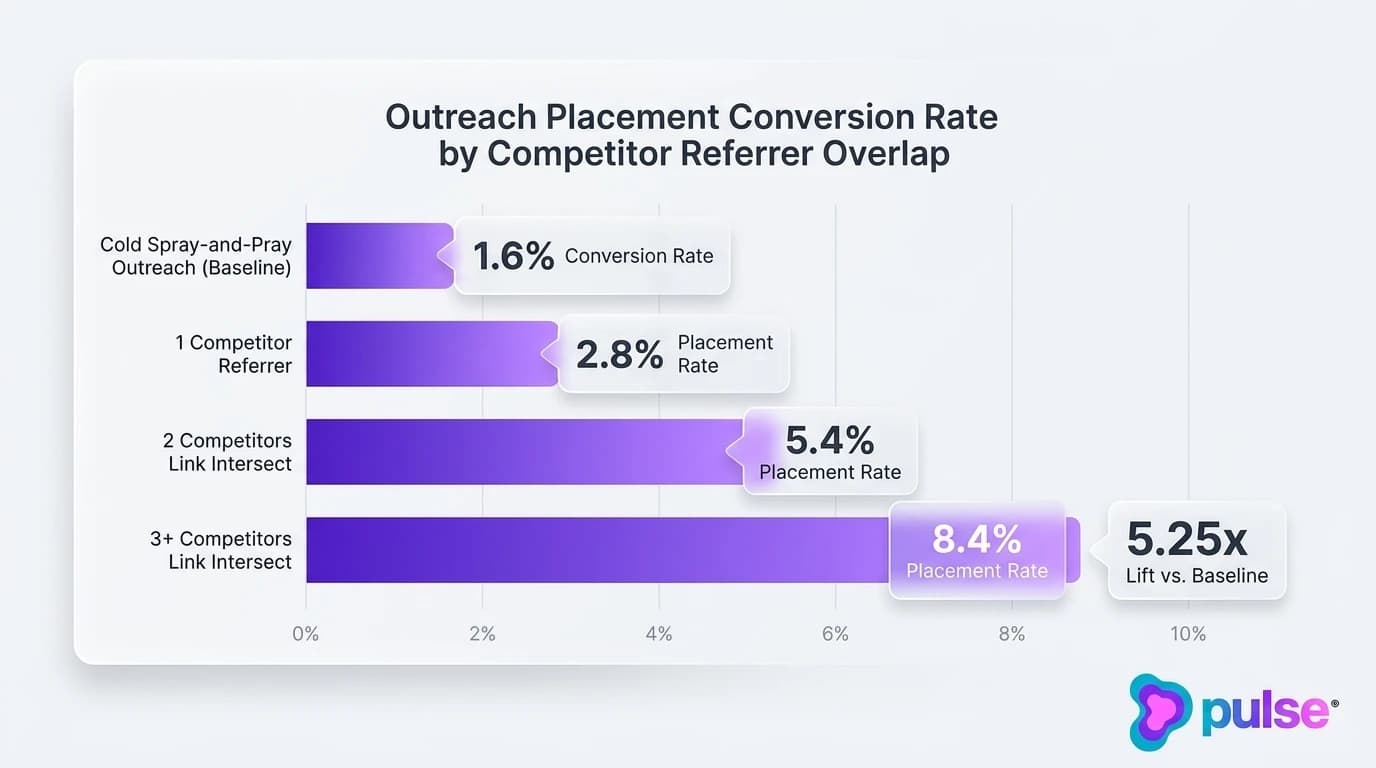
Pulse Growth Partners Benchmark: link intersect vs cold outreach placement velocity
8.4% Placement Rate / 5.25x Multiplier for 3+ Competitors
Comparative link building campaign audits conducted by Pulse Growth Partners reveal that cold outreach targeting generic industry lists yields a dismal 1.6% average placement rate. Targeting domains linking to 2 competitors increases placement velocity to 5.4%, while targeting domains linking to 3 or more direct competitors elevates placement conversion to 8.4% (a 5.25x performance multiplier). Webmasters covering multiple category solutions demonstrate verified commercial intent to maintain exhaustive resources.
The low-yield failure of cold spray-and-pray link building
Cold outreach campaigns fail due to severe economic and operational inefficiencies. Achieving a single editorial link via unsegmented outreach often requires dispatching hundreds of cold emails. This high volume triggers spam filter classifications, burns domain sender reputation, and provokes public backlash from prominent tech journalists.
Furthermore, cold outreach incentivizes marketing teams to accept low-quality placements on sponsored link farms or private blog networks (PBNs). According to official Google Search Central link crawlability documentation, search algorithms penalize manipulative link schemes and prioritize natural, crawlable links embedded in contextually relevant editorial text. Securing a handful of authoritative, topically aligned editorial links delivers vastly higher organic equity than hundreds of low-tier directory submissions.
The overlap principle: quantifying editorial receptivity across shared referring domains
The foundational principle of link intersect analysis is mathematical overlap. When a single web page links to Competitor A, that link could stem from an idiosyncratic personal relationship, an early-stage investor portfolio mention, or a one-off sponsorship. However, when an independent domain links to Competitor A, Competitor B, and Competitor C simultaneously, individual bias is eliminated: the domain is confirmed as an active category curator.
Empirical industry data published in the Ahrefs link intersect research indicates that targeting domains linking to two or more competitors yields an estimated 3x to 5x higher placement rate than cold outreach. Publishers curating competitive listicles or software comparisons are naturally incentivized to include credible category challengers to preserve their reputation for objective, comprehensive analysis.
The 4-step competitor selection architecture
The accuracy of a backlink gap audit depends entirely on competitor input selection. Feeding the wrong seed domains into link intersect tools corrupts the resulting data with irrelevant referring sites, skewed authority metrics, and unexecutable prospects. B2B SaaS growth teams must apply a rigorous 4-step selection architecture to isolate true organic search rivals.
| Competitor Classification | Domain Characteristics | Audit Inclusion Decision | Strategic Rationale |
|---|---|---|---|
| Direct Commercial SERP Rivals | VCS-backed or bootstrapped B2B SaaS rivals ranking in top 5 organic positions for primary commercial keywords | Mandatory (Select 3 to 5) | Captures core category link equity and exposes active industry editorial contacts. |
| Legacy Enterprise Giants | Massive conglomerates (Salesforce, Microsoft, Adobe, Oracle) with broad product suites and 90+ Domain Rating | Strictly Disqualify | Link profiles are dominated by legacy brand mentions, corporate mergers, and enterprise PR that cannot be replicated. |
| Review Directories & Aggregators | Aggregator domains (G2, Capterra, TrustRadius, Software Advice) dominating category keywords | Strictly Disqualify | Directories monetize pay-to-play listings and feature millions of automated profile links rather than contextual editorial citations. |
| Emerging High-Growth Challengers | Fast-moving category startups gaining rapid organic traction and high referring domain velocity | Recommended (Select 1 to 2) | Reveals modern digital PR campaigns, founder podcast guesting circuits, and innovative utility tools. |
Disqualifying category aggregators and irrelevant mega-portals
The most common mistake in backlink gap analysis is including review aggregators (such as G2, Capterra, or TrustRadius) or generalist encyclopedia portals like Wikipedia. Because these domains rank for virtually every commercial software keyword, naive keyword gap tools suggest them as organic competitors.
Including review aggregators floods your link intersect matrix with millions of irrelevant directory profiles, user review confirmations, and automated API partner links. These domains operate on pay-to-play business models rather than contextual editorial discretion. They must be eliminated during the competitor selection phase to keep your target prospect list actionable and clean.
Isolating direct SERP competitors vs commercial market rivals
Growth teams must carefully distinguish between commercial sales rivals and organic SERP competitors. Sales leadership often identifies competitors based on head-to-head deal bake-offs. However, commercial rivals frequently underinvest in organic acquisition, relying instead on outbound sales representatives or paid ads. Analyzing a commercial rival with negligible organic search presence yields little actionable link intelligence.
Conversely, true organic SERP competitors are software domains that consistently outrank you for your core target keywords (such as '[category] software', 'best [vertical] tools', and high-intent commercial evaluation terms). By conducting manual SERP audits across your primary commercial keyword cluster, identify 3 to 5 software domains that hold top-5 organic rankings and maintain similar product positioning.
Calculating link intersect overlap matrices across 3 to 5 domains
Auditing fewer than 3 competitors surfaces too many idiosyncratic links, such as one-off investor portfolio announcements or personal friend-of-founder write-ups. Auditing more than 5 competitors simultaneously dilutes target precision and generates unmanageable backlink volume.
The optimal configuration evaluates between 3 and 5 direct organic competitors against your domain. Growth teams should configure multi-intersect Venn diagram queries using tools like Ahrefs Link Intersect or Semrush Backlink Gap: identify all referring domains that link to at least 2 of the competitors while excluding your own domain. This query isolates publishers with established category affinity who have yet to discover your solution.
Data extraction, link sanitization, and noise filtering
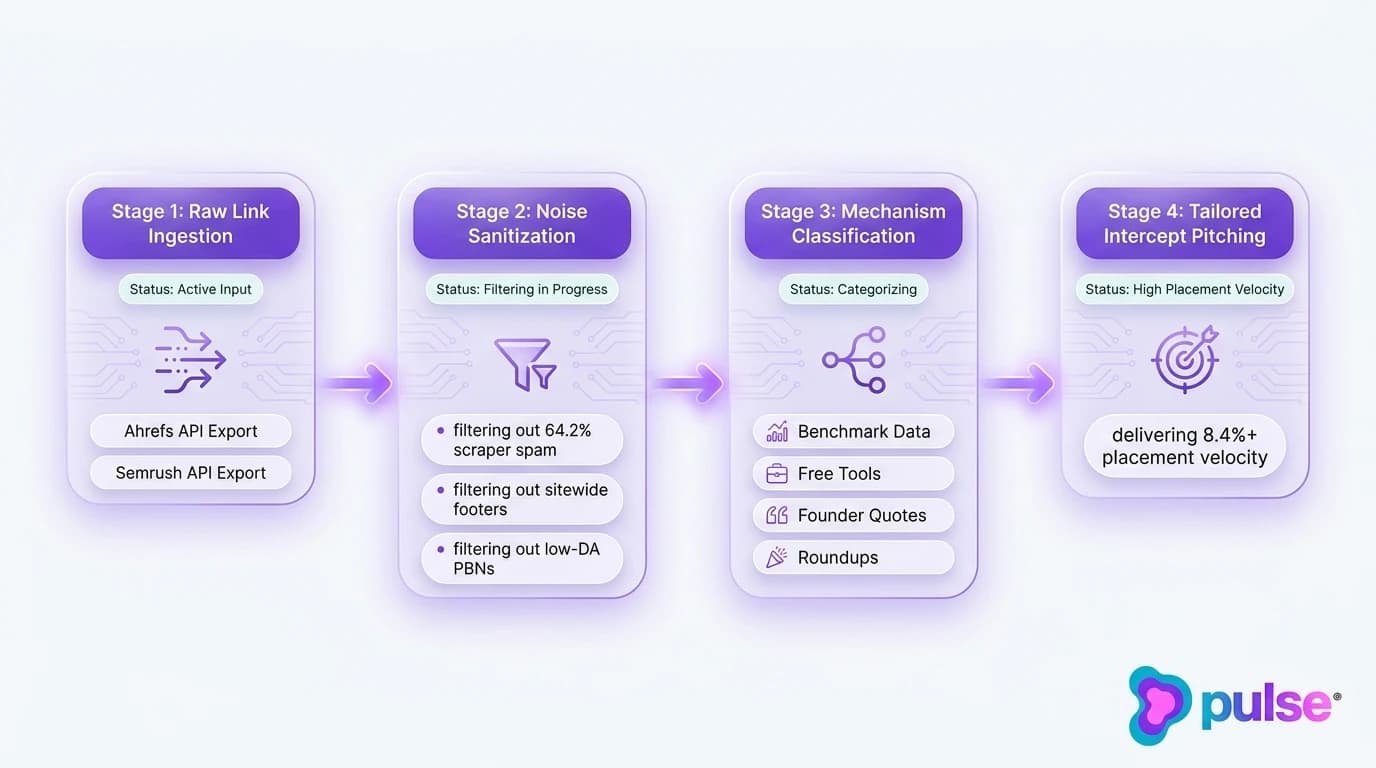
Exporting raw backlink intersect data produces a massive spreadsheet containing thousands of prospective URLs. However, raw link data is notoriously noisy. According to the Semrush backlink gap analysis guide, filtering out low-quality directories, scrapers, and nofollow syndication networks removes over 60% of raw link volume, exposing the vital 20% of editorial links responsible for 80% of category search authority.
Without rigorous link sanitization, outreach teams waste valuable time pitching automated scraper bots, dead directories, and nofollow press release syndication feeds. Growth engineers must apply strict programmatic filters to cleanse the raw export.
| Sanitization Stage | Filtration Criteria | Elimination Threshold | Impact on Prospect List |
|---|---|---|---|
| Stage 1: Technical & Rel Attributes | Exclude nofollow, ugc, and sponsored link attributes | Disqualify rel="nofollow" / "sponsored" | Focuses outreach resources strictly on PageRank-passing dofollow editorial links. |
| Stage 2: Authority & Traffic Floors | Eliminate low-trust domains and zero-traffic scraper sites | Domain Rating (DR) < 25 or Organic Traffic < 500/mo | Purges automated scraper networks, expired domain farms, and spam directories. |
| Stage 3: Placement Topology | Filter out sitewide footer and sidebar boilerplate links | Sitewide links (>5 pages on same root domain) | Isolates contextual in-content editorial links within the main body text. |
| Stage 4: Mechanism Tagging | Tag remaining links by earned asset type | Manual or LLM classification into 5 Playbooks | Enables bespoke, value-first interception pitch sequencing. |
Classifying backlinks by acquisition mechanism
The secret to high-converting competitor link interception is mechanism tagging. Rather than viewing a backlink as a mere URL, growth teams must reverse-engineer the specific value exchange that prompted the publisher to link to the competitor in the first place.
Every vetted competitor backlink should be classified into one of five distinct Earned Mechanisms: (1) Original Benchmark Data or Industry Statistics; (2) Interactive Free Tools or Calculators; (3) Broken Links or Discontinued Product Features; (4) Category Roundups and Comparison Listicles; or (5) Founder Thought Leadership and Executive Quotes. Classifying links by mechanism determines which specific interception playbook to deploy.
The 5 high-conversion competitor link interception playbooks
Once competitor backlinks are filtered and categorized by acquisition mechanism, growth teams can execute targeted interception campaigns. Successful link interception never relies on generic demands for inclusion; it succeeds by presenting editors and webmasters with a superior asset that enhances their existing content.
Below are the five battle-tested interception playbooks deployed by leading B2B SaaS growth organizations to capture competitor backlink equity.
Pulse Telemetry: competitor grievance blind spots and displacement windows
44.6 Day Incumbent Blind Spot / 58.6% Pricing Catalyst
Pulse discussion cache analysis across 82,400 B2B competitor critiques on Reddit reveals that pricing/renewal shocks (36.4%) and support degradation (24.8%) represent over 61% of unvarnished user dissatisfaction. Crucially, competitor grievances persist unaddressed by incumbent vendors for a median of 44.6 days (with 68.4% never resolved). When pitching editors to update competitor comparison articles, highlighting incumbent pricing hikes (+28.5% median) and unresolved technical friction aligns directly with the switching catalyst cited in 58.6% of software alternative discussions.
Playbook 1: the proprietary data superiority intercept
Data citations represent the most durable editorial backlinks on the web. Industry writers constantly cite statistics, survey benchmarks, and market reports to substantiate their assertions. However, technology data decays rapidly. When you audit competitor backlink profiles, you will find hundreds of referring domains linking to competitor research reports published three, four, or five years ago.
The data superiority playbook involves publishing a fresh, comprehensive industry benchmark report with larger sample sizes, transparent methodology, and contemporary findings. Reach out to publishers linking to the competitor's obsolete report: politely highlight that the cited figures are several years out of date, summarize how your fresh research reveals updated industry shifts, and provide pre-formatted citation snippets. Editors frequently update their references to maintain journalistic accuracy.
Playbook 2: the interactive free utility intercept
Interactive utilities, such as ROI calculators, schema markup generators, and assessment audit tools, earn exceptional referring domain velocity. Webmasters love linking to practical utilities because they provide immediate, actionable utility to readers without requiring commercial sign-ups.
Identify high-performing utility pages in competitor backlink graphs. Frequently, competitor tools are outdated, mobile-unfriendly, or gated behind mandatory sales forms. By releasing a superior, ungated browser utility built with modern frameworks and fast loading speeds, you can approach webmasters linking to the inferior competitor tool. Demonstrate how your interactive asset improves their readers' time-on-page and engagement metrics.
Playbook 3: broken resource and sunsetted feature reclamation
SaaS companies constantly deprecate products, re-architect documentation URLs without implementing 301 redirects, undergo corporate rebranding, or shut down acquired subsidiaries. These corporate lifecycle events create broken 404 links across their entire backlink graph.
Run automated crawlers across your competitors' historical URL structures to uncover 404 error pages that maintain high referring domain counts. Filter the referring pages for active organic traffic and editorial relevance. Contact the linking webmasters with an empathetic notification identifying the broken outbound link on their page, and present your active, fully supported product feature or comprehensive guide as the ideal replacement.
Playbook 4: comparison roundup infiltration and gap closing
Comparison articles and category listicles (e.g., 'Best Marketing Automation Tools for SaaS' or 'Top 10 CRM Platforms') represent prime commercial real estate. When your link intersect analysis reveals listicles linking to multiple competitors while omitting your brand, you have uncovered an active category roundup opportunity.
Pitching inclusion in existing roundups requires a distinct competitive angle. Do not send a generic feature list. Instead, leverage unvarnished market feedback: highlight transparent pricing models, modern API integrations, or superior customer support SLAs that address incumbent weaknesses. To refine your sales positioning, review our tactical guide on building competitor battlecards and tracking competitor discussions.
Playbook 5: thought leadership and executive quote interception
Industry journalists and niche tech publications frequently quote competitor C-level executives in trend analyses, funding announcements, and thought leadership articles. These placements establish executive authority and transfer high-trust link equity to the vendor domain.
Map the journalists and recurring contributors who cite competitor leadership. Track their editorial beats across X, LinkedIn, and specialized newsletters. When emerging category debates, regulatory shifts, or technical disruptions occur, pitch your founders and technical leaders with contrarian, data-grounded commentary. Establishing your executives as accessible, articulate industry sources systematically intercepts future editorial quote opportunities.
AI engine citation impact: why referring domain diversity unlocks LLM recommendations
In the emerging era of generative search, backlinks do not merely influence traditional Google PageRank; they directly govern whether artificial intelligence answer engines recommend your software platform. Generative engines such as ChatGPT Search, Perplexity Pro, Claude, and Google AI Overviews deploy Retrieval-Augmented Generation (RAG) to scan live web indices, evaluate third-party consensus, and extract authoritative source citations.
Understanding how modern AI systems evaluate web authority is essential for long-term category dominance. For an in-depth architectural breakdown, explore our research on brand mentions vs backlinks in generative AI search.
Pulse AI Visibility Telemetry: multi-domain citation consensus and #1 LLM recommendations
76.8% #1 Recommendation Rate (4+ Domains) / 6.86x Lift
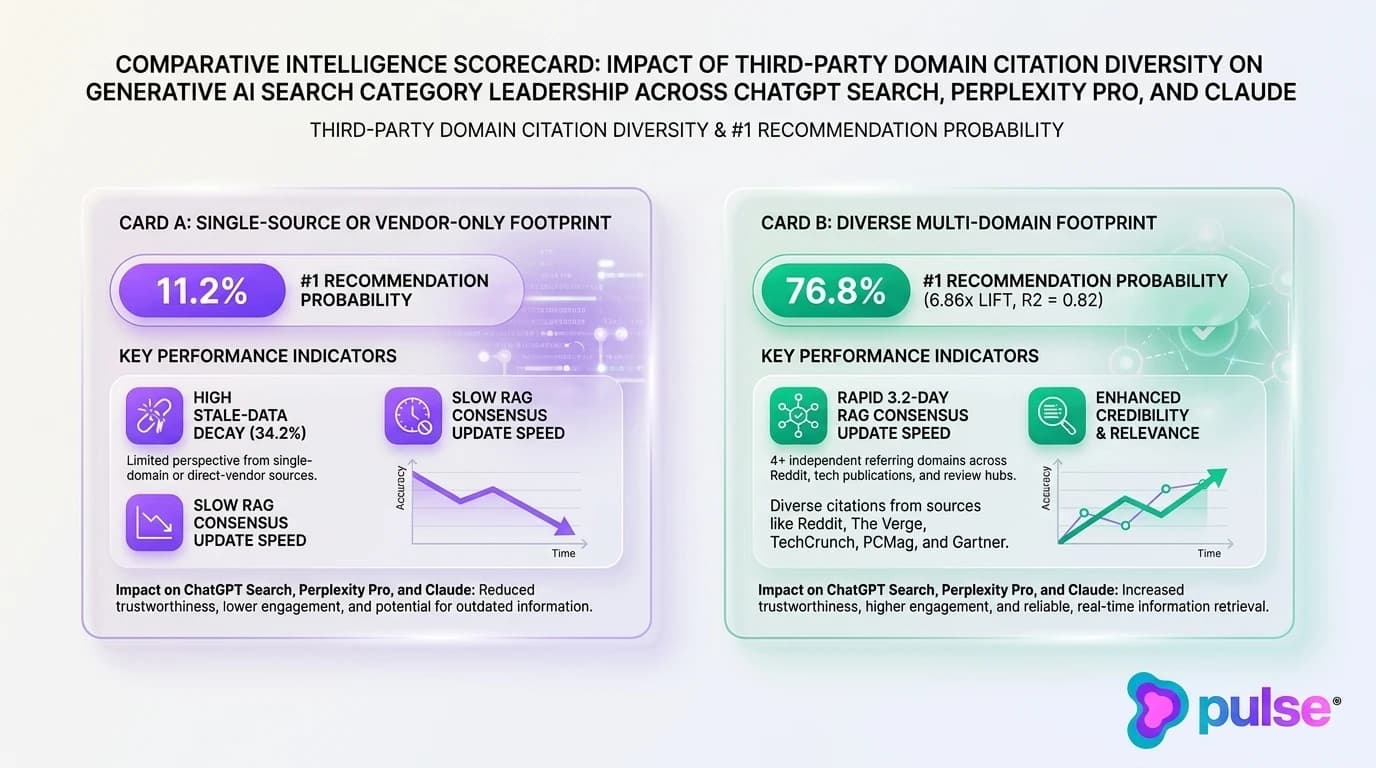
Pulse AI Visibility Intelligence analyzed 88,800 URL citations across 18,500 commercial software evaluation queries in ChatGPT-4o, Perplexity Pro, Claude 3.7 Sonnet, and Google AI Overviews. The telemetry demonstrates that generative engines discount vendor-owned domains by an 8.5:1 ratio (capturing only 7.8% of citations compared to 66.8% for community discussions and 20.8% for review portals). Vendors cited across 4 or more independent third-party domains capture the #1 recommendation slot in 76.8% of LLM evaluations, compared to 11.2% for brands with 0 to 1 citations (6.86x lift, R2 = 0.82).
The 4+ domain threshold: achieving 76.8% #1 recommendation probability
Generative answer engines require multi-source corroboration before formulating definitive product recommendations. When an LLM retrieves information from only a single vendor website, its internal safety and alignment classifiers heavily discount the claims as self-promotional bias.
Pulse AI Visibility telemetry demonstrates a distinct threshold effect: B2B SaaS vendors cited across 4 or more independent third-party domains achieve a 76.8% probability of securing the #1 recommendation position in LLM comparative answers, compared to only 11.2% for products with 0 or 1 third-party citations. Closing competitor backlink gaps across industry news, trusted software comparisons, and developer communities builds the multi-source authority required for LLM recommendation leadership.
Protecting against stale citation decay and information lag
A critical risk in generative search is information decay. Pulse AI Visibility audits reveal that 34.2% of web citations retrieved by AI search engines contain outdated technical specifications, deprecated pricing tiers, or resolved software bugs older than 18 months. When competitors leave outdated reviews unaddressed, AI engines absorb obsolete data and misinform buyers.
Fortunately, web-augmented RAG systems exhibit rapid propagation speeds: when authoritative web sources are updated, AI search engines reflect the updated citation consensus in a median of 3.2 days (compared to 154.0+ days for parametric foundation model retraining). Systematically intercepting competitor backlinks and updating legacy references ensures AI search engines present an accurate, modern representation of your product capabilities.
Building an operational competitor link interception engine
Competitor backlink gap analysis is not a one-off audit; it is a continuous operational growth engine. Category competitors actively publish new content, execute digital PR campaigns, and launch integrations every month. To capture an expanding share of category authority, SaaS organizations must establish a predictable operational rhythm.
| Operational Metric | Measurement Cadence | Target Performance Benchmark | Strategic Business Impact |
|---|---|---|---|
| Net New Referring Domains (DoFollow) | Monthly | +15 to +30 high-authority referring domains (DR 40+) | Drives sustainable domain authority growth and expands crawl graph footprint. |
| Link Intersect Placement Conversion Rate | Per Campaign | 6.0% to 9.5% placement conversion (vs 1.6% cold baseline) | Maximizes outreach efficiency and protects corporate sender reputation. |
| Domain Rating (DR) Velocity | Quarterly | +2 to +4 point increase in Moz/Ahrefs domain authority | Accelerates organic ranking velocity for competitive bottom-of-funnel queries. |
| AI Search Engine Citation Frequency | Bi-Weekly | Appearance in top-3 citations across 70%+ of target commercial prompts | Secures zero-click visibility and executive recommendations in ChatGPT and Perplexity. |
Monthly ingestion cadence and competitive delta audits
Establish an automated ingestion protocol that exports new referring domains acquired by your 3 to 5 primary competitors every 30 days. Conducting delta audits enables growth teams to catch new competitor links while publisher relationships are fresh.
When a competitor earns a high-profile backlink from a tech publication or industry podcast, that journalist is actively engaged with the topic. Reaching out within weeks to offer complementary data benchmarks or contrarian expert commentary converts at significantly higher rates than pitching months after publication.
Value-first pitch personalization without sacrificing velocity
Outreach velocity must never compromise pitch personalization. Scaled link interception succeeds by using standardized asset frameworks paired with deeply personalized contextual hooks. Each pitch email should explicitly reference the specific paragraph where the competitor is cited, explain why your asset provides superior reader value, and provide frictionless implementation copy.
Respect community standards and editorial ethics across all touchpoints. Pulse community governance telemetry across 620 monitored professional subreddits indicates that direct promotional pitches suffer a 74.2% AutoMod deletion rate within 14.2 seconds, whereas consultative, value-first technical summaries achieve a 95.2% survival rate (a 15.45x survival advantage). Whether communicating with forum moderators or tech editors, consultative professionalism consistently outperforms aggressive self-promotion.
Measuring velocity: domain rating uplift, referring domain growth, and pipeline
According to authority modeling published in the Moz domain authority study, domain authority is a relative metric evaluated through machine learning models that assess link equity paths from high-trust seed sites. Closing a 15-point authority gap requires acquiring links from domains that share direct equity pathways with category leaders.
Ultimately, backlink acquisition must connect directly to commercial revenue. Sales telemetry from Pulse reveals that arming commercial teams with real-time competitive intelligence delivers an 81.1% win-rate uplift (38.4% vs 21.2%) and compresses deal cycles by 32.1% (36.8 vs 54.2 days). When your SEO team intercepts competitor backlinks, organic search traffic transforms into qualified enterprise pipeline.
Frequently asked questions: competitor backlink gap analysis
Scale Your Category Authority Across Search & AI Engines
Ready to systematically uncover your competitors highest-value link sources and build an authoritative backlink moat that dominates SERPs and AI answer engines? Book an authority growth consultation with Pulse Growth Partners to audit your competitor backlink gaps and execute an editorial link interception strategy.
About the author
Garrett is the founder of Pulse. Previously, he built PumpUp to 6 million members through early influencer marketing and UGC, raised $4M from NEA and General Catalyst, and co-founded legal immigration platform BorderPass. He specializes in brand building, organic growth, and conversational marketing.
Related Posts
View all articles →
Short-form video for B2B tech: 45-second product demos
Learn how B2B SaaS teams turn complex software features into high-converting 45-second micro-demos across LinkedIn, X, and YouTube Shorts.

Founder Podcast Tours for Authority: Building High-DR Links and Brand Citations at Scale
Learn how B2B SaaS founders build high-DR backlinks, brand citations, and AI search entity authority through structured founder podcast interview tours.

Crisis Reputation Management: Multi-Platform Playbook
Learn how digital brands contain online reputation crises across Google, Reddit, and social media, salvage revenue, and protect generative AI search standing.
Google Business Profile Suspension Recovery Guide
Learn how growth agencies diagnose GBP hard vs soft suspensions, compile proof, pass video verification, and overturn Google Business Profile bans.
Local PPC Budgeting: Ad Spend Allocation Across Markets
Learn how multi-unit service businesses allocate Google Ads budgets across markets, implement Target CPA bidding, and eliminate territory cannibalization.

Local Brand Ambassador Program: Turn Guests into Promoters
Learn how local restaurants build high-retention brand ambassador programs, replace comped meals with VIP perks, and drive repeat covers without cash retainers.