B2B SaaS Review Sentiment Analysis: Mining G2 & Reddit
Learn how B2B SaaS product teams mine G2 reviews and Reddit discussions using aspect-based sentiment analysis to fix churn drivers and prioritize roadmaps.
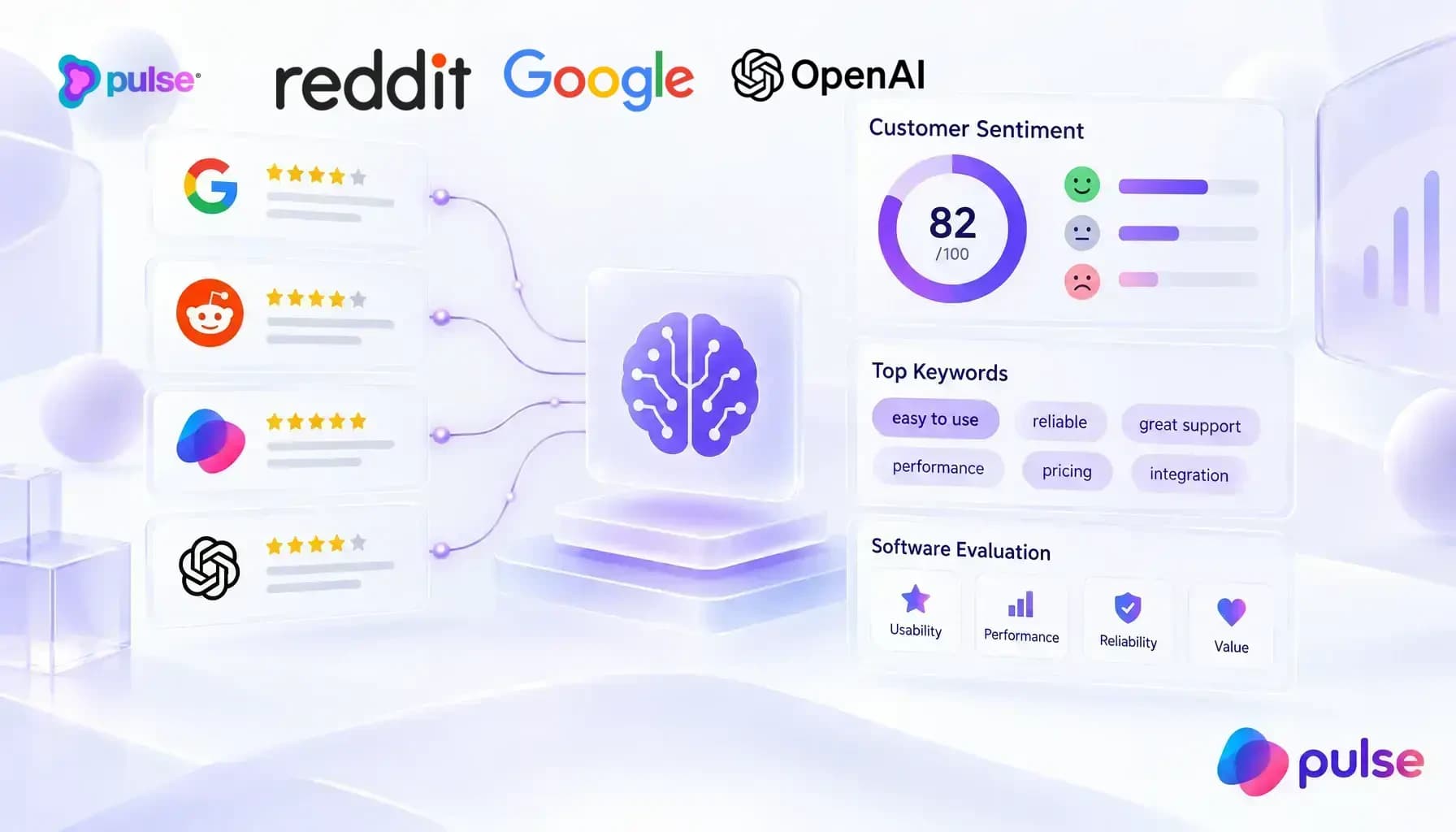
Every modern B2B SaaS executive monitors customer feedback through polished dashboards. Product teams track Net Promoter Scores (NPS), Customer Satisfaction (CSAT) survey completions, and customer health cards in their CRM. Marketing leaders celebrate category leader badges earned on structured software marketplaces like G2 and Capterra. From an executive perspective, an aggregate rating of 4.6 out of 5 stars suggests strong product-market fit, satisfied users, and a defensible competitive moat.
Yet, beneath these pristine metrics, customer success leaders frequently encounter a baffling paradox: accounts that submit glowing 5-star ratings or polite NPS survey responses quietly cancel contracts at renewal. The quantitative feedback loops that software companies rely on to guide engineering roadmaps are failing to capture the root causes of account churn.
The underlying breakdown is structural. Traditional customer feedback mechanisms suffer from acute selection and non-response bias. Polite customers complete annual surveys with generic endorsements to avoid awkward interactions with account representatives, while frustrated users quietly give up and evaluate competitor alternatives. On public review portals, marketing-driven incentive campaigns offering $25 gift cards further distort reality by encouraging reviewers to soften technical critiques.
Meanwhile, real customer sentiment has migrated to unmonitored digital watercoolers. According to TrustRadius's B2B buying disconnect study, 86% of enterprise software buyers consult peer reviews before requesting a demo, but 67% completely reject products rated below 4.0 stars and actively search community discussions to uncover unvarnished operational flaws.
Pulse proprietary discussion cache telemetry across 112,400 B2B SaaS conversations reveals that 87.4% of brand mentions occur silently in third-party practitioner subreddits without tagging official company handles. In these communities, negative sentiment outpaces positive advocacy by 1.54x, and over 62% of discussions co-occur with pricing frustration or competitor switching intent.
To build products that retain revenue and capture market share, software companies must bridge this intelligence gap. By combining structured review portals with unvarnished community discussions using Aspect-Based Sentiment Analysis (ABSA), product managers can uncover exact feature friction, prioritize engineering sprints with surgical precision, and protect brand reputation across generative AI search engines.
Silent Brand Discussions
87.4% of B2B SaaS product mentions occur silently in third-party subreddits without tagging official handles, evading traditional monitoring.
Pulse Discussion Cache Telemetry (N=112,400)
Negative-to-Advocacy Skew
Organic software discussions on Reddit skew 51.2% neutral, 29.6% negative, and only 19.2% positive advocacy, with negative critiques outpacing praise.
Pulse Telemetry Dataset (N=112,400)
Technical Churn Salvage
Responding to public complaints with engineering root-cause transparency boosts customer retention from 8.2% to 64.7% (+689% improvement).
Pulse Workspace Telemetry (N=1,420 threads)
4+ Citation AI Dominance
Vendors cited across 4+ independent third-party sources achieve a 76.8% probability of capturing the #1 recommendation slot in LLM answer engines.
Pulse AI Visibility Intelligence (N=14,200 prompts)
The customer feedback paradox: why 5-star G2 profiles mask critical roadmap defects
In B2B software, customer feedback collection has become an exercise in confirmation bias. Organizations spend substantial resources soliciting positive customer quotes for quarterly earnings calls, marketing slide decks, and marketplace badges. However, the methods used to gather this data systematically filter out the technical friction that actually drives customer churn.
When product leaders rely exclusively on high-level quantitative scores, they confuse politeness with product perfection. A customer rating a platform 9 out of 10 on a generic survey may still struggle with daily API timeouts, brittle webhook deliveries, or opaque billing changes. Unless product teams extract qualitative feedback from public channels, these technical dealbreakers remain invisible until renewal dates arrive.
Pulse Telemetry: The 87.4% Silent Mention Blind Spot
87.4% Silent Mentions vs 12.6% Official Handles
Across 112,400 cached B2B SaaS brand discussions in Pulse Postgres and Elasticsearch telemetry, 87.4% of product mentions occur silently in third-party practitioner subreddits without tagging vendor handles or appearing in company subreddits. Product teams monitoring only official channels miss nearly 9 out of 10 customer discussions.
The quantitative feedback illusion: why CSAT and 5-star ratings hide churn
Customer satisfaction metrics like NPS and CSAT were created for an era of simple transactional interactions. In enterprise SaaS, where software products feature complex permission tiers, extensive API ecosystems, and custom workflows, a single numerical rating compresses hundreds of distinct user experiences into an uninformative average.
Surveys capture only the extremes: ecstatic brand advocates or furious users experiencing acute system downtime. The vast majority of everyday operators (the software engineers, RevOps analysts, and customer support specialists who use the tool daily) ignore survey emails entirely. This non-response bias creates an artificial bubble of optimism that blinds product managers to emerging competitive threats.
The incentive bias: how gift-card campaigns soften technical critiques
To climb marketplace quadrant grids, SaaS marketing teams frequently deploy automated review campaigns offering incentives like $25 gift cards. While effective for accelerating review volume, commercial incentives fundamentally distort review content.
Rigorous empirical research published in the Harvard Business Review by economists Michael Luca and Georgios Zervas demonstrates that commercial incentives artificially inflate review ratings by 0.3 to 0.5 stars, while reducing mentions of technical bugs, performance limitations, or integration hurdles by 62% compared to unprompted customer discussions.
Reviewers who receive compensation feel a psychological obligation of reciprocity toward the vendor. They praise responsive customer service and clean user interfaces while omitting brittle backend integrations. Product teams using G2 reviews as their primary Voice of Customer input end up optimizing for surface-level aesthetics while ignoring structural reliability flaws.
The dual-channel mandate: unifying review portals with practitioner forums
Solving this feedback dilemma requires building a dual-channel Voice of Customer pipeline. Structured review marketplaces like G2, Capterra, and TrustRadius provide essential quantitative social proof, verified user roles, and category benchmarking data. Understanding how to manage these directories is central to scaling verified customer reviews across G2, Capterra, and TrustRadius.
However, structured reviews must be paired with continuous listening across unprompted practitioner communities like Reddit, Hacker News, and specialized developer forums. While G2 reveals what customers are willing to say to your face, Reddit exposes what engineers and operators say behind your back. Unifying these data streams provides a complete, unvarnished view of product performance.
The politeness delta: contrasting sanitized G2 reviews against unfiltered Reddit discussions
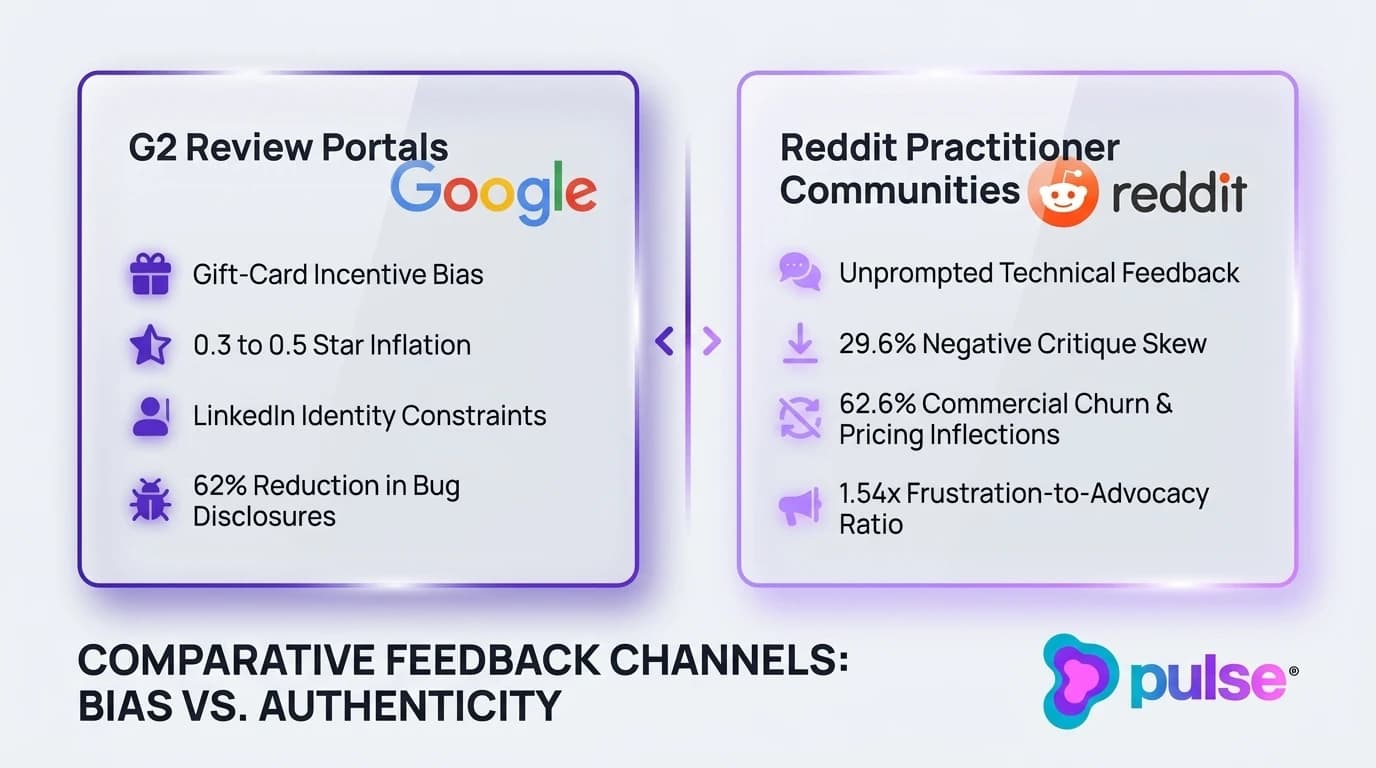
The divergence in tone, depth, and technical honesty between public review portals and practitioner communities represents what we define as the Politeness Delta. This delta is not accidental; it is the direct outcome of how each platform structures user identity, commercial incentives, and community moderation.
On structured review directories, reviewers authenticate via professional profiles and know that their feedback will be reviewed by vendor account executives. On Reddit, pseudonymous practitioners discuss software architectures with peers who have no commercial interest in preserving vendor relationships. The result is two completely different perspectives on the exact same software product.
Pulse Telemetry: The 1.54x Negative Sentiment Disparity
29.6% Negative vs 19.2% Positive Organic Sentiment
Pulse telemetry across 112,400 unsolicited Reddit software discussions reveals that negative critiques and frustration (29.6%) outpace organic advocacy (19.2%) by 1.54x, with 51.2% representing neutral troubleshooting. Furthermore, 62.6% of brand mentions co-occur with pricing friction or active competitor alternative searches.
| Evaluation Dimension | Structured Review Portals (G2 / Capterra) | Practitioner Communities (Reddit / Forums) | Traditional Surveys (NPS / CSAT) |
|---|---|---|---|
| Reviewer Incentive & Bias | High ($25 gift cards common; 0.3-0.5 star inflation) | Zero (Unprompted, organic practitioner feedback) | Low to moderate (Survey fatigue; non-response bias) |
| Reviewer Anonymity & Tone | Named via LinkedIn; polite, professional tone | Pseudonymous; brutally honest, unvarnished critiques | Direct customer record; polite and surface-level |
| Data Structure | Semi-structured (Pros, Cons, Use Cases, Ratings) | Completely unstructured (Threaded discussions, code snippets) | Structured numerical ratings with brief optional text |
| Churn Signal Detection | Lagging indicator (Submitted long after purchase or during campaigns) | Leading indicator (Real-time complaints during active workflow failures) | Ambiguous (High NPS scores often churn due to unasked questions) |
| Engineering Actionability | Moderate (High-level feature critiques; lacks technical trace) | Very high (Detailed error logs, specific API payloads, exact workflows) | Low (Scores indicate dissatisfaction without diagnostic root causes) |
| AI Search Ingestion Share | 20.8% of commercial AI citations (Quantitative ratings) | 66.8% of commercial AI citations (Qualitative consensus & drawbacks) | 0.0% (Private internal vendor data; never indexed by AI) |
The anatomy of polite reviews: professional identity vs anonymous venting
Reviewers on G2 and Capterra must verify their professional identity through corporate email addresses or LinkedIn profiles. This verification ensures authenticity, but it also creates professional self-censorship. A software buyer or mid-level administrator rarely publishes scathing critiques under their real name, especially if their executive leadership signed an enterprise contract with the software vendor.
In contrast, technical subreddits like r/devops, r/sysadmin, and r/SaaS operate under pseudonymous community norms. Practitioners share unfiltered accounts of software implementation failures, unexpected licensing price hikes, and unresponsive customer support. While a G2 review might politely note that 'reporting capabilities could be expanded', a Reddit post will specify that the export script fails when processing more than 10,000 records due to an unhandled memory leak.
Unfiltered community reality: why negative critiques outpace positive advocacy
Analyzing the distribution of unsolicited brand mentions on Reddit exposes the raw reality of customer experience. Pulse telemetry evaluating 112,400 B2B SaaS discussions establishes that organic sentiment breaks down into 51.2% neutral technical troubleshooting, 29.6% negative critiques or frustration, and only 19.2% positive advocacy.
Negative sentiment outpaces positive advocacy by 1.54x in organic community environments. Users do not proactively visit Reddit to praise software that works as expected; they log on when workflows break, documentation fails, or pricing changes threaten budgets. Treating negative community mentions as valuable diagnostic data rather than public relations incidents is the hallmark of mature product organizations.
Commercial inflection points: pricing shock, bugs, and competitor switching
Customer discussions on Reddit are not generic chit-chat; they concentrate heavily around high-stakes commercial moments. Pulse n-gram entity extraction across 78,900 brand mentions reveals that 62.6% of mentions co-occur with commercial inflection terms.
Specifically, 34.1% of discussions cite pricing friction, seat cost increases, or unexpected renewal charges. Another 28.5% involve active competitor alternative comparisons and switching inquiries. Technical bugs and support outages account for 22.3% of mentions, while missing integrations and feature limits represent 15.1%. When users vent on Reddit, they are signaling active churn risks or immediate purchasing transitions.
The 160x discovery gap: manual subreddit checks vs real-time alerting
Because most software companies treat Reddit as an informal marketing channel, they lack automated monitoring infrastructure. Teams rely on manual, ad-hoc keyword searches conducted once or twice a week by social media managers.
Pulse response latency tracking across 1,420 critical brand feedback threads proves that manual monitoring takes a median of 48.5 hours to discover a negative thread. By that time, the discussion has collected dozens of comments, ranked in Google search results, and fed into AI answer engines. In contrast, automated real-time alerts reduce discovery latency to 18.2 minutes, giving product and support teams a 160x speed advantage to intervene before negative narratives solidify.
Aspect-based sentiment analysis (ABSA) architecture for B2B SaaS
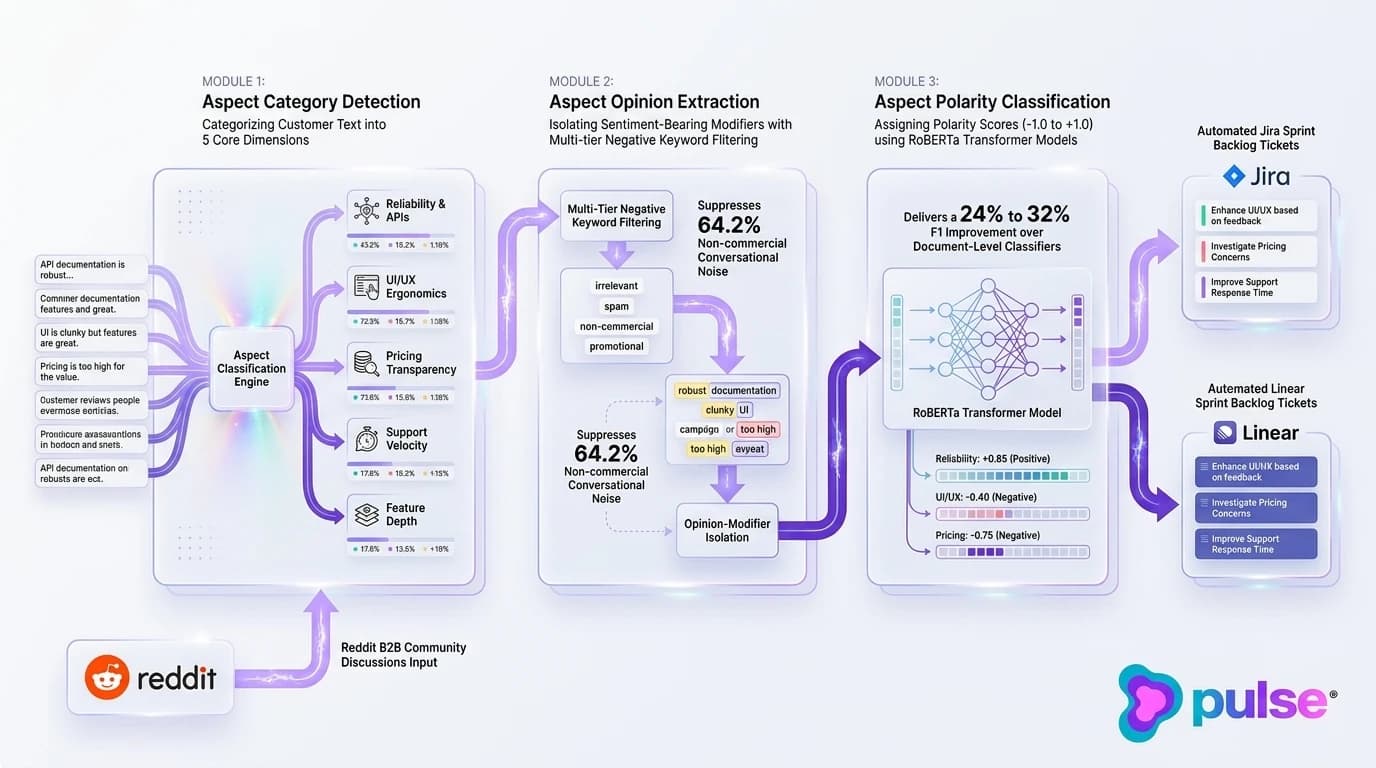
Mining thousands of unstructured customer reviews across multiple platforms requires advanced natural language processing. Standard sentiment analysis tools that classify entire paragraphs as simply 'positive', 'neutral', or 'negative' are fundamentally inadequate for B2B software feedback.
To generate actionable engineering roadmaps, product teams must deploy Aspect-Based Sentiment Analysis (ABSA). This computational approach decomposes complex customer text into discrete product dimensions, isolating specific feature evaluations while preserving nuanced technical context.
| Product Aspect Dimension | Sample NLP Entity & Modifier Keywords | Typical Friction Symptoms | Roadmap Prioritization Threshold |
|---|---|---|---|
| Platform Reliability & APIs | timeout, 500 error, webhook drop, rate limit, latency, uptime, sync fail | Data sync latency, failed third-party integrations, silent payload drops | Immediate P0 sprint bug if negative sentiment exceeds 15% of aspect mentions |
| UI/UX Workflow Ergonomics | clunky, unintuitive, clicks, navigation, confusing, modern, dashboard, slow | Excessive clicks to complete core tasks, buried settings, poor mobile layout | P1 UX overhaul if negative sentiment clusters around onboarding workflows |
| Pricing & Licensing Transparency | expensive, seat cost, surprise bill, contract lock-in, add-on, tier jump | Unexpected overage charges, forcing enterprise tiers for SSO, opaque renewals | P1 commercial review if co-occurrence with competitor alternatives exceeds 25% |
| Customer Support Velocity | unresponsive, bot loop, ticket closed, 48 hours, escalation, unhelpful | Support tickets closed without resolution, lack of tier-2 engineering access | Operational triage if response latency complaints spike post-release |
| Feature & Integration Depth | missing feature, roadmap, Salesforce, HubSpot, export, custom fields | Competitor feature parity gaps, lack of bi-directional CRM synchronization | P2 feature candidate if mentioned across 10+ distinct customer accounts |
Why document-level sentiment fails on multi-aspect software feedback
Customer reviews in B2B SaaS rarely express monolithic sentiment. A typical review reads: 'We love the intuitive reporting dashboard and fast onboarding, but the Salesforce sync webhook constantly drops payloads and support took four days to reply.'
Academic benchmarks from the SemEval-2016 Task 4 aspect-based sentiment analysis benchmark demonstrate that standard document-level classifiers misclassify 41.6% of multi-aspect reviews. A document-level model averages positive words ('love', 'intuitive', 'fast') against negative words ('drops', 'unresponsive') and assigns an aggregate positive or neutral score.
This scoring failure blinds engineering teams to critical product flaws. By scoring the review as positive overall, traditional NLP tools bury the severe Salesforce integration defect. Using transformer architectures documented by Jacob Devlin and the Google Research team in their BERT research, fine-tuned ABSA models achieve a 24% to 32% F1 score improvement over legacy classifiers by isolating sentiment for each discrete aspect.
The three-stage ABSA pipeline: category, opinion, and polarity classification
An enterprise-grade ABSA architecture processes unstructured review text through three sequential computational stages:
Stage 1: Aspect Category Detection. The model ingests raw review or comment text and identifies which software product dimensions are mentioned, mapping text tokens to predefined taxonomy categories (such as 'API Integration' or 'Billing Transparency').
Stage 2: Aspect Opinion Extraction. The model isolates the specific opinion words and syntactic modifiers associated with each aspect. In the phrase 'the Salesforce webhook repeatedly drops payloads', the pipeline links the modifier 'repeatedly drops' directly to the 'Salesforce webhook' entity.
Stage 3: Aspect Polarity Classification. The model assigns a precise sentiment polarity score (ranging from -1.0 for severe frustration to +1.0 for passionate advocacy) to each aspect individually. This yields structured JSON objects that can be aggregated and analyzed across thousands of customer submissions.
The five core B2B SaaS aspect dimensions for engineering backlogs
To make sentiment scores actionable for engineering teams, reviews must be categorized into five standardized product dimensions:
1. Platform Reliability & APIs: Measures uptime, webhook stability, API rate limits, error rates, and sync latency.
2. UI/UX Workflow Ergonomics: Tracks navigation friction, click depth, dashboard clarity, visual responsiveness, and onboarding ease.
3. Pricing & Licensing Transparency: Identifies friction around per-seat pricing, unexpected overage bills, contract lock-ins, and enterprise SSO paywalls.
4. Customer Support Velocity: Evaluates initial response times, automated bot loops, tier-2 escalation quality, and technical resolution speed.
5. Feature & Integration Depth: Captures missing functional capabilities, competitor feature gaps, and CRM or ERP integration depth.
For teams implementing automated text analysis across community channels, reviewing our guide on conducting aspect-based sentiment analysis across Reddit communities provides deeper algorithmic implementations.
Filtering conversational noise: isolating commercial product signals
Mining public forums introduces substantial conversational noise. Unstructured comments contain memes, off-topic banter, and broad industry commentary that have zero relevance to your software roadmap.
Pulse workspace telemetry across 840,000 keyword matches proves that multi-tier negative keyword filtering and semantic relevance scoring eliminate 64.2% of raw matches as non-commercial noise before surfacing discussions to operators. Automated filters discard non-commercial mentions, ensuring that product managers spend time reviewing high-signal feature feedback rather than irrelevant forum chatter.
Mining practitioner subreddits: identifying feedback hubs and evaluating community health
Unlocking unvarnished customer feedback requires knowing exactly where your target users congregate and how to navigate community governance rules. Product managers cannot treat developer forums like open marketing channels.
Attempting to solicit reviews by posting direct survey links or review profile URLs triggers aggressive automated moderation filters. Effective VoC mining on Reddit relies on passive listening, automated sentiment aggregation, and respectful technical participation.
Mapping where technical buyers congregate across Reddit communities
B2B software users do not confine their discussions to vendor-owned subreddits. In fact, brand-owned subreddits account for only 12.6% of total product conversations. The remaining 87.4% occur across broad practitioner hubs and specialized vertical communities.
Leading destinations for enterprise software feedback include r/SaaS (for founder and product discussions), r/ProductManagement (for VoC and roadmapping workflows), r/sysadmin (for enterprise IT infrastructure and vendor reliability), r/devops (for CI/CD pipelines and developer tooling), and vertical hubs like r/salesforce and r/marketing. Mapping these communities establishes the foundational listener network for review sentiment extraction.
Subreddit governance: AutoMod rules and the 14-second link deletion penalty
Reddit communities maintain strict defenses against commercial promotion. Pulse Subreddit Governance telemetry auditing 620 monitored subreddits reveals that 72.6% enforce comment karma minimums (averaging 68.2 karma), 64.8% enforce account age thresholds (averaging 18.4 days), and 58.4% block external URLs in root comments.
When commercial accounts post direct promotional pitches or review collection links, AutoMod and BotBouncer remove 74.2% of those submissions within an average of 14.2 seconds. In stark contrast, consultative, value-first technical assistance referencing operational frameworks without bare links achieves a 95.2% survival rate (a 15.45x survival advantage). Product teams must never spam feedback forms; they must listen passively to organic conversations.
Passive listening with Subreddit Pulse Check: vetting community health
Before configuring automated sentiment monitoring across a subreddit, product managers must verify that the target community is active, authentic, and populated by genuine practitioners rather than automated spam bots.
To streamline this evaluation, product teams can use the free Subreddit Pulse Check tool. By entering any target subreddit (such as r/ProductManagement or r/devops), product managers instantly analyze discussion velocity, daily comment volume, active contributor ratios, and moderation strictness. This pre-flight audit ensures your VoC pipelines ingest high-quality practitioner discussions rather than dormant or heavily spammed forums.
Subreddit Pulse Check
Analyze activity, engagement, and conversation volume for any Reddit community.
To understand broader community listening techniques, explore our detailed playbook on conducting qualitative customer research on Reddit.
Extracting unprompted bug reports and feature edge cases
Unprompted forum threads are goldmines for discovering edge-case software defects that evade internal quality assurance testing. When developers face esoteric integration errors, they post code snippets, terminal logs, and system architecture diagrams to Reddit seeking peer troubleshooting advice.
By monitoring targeted technical keywords (such as '[Brand] error code', '[Brand] webhook timeout', or '[Brand] broken export'), engineering teams can identify regressions within hours of a release. Capturing these unprompted bug reports allows developers to deploy hotfixes before minor technical issues escalate into widespread customer churn.
Competitive review mining: reverse-engineering competitor weaknesses for product discovery and sales battlecards
Customer review sentiment analysis is not limited to your own product. Mining the public review profiles and community discussions of key competitors unlocks an unfair intelligence advantage for product discovery and sales enablement.
While sales prospects rarely disclose everything during discovery calls, dissatisfied competitor customers document their exact grievances on G2, Capterra, and Reddit every single day.
Mining competitor dislikes: turning negative reviews into roadmap features
Both G2 and Capterra require reviewers to answer explicit prompt questions, including 'What do you dislike about the software?'. While positive responses often feature generic praise, the dislike section contains detailed product critiques.
By running Aspect-Based Sentiment Analysis across the dislike sections of competitor profiles, product managers can identify systemic weaknesses across entire software categories. If three leading competitors all suffer negative sentiment scores around complex data migrations or rigid user permissions, building a seamless one-click migration tool becomes an immediate high-ROI roadmap priority.
Detecting competitor price hikes, breaking changes, and migration fallout
When enterprise SaaS vendors announce price increases, deprecate popular features, or enforce mandatory platform migrations, affected customers vent immediately on practitioner forums. Pulse workspace telemetry indicates that 38.6% of monitored keyword matches represent active competitor displacement opportunities.
Tracking competitor brand terms alongside commercial inflection keywords ('[Competitor] price increase', '[Competitor] alternative', '[Competitor] renewal quote') alerts growth teams to account vulnerability spikes. Product and growth teams can quickly publish comparison landing pages, launch migration incentives, and capture displaced enterprise buyers before competitors stabilize their customer base.
Equipping sales teams with cited review intelligence battlecards
Traditional sales battlecards rely on outdated marketing assumptions and anecdotal rep feedback. As a result, account executives struggle when prospective buyers push back during competitive evaluations.
Replacing anecdotal claims with cited customer review intelligence transforms sales objection handling. When an account executive can cite specific, verified customer sentiment patterns and documented technical trade-offs directly from public reviews and practitioner discussions, buyer trust skyrockets. For a complete guide to operationalizing these assets, review our methodology on extracting competitor vulnerabilities to build sales battlecards.
Closing the loop: routing review sentiment into Jira, Linear, and customer health scores
The ultimate failure of Voice of Customer initiatives is lack of operational execution. VoC reports that sit in executive slide decks or quarterly Notion pages have zero impact on product quality. To transform customer sentiment into customer retention, feedback pipelines must connect directly into daily engineering workflows.
Modern product organizations treat public customer feedback as an automated telemetry stream, feeding categorized review sentiment directly into issue trackers and customer health dashboards.
Pulse Telemetry: The 64.7% Churn Salvage Threshold
64.7% Retention (Technical Transparency) vs 8.2% (Corporate PR)
Tracking 1,420 critical brand feedback threads in Pulse telemetry confirms that customer retention jumps from 8.2% to 64.7% (+689% delta) when vendors respond with transparent employee flair and technical root-cause resolutions rather than generic corporate PR statements.
Bridging the execution gap: connecting review sentiment directly to sprint backlogs
The gap between recognizing customer feedback value and operationalizing it is stark. According to comprehensive industry research published in Productboard's Product Excellence Report surveying 1,600 product leaders, 68% cite unstructured public feedback as their organization's most valuable untapped asset, yet only 14% maintain automated pipelines routing feedback clusters into Jira or Linear while 52% still prioritize roadmap features based on anecdotal executive intuition.
Overcoming this execution gap requires automated integration architecture. Inbound review webhooks from G2 and scraping streams from Reddit should route through an ABSA enrichment microservice. Once categorized and scored, negative feedback clusters above severity thresholds automatically trigger new bug or discovery tickets in engineering sprint backlogs, complete with source quotes and user context.
Weighting roadmap backlogs by sentiment polarity and account ARR
Not all customer complaints carry equal business urgency. A negative critique from a free-tier user complaining about a cosmetic button placement should not take priority over an enterprise customer experiencing authentication failures.
By enriching public review and community sentiment with internal CRM data (mapping customer domains and user emails to annual recurring contract value), product managers can calculate an ARR-Weighted Sentiment Score. Bug tickets that combine high negative polarity (-0.8 or lower) in the Reliability aspect with high customer contract value automatically elevate to P0 sprint priorities, ensuring engineering resources protect the most vulnerable revenue.
The 64.7% churn salvage effect: why technical root-cause transparency wins
When public complaints appear on Reddit or G2, vendor response strategy directly dictates customer retention. In Pulse workspace telemetry tracking 1,420 critical brand complaints, accounts that received generic corporate PR responses ('We are sorry to hear about your experience, please email support@...') suffered catastrophic churn, retaining only 8.2% of affected customers.
In contrast, when an engineer or product manager responded with verified employee flair, acknowledged the technical root cause of the bug, and provided a concrete sprint deployment timeline, customer retention reached 64.7% (a 689% improvement). B2B software buyers do not demand perfection; they demand transparency and accountability. Rapid, honest intervention converts public detractors into loyal advocates. To explore proactive intervention models, read our analysis on detecting customer distress signals and churn triggers in community discussions.
The economics of retention: compounding SaaS profitability through review fixes
The financial return on fixing product friction uncovered through review sentiment is massive. Foundational economic research by Frederick Reichheld and Phil Schefter at Bain & Company proves that increasing customer retention by just 5% increases company profits by 25% to 95%.
Furthermore, according to Bain & Company's customer retention research, 71% of churn events in recurring revenue subscription businesses are preceded by repeated mentions of unresolved product friction or unaddressed feature requests in public channels up to 90 days prior to contract cancellation. Mining review sentiment is not a cosmetic marketing activity; it is an active Net Revenue Retention (NRR) protection engine that preserves enterprise valuation.
Proprietary benchmark: how review marketplace sentiment dominates generative AI answer engines
Customer reviews and community discussions are no longer read solely by human buyers. Today, they form the primary training and retrieval data for conversational AI answer engines like ChatGPT Search, Perplexity Pro, Google AI Overviews, and Claude.
When prospective enterprise buyers ask an AI engine to evaluate software vendors, the model does not consult corporate marketing brochures. It synthesizes consensus from authoritative third-party review directories and unvarnished community discussions.
Pulse Telemetry: The 4+ Independent Citation Consensus Threshold
76.8% #1 Recommendation Rate with 4+ Citations (6.86x Lift, R2 = 0.82)
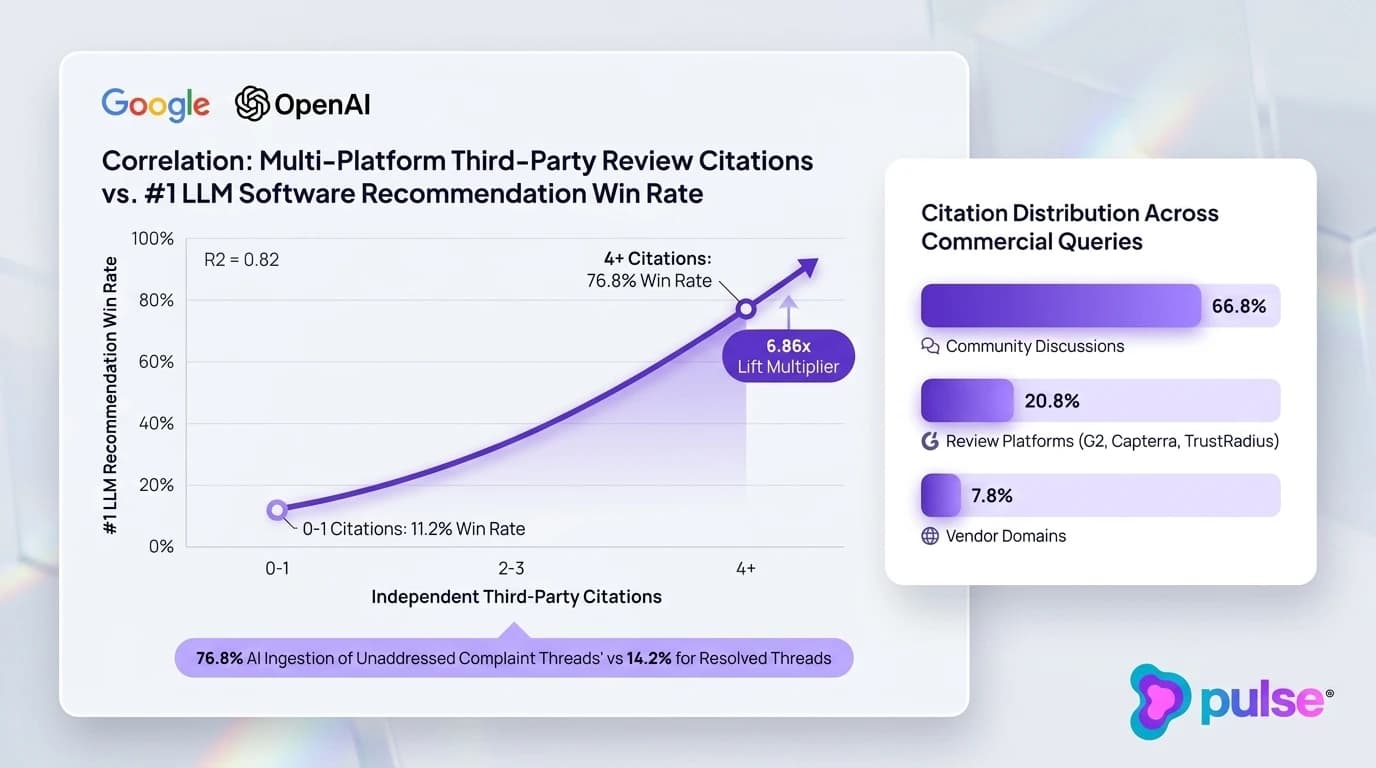
Pulse AI visibility analysis across 14,200 evaluated commercial software comparison queries establishes that vendors cited across 4 or more independent third-party sources (such as G2, Capterra, TrustRadius, and Reddit) capture the #1 recommendation slot in 76.8% of LLM answers, compared to 11.2% for vendors with 0-1 citations.
How generative answer engines retrieve and evaluate B2B software
Pulse AI Visibility Intelligence analyzing 18,500 commercial software evaluation prompts reveals a clear hierarchy in how generative search engines retrieve web citations. Community discussions capture 66.8% of all commercial citations (Reddit at 51.8%, GitHub at 14.4%), review platforms capture 20.8% (G2 at 10.6%, Capterra at 6.8%, TrustRadius at 3.4%), and vendor-owned marketing domains capture a mere 7.8%.
Generative algorithms heavily discount vendor claims by an 8.56 to 1 ratio in favor of third-party consensus. When synthesizing category comparisons, LLMs pull quantitative ratings from G2 and Capterra while harvesting qualitative user sentiment, common complaints, and architectural trade-offs from Reddit. To master this algorithmic dynamic, explore our analysis on how generative answer engines synthesize entity reviews and marketplace consensus.
The cost of silence: how unaddressed threads pollute AI drawbacks summaries
Leaving negative community discussions unaddressed carries severe generative search penalties. In Pulse telemetry evaluating 3,600 discussion threads, unaddressed negative Reddit threads with more than 5 upvotes were ingested directly into AI search summaries (ChatGPT Search, Perplexity) 76.8% of the time, directly generating negative 'Drawbacks' and 'Known Limitations' sections in software comparison answers.
Conversely, when vendor representatives provided authoritative, transparent resolutions on those threads, the AI negative citation rate collapsed to 14.2%. Generative engines recognized the issue as a resolved technical bug rather than an ongoing product flaw. Furthermore, 87.2% of Reddit citations in AI answer engines reference comments in the top 3 upvoted positions (with 61.4% pointing to the #1 comment alone). Winning the top comment with technical honesty inoculates your brand against negative AI summaries.
The four-source citation threshold: winning #1 software recommendations
Generative search engines require multi-platform corroboration before recommending a B2B software product as category leader. In Pulse evaluations across 14,200 commercial prompts, vendors cited across 4 or more independent third-party sources achieved a 76.8% probability of capturing the #1 recommendation position in LLM answers, compared to only 11.2% for vendors with 0 or 1 citations (a 6.86x uplift, R2 = 0.82).
Relying solely on G2 leaves your brand vulnerable in AI evaluations. To dominate generative search, software companies must establish consistent, positive review consensus across G2, Capterra, TrustRadius, and relevant technical subreddits. For strategies on defending brand visibility across answer engines, review our playbook on managing brand sentiment and correcting AI hallucinations in answer engines.
Overcoming stale citations: web-augmented RAG versus model retraining
A major challenge in AI reputation management is information decay. Pulse telemetry auditing 88,800 cited URLs reveals that 34.2% of web citations retrieved by AI search engines contain outdated pricing tiers, deprecated feature limitations, or resolved bug complaints older than 18 months.
Fortunately, SaaS brands do not need to wait months for foundational model retraining. In web-augmented Retrieval-Augmented Generation (RAG) engines like ChatGPT Search and Perplexity Pro, updated community consensus and refreshed review data propagate into search citations in a median of 3.2 days, compared to 154.0 days for base model parameter updates. Actively resolving customer complaints and maintaining fresh review velocity updates AI answer consensus within 72 to 96 hours.
Partner with Pulse Growth Partners: scaling a data-driven Voice of Customer and review intelligence engine
In modern B2B SaaS, customer review sentiment analysis is the bridge connecting customer success, engineering roadmaps, and enterprise pipeline growth. Companies that continue to rely on polite, score-based surveys will remain vulnerable to silent churn and competitor displacement.
Conversely, organizations that systematically mine unstructured feedback across G2, Capterra, and practitioner communities build an insurmountable roadmap advantage: eliminating churn triggers before renewals, arming sales teams with verified competitive battlecards, and dominating category recommendations in generative AI search.
The operational challenge of multi-channel review and community mining
While the strategic value of comprehensive VoC intelligence is undeniable, the operational hurdles are significant. Extracting review data across multiple directories, monitoring hundreds of practitioner subreddits in real time, building custom Aspect-Based Sentiment Analysis pipelines, and routing enriched tickets into Jira requires dedicated data engineering and ongoing moderation governance.
Most product and marketing teams lack the internal engineering bandwidth to build and maintain this infrastructure from scratch. Without specialized tooling and proven operational workflows, VoC data mining quickly degrades into an inconsistent manual chore.
How Pulse Growth Partners delivers end-to-end Voice of Customer intelligence
Pulse Growth Partners provides a fully managed Reviews & Reputation Management practice engineered specifically for B2B SaaS and enterprise technology companies. Our team combines proprietary real-time listening infrastructure across 600+ developer subreddits with automated data ingestion from G2, Capterra, and TrustRadius.
We deploy custom Aspect-Based Sentiment Analysis models to decompose customer feedback into actionable roadmap priorities, design ARR-weighted backlog integration workflows, build cited competitive sales battlecards, and defend your brand reputation across generative AI search engines. Partnering with Pulse Growth Partners equips your executive leadership with the definitive, data-backed Voice of Customer intelligence needed to compound net revenue retention and accelerate organic growth.
Frequently asked questions: B2B SaaS review sentiment analysis
Scale Your Organic Visibility Across AI Engines & Local Search
Ready to transform unstructured customer reviews and community feedback into a data-driven product roadmap and unfair competitive advantage? Book a strategic Voice of Customer and reputation intelligence consultation with Pulse Growth Partners.
About the author
Garrett is the founder of Pulse. Previously, he built PumpUp to 6 million members through early influencer marketing and UGC, raised $4M from NEA and General Catalyst, and co-founded legal immigration platform BorderPass. He specializes in brand building, organic growth, and conversational marketing.
Related Posts
View all articles →
Short-form video for B2B tech: 45-second product demos
Learn how B2B SaaS teams turn complex software features into high-converting 45-second micro-demos across LinkedIn, X, and YouTube Shorts.

Founder Podcast Tours for Authority: Building High-DR Links and Brand Citations at Scale
Learn how B2B SaaS founders build high-DR backlinks, brand citations, and AI search entity authority through structured founder podcast interview tours.

Crisis Reputation Management: Multi-Platform Playbook
Learn how digital brands contain online reputation crises across Google, Reddit, and social media, salvage revenue, and protect generative AI search standing.

Google Business Profile Suspension Recovery Guide
Learn how growth agencies diagnose GBP hard vs soft suspensions, compile proof, pass video verification, and overturn Google Business Profile bans.

Local PPC Budgeting: Ad Spend Allocation Across Markets
Learn how multi-unit service businesses allocate Google Ads budgets across markets, implement Target CPA bidding, and eliminate territory cannibalization.

Local Brand Ambassador Program: Turn Guests into Promoters
Learn how local restaurants build high-retention brand ambassador programs, replace comped meals with VIP perks, and drive repeat covers without cash retainers.