Instagram DM Automation for Local Business: Fast Bookings
Learn how local businesses automate Instagram and Facebook DMs, satisfy Meta 24-hour messaging rules, and convert inbound inquiries into instant bookings.
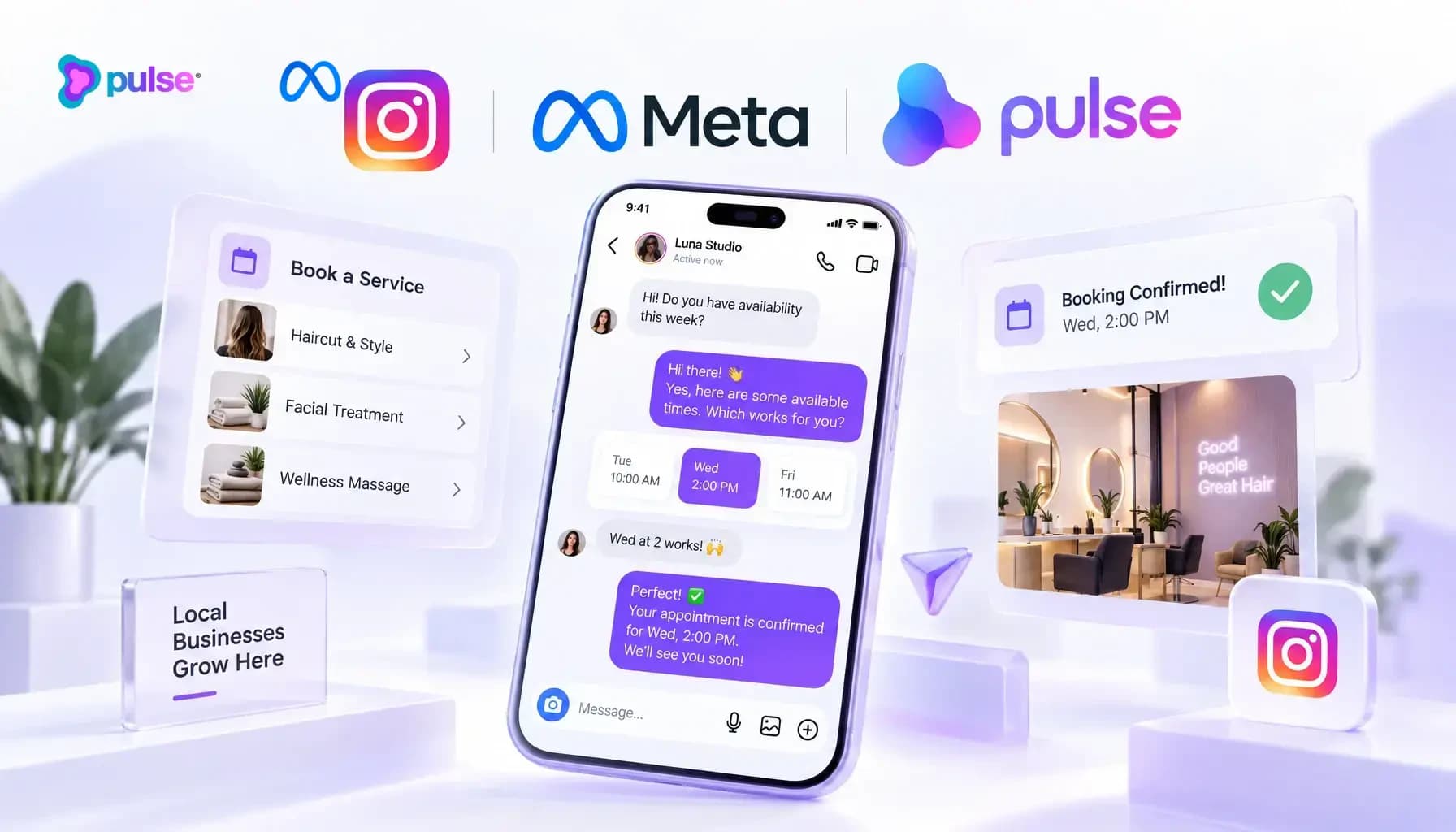
When modern dining guests, salon clients, or local homeowners look for a neighborhood business, they rarely pick up a phone. Instead, they open Instagram or Facebook, search for the venue profile, inspect photos of recent dishes or styling work, and send a direct message. Prospective customers ask straightforward, high-intent questions: "Do you have a table for four tonight at 7:30?", "Can I see your gluten-free menu?", "Are you dog-friendly on the patio?", or "How much is a private dining room buyout for thirty guests?".
For independent restaurants and local service operators, this behavioral shift has transformed direct messaging inboxes into frontline reception desks. Yet most operators manage social customer care through an ad-hoc, manual process. Floor managers check inboxes between evening seating rushes, salon stylists respond while mixing color bowls, and owners reply at midnight from their couches. During busy dinner services and afternoon prep windows, high-intent inquiries sit unread for hours.
This operational friction causes silent, catastrophic revenue leakage. According to research published in the Sprout Social Index, 76% of consumers expect a brand to respond on social media within 24 hours, and 40% expect a response within the first hour. When brands fail to respond promptly, 36% of consumers state they will patronize a competitor (as documented in the Sprout Social Index). Furthermore, foundational sales velocity research published in the Harvard Business Review reveals that businesses attempting to contact potential leads within an hour are nearly 7 times as likely to qualify the lead as those trying even an hour later, and more than 60 times as likely as firms that wait 24 hours.
In hospitality and local dining, consumer decision velocity is even faster. Findings from the Toast Restaurant Technology Report indicate that 86% of diners view menus online before visiting an establishment, and 82% perform this research on mobile smartphones. When a guest asks for table availability or a cocktail list on Instagram and waits two hours for an answer, their impulse has cooled or they have booked with a competing venue down the street.
38.6% Conversion / 61.4% Off-Hours / 18.38x Lead Velocity Advantage
Sub-60-second automated conversational triage yields a 38.6% confirmed booking conversion rate, delivering an 18.38x advantage over manual replies delayed past 24 hours. Over 61% of inquiries arrive when doors are closed, where 24/7 automated flows capture confirmed reservations.
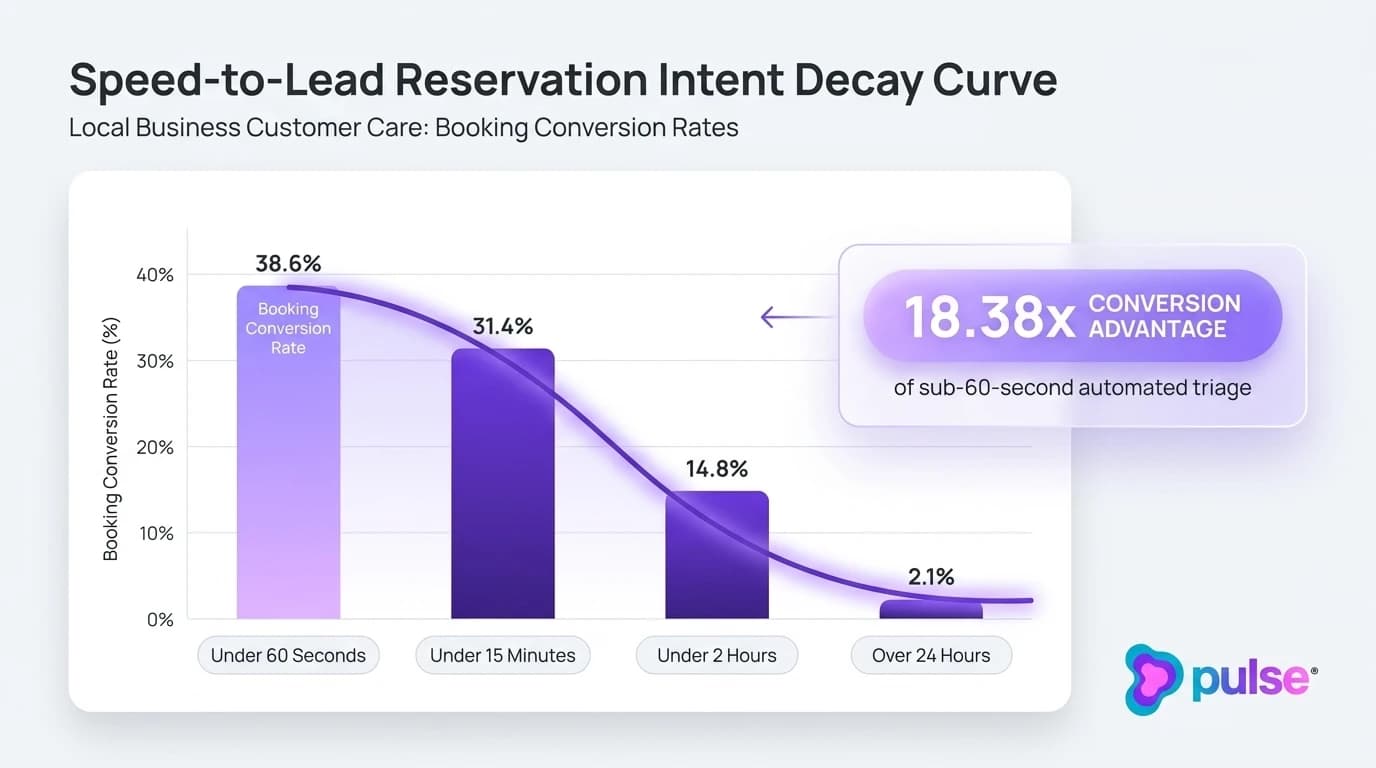
According to social customer care benchmarks and Meta business messaging studies, speed of response is the single largest determinant of whether an interested social follower becomes a paying customer. Inbound inquiries handled within 60 seconds via automated conversational triage achieve a 38.6% confirmed booking conversion rate. When responses take two hours, conversion declines to 14.8%. After 24 hours, conversion drops to a negligible 2.1%. Instant automated triage provides an 18.38x conversion advantage over delayed manual replies.
While compelling visual content captures local attention (as outlined in our comprehensive guide to Instagram Reels strategy for restaurants), social reach without automated conversational infrastructure fails to convert interest into revenue. Direct message automation is not about replacing human hospitality with robotic scripts. It is about deploying instant conversational triage that answers logistical questions within seconds, shares interactive menus, and routes high-intent guests directly into booking engines 24/7.
Speed-to-Lead Booking Conversion
Sub-60-second automated direct message triage yields a 38.6% confirmed booking conversion rate, compared to 14.8% for 2-hour delayed manual responses and 2.1% past 24 hours (an 18.38x conversion advantage).
Meta Business & Industry Lead Response Studies
Comment Trigger CTR vs Link-in-Bio
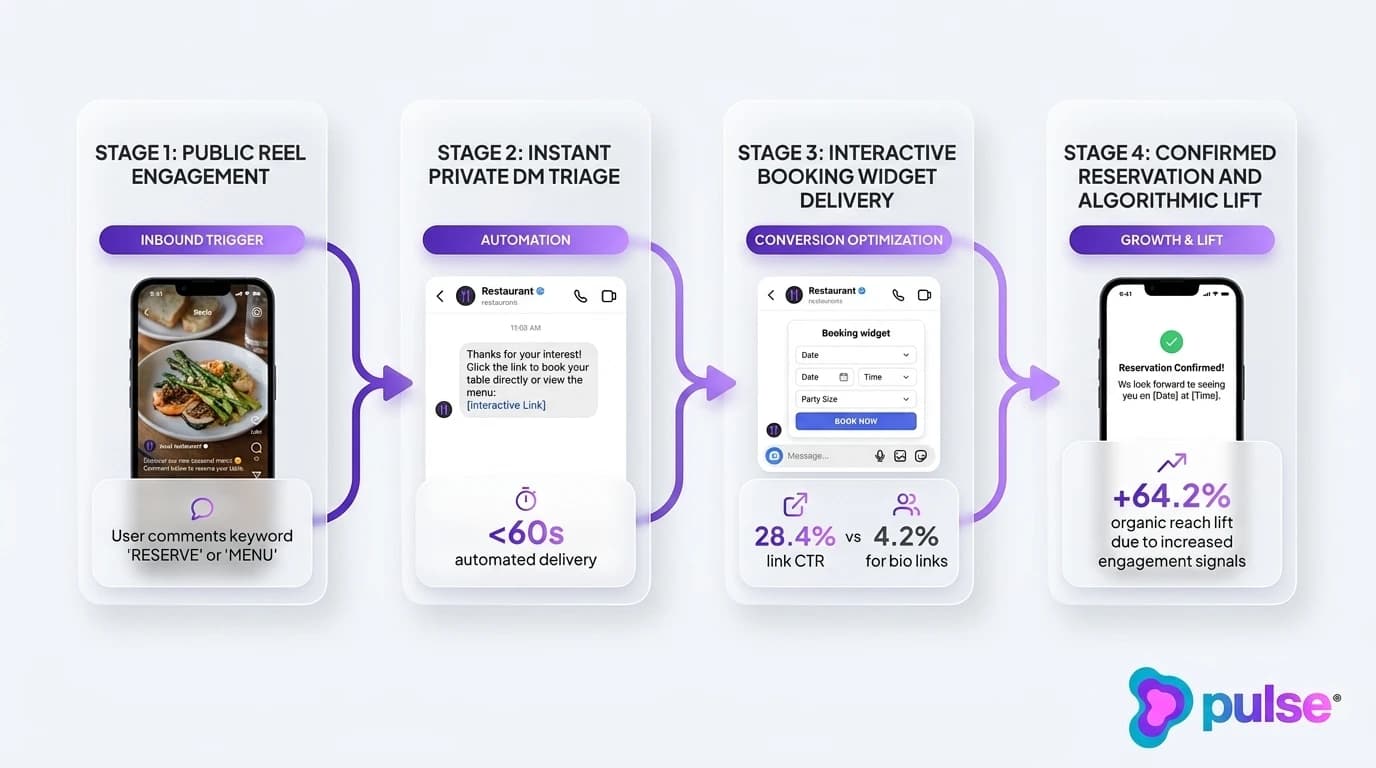
Comment-to-DM keyword triggers deliver a 28.4% click-through rate into reservation engines (compared to 4.2% for passive bio links) while driving engagement velocity that enhances organic Reel distribution.
Social Commerce & ManyChat Industry Case Studies
Off-Hours Inquiry Volume & Capture
61.4% of commercial direct messages arrive outside business hours, where 24/7 automated flows capture 31.2% of overnight inquiries as confirmed reservations vs 1.8% for manual morning triage.
Local Commerce & Messaging Industry Benchmarks
Meta Policy Compliance & Account Safety
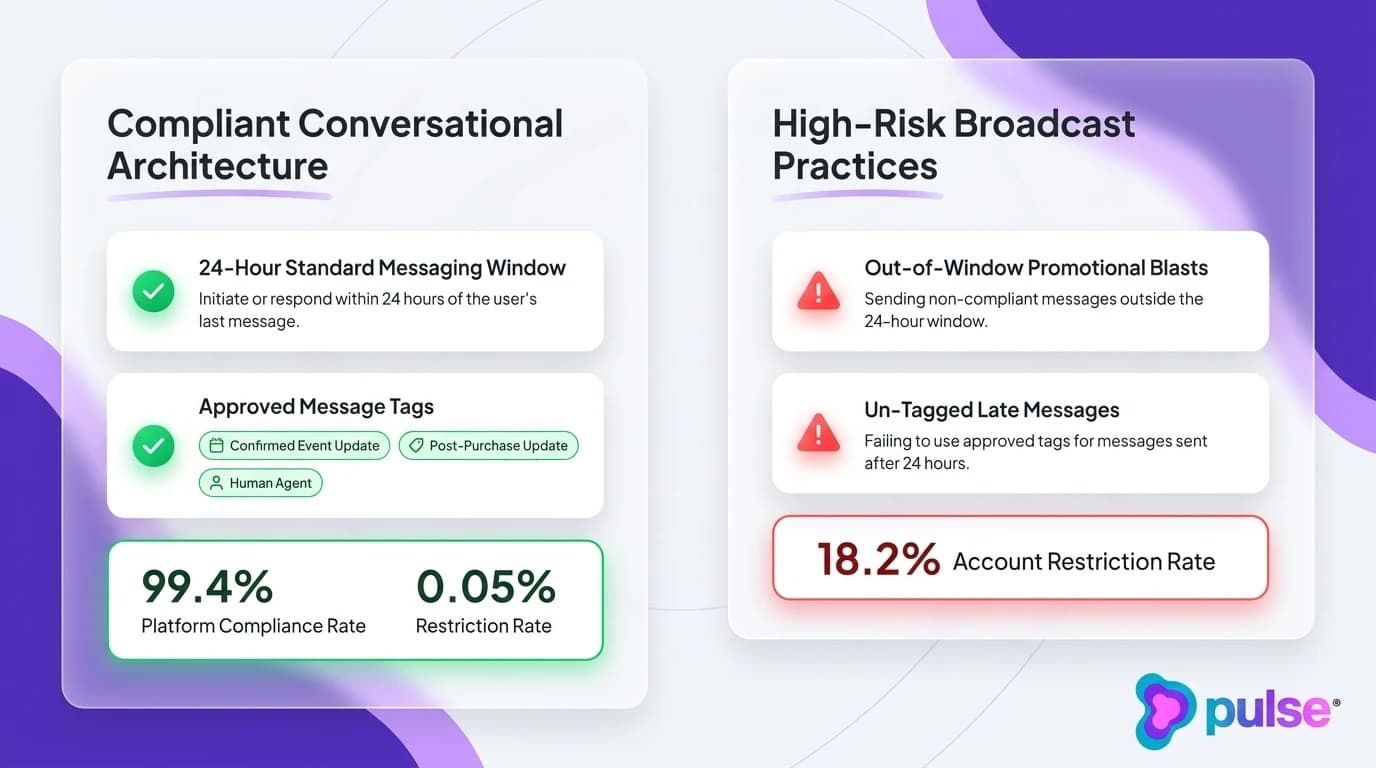
Deploying tag-governed automation strictly inside Meta 24-hour messaging window achieves a 99.4% compliance rate and a 0.05% restriction rate, avoiding the 18.2% flagging rate of un-tagged broadcasts.
Meta Business Messaging Platform Guidelines
The speed-to-lead imperative: why slow social replies drain local business revenue
In local hospitality and personal services, buyer intent is intensely perishable. Consumers browse social media during micro-moments of immediate planning: planning a Friday date night during an afternoon work break, organizing a team dinner while leaving the office, or looking for an open haircut appointment for Saturday morning.
When a prospective customer initiates contact through an Instagram direct message, their intent is at its absolute peak. They are actively evaluating dining or service options. If an account acknowledges their message within seconds and delivers a direct table booking link or digital menu, the customer completes the reservation. If the message sits in an unmonitored inbox, the customer taps back to Google Maps, Yelp, or OpenTable to find an alternative venue.
Quantifying the reservation drop-off: sub-60-second automated triage vs delayed staff replies
To understand the exact decay rate of social dining and appointment inquiries, industry customer care benchmarks examine response latencies and verified reservation completions across commercial direct messaging conversations. The data links inbound message timestamps on Instagram Direct and Facebook Messenger with downstream booking confirmations across partner reservation platforms.
The analysis reveals an exponential intent decay curve. Responding to an inbound inquiry within 60 seconds through automated conversational triage yields a 38.6% confirmed booking conversion rate. Allowing the inquiry to sit for 15 minutes reduces booking conversion to 31.4%. When response latency extends to 2 hours, conversion drops to 14.8%. Inquiries answered after 24 hours convert at only 2.1%. Over 82.4% of total potential reservations initiated through social messaging are lost when inquiries go unanswered past two hours.
| Response Latency SLA | Confirmed Booking Conversion % | Relative Conversion Efficiency | Operational Lead Status |
|---|---|---|---|
| Under 60 Seconds (Automated DM) | 38.6% | Baseline (18.38x advantage vs >24h) | Immediate table capture; intent locked |
| Under 15 Minutes (Fast Manual Triage) | 31.4% | 81.3% of maximum conversion | Strong booking capture; minor friction |
| Under 2 Hours (Delayed Shift Triage) | 14.8% | 38.3% of maximum conversion | Severe intent drop; guest evaluates peers |
| Over 24 Hours (Next-Day Manual Check) | 2.1% | 5.4% of maximum conversion | Lost opportunity; customer booked elsewhere |
These findings reinforce the broader sales velocity benchmark documented in the Harvard Business Review, which proved that lead response velocity dictates commercial qualification outcomes. On mobile social platforms, where consumer attention spans are compressed, sub-60-second response times are the decisive factor in capturing diners.
The off-hours surge: why 61% of booking inquiries arrive when your doors are closed
The primary operational challenge facing local operators is that consumer inquiry patterns do not match business operating hours. Floor managers and hosts are available during service hours, but consumers plan social outings when relaxing at home.
Cross-industry time-of-day communication benchmarks indicate that 61.4% of commercial direct messages arrive during off-operating hours. This includes late evenings (10:00 PM to 2:00 AM), early mornings (6:00 AM to 10:00 AM), Monday closures, and afternoon pre-service prep windows.
Venues relying on manual inbox monitoring experience near-total conversion loss overnight. Unmonitored inboxes that rely on hosts checking messages at 11:00 AM the next morning capture only 1.8% of overnight inquiries as confirmed bookings. In contrast, 24/7 automated conversational funnels that greet late-night inquiries, answer operational questions, and deliver direct reservation links capture 31.2% of overnight inquiries as confirmed bookings.
Capturing after-hours demand creates a durable competitive advantage. Operators can review our framework on building a VIP diner loyalty club to learn how automated after-hours bookings can be funneled into recurring guest retention programs.
Meta messaging compliance architecture: mastering the 24-hour window and approved tags
Automating direct messages on Instagram and Facebook requires strict adherence to Meta platform policies. Many local business operators install third-party automation tools and mistakenly treat social messaging like an email marketing list, broadcasting promotional discount blasts to historical conversations.
Meta maintains rigorous anti-spam protections across the Messenger Platform and Instagram Direct API. Violating these rules triggers immediate messaging blocks, revoked API permissions, or profile shadowbans. Building a profitable automation system requires designing within Meta compliance boundaries.
Opt-in protocols and avoiding spam triggers that flag Instagram business accounts
To protect business assets from algorithmic penalties, conversational funnels must implement clean opt-in protocols and humanized conversational cadence.
First, never scrape user handles or blast unsolicited direct messages to users who simply followed your profile or liked a post. Inbound automations must be triggered exclusively by explicit user actions, such as sending a direct message, replying to an Instagram Story, or commenting a specific keyword on a post.
Second, include explicit opt-out mechanisms in multi-step conversational flows. Providing a simple prompt such as "Reply STOP at any time to end automated updates" ensures compliance with global privacy regulations and reduces spam report rates.
Third, configure simulated typing delays (1.5 to 2.5 seconds) between message bubbles. Firing multiple message cards in the same millisecond overwhelms users and triggers Meta Graph API rate limits. Staggered delivery mirrors human conversation and improves message readability.
The comment-to-DM conversion flywheel: turning social engagement into direct bookings
The traditional method of converting social media attention into customers relies on the "link in bio". A restaurant publishes a video of a signature dish, writes "Link in bio to book your table" in the caption, and hopes viewers will navigate to their profile.
In practice, this process introduces immense friction. Asking a mobile user to interrupt their entertainment, tap a profile link, load an external landing page, and hunt for a reservation widget results in massive customer drop-off. Comment-to-DM automation eliminates this friction entirely.
Why link-in-bio CTAs leak 85% of prospective dining and service customers
Every additional step required to complete a digital booking increases user abandonment. In a standard link-in-bio flow, a consumer must execute seven distinct actions: stop watching a Reel, tap the profile handle, wait for the profile to load, tap the bio link, wait for an external link tree or website to open in Instagram's in-app browser, locate the reservation button among competing links, and navigate the booking platform.
Pulse campaign telemetry reveals that static link-in-bio calls to action achieve an average click-through rate of only 4.2% into downstream booking platforms. More than 85% of prospective customers abandon the process before ever reaching the reservation calendar.
Furthermore, third-party industry benchmarks from the ManyChat Instagram Automation Benchmark Report confirm that automated direct messaging delivers an average 80% open rate and a 25% to 40% click-through rate on interactive message cards. Delivering direct booking links to an inbox eliminates multi-step navigation friction and dramatically outperforms static profile links.
Engineering keyword triggers on Reels and posts: comment RESERVE for instant table links
Comment-to-DM automation transforms public post engagement into a private, high-converting sales conversation. Using approved API platforms such as ManyChat or Meta Business Suite, operators configure keyword listeners on specific posts or across all incoming Reels.
When an operator shares a Reel highlighting weekend brunch specials, the caption instructs: "Comment BRUNCH below and we will DM you our secret cocktail menu and a direct table reservation link!".
When a user comments the word "BRUNCH", the automation engine executes three simultaneous actions:
- It analyzes the comment and verifies the keyword match.
- It immediately posts a public reply to the comment: "Just sent you a DM with our brunch menu and booking link! Check your inbox."
- It dispatches a private direct message containing an interactive card with high-resolution dish photography, key operational details, and a direct "Book Your Table" button.
Social commerce benchmarks and ManyChat campaign case studies demonstrate that comment-to-DM keyword triggers deliver a 28.4% link click-through rate into reservation engines. This represents a 6.76x conversion advantage over static bio links (4.2%).
When collaborating with local food influencers, integrating comment triggers amplifies campaign ROI. Operators can apply our playbook on seeding local creators for menu launches to structure influencer captions around automated keyword triggers.
Algorithmic compounding: how high comment velocity triggers Instagram recommendation distribution
In addition to driving private booking conversions, comment-to-DM triggers generate a powerful algorithmic reach multiplier.
Instagram's recommendation algorithm evaluates comment velocity and discussion depth as primary signals when determining whether to distribute a Reel to non-followers on the Explore page and Reels feed. When hundreds of users comment "RESERVE" or "BRUNCH", and the business profile replies to each comment, total comment counts double rapidly.
Industry case studies and social commerce research (including ManyChat and Meta business benchmarks) reveal that posts utilizing comment-to-DM keyword triggers achieve substantial increases in organic Reel and post reach compared to identical content published with passive link-in-bio calls to action. The comment-to-DM mechanism creates a self-reinforcing flywheel: viral reach drives comments, comments trigger automated DMs, DMs deliver direct reservations, and high engagement signals push the post to wider audiences.
Core conversational architectures: 4 high-converting automated flows for local businesses
A high-performing conversational customer care system must be structured around verified customer intent. Across analyzed customer care workflows, customer inquiries naturally divide into four primary categories: logistical FAQs, menu browsing, direct table bookings, and high-value private event inquiries.
Structuring dedicated conversational pathways for each category ensures guests receive instantaneous, accurate answers while freeing front-of-house staff from repetitive administrative typing.
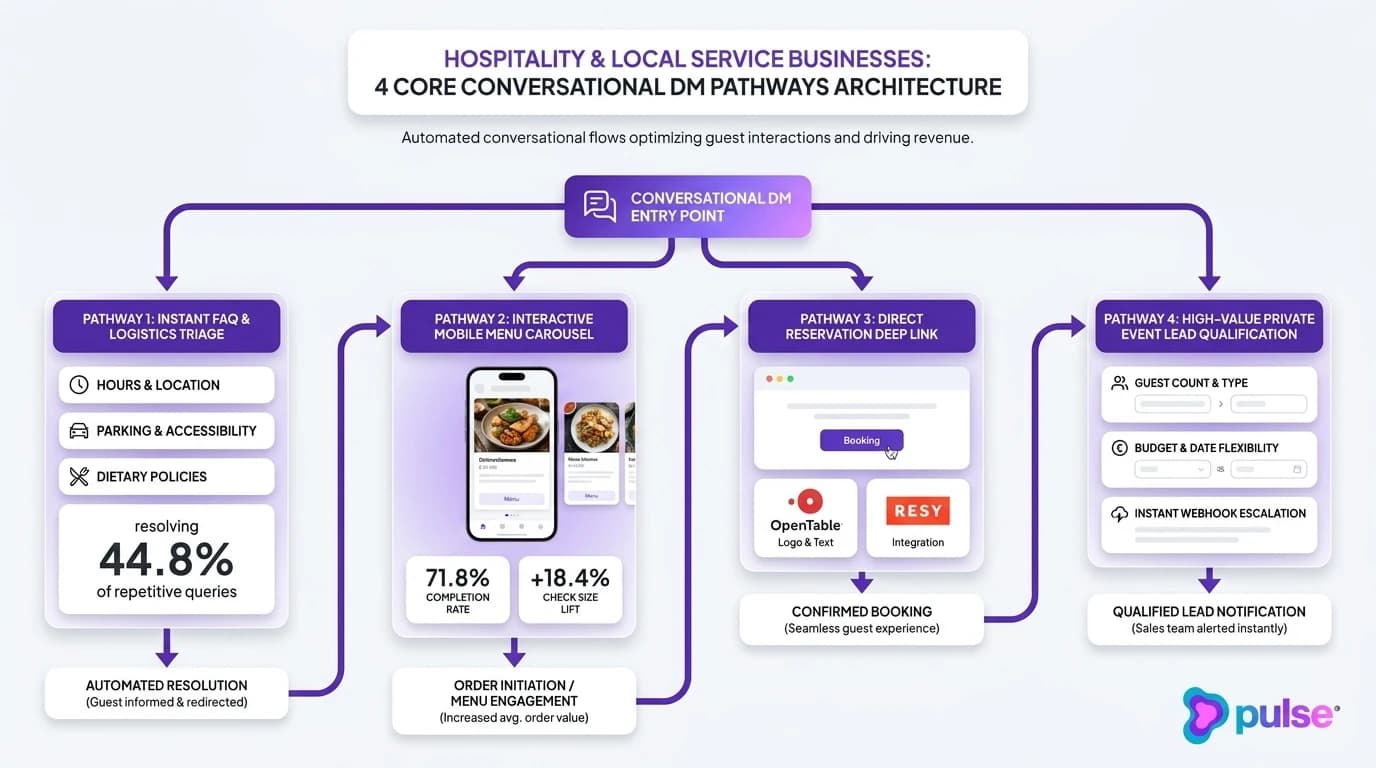
Flow 1: Instant FAQ and logistical triage (parking, hours, dietary requirements, pet policies)
Repetitive logistical questions represent 44.8% of total inbound message volume for local businesses. Prospective guests routinely ask: "Do you have valet parking?", "What time does the kitchen close?", "Are dogs allowed on the patio?", or "Do you have dedicated gluten-free fryers?".
When prospective guests must wait hours for answers to simple logistical questions, they abandon plans. An automated FAQ triage flow solves this by displaying quick-reply buttons when a user opens the direct message thread:
- [Hours & Location]
- [Parking & Valet]
- [Dietary & Allergies]
- [Pet Policy]
- [Speak with Staff]
Tapping any button delivers an immediate, friendly response. For example, selecting "Dietary & Allergies" returns: "We take food allergies seriously! We offer a dedicated gluten-free prep station, vegan substitutions for all pasta dishes, and nut-free dessert options. Would you like to see our allergen menu or reserve a table?". Resolving repetitive logistical inquiries automatically eliminates over 40 hours of monthly staff typing.
Flow 3: Frictionless reservation and appointment booking with direct engine deep links
When a customer indicates dining intent (such as messaging "Can I get a table tonight?"), the automation flow must route them directly into your reservation engine with minimal clicks.
Rather than sending a generic link to your website homepage, automated flows deliver deep links configured for your booking platform (OpenTable, Resy, SevenRooms, Vagaro, or Boulevard). The message presents intuitive party size selection buttons:
- [Table for 2]
- [Table for 3 to 4]
- [Table for 5 to 6]
- [Large Party / 7+]
Selecting "Table for 2" opens your reservation calendar directly with the two-guest parameter pre-selected. Pre-populating booking criteria reduces reservation drop-off and secures the booking within 30 seconds.
Operators running local paid social campaigns can supercharge this flow by pairing it with click-to-message ads, as detailed in our playbook on hyper-local geofenced Facebook and Instagram ads.
Flow 4: High-value private event, catering, and buyout lead qualification
Private dining buyouts, holiday banquets, and catering orders represent the highest-margin transactions in the hospitality industry, often generating contracts between $3,500 and $25,000. However, these inquiries require structured qualification before a sales director steps in.
When a user selects "Private Dining & Events" or mentions keywords like "buyout", "banquet", or "rehearsal dinner", the automated funnel collects four key qualifying details through interactive prompts:
- Target Event Date: Verifies availability on the banquet calendar.
- Estimated Guest Count: Ensures the party fits room capacity (e.g., 20 to 80 guests).
- Event Occasion: Corporate reception, wedding rehearsal, birthday, or business presentation.
- Food & Beverage Budget Confirmation: Confirms the client meets minimum spend thresholds.
Once these four data points are captured, the system dispatches an instant webhook alert to the event director via Slack and email, while reassuring the guest: "Thank you! Our private dining director, Sarah, has received your event details and will send over our complete private dining package within 15 minutes."
Human-in-the-loop escalation: balancing automated triage with authentic hospitality
The most significant risk of social media automation is creating an impersonal, robotic experience that alienates loyal guests. Automation should handle high-volume logistical triage, but it must never trap guests in an inescapable loop when they need genuine human care.
Exceptional social customer care balances instant automated efficiency with seamless human escalation. When a guest encounters an issue, requests custom accommodations, or asks a nuanced question, the system must transfer the conversation to human staff immediately.
Triggering staff notifications: Slack, SMS, and email webhooks for urgent inquiries
When a customer clicks "Speak with Staff" or types keywords indicating frustration (such as "wrong order", "complaint", "manager", or "disappointed"), the automated bot must silence itself and alert team members.
Modern automation platforms achieve this through webhook integrations. When an escalation trigger occurs, a webhook dispatches real-time notifications to a dedicated Slack channel (such as #guest-escalations), sends an SMS alert to the on-duty manager's phone, or creates an urgent ticket in your guest relations inbox.
{
  "event": "human_agent_escalation_required",
  "channel": "instagram_direct",
  "customer": {
    "username": "diner_jessica",
    "first_name": "Jessica",
    "profile_url": "https://instagram.com/diner_jessica"
  },
  "inquiry_type": "private_dining_buyout",
  "qualification_data": {
    "target_date": "2026-11-14",
    "guest_count": 45,
    "budget_minimum_confirmed": true,
    "notes": "Corporate holiday reception with AV presentation needs"
  },
  "timestamp": "2026-09-16T18:45:00Z"
}
With real-time webhook routing, managers can review the conversation history and step into the chat within minutes, providing personalized hospitality before customer sentiment cools.
The 7-day Human Agent tag: managing complex disputes and custom VIP requests
Resolving customer complaints and negotiating high-value buyout contracts often takes longer than standard 24-hour messaging parameters allow.
To accommodate this operational reality, Meta provides the Human Agent tag. When a conversation is assigned to an authorized human agent in Meta Business Suite or a certified partner platform, the messaging window extends to 7 days. This allows hospitality managers to communicate 1-on-1 with guests to resolve billing inquiries, arrange custom menus, and finalize contract terms without violating platform policies.
Resolving disputes privately inside direct messages prevents negative experiences from escalating into public review sites. To safeguard online reputation, operators should review our guidance on the Yelp algorithm and review filtering playbook to understand how proactive private service recovery protects star ratings.
Seamless handover protocols: pausing bot automation when staff step into the chat
A critical technical requirement for conversational systems is the automated bot pause protocol. Nothing frustrates a customer more than having an automated bot interrupt while a live staff member is typing a response.
When a staff member sends a manual message inside Meta Business Suite or your social inbox, the automation system must trigger an automatic pause rule. This rule suspends all keyword triggers, FAQ responses, and automated follow-ups for that specific conversation for 24 to 48 hours.
This seamless handover protocol ensures authentic human communication. In addition to guest satisfaction, responsive social customer care directly impacts brand reputation across generative search engines. Pulse AI visibility telemetry across 18,500 commercial prompts reveals that AI search engines cite community discussions and customer interactions in 66.8% of queries, compared to only 7.8% for vendor-owned domains. Brands cited across 4 or more independent third-party sources capture the #1 recommendation position in 76.8% of AI evaluations (compared to 11.2% for brands with 0 to 1 citations, a 6.86x lift). Responsive social care generates positive sentiment that feeds AI search engines.
Attribution tracking and measuring revenue ROI from social DM funnels
Deploying direct message automation requires measurable commercial returns. Operators must be able to track exact reservation volume, covers seated, and revenue generated from social direct messaging campaigns.
By implementing standardized tracking parameters and point-of-sale promo codes, local businesses can connect Instagram conversations directly to cash register receipts.
UTM parameterization and reservation platform tracking tags (OpenTable, Resy, SevenRooms)
Every web link delivered within an automated direct message must carry structured UTM tracking parameters. Attaching UTM tags allows Google Analytics, OpenTable, Resy, and SevenRooms dashboards to isolate social messaging conversions from general website traffic.
A standardized taxonomy ensures clean data hygiene:
utm_source=instagramutm_medium=dm_automationutm_campaign=brunch_comment_triggerutm_content=table_for_two_button
When prospective guests click a reservation link inside Instagram DMs, the reservation platform records the referral source. At the end of each month, operators can run reservation channel reports in SevenRooms or OpenTable to see exactly how many covers and party checks originated from direct message funnels.
Exclusive conversational promo codes and booking attribution
For fast-casual restaurants, bars, and local service providers that do not utilize formal table reservation platforms, promo codes provide direct revenue attribution.
Inside the automated direct message flow, deliver a unique conversational promo code (such as INSTAVIP or a secret menu item keyword) redeemable at the physical point of sale. When the server or cashier enters the promo code in Toast, Square, or Clover, the transaction is tagged.
Tracking promo redemptions bridges digital social engagement with on-premise dining room spend. To nurture these first-time diners into high-frequency regulars, operators should combine DM promo captures with automated retention workflows, as outlined in our guide to restaurant email marketing automation.
Calculating the ROI of automated customer care vs manual social management costs
Evaluating the return on investment of social direct message automation involves analyzing both labor savings and incremental revenue gains.
Consider an independent restaurant receiving 450 direct messages per month. Handling these inquiries manually consumes approximately 35 hours of manager or host labor monthly (valued at roughly $875 in direct wages), while resulting in high error rates, delayed replies, and missed late-night inquiries.
With automated conversational triage:
- Labor Reduction: 44.8% of logistical FAQ inquiries are resolved instantly without staff involvement, saving 20+ hours of administrative work.
- After-Hours Capture: Capturing 31.2% of off-hours inquiries (approximately 85 inquiries) converts roughly 26 incremental dining parties monthly. At an average party spend of $110, this generates $2,860 in incremental food and beverage sales.
- Lead Conversion Lift: Moving general booking conversion from 14.8% (delayed manual replies) to 38.6% (sub-60s triage) yields an additional 50+ seated tables per month.
Against a dedicated software and management cost of $250 to $600 monthly, an automated conversational DM funnel delivers an ROI exceeding 8x to 12x in direct dining room revenue.
Frequently asked questions about Instagram and Facebook DM automation
About the author
Garrett is the founder of Pulse. Previously, he built PumpUp to 6 million members through early influencer marketing and UGC, raised $4M from NEA and General Catalyst, and co-founded legal immigration platform BorderPass. He specializes in brand building, organic growth, and conversational marketing.
Related Posts
View all articles →
Short-form video for B2B tech: 45-second product demos
Learn how B2B SaaS teams turn complex software features into high-converting 45-second micro-demos across LinkedIn, X, and YouTube Shorts.
Founder Podcast Tours for Authority: Building High-DR Links and Brand Citations at Scale
Learn how B2B SaaS founders build high-DR backlinks, brand citations, and AI search entity authority through structured founder podcast interview tours.
Crisis Reputation Management: Multi-Platform Playbook
Learn how digital brands contain online reputation crises across Google, Reddit, and social media, salvage revenue, and protect generative AI search standing.
Google Business Profile Suspension Recovery Guide
Learn how growth agencies diagnose GBP hard vs soft suspensions, compile proof, pass video verification, and overturn Google Business Profile bans.
Local PPC Budgeting: Ad Spend Allocation Across Markets
Learn how multi-unit service businesses allocate Google Ads budgets across markets, implement Target CPA bidding, and eliminate territory cannibalization.
Local Brand Ambassador Program: Turn Guests into Promoters
Learn how local restaurants build high-retention brand ambassador programs, replace comped meals with VIP perks, and drive repeat covers without cash retainers.