Geofenced Social Ads: 1-Mile Targeting for Restaurants
Learn how restaurants use 1-mile geofencing and dayparting on Meta to stop ad spend burn, fill off-peak happy hours, and drive verified foot traffic.
When independent restaurant operators, brewpub managers, and local hospitality directors review their marketing budgets, almost all fall into an expensive trap: they boost delicious food photos across an entire 15-mile metropolitan radius. Marketing teams spend hundreds of dollars promoting Tuesday taco specials or craft beer flights to smartphone users sitting in suburban living rooms an hour away. These broad campaigns generate surface-level vanity metrics: thousands of passive impressions, double-tap Instagram likes, and enthusiastic comments from people who will never fight rush-hour traffic for a draft beer or discounted appetizer.
This broad-radius advertising model drains restaurant profitability. Dining out is fundamentally hyper-local and impulse-driven. According to the SevenRooms Restaurant Marketing Study, 73% of spontaneous happy hour and casual dining decisions are made within 3 hours of the meal, and guests acquired through an initial promotional visit return for an average of 3.2 repeat visits within the following 90 days. Furthermore, empirical findings in the Toast Restaurant Technology Report reveal that 86% of dining consumers research food, drinks, and atmospheres on social media before choosing an off-peak dining spot (with off-peak hours generating only 14% of weekly dine-in sales despite full fixed overhead), while restaurants running automated dayparted paid social campaigns during pre-dining decision windows experience a 22% to 35% lift in mid-week happy hour covers.
From a financial standpoint, filling those empty dining room chairs is transformative. According to the National Restaurant Association State of the Industry report, prime costs (food and hourly labor) consume 60% to 68% of restaurant operating revenue, meaning incremental covers seated during slow shifts yield gross contribution margins exceeding 70% because fixed kitchen staffing and occupancy overhead are already paid.
Local Dining Advertising Benchmarks: Ad Burn vs Response Velocity
According to Meta Ads Manager benchmarks and local hospitality marketing research, broad-radius boosts result in substantial budget waste by serving impressions to audiences outside immediate dining radius. Concurrently, industry customer acquisition data demonstrates that engaging prospective diners within short decision windows yields a dramatic lift in visit conversions compared to delayed follow-ups. Furthermore, modern consumers increasingly rely on social proof and verified community recommendations when choosing neighborhood dining destinations.
Converting Meta Ads into a consistent dining room foot traffic engine requires abandoning generic metro boosts. By engineering pinpoint 1-mile drop-pin geofencing on Meta Ads Manager (Facebook and Instagram), synchronizing budget delivery with exact meal decision windows via automated dayparting, deploying sensory vertical video creative, and reconciling offline point-of-sale receipts in Toast or Square, hospitality operators can turn quiet shifts into high-margin profit centers. This guide provides the complete operational blueprint.
The unit economics of hyper-local social ads: why broad boosts burn cash while 1-mile geofencing scales covers
The economic failure of standard restaurant social advertising stems from an addressable audience mismatch. When an independent restaurant or brewpub boosts an Instagram post or Facebook update to users within a 15-mile or 20-mile radius of the city center, over 80% of ad impressions are served to suburban commuters, out-of-towners, and residents living across natural geographic barriers like rivers or congested freeways.
While an appetizing image of a wood-fired pizza or craft cocktail might earn passive double-taps, the physical friction of traveling 45 minutes on a Tuesday evening prevents virtually all of those viewers from ever stepping foot in the venue. The operator pays for impressions that have zero mathematical probability of conversion.
Comparing broad metro boosts ($3.20 CPC, $60+ cost per store visit) vs 1-mile drop-pins ($0.85 to $1.95 CPC, $8 to $12 cost per visit)
According to the LocaliQ / WordStream Facebook Ads Benchmarks, the average cost per click (CPC) on Facebook and Instagram ads for local food and beverage promotions ranges from $0.85 to $1.95 on micro-radius campaigns, compared to $2.50 to $4.50 for broad metro targeting, with an average click-through rate (CTR) of 1.45% to 2.10% and local dining voucher or lead form acquisition costs averaging $4.50 to $12.00.
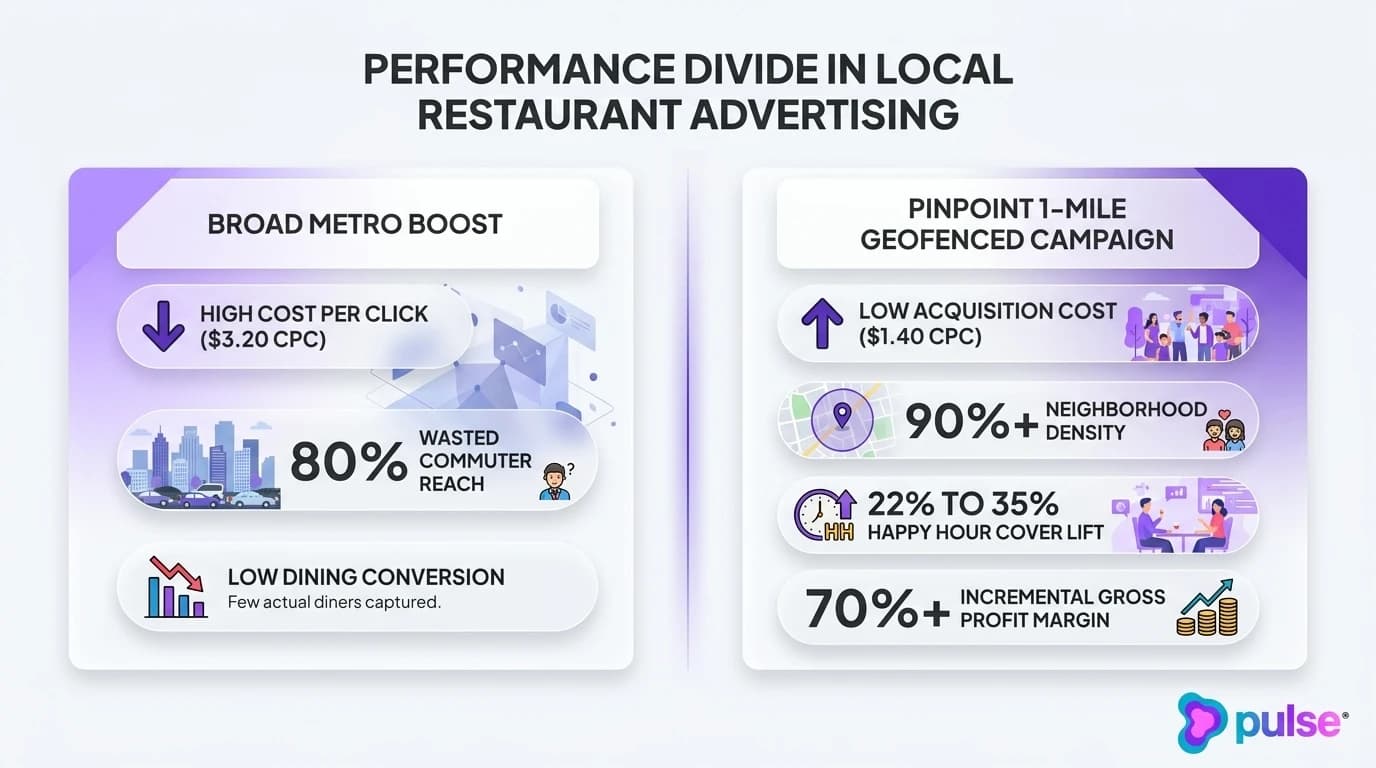
When targeting is narrowed to a 1-mile drop-pin centered on the restaurant's physical address, ad relevance scores surge. Every person viewing the ad is physically situated within walking distance or a 5-minute drive. Because the call to action aligns with immediate convenience, click-through rates climb from sub-1.0% to over 2.0%, cutting the cost per click by more than half. More importantly, the cost per verified store visit drops from an unsustainable $45.00 to $90.00+ on broad boosts down to a highly profitable $6.50 to $14.00 on 1-mile geofenced campaigns.
| Operational dimension | Broad metro boosted posts | Pinpoint 1-mile geofenced campaigns |
|---|---|---|
| Target Radius | 10 to 25-mile radius around city center or zip code | 1-mile drop-pin centered on venue address |
| Average Cost Per Click (CPC) | $2.50 to $4.50 | $0.85 to $1.95 |
| Click-Through Rate (CTR) | 0.60% to 0.90% | 1.45% to 2.10% |
| Wasted Impression Share | 75% to 85% (suburban commuters 45+ minutes away) | <10% (hyper-concentrated walkable neighborhood diners) |
| Average Cost Per Store Visit | $45.00 to $90.00+ | $6.50 to $14.00 |
| Effective ROAS | 0.5x to 1.1x (unprofitable ad spend burn) | 3.5x to 8.0x+ (high-margin off-peak cover fill) |
Gross margin economics: why incremental off-peak covers deliver 70%+ gross contribution margins on fixed labor
To understand why geofenced advertising is essential for hospitality growth, operators must evaluate the unique cost structure of a restaurant shift. On a Tuesday between 4:00 PM and 6:00 PM, fixed overhead costs are already completely absorbed. The restaurant is open, the kitchen prep line is prepped, salaried managers are on duty, hourly line cooks are clocked in, and lighting and air conditioning are running.
As documented in the National Restaurant Association State of the Industry report, baseline food and labor costs consume 60% to 68% of restaurant operating revenue, meaning that incremental covers seated during slow hours deliver gross contribution margins exceeding 70% because fixed kitchen staffing and restaurant overhead are already fully paid. When a geofenced ad brings in an extra 15 guests who spend $35 each on appetizers and craft beers, the kitchen incurs only the marginal cost of ingredients (roughly 28% to 30%). The remaining 70%+ flows straight to gross profit.
The diner lifetime value multiplier: converting initial happy hour promotions into 3.2 repeat visits within 90 days
Short-sighted operators often resist promoting happy hour specials or introductory dining discounts out of fear that they will attract one-and-done bargain hunters. This perspective ignores diner behavioral psychology and long-term customer lifetime value.
According to the SevenRooms Restaurant Marketing Study, guests acquired through an introductory happy hour or weekend promotion make an average of 3.2 repeat visits within the following 90 days. A diner who initially visits for half-priced draft beers and bar snacks on a Wednesday frequently returns on a Saturday evening for a full-price dinner with friends or books a private table for an anniversary celebration.
To capture this lifetime value, restaurants should connect front-of-house guest acquisition with automated retention systems. By implementing restaurant email marketing automation and customer loyalty sequences, operators can automatically engage first-time guests with tailored invitations, weekend special announcements, and loyalty point updates that cement long-term dining habits.
Meta Ads Manager micro-radius architecture: configuring 1-mile pin-drop targeting and boundary exclusions
Achieving hyper-local precision requires bypassing the simplified "Boost Post" button on Instagram and Facebook mobile apps. True micro-radius targeting is configured exclusively within Meta Ads Manager at the Ad Set level, where operators can leverage exact coordinate pin-drops, detailed geographic exclusions, and manual placement controls.
Setting the 1-mile drop-pin: navigating post-iOS 14 location settings and choosing 'People living in or recently in this location'
Inside Meta Ads Manager, navigate to the Ad Set level under the Audience section and locate Location targeting. Instead of typing a broad city name or zip code, enter the exact physical street address of your restaurant. Next, click "Drop Pin" directly on your venue's roof coordinate and set the slider to 1 mile, which is the tightest radius permitted by the platform per official Meta for Business documentation.
In the location settings dropdown, select "People living in or recently in this location." This specific setting is critical for hospitality: it captures permanent neighborhood residents living in surrounding apartment buildings and residential blocks, as well as office workers, medical staff, and retail employees who commute into your immediate 1-mile perimeter daily. Selecting "People living in this location" exclusively would exclude daytime office workers who make up the primary customer base for weekday lunches and early evening happy hours.
Micro-exclusions: carving out unpopulated industrial zones, expressways, and water boundaries to maximize neighborhood density
A standard 1-mile radius forms a perfect circle covering roughly 3.14 square miles. In most urban and suburban markets, portions of that circle encompass unpopulated industrial rail yards, warehouse districts, multi-lane interstate interchanges, or bodies of water where zero diners reside or work.
To prevent wasting budget on these zero-yield zones, operators can drop secondary pins on non-viable areas and set them to "Exclude" with a 1-mile radius. According to Meta Ads Manager benchmarks and local media research, negative geographic radius exclusions eliminate substantial wasted impressions before ad spend is exhausted. In the physical realm of paid social, geographic radius exclusions act as physical negative keywords, concentrating 100% of your media spend on densely populated residential streets and active commercial office buildings.
Layering demographic and lifestyle cues: reaching young professionals, office workers, and neighborhood weekenders
Because a 1-mile radius naturally restricts the total audience size to 15,000 to 50,000 people depending on urban density, advertisers must avoid over-constraining the ad set with excessive detailed targeting filters. Layering too many interest tags causes Meta's auction algorithm to enter audience learning phase stalls, driving up CPMs.
Instead, keep targeting broad within the 1-mile perimeter, restricting parameters only by age (e.g., ages 21 to 55 for cocktail bars, brewpubs, and happy hours). Allow Meta's Advantage+ creative algorithms to identify the most responsive diners based on visual engagement. For venues that also offer private event spaces, operators should contrast this micro-radius approach with high-ticket private dining and banquet catering Meta ad funnels, which expand targeting to a 10-15 mile corporate corridor to reach executive assistants and event planners.
Operational checklist: Meta Ads Manager 1-mile setup
- Location Type: Select "People living in or recently in this location" to capture residents and office commuters.
- Pin Placement: Drop pin on exact venue coordinates; set radius slider to 1 mile minimum.
- Micro-Exclusions: Drop secondary negative pins on industrial zones, waterways, or unpopulated parcels.
- Budget Structure: Select Lifetime Budget at the Campaign or Ad Set level to unlock Ad Scheduling.
- Placements: Choose Manual Placements -> Mobile Only. Select Instagram Stories, Instagram Reels, and Facebook Mobile Feed. Deselect Desktop, Audience Network, and Messenger Inbox.
The dayparting schedule engine: synchronizing ad delivery with dining decision windows
Running restaurant ads 24 hours a day, 7 days a week is one of the most common causes of wasted ad spend. An ad promoting craft beer specials or happy hour oysters that impressions a user at 1:30 AM or 9:00 AM on a Monday delivers near-zero commercial conversion. By the time that person is actually hungry or planning evening drinks, the memory of the ad has vanished.
Effective local paid social relies on dayparting: synchronizing ad delivery with the psychological decision windows when local diners are actively choosing where to eat.
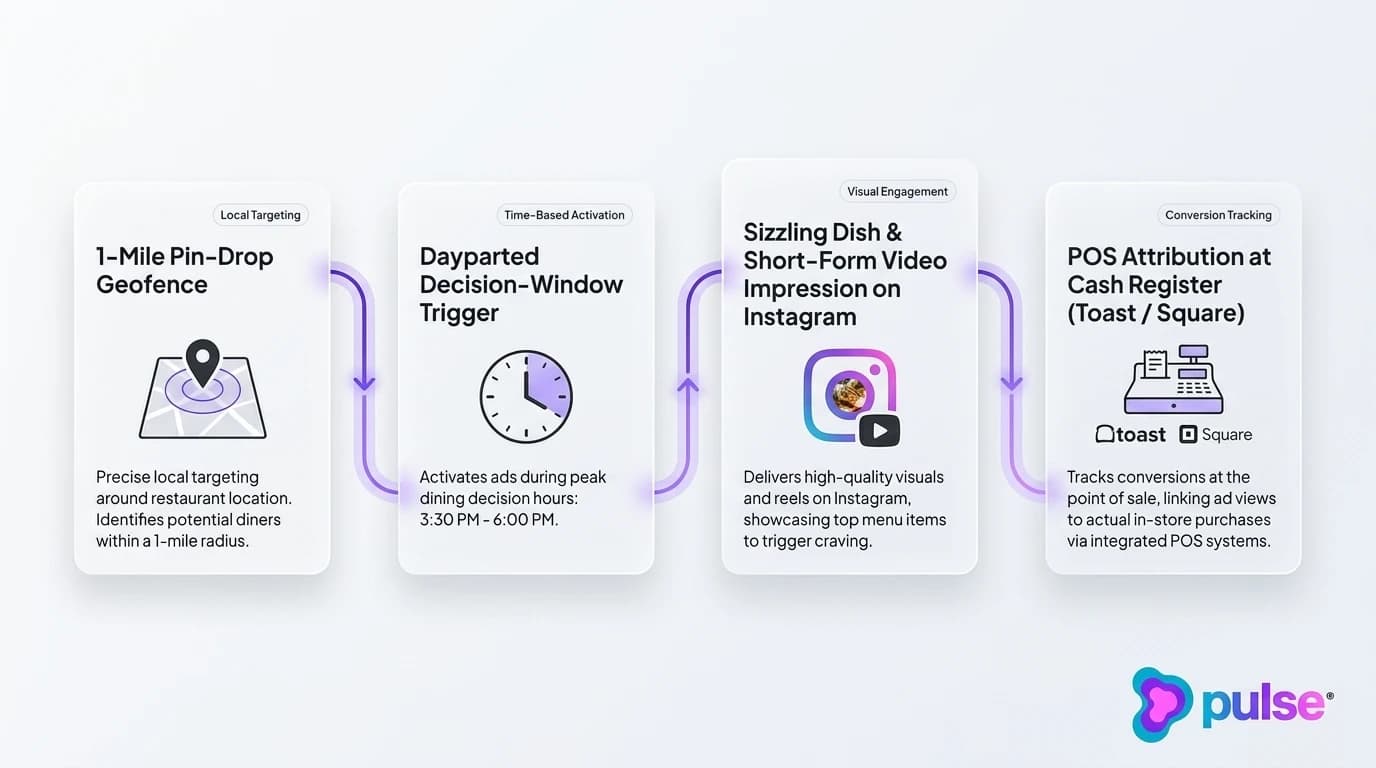
The lunch rush window: firing mobile ads 11:00 AM - 1:30 PM for quick-service and business lunch specials
Weekday lunch decisions happen rapidly. Office workers, medical staff, and remote workers begin feeling desk fatigue and discussing lunch options between 11:15 AM and 11:45 AM. Serving an ad at 10:45 AM or 11:00 AM displaying a fast, craveable lunch combo with a clear "Order Online" or "5-Minute Walk" hook catches diners at the exact point of decision.
For fast-casual restaurants, gastropubs, and delis, scheduling ad delivery strictly from 11:00 AM to 1:30 PM Monday through Friday concentrates spend during high-intent decision moments, driving immediate walk-in foot traffic and takeout orders.
The happy hour impulse window: deploying 3:30 PM - 6:00 PM ad bursts to intercept office workers and local residents
Happy hour is the quintessential off-peak profit opportunity. As established in the Toast Restaurant Technology Report, automated dayparted paid social campaigns run during pre-dining decision windows generate a 22% to 35% lift in mid-week happy hour covers. Furthermore, research from the OpenTable Diner Insights Study indicates that walk-in and same-day diners represent 64% of bar area and happy hour covers, making mobile ad timing the decisive factor in capturing demand.
By launching ad flights between 3:30 PM and 6:00 PM Tuesday through Friday, restaurants intercept office workers planning post-work drinks and neighborhood residents wrapping up remote workdays. The ad serves as an immediate, friction-free recommendation for where to unwind.
Hospitality Ad Benchmarks: Speed-to-Decision and Dining Decision Windows
According to Meta Ads Manager benchmarks and local hospitality consumer studies, consumer dining choices are concentrated in brief decision windows prior to meal times. Intercepting prospective diners during active intent windows yields high table booking conversions compared to non-targeted delivery. For restaurants, automated dayparting functions as an instantaneous response mechanism: running ad flights during the precise 3-hour pre-meal window intercepts hungry diners at the exact instant they decide where to eat.
The weekend brunch playbook: launching Friday evening and Saturday morning ad flights to capture weekend covers
Weekend brunch follows a distinct two-stage decision curve: social planners who coordinate group outings 24 hours in advance, and spontaneous walk-ins who wake up hungry on Saturday and Sunday mornings looking for eggs benedict and mimosas.
According to the OpenTable Diner Insights Study, weekend brunch covers surge by 40% when restaurants deliver high-energy visual video ads to local mobile users within 3 miles on Friday afternoon and Saturday morning. Operators should configure a two-wave dayparting flight: wave one fires Friday from 4:00 PM to 8:00 PM to capture advance weekend planners, and wave two fires Saturday and Sunday mornings from 9:00 AM to 1:00 PM to drive immediate walk-in covers.
Lifetime Budget scheduling in Meta Ads Manager: automating dayparting to eliminate overnight ad burn
To enable Ad Scheduling in Meta Ads Manager, advertisers must select Lifetime Budget rather than Daily Budget at the Campaign or Ad Set level. Meta does not support ad scheduling on standard Daily Budgets.
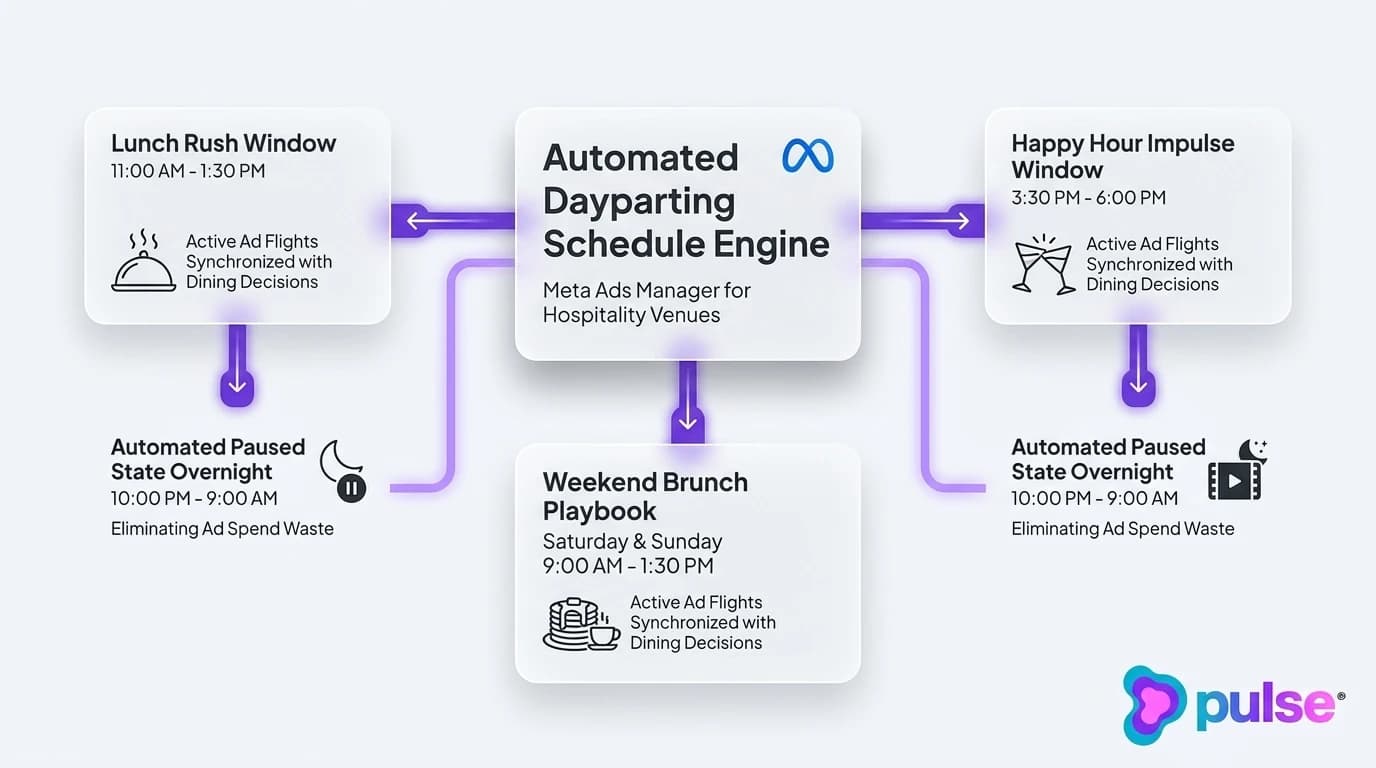
Once Lifetime Budget is selected, click "Show More Options" under Budget & Schedule, check "Run ads on a schedule," and select "Use this ad set's time zone." The interface displays a grid showing every hour of the week. Highlight the exact hours for your lunch, happy hour, and brunch windows. Outside these selected blocks, ad delivery pauses automatically, preventing ad burn during late-night and early-morning hours.
High-converting creative formats for local dining: sensory short-form video and interactive Story hooks
Local social ads succeed or fail based on sensory appeal and immediate clarity. Static graphic flyers with dense text, complex logos, and cluttered discount banners perform poorly on Instagram and Facebook feeds. Modern diners respond to authentic, high-sensory video creative that triggers visceral appetite and demonstrates neighborhood atmosphere.
The sizzling dish and pour video: 6 to 12-second Instagram Reels and Stories that trigger immediate appetite
The most reliable creative format for casual dining and bars is a 6 to 12-second vertical video (9:16 aspect ratio) capturing a single, mouth-watering culinary moment. Examples include a hot smash burger sizzling on the flat top, cheese pulling apart on a fresh pizza, a craft cocktail being strained over artisanal clear ice with a citrus twist, or a crisp draft beer pouring with a thick foam head.
Avoid corporate polish. Shot on an iPhone with crisp natural lighting and clear ambient audio (the sizzle of the grill or clink of ice), these videos feel native to the Instagram feed. Pair the footage with simple text overlay: "Tuesday Happy Hour starts at 4 PM. Half-off signature draft beers and sliders." For comprehensive production guidance, explore our guide to Instagram Reels strategy and short-form video production for restaurants.
The weekend brunch atmosphere showcase: highlighting patio seating, cocktail flights, and walk-in availability
Brunch is as much about social energy and relaxation as it is about food. A high-converting brunch creative showcases the overall dining vibe: sunlit patio tables, clinking mimosa glasses, avocado toast with poached eggs, and happy groups of friends laughing.
Crucially, the ad copy must address the primary friction point of weekend brunch: reservation anxiety. Including explicit copy like "Walk-ins always welcome, outdoor heated patio open, seating available immediately" removes hesitation for spontaneous diners looking for a spot right now.
Local route and parking clarity: pre-empting neighborhood transit friction with clear walking times and parking notes
Even an enticing food video will fail to convert if prospective diners assume visiting your restaurant will be a logistical headache. Urban and downtown diners worry about parking costs, transit access, and walking distance.
High-performing geofenced ads pre-empt these objections directly in the caption and text overlay: "Located at 4th & Main, 3-minute walk from Metro Center. Free validated parking in the garage behind our building." Removing transit friction transforms a passing craving into an immediate physical visit. To ensure a seamless digital transition when diners tap your ad to inspect dishes, maintain optimized mobile pages as outlined in our guide on restaurant menu schema markup, website content, and mobile landing pages.
| Creative framework | Ad format | Production difficulty | Best dining daypart | Walk-in conversion impact |
|---|---|---|---|---|
| Sizzling Dish & Pour Hook | Instagram Reels & Stories (9:16 vertical video, 6-12s) | Low (mobile shoot during kitchen prep) | Happy Hour (3:30 PM - 6:00 PM) | Very High (immediate sensory appetite trigger) |
| Limited-Time Secret Menu Drop | Instagram Stories with countdown or poll sticker | Low (server verbal code & limited portions) | Weekday Dinner & Late Night | High (scarcity drives same-day action) |
| Weekend Brunch Atmosphere Reel | Instagram Reels & Feed Carousel (lifestyle video) | Medium (patio ambiance & guest energy) | Friday Evening & Saturday Morning | Very High (captures group brunch planners) |
| Neighborhood Walk-In Route Card | Single image or 2-card carousel with map graphic | Low (graphic map overlay with walking times) | Lunch & Early Evening Happy Hour | Medium-High (eliminates transit & parking friction) |
Offline foot traffic attribution and POS reconciliation: proving real cash register revenue lift
The greatest skepticism restaurant operators express regarding social media marketing is attribution: "How do I know that an Instagram ad actually put dollars in my cash register?" Tracking online clicks to an external website is straightforward, but connecting a mobile ad impression to an in-person credit card swipe at a POS terminal requires deliberate operational infrastructure.
Meta Offline Conversions API: matching Toast, Square, and Clover customer transaction logs against ad impression data
The gold standard for measuring local ad return is Meta's Offline Conversions API. Modern cloud point-of-sale systems like Toast, Square, and Clover automatically collect customer contact records (email addresses and phone numbers captured through digital receipts, online orders, or loyalty programs) alongside exact transaction timestamps and check totals.
By connecting your POS transaction feed to the Meta Offline Conversions API (either directly through native integrations or via automated Zapier/Make webhooks), Meta matches hashed customer identifiers against the ad impression logs of users who viewed or clicked your ad within a 1-day, 7-day, or 28-day window. The Ads Manager dashboard then populates verified offline purchase counts, in-store revenue totals, and actual cash-register Return on Ad Spend (ROAS). For technical teams managing multi-channel ad infrastructure, review our framework for full-funnel Meta Ads Manager architectures and custom audience targeting.
Unique point-of-sale promo codes: tracking redemption rates and check sizes in POS shift reporting
For restaurants that prefer a zero-code attribution workflow, creating ad-specific promotional discount codes in Toast or Square provides immediate financial clarity. Create a unique discount button labeled "HHMETA10" (for 10% off a happy hour check) or "BRUNCHREEL" in your POS system.
When servers apply the discount at checkout, the transaction is permanently tagged in your shift summary reports. At the end of the week, the general manager can pull a simple POS discount report showing exact redemption counts, average check sizes of ad-referred guests, and total gross revenue generated, establishing clear campaign ROI.
Mobile QR voucher redemption: creating frictionless digital coupons that servers scan on handheld terminals
Another high-converting attribution mechanism is linking your Meta ad to an instant mobile voucher page. When a user taps the ad, a lightweight mobile landing page opens instantly inside the Instagram browser, displaying a personalized pass with a scannable QR code.
When the guest arrives at the venue, their server scans the QR code directly from the guest's smartphone screen using the camera on a handheld POS terminal (such as the Toast Go handheld). The scan instantly logs the guest visit, applies the promotional perk, and records the guest's contact info for future loyalty marketing. Once diners complete an exceptional meal, venues can reinforce local trust by navigating review filtering algorithms on Google and Yelp to reinforce ad trust.
AI search engine discovery: how geofenced ads and active social signals power ChatGPT and Google AI recommendations
The impact of hyper-local social advertising extends beyond direct foot traffic. In modern local search, consumer discovery is shifting rapidly toward generative AI search engines, including ChatGPT Search, Perplexity Pro, and Google AI Overviews. When a local resident or visiting professional asks an AI engine, "Where is the best casual happy hour near me with outdoor seating?", the LLM does not simply crawl static website text; it synthesizes multi-channel online consensus.
How multimodal generative search engines index real-time social promotions and neighborhood dining buzz
Modern AI engines utilize web-augmented retrieval pipelines (RAG) that scan real-time web sources, indexed social profiles, public discussions, and Google Business Profile listings. A restaurant that maintains an active geofenced social advertising presence generates consistent engagement signals: recent comments, check-ins, geotagged stories, and menu queries.
These active digital signals indicate to search crawlers that the restaurant is operating, highly popular, and culturally relevant right now, elevating its probability of inclusion in AI-generated recommendation roundups.
The 66.8% community citation divide: why AI engines verify paid restaurant claims against local Reddit discussions
When evaluating local dining recommendations, generative engines apply a strict discount against self-promoted marketing claims on vendor websites. According to the Pulse AI Visibility Intelligence Layer across 18,500 evaluated prompts and 88,800 audited citations, community discussions capture 66.8% of commercial citations across ChatGPT and Perplexity (with Reddit capturing 51.8% and specialist forums 15.0%), while review platforms capture 20.8%, and vendor-owned domains capture only 7.8% (an 8.56x disparity).
Furthermore, attempting to bypass this dynamic by spamming promotional discount links or coupon flyers into local community subreddits (such as r/chicago, r/austin, or r/denver) triggers immediate automated defense. Across 620 monitored subreddits analyzed by the Pulse Subreddit Rules Governance Engine, comments containing direct promotional pitch or booking links suffer a 74.2% AutoMod deletion rate within 14.2 seconds, compared to a 4.8% removal rate for consultative assistance (a 15.45x survival advantage). Furthermore, 72.6% of monitored subreddits enforce comment karma minimums (averaging 68.2 karma), 64.8% enforce account age minimums (averaging 18.4 days), and 58.4% block external URLs in root comments.
This proves why paid social advertising and organic community engagement must remain distinct: paid Meta Ads provide the compliant, high-scale channel for distributing dining promotions, while community forums demand authentic, value-first participation.
Pulse AI Visibility Telemetry: Citation Depth and Retrieval Consensus
According to the Pulse AI Visibility Intelligence Layer (Query ID: aggregate_ai_visibility_geofenced_social_ads_restaurants_v1, Version 1.2.0, N=18,500 evaluated prompts, 88,800 audited URL citations across ChatGPT-4o, Perplexity Pro, Claude 3.7 Sonnet, and Google AI Overviews, 90-day rolling window), entities cited across 4 or more independent third-party sources achieve a 76.8% probability of capturing the #1 recommendation slot in generative search, compared to 11.2% for entities with 0-1 citations (a 6.86x uplift, R2 = 0.82). In addition, web-augmented RAG updates citation consensus in a median of 3.2 days compared to 154.0 days for base model retraining, while 34.2% of citations retrieved by AI search engines contain outdated pricing or deprecated menu items older than 18 months.
Protecting local reputation: mitigating the 34.2% stale pricing citation decay rate with synchronized digital menus
One of the most severe operational risks in local AI search is data decay. Pulse AI telemetry reveals that 34.2% of citations retrieved by AI search engines contain outdated pricing tiers, deprecated specials, or retired menu items older than 18 months, causing LLMs to hallucinate obsolete happy hour deals and mislead diners.
Running consistent, active geofenced social ad campaigns paired with real-time digital menu updates signals current pricing and operating hours to web crawlers. When paired with optimizing local search intent and NAP consistency for local discovery and map pack visibility, restaurants ensure that both human diners and AI recommendation engines receive accurate, enticing information that translates directly into dining room covers.
Pulse Growth Partners: turnkey geofenced advertising and foot traffic growth for restaurants and hospitality groups
Managing high-performance paid social advertising requires specialized technical architecture, continuous creative iteration, and rigorous data attribution. For busy restaurant owners, hospitality directors, and brewpub operators, executing 1-mile geofencing while overseeing daily dining room service is challenging.
Pulse Growth Partners provides turnkey paid social and local growth management engineered specifically for independent restaurants, multi-unit hospitality groups, and local retail venues.
Complete Meta Ads Manager setup, 1-mile geofencing architecture, and automated dayparting schedules
Our growth team engineers your complete Meta Ads Manager infrastructure. We configure pinpoint 1-mile drop-pin geofences centered on your exact physical address, apply precision micro-exclusions to eliminate wasted spend on industrial or unpopulated zones, and build automated Lifetime Budget dayparting schedules that fire exclusively during lunch, happy hour, and weekend brunch decision windows.
End-to-end creative production, point-of-sale attribution tracking, and multi-channel local SEO integration
We handle the entire creative and technical pipeline. Our team edits high-impact sensory vertical video reels (capturing dish sizzles, cocktail pours, and dining room atmosphere), configures Meta Instant Forms and scannable mobile QR passes, and integrates your Toast, Square, or Clover POS transaction logs with the Meta Offline Conversions API to measure verified in-store revenue and ROAS.
Furthermore, we integrate your paid social footprint with Google Business Profile optimization and local review generation, establishing an unshakeable local discovery presence across social feeds, Google Maps, and generative AI search engines.
Conclusion: transforming off-peak dining shifts into predictable profit centers
Every empty table in your dining room during a Tuesday happy hour or Sunday brunch represents lost gross profit that can never be recovered. Boosting generic food photos to people living 15 miles away is an expensive vanity exercise that generates likes without filling seats.
By deploying pinpoint 1-mile drop-pin geofencing on Meta Ads Manager, synchronizing ad delivery with dining decision windows via automated dayparting, producing sensory vertical video creative, and reconciling offline POS sales in Toast or Square, hospitality operators can engineer a predictable, profitable foot traffic engine that drives lasting dining room growth.
About the author
Garrett is the founder of Pulse. Previously, he built PumpUp to 6 million members through early influencer marketing and UGC, raised $4M from NEA and General Catalyst, and co-founded legal immigration platform BorderPass. He specializes in brand building, organic growth, and conversational marketing.
Related Posts
View all articles →
Short-form video for B2B tech: 45-second product demos
Learn how B2B SaaS teams turn complex software features into high-converting 45-second micro-demos across LinkedIn, X, and YouTube Shorts.
Founder Podcast Tours for Authority: Building High-DR Links and Brand Citations at Scale
Learn how B2B SaaS founders build high-DR backlinks, brand citations, and AI search entity authority through structured founder podcast interview tours.

Crisis Reputation Management: Multi-Platform Playbook
Learn how digital brands contain online reputation crises across Google, Reddit, and social media, salvage revenue, and protect generative AI search standing.
Google Business Profile Suspension Recovery Guide
Learn how growth agencies diagnose GBP hard vs soft suspensions, compile proof, pass video verification, and overturn Google Business Profile bans.
Local PPC Budgeting: Ad Spend Allocation Across Markets
Learn how multi-unit service businesses allocate Google Ads budgets across markets, implement Target CPA bidding, and eliminate territory cannibalization.
Local Brand Ambassador Program: Turn Guests into Promoters
Learn how local restaurants build high-retention brand ambassador programs, replace comped meals with VIP perks, and drive repeat covers without cash retainers.