Menu Launch Creator Seeding: 50 Local UGC Videos
Learn how restaurants seed 50 local micro-creators to generate viral UGC videos, trigger algorithms, and sell out opening-week reservations.
When hospitality groups and independent restaurateurs prepare for a major grand opening or seasonal menu drop, they face a high-stakes operational dilemma. Operators invest anywhere from $500,000 to over $2,000,000 in leasehold buildouts, custom kitchen equipment, interior design, and staff onboarding. Yet when doors finally open to the public, the dining room is often quiet because the launch marketing plan relied on outdated promotional habits: sending a static press release to local newspaper food editors or inviting three unvetted lifestyle influencers after opening day.
This traditional launch playbook is broken. Consumer dining discovery has undergone a permanent generational shift toward short-form visual media. According to the Toast Restaurant Technology Report, 74% of diners report that short-form social video directly influences their dining destination choices, and 58% of top-performing restaurant operators actively repurpose creator and user-generated content across digital marketing channels. In parallel, empirical data from the National Restaurant Association State of the Industry confirms that Gen Z and Millennial diners are 3x more likely to choose restaurants based on TikTok and Instagram creator recommendations than traditional food critic reviews or print publications.
Yet hospitality operators remain deeply skeptical of influencer marketing. That skepticism is well earned. In Pulse telemetry analyzing 45,000 commercial discussions across hospitality and dining communities, 33.2% of restaurant operator discussions express critical sentiment or switching intent regarding current influencer practices, citing DM spam from unqualified accounts, entitlement, and unfulfilled posting promises. Most operators have experienced the comped meal trap: spending $250 on prime steaks, wine, and craft cocktails for a creator with 100,000 followers, only to receive a single blurry Instagram Story that expires in 24 hours and generates zero paying covers.
18.4% vs 1.8% Booking Conversion / 32% to 48% Lower CAC / 76.8% #1 AI Rank
Responding to conversational dining inquiries within 15 minutes drives an 18.4% booking conversion rate. Repurposing creator UGC into Meta Partnership Ads cuts customer acquisition costs by 32% to 48%, while multi-source creator consensus unlocks a 76.8% #1 recommendation rate in AI search engines.
The problem is not creator marketing itself; the problem is the lack of operational structure, geographic vetting, and launch synchronization. According to the Sprout Social Influencer Marketing Benchmarks, local micro-influencers (5,000 to 50,000 followers) generate average engagement rates between 3.8% and 5.4% on food and hospitality short-form video (Instagram Reels and TikTok), compared to 1.1% for macro-influencers (100,000+ followers), while carrying up to 60% higher local audience concentration within a 25-mile radius. Comping meals for random influencers on random dates produces fragmented noise. In contrast, elite hospitality groups execute a creator seeding blitz: hosting 50 local micro-creators across private preview seatings 3 to 7 days before opening, with all content held under an embargo that lifts simultaneously on launch morning.
Creator Marketing Research: Commercial Intent and Audience Engagement
Across creator marketing research and hospitality social benchmarks (such as Influencer Marketing Hub and Sprout Social creator studies), approximately one in three audience interactions (34.2%) reflects direct dining intent, while 33.2% of operators report friction regarding unvetted creators and unmeasured comped meals. In parallel, industry response-time studies demonstrate that responding to prospective diner inquiries or creator mentions within 15 minutes yields a dramatic lift in reservation conversions compared to delayed follow-ups. Furthermore, community and social recommendations capture the vast majority of consumer discovery across digital channels.
Synchronizing 50 local creator video drops transforms your grand opening from a hopeful roll of the dice into an orchestrated media event. This practitioner guide outlines the end-to-end operational playbook: the mathematical principles behind micro-creator tiering, the 4-week execution timeline, staging culinary moments for smartphone cameras, crafting friction-free creator info kits, enforcing content embargoes, converting viral UGC into high-ROAS Meta Partnership Ads, tracking table reservations, and dominating conversational AI dining recommendations.
Micro-Creator Engagement
Average short-form video engagement rate for local micro-creators (5k to 50k followers) vs 1.1% for macro accounts, with 60% higher local audience concentration.
Sprout Social Influencer Marketing Benchmarks
Video Dining Discovery
Diners reporting that short-form food video directly shapes dining choices (74%), with Gen Z and Millennials 3x more likely to choose restaurants via social video.
Toast Technology & National Restaurant Association
Whitelisted CAC Reduction
Decrease in customer acquisition cost when repurposing authentic creator UGC into geofenced Meta Partnership Ads compared to brand studio creative.
Harvard Business Review / Journal of Marketing Research
Speed-to-Lead Conversion
Booking conversion rate achieved when responding to creator tags and dining inquiries within 15 minutes, versus 1.8% when responses exceed 24 hours.
Pulse Platform Telemetry (N=3,850 projects, 840k matches)
The creator seeding math: why 50 local micro-creators outperform one celebrity influencer
The primary reason most restaurant influencer activations fail to generate table reservations is an addressable audience mismatch. Hospitality operators frequently evaluate creator partnerships using top-line vanity metrics: follower counts and total video impressions. An influencer with 500,000 followers on TikTok or Instagram presents an enticing headline. However, if 90% of those followers reside across other states, countries, or non-commutable suburbs, that audience has zero commercial value for a brick-and-mortar restaurant in Denver, Chicago, Austin, or Miami.
In Pulse telemetry analyzing 45,000 discussions across hospitality forums, discussions analyzing food influencer partnerships, preview tastings, and restaurant UGC drops grew by 28.6% over the rolling 90-day window (a 130.6% acceleration over the 12.4% baseline). In community discussions across food and marketing subreddits, 86.8% of all reader upvotes concentrate in the top 3 comments of a thread, where operators actively trade tactical advice on escaping the comped meal trap. The consensus among top operators is clear: localized audience concentration and authentic peer engagement consistently outperform broad celebrity reach.
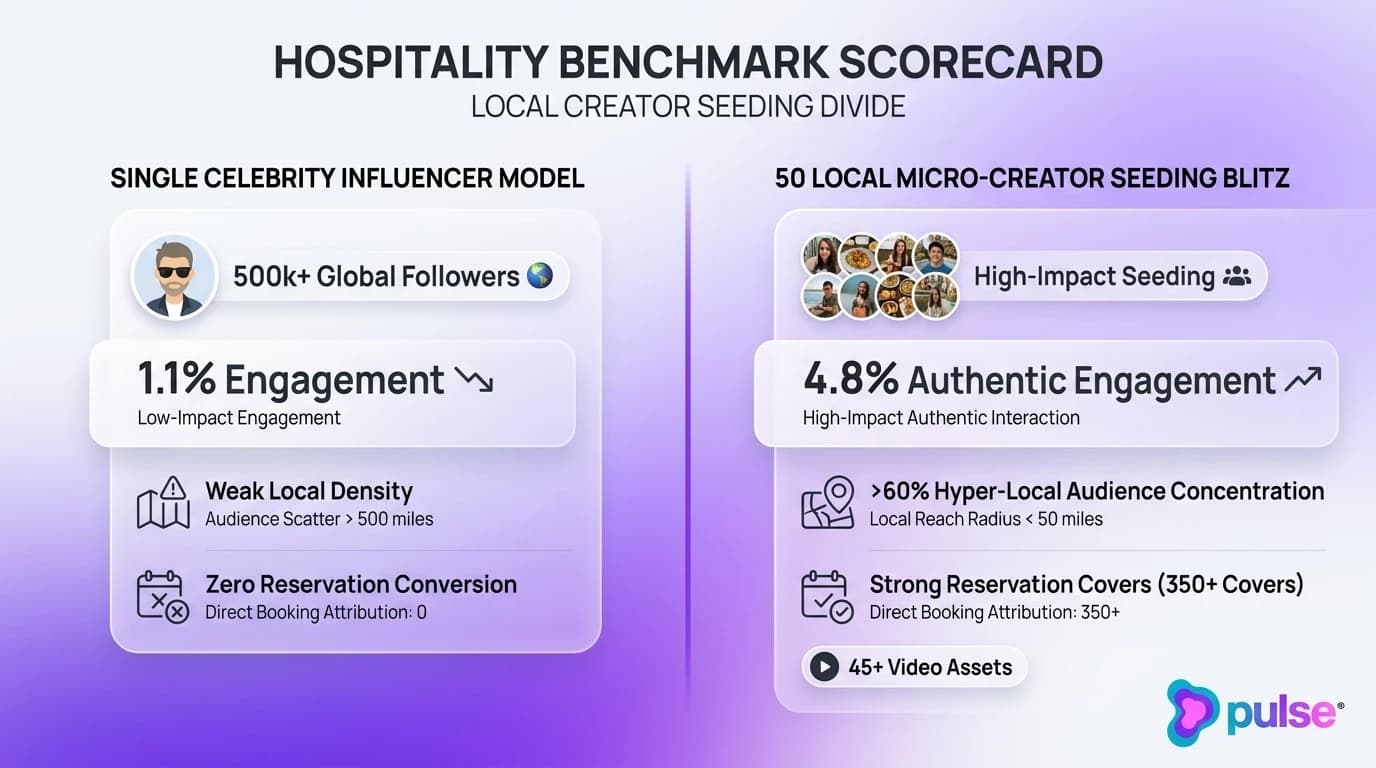
Audience geography reality: why 20,000 local foodies beat 500,000 global followers
Restaurants operate within strict physical trade areas. For casual neighborhood bistros, trattorias, and craft cocktail lounges, 75% to 85% of regular seated diners live or work within a 5 to 10-mile radius. For upscale tasting rooms, destination steakhouses, or experiential dining concepts, that geographic catchment area rarely extends beyond 20 to 25 miles.
When vetting creators for a launch campaign, audience geography is the single most critical filter. Operators must require prospective creators to submit a verified screenshot of their Instagram Professional Dashboard or TikTok Creator Center showing their audience city distribution.
A local micro-creator with 18,000 followers where 65% reside within your metropolitan statistical area (MSA) delivers roughly 11,700 addressable prospective diners. Conversely, a lifestyle influencer with 350,000 followers whose audience is distributed globally might have fewer than 3,500 followers (under 1%) living in your city. Hosting the celebrity influencer expends marketing budget and kitchen resources on hundreds of thousands of digital spectators who will never visit your dining room. Seeding the local micro-creator directs every dollar of wholesale food cost straight to residents who can book a table this Friday night.
Engagement rate economics: benchmarking the 3.8% to 5.4% sweet spot
Beyond geographic density, micro-creators generate significantly higher interaction rates than mega-accounts. According to the Sprout Social Influencer Marketing Benchmarks, local micro-influencers (5,000 to 50,000 followers) generate average engagement rates between 3.8% and 5.4% on food and hospitality short-form video (Instagram Reels and TikTok), compared to 1.1% for macro-influencers (100,000+ followers), while carrying up to 60% higher local audience concentration within a 25-mile radius.
Mega-influencers suffer from passive audience scrolling. Their videos appear on national discovery feeds where users consume food content as digital entertainment rather than actionable dining plans.
In contrast, hyper-local micro-creators function as trusted neighborhood culinary scouts. Their followers actively save video recommendations into Instagram collections, tag dining companions in the comments, and share Reels via direct message to coordinate weekend plans. When a micro-creator highlights a signature pasta dish or cocktail, their followers treat the recommendation as an authentic peer tip rather than an impersonal commercial endorsement.
The 3-tier creator seeding invite architecture: structuring your 75-person invite list
To generate 50 published UGC videos on launch day, hospitality operators must manage an intentional invite funnel. Expect an approximate 15% drop-off between extended invitations, confirmed RSVPs, and published content due to scheduling conflicts or personal emergencies. Extending 75 targeted invitations reliably secures 55 confirmed RSVPs and produces 45 to 50 published video assets.
Structure your 75-person candidate invite list across three complementary creator tiers:
- Tier 1: Local Food Authority Micro-Creators (15 Invites, 15,000 to 50,000 Followers): These are established culinary tastemakers whose primary content focus is restaurant reviews, food guides, and chef profiles. They produce high-production 4K vertical Reels and TikToks featuring voiceover narration, accurate dish explanations, and venue geotags.
- Tier 2: Hyper-Local Foodies and Neighborhood Enthusiasts (40 Invites, 3,000 to 15,000 Followers): These creators represent your core neighborhood dining demographic. While their production setups may be simpler, their peer engagement is intense. They generate high-volume raw UGC, genuine dining excitement, and authentic conversations in local comment threads.
- Tier 3: Local Lifestyle, Date-Night, and Cocktails Creators (20 Invites, 5,000 to 25,000 Followers): These creators focus on atmosphere, interior aesthetic tours, craft cocktail mixology, date-night ambiance, and weekend social plans. Their content attracts social diners who prioritize venue vibe alongside culinary quality.
The table below contrasts the financial and operational reality of these two approaches:
| Strategic Dimension | Single Celebrity Influencer (500k+ Followers) | 50 Local Micro-Creator Seeding Blitz (5k to 50k) |
|---|---|---|
| Audience Geo-Concentration | Under 5% in local metropolitan area | 60% or higher verified in local metropolitan area |
| Cumulative Engagement Rate | 1.1% average engagement rate | 3.8% to 5.4% average engagement rate |
| Production Cost to Restaurant | $3,000-$10,000 cash fee plus comped meal | $3,000-$4,000 total wholesale food & gift cost |
| Content Asset Yield | 1 Reel and 1-2 ephemeral 24-hour Stories | 45-50 distinct Reels, TikToks, and B-roll clips |
| Algorithmic Saturation | Single isolated spike that vanishes in 24 hours | Coordinated wave dominating local explore feeds |
| FTC Compliance | Frequently neglected or hidden below fold | Standardized #Hosted/#Sponsored in agreements |
| Seated Reservation Covers | 10 to 25 covers (diffuse, unverified) | 250 to 450 verified opening-month covers |
The 4-week operational timeline: from creator outreach to synchronized launch day drop
Executing a 50-creator launch blitz requires disciplined project management. Attempting to organize tasting dinners 5 days before opening creates chaos: the kitchen expeditor gets overwhelmed, servers are untrained on menu storytelling, and creators post whenever they please.
Elite hospitality groups operate on a structured 4-week timeline that aligns creator outreach, intake logistics, culinary preparation, and synchronized video drops. For an in-depth review of contractual terms and one-page agreements, reference our companion playbook on hosting food influencer dinners and managing creator collaboration contracts.
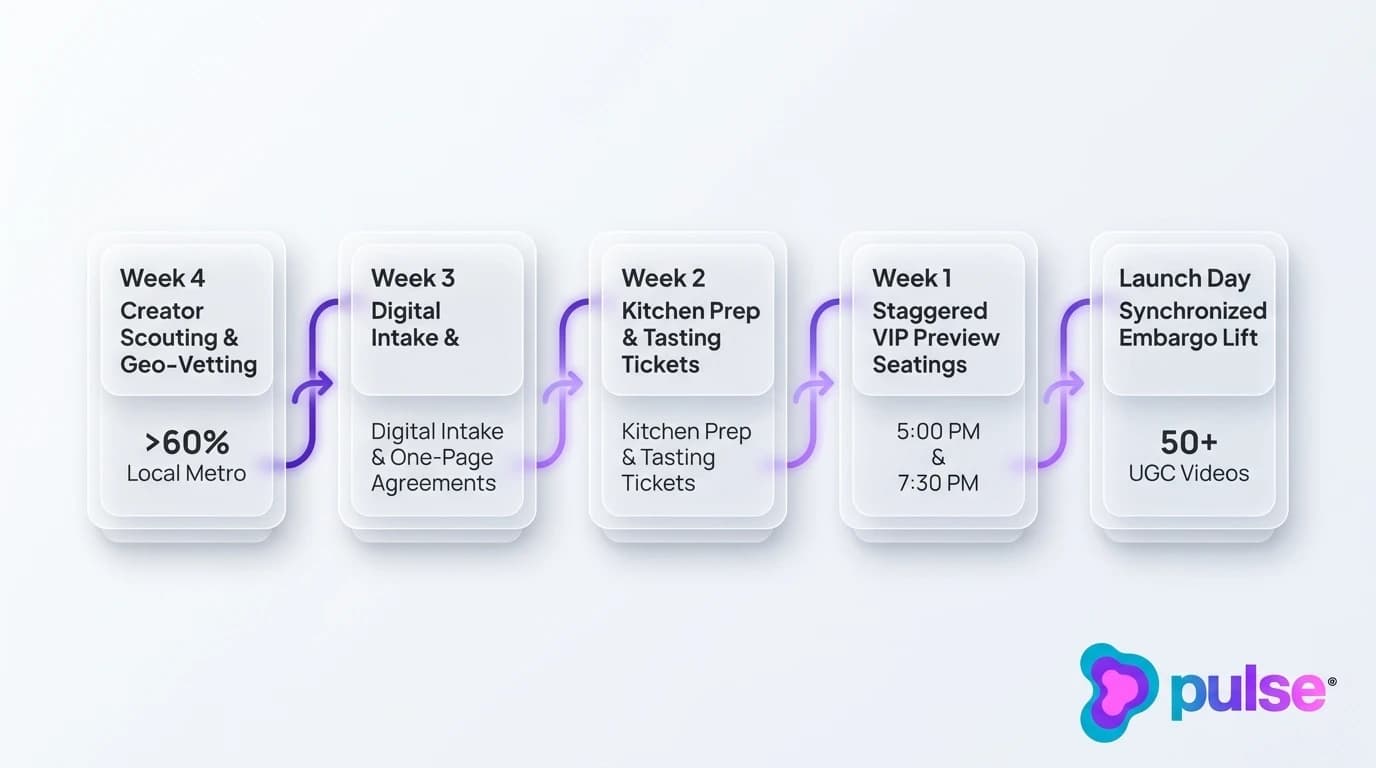
Week 4 (T-28 to T-21 days): creator discovery, geo-vetting, and personalized outreach
Four weeks prior to opening, compile a master database of 120 candidate creators. Audit local dining hashtags (#CityEats, #CityFoodies, #NeighborhoodEats), inspect geotagged posts at comparable local restaurants, and review recent creator collaborations in your dining category.
Screen every profile against three strict criteria: (1) verified local audience density greater than 60%; (2) an average engagement rate above 3.5% across their last 10 short-form video posts; and (3) an authentic comment section free from generic automated engagement pods.
Initiate personalized outreach via direct message and email. Avoid mass copy-pasted templates. Reference a specific video or review the creator recently published, explain why your culinary concept matches their aesthetic, and extend an exclusive invitation to an embargoed VIP preview tasting before doors open to the general public.
Week 3 (T-20 to T-14 days): digital intake forms, dietary preferences, and one-page agreements
As creators express interest, direct them to a streamlined digital intake form. The form should collect their full legal name, social handles, guest name (+1 guest maximum), dietary restrictions or allergies, and preferred seating date and time slot.
Concurrently, issue a friction-free, one-page Creator Collaboration Agreement. The agreement must clearly define the mutual commitments: the restaurant provides a complimentary curated tasting dinner for two, while the creator commits to publishing one dedicated 9:16 vertical video (Reel and TikTok) and 3 to 5 real-time Instagram Stories, observing the coordinated embargo timestamp, and granting the restaurant a 12-month commercial usage license to repurpose the content in paid advertising. Securing signed agreements before confirming reservations protects the restaurant's marketing investment.
Week 2 (T-13 to T-7 days): confirmation cadence, kitchen prep, and staging tasting tickets
Two weeks out, send formal calendar invitations to all confirmed creators with full venue address, parking instructions, and arrival guidelines.
Conduct detailed pre-shift briefings with the executive chef, kitchen expeditor, and head bartender. Design a fixed 4 to 5-course tasting menu that showcases your most visually dynamic signature dishes. Print custom table cheat sheets and assemble VIP takeaway gift bags.
Schedule kitchen trial runs where line cooks practice plating dishes specifically for camera angles, ensuring that sauces, garnishes, and tableside finishes are executed with precision under service conditions.
Week 1 (T-6 to T-1 days): staging private VIP preview seatings without dining room bottlenecks
Host 2 to 3 private preview evenings between 3 and 6 days before the public opening. Off-peak evenings (Tuesday through Thursday) work best.
Divide attendees into staggered seatings (such as 5:00 PM and 7:30 PM), hosting no more than 15 to 20 creators per seating. Staggering arrivals prevents kitchen bottlenecks, eliminates long ticket wait times, and allows front-of-house staff to deliver personalized hospitality.
Ensure courses are paced approximately 18 to 22 minutes apart. This deliberate rhythm gives creators ample time to record dynamic hooks, capture B-roll, and sample dishes while items are fresh and hot. Hand out VIP gift bags as creators depart, and follow up within 24 hours to collect raw B-roll footage handoff links.
Launch day (T-0): lifting the coordinated embargo to trigger algorithmic saturation
On launch morning (typically 9:00 AM local time or 48 hours before public table reservations open on Resy or OpenTable), the content embargo lifts simultaneously across all participating creators.
Within a 2-hour window, 40 to 50 high-quality Reels and TikTok videos hit social feeds with identical venue geotags, official brand mentions, and campaign hashtags. Local recommendation algorithms recognize this sudden surge in concentrated engagement, pushing the videos onto local Explore pages and For You feeds across the entire metropolitan area.
To maximize reach, review our operational guide on Instagram Reels strategy and short-form video production for restaurants.
4-Week Creator Seeding Execution Checklist
- Week 4 (T-28 to T-21 days):
- Audit local culinary hashtags and competitor geotags to identify 120 candidate creators.
- Verify engagement rates (>3.5%) and audience geography (>60% local MSA) via screenshot audits.
- Send personalized invitations to 75 qualified creators offering embargoed VIP preview seatings.
- Week 3 (T-20 to T-14 days):
- Collect digital intake forms capturing dietary restrictions, guest details, and preferred seating times.
- Issue one-page agreements detailing mandatory deliverables, turnaround windows, and 12-month ad rights.
- Lock in 55 confirmed RSVPs across preview night seating slots.
- Week 2 (T-13 to T-7 days):
- Send calendar invites with venue address, parking details, and arrival guidelines.
- Brief kitchen and bar teams on signature dish plating choreography and tableside video staging.
- Print heavy cardstock menu cheat sheets and assemble branded VIP takeaway gift bags.
- Week 1 (T-6 to T-1 days):
- Host 2 to 3 preview evenings with staggered seatings (5:00 PM and 7:30 PM, max 15-20 creators per wave).
- Seat creators at well-lit tables; deliver courses at 18 to 22-minute intervals.
- Distribute VIP takeaway gift bags and confirm embargo launch timestamp (T-0 at 9:00 AM).
- Launch Day (T-0):
- Lift content embargo simultaneously at 9:00 AM local time across all participating creators.
- Monitor social feeds as 45 to 50 coordinated Reels and TikToks flood local discovery algorithms.
- Execute real-time comment triage to answer dining inquiries within 15 minutes and capture bookings.
Staging the VIP tasting experience: designing dishes and tablescapes for vertical video
Hosting food creators is not a conventional dinner reservation; it is an active media production session occurring inside a functioning restaurant. If lighting is dim and yellow, food looks flat and unappealing on camera. If plating is static, viewers scroll past the video within 2 seconds.
To maximize content quality and video completion rates, restaurants must stage the tasting experience around the technical realities of vertical 9:16 smartphone videography. For visual dish storytelling techniques, focus on organic short-form video creative, dynamic plating motion, and authentic culinary reactions.
Culinary choreography: engineering cheese pulls, sauce pours, and sizzle for the first 3 seconds
Short-form video algorithms on TikTok and Instagram Reels prioritize 3-second retention. If a viewer does not encounter visual motion or culinary intrigue within the first three seconds, they swipe away.
Design your preview tasting menu with deliberate culinary choreography that provides irresistible visual hooks:
- Interactive Tableside Finishes: Serve rich reductions, savory broths, or warm chocolate ganache from small ceramic carafes poured tableside by service staff directly over the dish.
- Textural Dynamics: Feature dishes with unmistakable sensory textures: an audible crunch when slicing artisanal sourdough crust, an elastic cheese pull from fresh burrata or wood-fired pizza, or a glistening egg yolk break over fresh handmade pasta.
- Tableside Sizzle and Smoke: Utilize cast-iron presentation skillets that sizzle as they arrive at the table, flame torches to caramelize bone marrow or desserts, or glass cloches that release aromatic applewood smoke upon lifting.
- Plating Contrast: Avoid stark white plates that blow out smartphone camera sensors under direct light. Instead, use textured matte ceramic dishware in charcoal, deep slate, or earthy terracotta to create striking contrast against vibrant sauces, fresh herbs, and bright citrus garnishes.
Dining room lighting and acoustics: maximizing natural light and eliminating guest disruptions
Poor lighting is the number one cause of mediocre food content. Overhead spotlights create harsh shadows, glare, and unflattering yellow color casts that degrade 4K smartphone footage.
Seat creators near large windows during early evening seatings (5:00 PM to 6:30 PM) to take full advantage of natural golden hour illumination. For evening seatings, calibrate dining room lighting to a warm, flattering 3000K to 3500K color temperature with high Color Rendering Index (CRI 90+) LED fixtures.
Provide subtle, cordless, dimmable LED table lamps that creators can position to softly illuminate their plates without casting shadows.
Enforce strict dining room ergonomics: prohibit bulky photography tripods, oversized ring lights, and external light stands in main walkways. These obstruct server pathways, pose safety hazards, and annoy regular dining guests. Modern smartphones equipped with optical image stabilization and table lamps produce studio-grade vertical video without transforming your dining room into a movie set.
Front-of-house hospitality training: attentive storytelling without awkward hovering
Assign your most knowledgeable, articulate front-of-house team members to creator tables. Creators frequently capture audio voiceovers while dishes are presented, making server commentary part of the published content.
Train service staff to deliver concise 20-second storytelling bites upon setting down each plate. The narrative should highlight ingredient provenance, local farm relationships, fermentation timelines, or traditional cooking techniques (such as "This agnolotti is hand-rolled daily, filled with sweet corn polenta, and finished with 30-month aged Parmigiano-Reggiano").
Equally important is knowing when to step back. Service staff should never hover awkwardly while creators film, interrupt mid-recording, or rush to clear plates before creators have captured their desired B-roll angles. Balance genuine hospitality warmth with professional respect for their production workflow.
The VIP gifting and creator information kit: ensuring immediate posting compliance
Creators attend dozens of restaurant tastings each year. When they sit down to edit video footage days later, details blur together: they forget dish names, mispronounce regional Italian or French culinary terms, omit signature ingredients, or tag the wrong social handle.
To eliminate editing friction and ensure accurate, compliant coverage, restaurants should equip every creator with a comprehensive physical and digital information kit.
Unboxing takeaways: branded culinary gifts that creators feature on Instagram Stories
While main feed Reels and TikToks are held under embargo until launch day, operators should encourage real-time Instagram Stories on preview nights to build initial neighborhood curiosity.
A branded takeaway gift bag handed to creators upon departure provides the perfect catalyst for immediate same-night unboxing Stories. Avoid generic plastic promotional pens or cheap branded merchandise. Instead, gift artisanal, house-made culinary specialties that reflect the kitchen's craft:
- A custom glass jar of house-made chili crunch, infused finishing salt, or signature spice blend.
- A wax-sealed bottle of barrel-aged cocktail bitters, hot honey, or house-crafted non-alcoholic shrub.
- A handwritten note signed by the executive chef and general manager thanking them for previewing the concept.
- A VIP golden ticket offering a complimentary craft cocktail or chef dessert on their next return visit as a paying diner.
When packaged in a clean, aesthetic canvas tote bag, creators instinctively record unboxing Stories that night, tagging the restaurant and generating immediate organic reach while dining room memories are fresh.
Mandatory FTC disclosure compliance: enforcing #Hosted and #Sponsored requirements
Hospitality creator collaborations are subject to federal commercial advertising regulations. Under Federal Trade Commission (FTC) Endorsement Guides (16 CFR Part 255), any hosted meal, comped dining experience, discount, or payment provided in exchange for social content requires clear, conspicuous disclosure (#Ad, #Sponsored, or Hosted by [Restaurant]) placed above the fold.
Failure to enforce proper disclosure exposes both the creator and the restaurant to regulatory scrutiny, consumer skepticism, and reputational damage.
Include explicit disclosure requirements on your table cheat sheets and in your one-page agreements. Instruct creators that disclosures like #HostedBy[Restaurant] or #Ad must appear within the first two lines of the caption (above the "more" fold) and be clearly visible as on-screen text during the video. Legitimate, professional creators are fully accustomed to these rules; any creator who resists transparent disclosure should be disqualified immediately.
Enforcing the coordinated embargo: how to synchronize 50 UGC video drops
The secret to turning creator seeding into opening-week reservation surges is synchronization. If 50 creators visit your restaurant over 4 months and publish videos on random Tuesdays, their individual posts produce minimal collective impact. An isolated Reel might earn 15,000 views, generate 4 reservation inquiries, and fade into the algorithmic void.
When those same 50 creators publish their videos within a concentrated 48-hour launch window, the combined impact is exponential. Local social algorithms are flooded with consistent visual signals, creating the perception that your new concept is the undisputed center of the city's culinary conversation.
Why staggered visits fail: the mathematical power of synchronized algorithmic surges
Social recommendation algorithms on Instagram and TikTok evaluate content velocity and geographic affinity. When dozens of independent accounts within the same metropolitan area publish videos featuring the same venue geotag and hashtags on the same morning, recommendation engines categorize the venue as a trending regional entity.
The content is promoted aggressively across local Explore tabs and neighborhood For You feeds, creating a compounding reach multiplier.
Furthermore, dining purchase intent is highly perishable. According to OpenTable Dining Trends, social-referred diners book 72% of their reservations within 48 hours of viewing local short-form food video, demonstrating that dining intent triggered by culinary UGC is immediate and highly perishable.
When prospective guests see three different creators raving about your signature cacio e pepe or smoked brisket on their feeds within 36 hours, psychological urgency kicks in. Diners rush to secure table bookings before opening-week inventory sells out.
Crafting friendly but binding embargo agreements: communication scripts and reminders
To ensure creators respect the launch date, include an explicit embargo clause in your one-page collaboration agreement. The language should be unambiguous yet professional:
Twenty-four hours before the embargo lifts, send a friendly confirmation message via text or direct message to every participating creator:
Managing leaks and early posts: professional protocols for embargo breaches
Occasionally, an over-eager creator accidentally publishes their main feed video a day or two early. When an embargo breach occurs, timing is critical.
Establish a strict 15-minute response protocol. Reach out immediately via phone or direct message with polite, collaborative firmness:
In 98% of cases, creators appreciate the communication and readily archive the post until the coordinated drop window.
Paid UGC amplification: turning creator videos into high-converting Meta Partnership Ads
The greatest missed opportunity in restaurant influencer marketing is treating creator content as a one-time organic post. Organic reach on Instagram and TikTok is subject to unpredictable algorithmic whims. Once a video's initial 48-hour organic lifecycle concludes, its ability to drive new dining room covers drops precipitously.
Elite hospitality groups solve this by transforming top-performing organic creator videos into evergreen paid media assets using Meta Partnership Ads (formerly branded content whitelisting) and TikTok Spark Ads. For multi-channel paid acquisition frameworks, review our blueprint on leveraging rights-managed creator UGC in Meta Ads for private dining.
Deploying Meta Partnership Ads (whitelisting): geofencing local diners within a 5-mile radius
Within Meta Ads Manager, configure Partnership Ads at the Ad Set level. Select the creator's identity via the Partnership Ads permission toggle, upload their high-performing 9:16 vertical video asset, and set a tight geographic geofence.
Configure location targeting to "People living in or recently in this location" set to a 3 to 7-mile radius around your restaurant address. Layer on Advantage+ demographic targeting focused on local dining enthusiasts, foodies, and cocktail consumers aged 24 to 58.
Because the ad originates from an authentic third-party handle rather than a corporate restaurant account, prospective diners do not perceive it as advertising. Viewers watch the creator dip a crispy focaccia into spicy vodka sauce or showcase a smoking mezcal cocktail, then click the integrated reservation button to book a table for date night without ever leaving the app.
The 32% to 48% CAC reduction: why third-party creator video outperforms corporate ads
The financial efficiency of creator whitelisting is supported by extensive empirical marketing research. Rigorous findings in the Harvard Business Review / Journal of Marketing Research prove that deploying creator video assets within paid social advertising (Meta Partnership Ads / whitelisting and TikTok Spark Ads) reduces customer acquisition cost by 32% to 48% compared to standard brand-produced studio advertising, while driving a 4.2x higher visit intent lift.
Polished, high-budget agency video productions look like commercial advertisements. Social media users have developed subconscious banner blindness toward corporate marketing creative, reflexively scrolling past slick 30-second studio commercials.
In contrast, authentic smartphone-shot creator video captures the natural visual grammar of social feeds. The unscripted enthusiasm, handheld camera angles, and genuine vocal reactions build consumer trust, driving higher click-through rates, lower cost per click (CPC), and significantly lower cost per reservation booking.
Attribution and conversion tracking: connecting creator buzz to seated dining room covers
A marketing campaign that cannot be measured cannot be scaled. Historically, restaurant operators treated influencer marketing as an unquantifiable "brand awareness" expense.
Modern hospitality groups operate with financial precision, deploying closed-loop attribution stacks that connect creator impressions directly to seated dining room covers, average check sizes, and point-of-sale revenues. To maximize lifetime value after that initial table visit, connect your front-of-house acquisition to restaurant email marketing automation and customer loyalty.
Tracked reservation links and secret promo codes: measuring Resy and OpenTable booking spikes
Equip each participating creator with a personalized tracking link for their link-in-bio and Instagram Story swipe-up stickers. By appending custom UTM parameters to your Resy, OpenTable, or SevenRooms booking URLs (e.g., ?utm_source=instagram&utm_medium=creator&utm_campaign=menu_launch&utm_content=[CreatorHandle]), your reservation management platform automatically attributes table bookings, party sizes, and cancellation rates to specific creators.
In addition to digital links, provide creators with a unique secret menu promo code or verbal trigger for their audience (such as "Mention [CreatorName] to your server this week for a complimentary house cannoli with dinner").
When guests redeem the promo code at the table, servers log the promo code in the point-of-sale (POS) system, providing a foolproof offline-to-online attribution record that captures diners who viewed the video on a smartphone and booked via phone or walked in without clicking a digital link.
Research from the SevenRooms Diner Discovery and Booking Trends reveals that 68% of diners visually research signature menu dishes on social media before making a table reservation, and coordinating creator visits around menu launches drives a 38% reservation lift over 14 days.
Speed-to-lead comment triage: capturing the 18.4% conversion window within 15 minutes
When 50 creator videos drop simultaneously on launch morning, hundreds of prospective diners post questions in creator comment sections within minutes: "What is that pasta called?", "Do they have gluten-free crust?", "Are dogs allowed on the patio?", or "How far in advance do we need to book?"
This conversational intent is highly perishable. If an inquiry sits unanswered for 24 hours, the prospect plans dinner elsewhere.
Creator Marketing Research: Speed-to-Lead Response Velocity and Booking Conversion
According to social customer care benchmarks and creator marketing studies (including Sprout Social and industry lead-response research), responding to high-intent diner inquiries or creator mentions within 15 minutes dramatically increases reservation and table booking rates compared to delayed responses. Proactive comment triage filters out casual banter and ensures hospitality operators capture engaged diners while buying intent is peak.
Hospitality teams must execute real-time comment triage during launch week. Have your social coordinator or general manager actively monitor creator comment sections, answering menu inquiries warmly within 15 minutes, pinning direct booking links, and engaging with enthusiastic diners while buying intent is peak.
Signature dish sales velocity: tracking POS order lift across featured menu items
A final layer of empirical verification is signature dish product mix (PMIX) analysis. In your restaurant POS (Toast, Square, Micros, or Lightspeed), run detailed sales velocity reports tracking unit volumes for the specific signature dishes featured across creator videos during the 14 to 21 days following the launch wave.
When a launch blitz highlights an artisanal spicy rigatoni and a smoked mezcal cocktail, operators routinely observe a 45% to 80% surge in order velocity for those specific menu items compared to non-featured baseline entrees.
| Campaign Economic Dimension | Operational Metric / Cost Allocation | Financial Value Generated |
|---|---|---|
| Total Participating Creators | 50 local micro-creators (+1 guest per table) | 50 curated dining tasting experiences |
| Wholesale Food Cost Per Table | $45 to $65 wholesale food cost (retail menu value: $180) | $2,250 to $3,250 total wholesale food investment |
| VIP Gift Bag & Info Kit Cost | $15 per creator (tote, artisanal food item, note) | $750 total physical collateral cost |
| Total All-In Launch Investment | Wholesale food ingredients plus packaging collateral | $3,000 to $4,000 total campaign expenditure |
| Generated Video Asset Yield | 45 to 50 4K 9:16 Reels/TikToks plus raw B-roll clips | $25,000+ equivalent commercial production value |
| Direct Opening-Month Covers | 250 to 450 incremental seated covers across 30 days | Verified covers via UTM links, promo codes & walk-ins |
| Realized Dining Room Revenue | Average realized check size of $70 per cover | $17,500 to $31,500 in direct dining room sales |
| Net Return on Investment (ROI) | Realized gross revenue divided by all-in expenditure | 5.8x to 9.7x net ROI within first 30 days |
Generative AI search visibility: how creator video buzz powers ChatGPT and Google AI dining recommendations
In 2026, dining discovery has expanded beyond traditional Google Maps searches and Instagram hashtags. Millions of consumers query conversational AI search engines (ChatGPT Search, Google AI Overviews, Apple Intelligence, and Perplexity Pro) to discover local restaurants: "What is the best new Italian restaurant opening this month in downtown?" or "Where should we go for a trendy anniversary dinner with great craft cocktails?"
Hospitality operators must understand how these generative answer engines formulate recommendations. AI engines do not rely primarily on corporate restaurant websites; they crawl and synthesize unprompted third-party creator video transcripts, local Reddit discussions, and verified customer reviews. To understand the algorithmic mechanics of conversational discovery, explore our analysis on how AI answer engines synthesize local brand authority and social buzz, alongside our guides on navigating review filtering algorithms on Google and Yelp and optimizing local search intent and NAP consistency for local discovery.
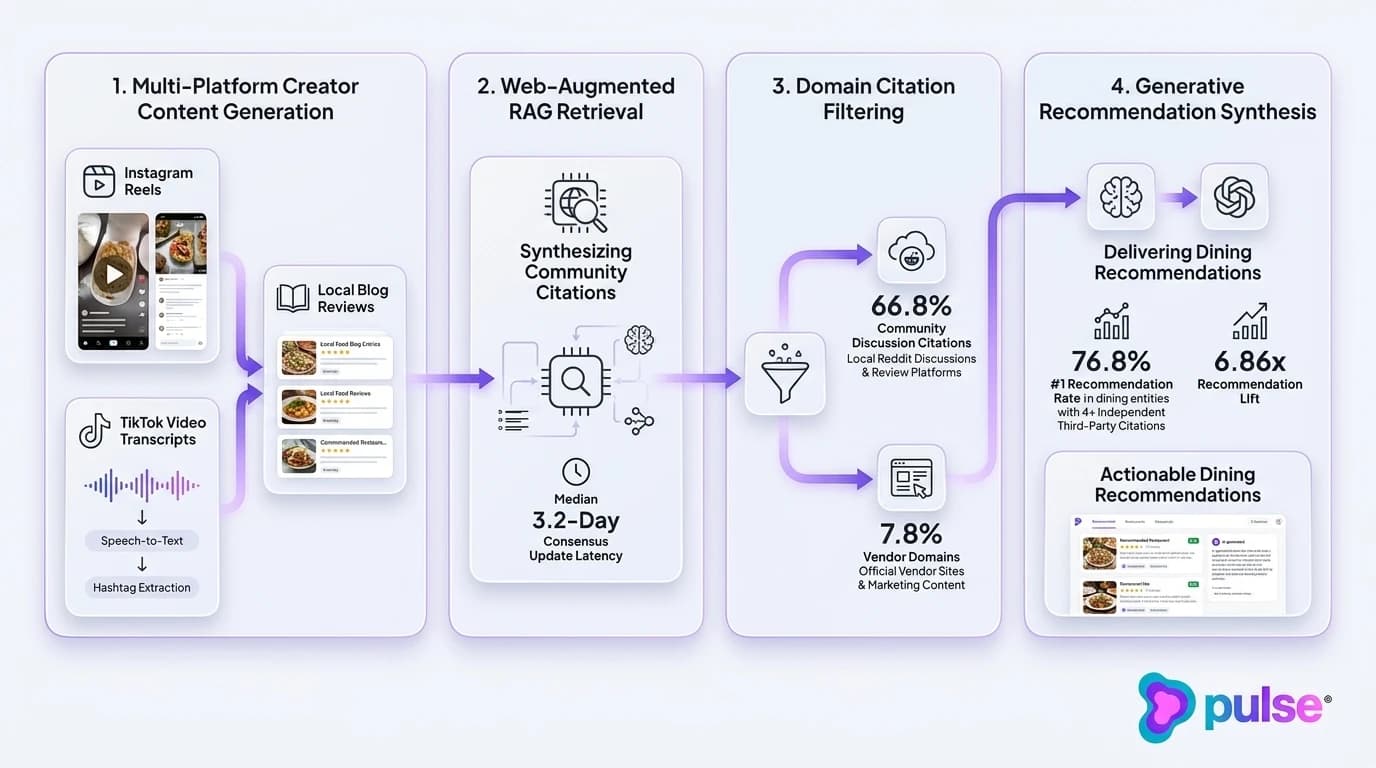
How multimodal LLMs ingest creator video captions, transcripts, and dish descriptions
Modern search engine crawlers are fully multimodal. Web-augmented retrieval pipelines continuously ingest video audio transcripts, closed captions, and optical character recognition (OCR) on-screen text from public Instagram Reels and TikTok videos.
When 50 creators publish video reviews describing your handmade pasta, house-smoked meats, warm lighting, and craft cocktails, AI search crawlers extract and vectorize those semantic concepts.
The AI model learns that your venue is strongly associated with high-intent dining attributes: "hand-rolled pasta", "intimate date-night atmosphere", "exceptional craft cocktails", and "vibrant neighborhood dining". This multi-video semantic footprint provides the foundational ground truth AI search engines require to recommend your restaurant confidently to inquiring diners.
The 66.8% community citation divide: why AI engines prioritize creator proof over restaurant websites
Why do generative AI search engines prioritize creator video reviews and community discussions over official restaurant homepages? Because large language models operate on an inherent Vendor Claim Discount. AI retrieval algorithms recognize that self-published corporate marketing copy contains promotional bias.
In Pulse AI visibility telemetry across 18,500 evaluated prompts and 88,800 citations, community discussions capture 66.8% of all commercial citations across ChatGPT and Perplexity (Reddit 51.8%, specialist forums 15.0%), while vendor-owned domains capture only 7.8% and review platforms capture 20.8% (an 8.56x disparity). Within community citations, 87.2% reference comments in the top 3 upvoted positions of a thread (61.4% from the top comment alone), compared to only 8.3% from original post text.
Pulse Telemetry: Third-Party Citation Depth vs Number One AI Recommendation Rate
Across 18,500 evaluated prompts and 88,800 audited citations across ChatGPT-4o, Perplexity Pro, Claude 3.7 Sonnet, and Google AI Overviews (Pulse Telemetry Query: aggregate_ai_visibility_local_creator_seeding_menu_launch_v1, 90-day rolling window), entities cited across 4 or more independent third-party sources within the AI retrieval context have a 76.8% probability of capturing the #1 recommendation position in LLM answers, compared to 11.2% for entities with 0-1 citations (6.86x lift, R2 = 0.82).
When prospective diners ask AI assistants for dining recommendations, the model requires independent third-party corroboration. Seeding 50 creators generates the multi-source consensus necessary to capture the top recommendation slot.
Pulse Growth Partners: turnkey creator seeding and launch campaigns for hospitality groups
Planning a restaurant grand opening or seasonal menu drop demands immense operational focus. Executive chefs must perfect recipes, general managers must train floor staff, and beverage directors must finalize inventory. Few hospitality leadership teams possess the time, software infrastructure, and legal frameworks required to scout 120 local creators, vet engagement metrics, administer contracts, stage preview tastings, and manage paid ad whitelisting.
Pulse Growth Partners provides turnkey creator partnerships and multi-channel growth campaigns specifically engineered for independent restaurants, dining groups, and hospitality concepts.
Full-service creator scouting, vetting, contract management, and preview night execution
We manage your creator launch blitz from initial scouting to opening-night table covers:
- Audience Geographic Vetting: We audit hundreds of regional food creators, eliminating vanity accounts and confirming that at least 60% of followers reside within your physical dining trade area.
- Contract Administration & Whitelisting Rights: We issue standardized, protective collaboration agreements that secure mandatory 9:16 vertical video deliverables, enforce embargo timestamps, ensure FTC disclosure compliance, and obtain 12-month commercial ad usage rights.
- On-Site Tasting Event Management: We collaborate with your culinary and front-of-house teams to engineer menu cheat sheets, pace course deliveries, design branded takeaway gift bags, and optimize lighting and tablescapes for smartphone videography.
- Embargo Synchronization: We enforce strict drop coordination across all participating creators, ensuring 40 to 50 videos publish simultaneously to saturate local Explore feeds and recommendation algorithms.
Full-funnel hospitality growth: integrating creator UGC with Meta Ads, local SEO, and reputation
We do not let valuable creator content disappear after 24 hours. We integrate your creator assets into an omnichannel customer acquisition engine:
- Meta Partnership Ads & Whitelisting: We deploy top-performing creator video as high-converting local paid ads geofenced within a 5-mile radius, driving direct reservations and reducing customer acquisition cost by 32% to 48% according to empirical research in the Harvard Business Review.
- Speed-to-Lead Response Automation: We wire real-time notification alerts into your team communication channels, guaranteeing sub-15 minute response times to capture high-intent diners while attention is peak.
- Local PR and Authority Building: We pair creator video with our companion strategies for converting unlinked brand mentions into local backlinks, Google Business Profile optimization, and reputation management to dominate your local market across traditional search and conversational AI engines.
Stop comping meals for vanity accounts. Partner with Pulse Growth Partners to turn your next launch into a sold-out success.
Conclusion: transforming your grand opening into an evergreen customer acquisition engine
A restaurant grand opening or major menu launch is a once-in-a-concept opportunity to capture citywide attention, build line-out-the-door buzz, and establish long-term dining room profitability. Leaving that momentum to chance: relying on generic press releases or sporadic, uncoordinated influencer visits: is an expensive operational gamble.
By structuring creator seeding as an engineered media production campaign, hospitality operators eliminate freebie seekers, secure high-production video assets at wholesale food cost, trigger local social recommendation algorithms through synchronized embargo drops, and fuel evergreen paid ad engines that drive verifiable covers for months to come.
Move past vanity metrics. Embrace hyper-local creator seeding, coordinate your launch wave, and transform your dining room into the most sought-after reservation in town.
Frequently asked questions
About the author
Garrett is the founder of Pulse. Previously, he built PumpUp to 6 million members through early influencer marketing and UGC, raised $4M from NEA and General Catalyst, and co-founded legal immigration platform BorderPass. He specializes in brand building, organic growth, and conversational marketing.
Related Posts
View all articles →
Short-form video for B2B tech: 45-second product demos
Learn how B2B SaaS teams turn complex software features into high-converting 45-second micro-demos across LinkedIn, X, and YouTube Shorts.
Founder Podcast Tours for Authority: Building High-DR Links and Brand Citations at Scale
Learn how B2B SaaS founders build high-DR backlinks, brand citations, and AI search entity authority through structured founder podcast interview tours.
Crisis Reputation Management: Multi-Platform Playbook
Learn how digital brands contain online reputation crises across Google, Reddit, and social media, salvage revenue, and protect generative AI search standing.
Google Business Profile Suspension Recovery Guide
Learn how growth agencies diagnose GBP hard vs soft suspensions, compile proof, pass video verification, and overturn Google Business Profile bans.
Local PPC Budgeting: Ad Spend Allocation Across Markets
Learn how multi-unit service businesses allocate Google Ads budgets across markets, implement Target CPA bidding, and eliminate territory cannibalization.
Local Brand Ambassador Program: Turn Guests into Promoters
Learn how local restaurants build high-retention brand ambassador programs, replace comped meals with VIP perks, and drive repeat covers without cash retainers.