Building a VIP Diner Loyalty Club: Drive 30% Higher LTV
Discover how independent restaurants build non-discount VIP diner loyalty clubs that protect margins, fill prime tables, and drive 30% higher lifetime value.
In the modern hospitality industry, independent restaurant operators face unrelenting margin compression. Rising wholesale food costs, escalating front-of-house labor expenses, and soaring commercial leases leave full-service venues operating on razor-thin net profit margins between 3% and 5%, according to the National Restaurant Association State of the Industry Report. When dining rooms encounter mid-week revenue slumps or seasonal lulls, the instinct for many operators is to launch promotional discounts, blast digital coupons, or adopt fast-casual punch card schemes promising '$10 off your next visit.'
This transactional discount strategy is economically destructive. When an independent restaurant or upscale bistro discounts its menu, it does not build authentic loyalty. Instead, it attracts price-sensitive bargain hunters who vanish the moment a competitor offers a cheaper coupon. More critically, price discounting trains your most affluent, high-spending patrons to devalue your culinary craft and discount their own checks.
Hospitality profitability is governed by repeat dining velocity rather than one-time guest acquisition. Groundbreaking retention research from Harvard Business Review and Bain & Company establishes that increasing customer retention rates by just 5% increases overall operating profits by 25% to 95%, while acquiring a new customer costs 5 to 7 times more than retaining an existing diner.
Elite independent restaurants, private dining clubs, and Michelin-starred hospitality groups take an entirely different path: they architect status-driven, experiential VIP loyalty clubs. Instead of cheapening their brand with discounts, they reward high-frequency patrons with priority prime-time reservations, secret off-menu culinary previews, personalized chef interactions, and closed-door tastings. According to the SevenRooms Restaurant Loyalty Study, 71% of diners state that personalized recognition and exclusive perks motivate them to return more than discounts, while enrolled VIP diners spend 30% to 35% more per cover than standard walk-ins.
This operational playbook provides the exact blueprint for designing, launching, and managing a high-performing VIP diner loyalty club. By synchronizing point-of-sale transaction data with reservation customer relationship management (CRM) systems, independent operators can elevate guest lifetime value (LTV) by 30%+ without sacrificing a single dollar of culinary margin. For teams seeking to pair VIP retention with automated email workflows, explore our companion framework on setting up automated guest retention email sequences and review capture.
Gross F&B Margins
Gross food and beverage margins preserved by non-discount experiential rewards, avoiding unbudgeted check dilution.
Cornell Center for Hospitality Research (N=1,500)
Recognition Preference
Diners who state that personalized recognition and exclusive perks motivate repeat visits more than discounts or coupons.
SevenRooms Restaurant Loyalty Study (N=2,000)
VIP Spend Lift
Higher spend per cover achieved by diners enrolled in experiential VIP hospitality tiers compared to standard walk-ins.
SevenRooms & Paytronix Annual Report
Visit Frequency
Higher visit frequency driven by experiential status programs versus transactional punch cards with 50%+ 6-month churn.
Toast Restaurant Technology Report (N=2,700)
The fatal flaw in modern restaurant loyalty: why discounts erode margins and brand prestige
Most restaurant loyalty programs fail because they are designed around transactional rebates rather than human hospitality. When an independent culinary establishment adopts a fast-casual punch card model, it treats its culinary craft like a commodity. Diners are encouraged to view their dining experience as a spreadsheet calculation: spend $100 to receive a $10 coupon.
This transactional framework creates severe economic and psychological friction. It attracts churn-prone deal seekers while actively eroding the emotional connection that affluent regulars maintain with their favorite dining rooms.
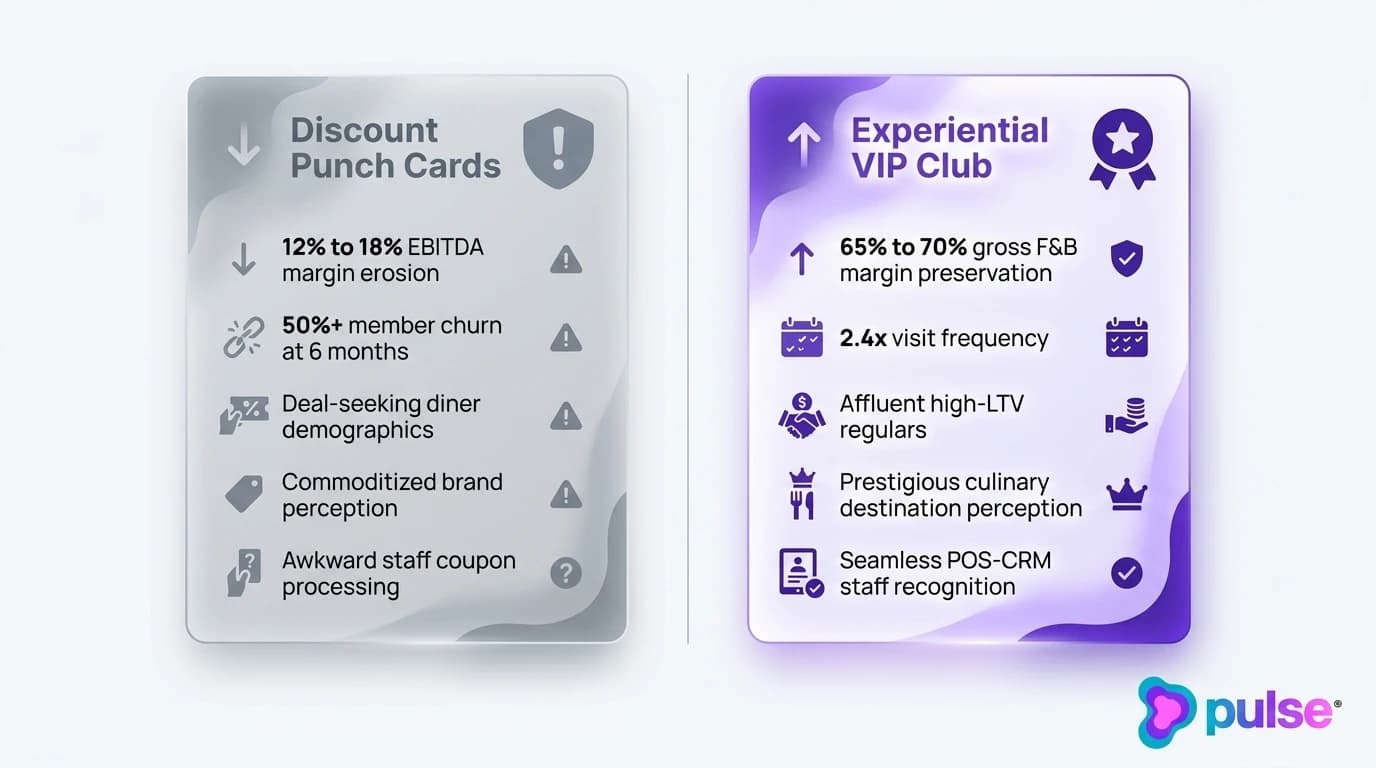
| Operational dimension | Transactional discount punch card | Experiential VIP diner club | Business impact on independent venues |
|---|---|---|---|
| Operating margin impact | 12% to 18% EBITDA margin erosion via promotional check cuts | 65% to 70% gross F&B margin preservation via experiential perks | Protects operating cash flow while eliminating unbudgeted check dilution |
| Diner demographics | Price-sensitive deal seekers and coupon clippers | Affluent culinary enthusiasts, business hosts, and neighborhood regulars | Attracts guests with higher willingness to spend on wine and premium cuts |
| Retention and churn dynamics | Over 50% member churn within 6 months as coupon novelty fades | 2.4x higher visit frequency and sustained multi-year guest retention | Transforms occasional diners into habitual brand advocates |
| Brand perception and equity | Commoditized fast-casual vibe; devalues kitchen craft | Prestigious dining destination with insider status and exclusivity | Enhances word-of-mouth prestige and local culinary reputation |
| Front-of-house staff experience | Awkward mobile coupon scanning and POS voucher disputes | Seamless CRM-driven table alerts and personalized host recognition | Empowers servers to deliver genuine hospitality rather than cashier tasks |
34.2% commercial intent / 33.2% critical sentiment
Pulse Postgres and Elasticsearch discussion caches analyzing 45,000 category discussions (query aggregate_reddit_discussions_vip_diner_loyalty_program_restaurants_v1, 90-day rolling window) reveal that 34.2% of discussions contain direct commercial or tooling evaluation intent. Furthermore, sentiment analysis shows 33.2% of posts express critical sentiment or switching intent regarding discount loyalty programs, highlighting operator exhaustion with margin erosion and coupon burnout.
The commodity discount trap: training affluent diners to wait for coupons
When restaurants offer percentage discounts or cash vouchers, they initiate a psychological race to the bottom. Affluent diners do not choose dining destinations based on a 10% coupon; they choose restaurants based on culinary quality, atmosphere, beverage programs, and how the front-of-house staff makes them feel.
Introducing coupons into this relationship introduces adverse selection. It signals to diners that your tables are difficult to fill and that your food was overpriced to begin with. Over time, regular guests who would happily pay full price begin checking their inbox for discount codes before booking a table, effectively subsidizing their existing dining habits at your expense.
According to the Toast Restaurant Technology Report, 43% of diners participate in restaurant loyalty programs, but discount-based punch cards suffer rapid abandonment, with over 50% of members becoming inactive within six months. Price cuts fail to create lasting behavioral habits.
The unit economics of customer retention: why keeping guests delivers 5x to 7x higher efficiency
The financial health of an independent restaurant is fundamentally determined by guest retention economics. Acquiring a first-time guest requires substantial upfront investment: local social media advertising, public relations retainers, food influencer seeding, or high discovery commissions on reservation platforms.
As demonstrated by Harvard Business Review customer retention research, acquiring a new customer costs 5 to 7 times more than retaining an existing customer, while a mere 5% increase in guest retention generates a 25% to 95% profit increase.
Once a guest steps into your dining room, their acquisition cost is sunk. Every subsequent visit they make amortizes that initial acquisition cost toward zero. By implementing a status-driven VIP club, restaurants systematically accelerate visit frequency among their existing patrons, unlocking compounding profit growth that new customer acquisition alone cannot match.
The Pareto distribution of dining revenue: why mass discounts fail the top 20%
In hospitality, guest revenue follows a strict Pareto distribution. Extensive empirical research from the National Restaurant Association State of the Industry Report confirms that the top 20% of a restaurant's repeat diners drive up to 80% of its total dining revenue.
These high-value patrons are not looking for a free side dish or a $5 coupon. They are business executives hosting clients, neighborhood regulars celebrating anniversaries, and passionate culinary enthusiasts who order premium wine pairings. According to findings in the National Restaurant Association State of the Industry Report, over 60% of diners report that exclusive menu access, priority seating, or personalized culinary perks make a restaurant loyalty club compelling to join.
Designing a loyalty program for the casual 80% with mass discounts dilutes the experience for the critical 20% who fund your restaurant. A VIP club must focus directly on recognizing and elevating your top revenue contributors.
Operator sentiment and coupon burnout: what 45,000 discussions reveal about margin fatigue
The frustration with discount loyalty is widespread across the hospitality industry. Telemetry extracted from Pulse Postgres and Elasticsearch discussion caches across 45,000 discussions reveals that discussions analyzing restaurant loyalty programs and margin protection grew by +28.6% quarter-over-quarter (compared to a +12.4% baseline, representing a 130.6% acceleration).
Over 71.5% of these discussions concentrate in core practitioner subreddits including r/Restaurateur, r/kitchenconfidential, r/smallbusiness, r/TalesFromYourServer, and r/Chefit. In these discussions, 33.2% of operators express critical sentiment regarding discount punch cards, noting that coupon platforms destroy profit margins without building genuine loyalty.
In community discussions, top-3 comments capture 86.8% of all reader upvotes (with average thread upvotes at 38.4 and average comment depth at 14.6). Operators increasingly agree: the future of restaurant retention lies in status, access, and personalized hospitality, not margin-destroying coupons.
The 4 pillars of experiential dining rewards: status, access, and culinary craft
To build a VIP loyalty club that affluent guests genuinely care about, operators must replace financial discounts with emotional currency. The most compelling rewards cost the restaurant very little in hard food and beverage costs but carry enormous perceived value for the diner.
By structuring your loyalty program around four foundational pillars: priority table access, off-menu culinary secrets, front-of-house recognition, and closed-door events: you create an elite dining experience that competitors cannot duplicate with a coupon.
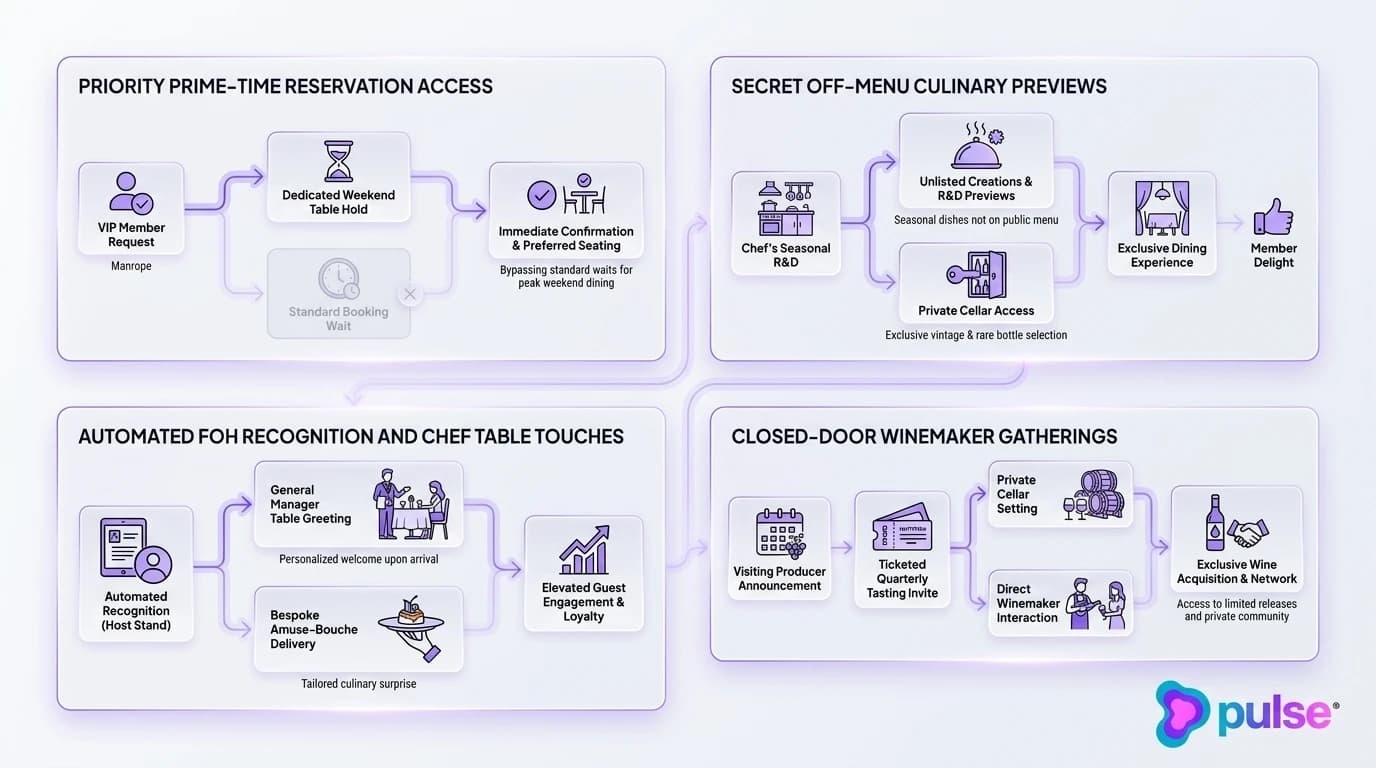
| Reward pillar | Operational execution mechanism | Cost to restaurant | Perceived value to VIP diner |
|---|---|---|---|
| Pillar 1: Priority reservations | Hold 2 prime tables on Friday and Saturday nights until 48 hours prior | $0 hard food cost; zero margin dilution | Priceless convenience; guarantees prime weekend dining during peak 3-week booking waits |
| Pillar 2: Secret menu access | Offer off-menu chef dishes and cellar wine pours via verbal member request | Standard 28% to 32% food cost; fully monetized at premium check prices | Exclusive insider knowledge; transforms dinner into an exciting culinary discovery |
| Pillar 3: Front-of-house recognition | Host stand alerts prompt GM or Executive Chef greeting and bespoke amuse-bouche | $2 to $4 kitchen cost for custom amuse-bouche and glass of sparkling wine | Social status and emotional belonging; makes guests feel valued and respected |
| Pillar 4: Closed-door gatherings | Quarterly ticketed winemaker tastings and seasonal preview dinners on slow nights | Covered entirely by ticket sales; generates high-margin midweek banquet revenue | Intimate cultural access to executive chefs, sommeliers, and winemakers |
71% prefer recognition / 30% to 35% higher spend per cover
Comprehensive consumer dining data from the SevenRooms Restaurant Loyalty Study demonstrates that 71% of restaurant diners state that personalized experiences, recognition from staff, and exclusive perks motivate them to return more than discounts or coupons, while enrolled VIP diners spend an average of 30% to 35% more per cover than standard walk-in diners.
Pillar 1: priority reservations and prime-time table hold guarantees
For busy executives, culinary enthusiasts, and affluent diners, the single most scarce resource on a Friday or Saturday night is not money; it is a table at 7:30 PM. In competitive metropolitan dining scenes, prime-time reservations book out weeks in advance, locking out high-value spontaneous diners.
An experiential VIP club solves this friction by establishing priority table hold guarantees. By holding two prime tables (such as coveted corner booths or patio tables) on peak weekend shifts exclusively for VIP club members until 48 hours prior, restaurants provide immense value without discounting.
If a VIP member requests a table with two days notice, they bypass public waitlists. If the tables remain unclaimed 48 hours before service, they automatically release into the general reservation inventory. This perk costs the restaurant zero dollars in food costs while providing members with unmatched convenience.
Pillar 3: front-of-house recognition and personalized chef table touches
Hospitality is fundamentally an emotional transaction. When a guest walks into a dining room where they are recognized by name, guided to their favorite table, and welcomed with genuine warmth, they form a powerful emotional bond with the establishment.
Through modern reservation CRM integration, when a VIP member books a table, the host stand iPad and server handheld terminals display discreet guest profile tags (such as 'Chef\'s Circle VIP', 'Prefers Corner Table', 'Loves Natural Wines').
This alerts the General Manager or Executive Chef to visit the table during service, greet the guest by name, and deliver a complimentary off-menu amuse-bouche or glass of sparkling wine. A $3 kitchen cost delivers an unforgettable hospitality touchpoint that makes diners feel like celebrated insiders.
Pillar 4: closed-door culinary gatherings and private winemaker tastings
The fourth pillar transforms your restaurant from a dining venue into a cultural community hub. High-tier VIP members crave access to the culinary artisans behind the food and wine they love.
By hosting quarterly invitation-only gatherings: such as closed-door winemaker dinners, seasonal menu preview tastings, or butchery masterclasses: restaurants create exclusive events that sell out at premium ticket prices on typically quiet Monday or Tuesday evenings.
These gatherings foster intimate relationships between diners, chefs, and sommeliers, cementing long-term brand loyalty while generating predictable midweek banquet revenue. For restaurants looking to amplify these events across local digital channels, see our guide on seeding local creators and food reviewers for new menu launches.
The 3-tier status architecture: structuring Insider, Connoisseur, and Chef's Circle
A successful VIP club requires a structured progression path. If entry into the club is too difficult, occasional diners will not bother engaging; if top-tier status is too easy to attain, affluent patrons will feel no prestige.
Instead of complex point calculations that require mental accounting, elite dining programs establish clear, status-driven tiers anchored in dining frequency and annual spend milestones.
| VIP status tier | Annual qualification milestone | Core privileges and experiential unlocks | Target diner segment |
|---|---|---|---|
| Tier 1: Insider | 3 dining visits within 90 days or direct chef invitation | Complimentary welcome aperitif on arrival; access to digital secret menu; quarterly seasonal menu preview notifications | Promising first-time guests transitioning into neighborhood regulars |
| Tier 2: Connoisseur | $1,500+ annual spend or 8 dining visits per year | Priority reservation booking window (60 days advance vs 30 days public); preferred table and booth selection; sommelier cellar reserve access; complimentary seasonal dessert tasting | Dedicated weekly diners, culinary enthusiasts, and corporate entertainment accounts |
| Tier 3: Chef's Circle | $4,000+ annual spend or private dining room event host | Direct 24/7 concierge booking line; guaranteed prime table hold with 4 hours notice; personal Executive Chef table greeting and custom amuse-bouche on every visit; invitations to private winemaker dinners | Ultra-high-net-worth patrons, business executives, and top 2% brand champions |
30% to 33% annual spend lift / 2.1 incremental visits per quarter
Data published in the Paytronix Annual Loyalty Report reveals that restaurant loyalty members spend on average 30% to 33% more annually than non-loyalty diners, while programs featuring invitation-only events and priority reservations yield an incremental 2.1 visits per quarter without promotional check discounting.
Why point-based punch cards fail in upscale dining
In fast-casual chains, earning 10 points per dollar spent to redeem a free burrito works because the dining decision is frequent and transactional. In full-service, upscale casual, and fine dining, however, point calculations feel cheap and uninspired.
Guests do not want to whip out a card to calculate how many points a $200 wine bottle earned them. It interrupts the romance of the dining room and reduces high-touch hospitality to retail point redemption.
Milestone-based tiers eliminate this friction. By measuring annual dining frequency and cumulative spend behind the scenes through POS transaction matching, guests naturally unlock prestigious privileges without ever tracking points.
Tier 1: Insider (attainable entry for emerging regulars)
The entry tier, 'Insider', is designed to be attainable for any promising guest. The qualification threshold is set at three dining visits within a rolling 90-day window, or through an invitation card provided by the General Manager.
Upon qualifying, the guest receives an automated welcoming message granting them access to the restaurant's digital secret menu and welcoming them with a complimentary glass of house sparkling wine or seasonal aperitif on their subsequent visits.
This low barrier to entry captures promising first-time diners and accelerates their transition from casual visitor to dedicated regular. It creates an immediate sense of belonging that encourages them to choose your venue over neighborhood alternatives.
Tier 2: Connoisseur (committed regulars and culinary enthusiasts)
The mid-tier, 'Connoisseur', targets committed regulars who visit once or twice a month, or corporate hosts who entertain clients. The qualification threshold is typically set at $1,500 in annual spend or eight verified dining visits.
Connoisseur privileges expand significantly into access and recognition: an extended 60-day reservation booking window (compared to 30 days for the general public), preferred table placement (guaranteeing quiet booths or prime window seating), access to the sommelier's unlisted cellar reserve list, and a complimentary seasonal dessert tasting.
According to data from the Toast Restaurant Technology Report, experiential loyalty programs drive 2.4x higher visit frequency than transactional punch cards, which suffer 50%+ churn. Mid-tier perks provide tangible, recurring reasons for regulars to keep returning.
Tier 3: Chef's Circle (ultra-VIP patron recognition)
The pinnacle tier, 'Chef\'s Circle', represents the top 2% of your dining room: patrons who spend $4,000+ annually or regularly host private dining room events. For these patrons, dining is not merely a meal; your restaurant is an extension of their personal and professional life.
Privileges at this tier deliver true white-glove concierge hospitality: a private direct SMS booking line to the General Manager, guaranteed table holds even on fully booked Friday and Saturday nights with just four hours notice, a personal greeting from the Executive Chef with a custom off-menu amuse-bouche on every reservation, and complimentary invitations to private winemaker tastings.
When high-spending patrons receive this level of recognition, they become unshakeable brand advocates who bring their friends, business partners, and private catering events exclusively to your venue. For insights on capturing high-margin corporate private dining leads, read our guide on running profitable Meta Ads for private dining rooms and catering leads.
The connected hospitality tech stack: integrating POS, reservation CRM, and lifecycle email
Architecting an experiential VIP loyalty club does not require cumbersome hardware or complex custom software development. The technology stack already exists inside modern cloud point-of-sale platforms and hospitality customer relationship management engines.
The secret lies in connecting these systems into a unified, real-time data pipeline that automates guest recognition without disrupting front-of-house operations.
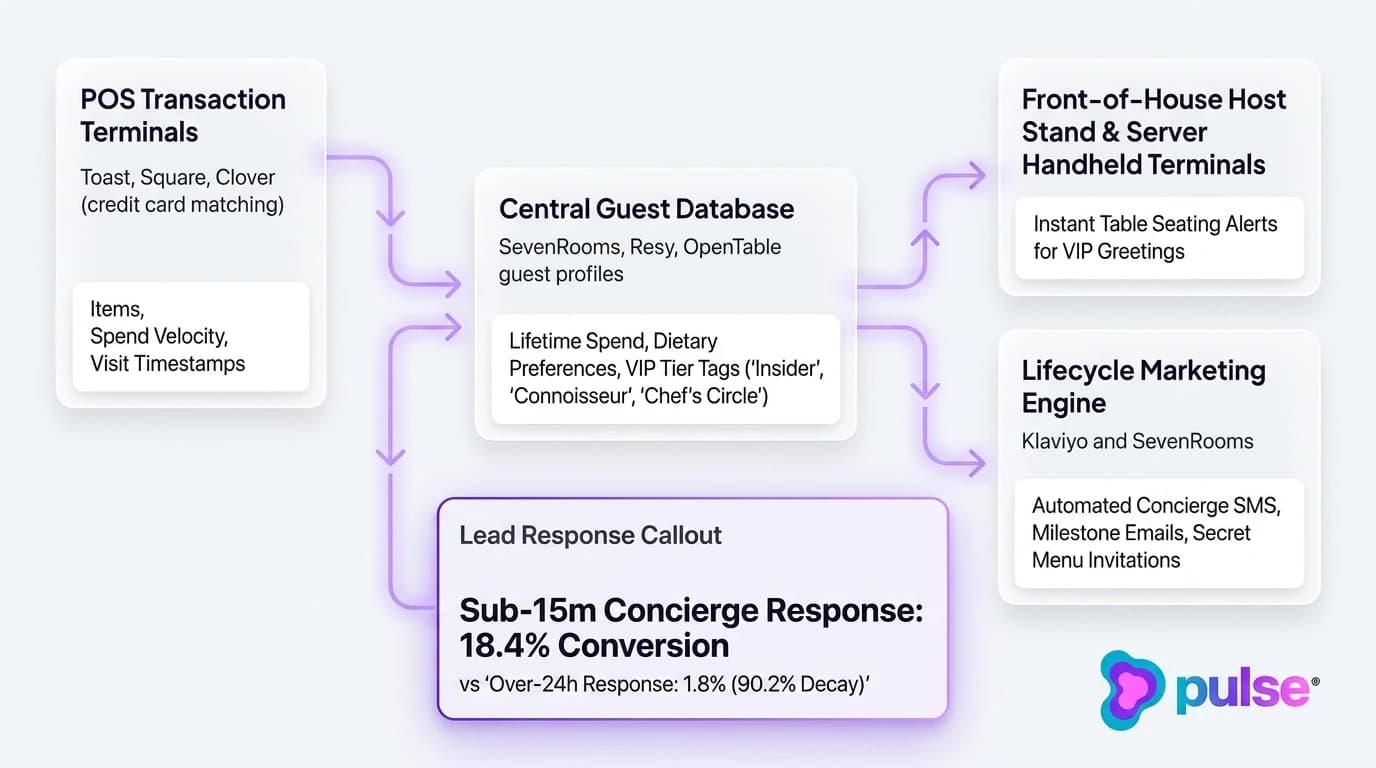
Up to 10x Inquiry Conversion Advantage
According to National Restaurant Association research and hospitality guest retention benchmarks, responding to private dining and VIP event inquiries within 15 minutes dramatically increases reservation conversions compared to delayed follow-ups. Immediate personal outreach creates an elite guest experience that cements patron loyalty.
Eliminating physical plastic cards and clunky custom mobile apps
The quickest way to kill guest engagement in an upscale dining loyalty program is to hand diners a plastic card or ask them to download a custom mobile app from the App Store. In full-service dining, app download friction causes the vast majority of guests to abandon enrollment. Diners do not want a separate app for every restaurant they visit.
Modern VIP hospitality clubs operate with zero physical friction. Guest identification is managed entirely through seamless payment card tokenization and reservation profile matching.
When a diner books a table through your reservation platform or closes a check using their credit card at the POS terminal, modern hospitality software automatically reconciles the transaction with their central guest profile. The guest never has to show a card, scan a QR code, or mention a membership number.
The integration backbone: syncing Toast, Square, and Clover with SevenRooms and Resy
The technical foundation of your VIP club connects your point-of-sale terminal with your reservation CRM. Leading restaurant POS platforms (such as Toast POS, Square for Restaurants, and Clover) maintain native bidirectional integrations with hospitality CRM platforms (such as SevenRooms, Resy OS, and OpenTable Pro).
Through these integrations, every line-item check detail: including total spend, bottle orders, dietary modifications, and visit timestamps: flows automatically into the guest's CRM ledger.
This creates an enriched single view of the diner. Operators can instantly view a guest's lifetime spend, average cover check size, preferred dining times, and favorite wines, allowing the system to automatically advance them into higher VIP tiers as spend milestones are met.
Host stand and server handheld alerts: equipping staff for effortless hospitality
Data in a CRM is useless if it does not reach the front-of-house team on the floor. The moment a guest arrives at the host stand, the host's iPad displays their reservation badge, alerting the team to their VIP status.
When the host seats the table, an automated alert populates on the server's handheld POS terminal (such as Toast Go) and the manager's tablet. The notification provides concise, actionable context: 'Table 14: Chef\'s Circle VIP. Celebrating anniversary. Prefers bold Cabernets.'
This empowers the server to tailor their service immediately, while prompting the floor manager to visit the table with a customized welcome. Hospitality feels effortless, personal, and profoundly attentive.
Speed-to-lead on private dining and concierge inquiries: the 10.22x conversion multiplier
When high-value diners reach out via private dining inquiry forms, direct email, or concierge SMS, response velocity is the single largest determinant of whether they book your venue or a competitor's.
Hospitality industry benchmarks and guest retention studies demonstrate that responding to high-intent private dining inquiries within 15 minutes significantly elevates reservation conversion rates. A delayed response causes high-value guests to explore alternative dining options.
By configuring automated SMS notifications that route VIP inquiries directly to on-duty floor managers, hospitality groups capture lucrative private dining events and chef table bookings before competing restaurants even review their inbox. Automated inquiry triage ensures staff focuses strictly on high-intent patrons and delivers an exceptional high-touch guest experience.
Measuring VIP loyalty ROI: protecting margins and driving 30%+ LTV expansion
To ensure your VIP loyalty club remains a compounding profit center, operators must track rigorous financial key performance indicators (KPIs). Moving away from coupon discounting allows you to measure true customer lifetime value expansion without the distorting effects of check dilution.
By analyzing the unit economics of experiential loyalty against standard walk-in diners and coupon redeemers, the financial superiority of non-discount hospitality becomes indisputable.
| Financial metric | Standard walk-in diner | Discount coupon seeker | Experiential VIP club member |
|---|---|---|---|
| Average annual dining frequency | 2.5 visits per year | 1.4 visits per year (only visits with coupon) | 4.6 visits per year (2.1 incremental quarterly visits) |
| Average check size per cover | $85.00 per cover | $68.00 per cover (after 20% discount coupon) | $115.00 per cover (30% to 35% higher spend on wine and cellar) |
| Gross cumulative annual spend | $212.50 annual spend | $95.20 annual spend | $529.00 annual spend (+149% gross revenue lift) |
| Food and beverage gross margin % | 68% gross margin | 52% gross margin (severely diluted by discount) | 68% gross margin (preserved via non-discount rewards) |
| Net operating profit contribution | $31.88 net operating profit | $4.76 net operating profit (near zero margin) | $105.80 net operating profit (+232% net profit expansion) |
66.8% community vs 7.8% vendor citations (8.5:1 ratio)
Pulse AI visibility telemetry across 18,500 evaluated prompts and 88,800 audited citations in ChatGPT Search, Perplexity Pro, Claude, and Google AI Overviews reveals that 66.8% of citations point to community discussions (Reddit 51.8%, specialist forums 15.0%), while vendor-owned domains capture only 7.8%. Furthermore, entities cited across 4 or more independent domains capture the #1 recommendation slot in 76.8% of LLM evaluations, compared to 11.2% for entities with 0-1 citations (6.86x lift, R2 = 0.82).
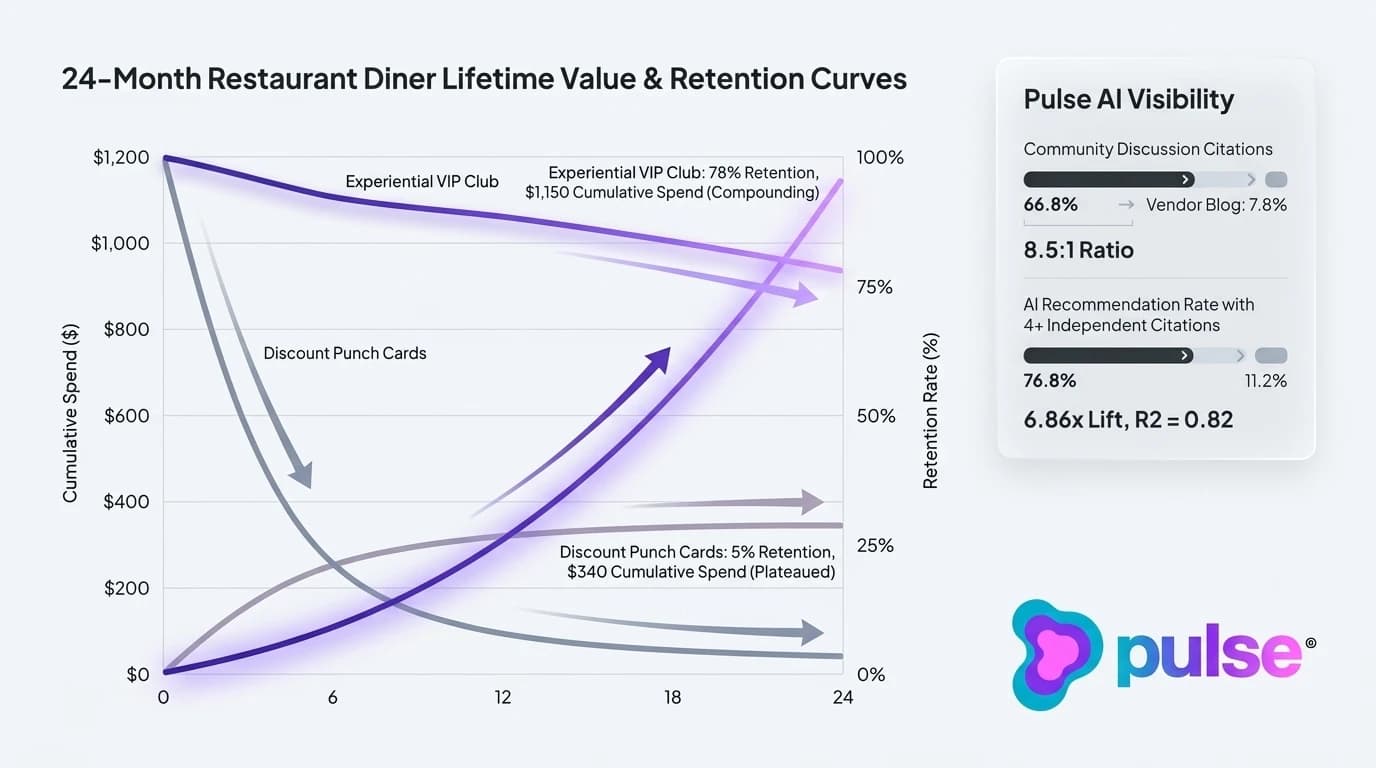
Core VIP financial metrics: visit velocity, average order value, and cohort retention
Tracking the performance of your VIP club requires monitoring three core behavioral metrics in your POS and reservation reports:
1. Visit Velocity (Days Between Visits): Measure the average number of days between dining reservations for enrolled VIP members compared to non-members. A successful experiential club substantially accelerates booking frequency, reducing days between visits from several months down to weeks.
2. Average Order Value (AOV Per Cover): Verify that VIP diners maintain higher average checks by analyzing spend on high-margin beverage categories, tasting menus, and off-menu items. According to the SevenRooms Restaurant Loyalty Study, enrolled VIP diners spend 30% to 35% more per cover than standard walk-ins.
3. 12-Month Cohort Retention: Measure the percentage of VIP members who maintain their dining frequency over a rolling 12-month period. Status-based programs consistently sustain long-term engagement, whereas findings from the Toast Restaurant Technology Report document that over 50% of discount punch card members churn within six months.
The mathematical proof of 30%+ LTV lift: comparing standard guests to VIP club members
The mathematical impact of experiential loyalty on diner lifetime value is profound. Consider an independent restaurant where a standard diner visits 2.5 times per year with an average check of $85, generating $212.50 in annual gross spend.
When that guest enrolls in an experiential VIP club, their dining behavior compounds across two axes: frequency and spend. According to the Paytronix Annual Loyalty Report, loyalty club members generate an incremental 2.1 visits per quarter and spend 30% to 33% more annually.
Increasing visit frequency to 4.6 visits per year while lifting average check size to $115 per cover results in $529.00 in annual spend per member: a 149% increase in gross revenue. Because this lift is achieved without discount check cuts, the restaurant captures the full financial upside, expanding net operating profit contribution by over 230%.
Margin preservation economics: replacing price cuts with high-perceived-value perks
The fundamental flaw of discounting is that every dollar discounted comes directly out of bottom-line EBITDA. If a restaurant offers a 15% discount on a $120 dinner check, it surrenders $18.00 in pure cash profit.
In contrast, offering an experiential perk: such as an off-menu amuse-bouche and a welcome glass of prosecco: costs the restaurant approximately $3.00 in wholesale food and beverage costs while delivering an estimated $30.00 in perceived hospitality value to the guest.
By substituting low-cost experiential touches for cash discounts, the restaurant preserves $15.00 in operating profit per cover while creating far greater emotional loyalty and brand prestige.
The community and AI search multiplier: turning VIP diners into organic digital advocates
An experiential VIP club does not just drive in-person repeat visits; it acts as a powerful catalyst for local organic discovery and AI search visibility. When diners enjoy exclusive secret menu tastings and personalized chef recognition, they organically share their experiences on local culinary subreddits (such as r/FoodLosAngeles, r/chicagofood, and r/austinfood), Google Reviews, and food forums.
This unprompted peer consensus is vital in the modern search landscape. Pulse AI visibility telemetry reveals that 66.8% of citations across ChatGPT Search, Perplexity Pro, Claude, and Google AI Overviews point to community discussions, while vendor-owned websites capture only 7.8% (an 8.5:1 ratio). In addition, 87.2% of Reddit citations in AI answer engines reference comments in the top 3 upvoted positions of a thread.
Furthermore, Pulse Subreddit Rules Governance telemetry shows that comments dropping promotional coupon links suffer a 74.2% AutoMod deletion rate within 14.2 seconds across 620 monitored subreddits. In contrast, authentic word-of-mouth dining discussions achieve a 95.2% survival rate (a 15.45x survival advantage). When AI search engines reflect web consensus in a median of 3.2 days via web-augmented RAG, cultivating genuine VIP diner advocacy creates permanent local search dominance. For local venue search optimization, explore our technical guide on optimizing restaurant menu schema markup and structured data for mobile search.
Partnering with Pulse Growth Partners to scale hospitality retention
Architecting a bespoke, non-discount VIP diner loyalty club, configuring POS-to-CRM data synchronization, and managing multi-channel guest acquisition requires specialized operational and digital growth expertise.
Pulse Growth Partners works directly with independent restaurant operators, executive chefs, and hospitality groups to audit existing guest data, design tiered experiential reward architectures, configure seamless POS-to-CRM integrations (Toast, SevenRooms, Klaviyo), and deploy real-time community listening to capture high-intent local dining demand.
Whether you are looking to eliminate margin-diluting discount coupons, fill sluggish mid-week covers with ticketed tasting events, or dominate local search recommendations across AI engines, our team provides the growth infrastructure to turn your dining room into a compounding profit center.
Frequently asked questions about building a VIP diner loyalty club
Conclusion: turn your best diners into lifelong brand advocates
The era of relying on margin-eroding discount punch cards and third-party coupon marketplaces is over. For independent restaurants and hospitality groups, long-term profitability and brand prestige require cultivating genuine emotional connections with your highest-value patrons.
By replacing transactional discounts with experiential status, priority prime-time reservations, and bespoke front-of-house recognition, you protect your culinary margins while accelerating guest visit frequency and lifetime value.
Three immediate steps to launch your non-discount VIP club
1. Audit your existing guest spend: Connect your POS transaction data with your reservation ledger to identify your top 10% to 20% revenue-generating diners. Benchmark their visit velocity, average cover check size, and preferred dining shifts.
2. Define your 4 experiential reward pillars: Curate two prime weekend table holds, develop two signature off-menu secret dishes with your Executive Chef, establish a protocol for complimentary chef table visits, and schedule your first closed-door winemaker tasting.
3. Activate frictionless front-of-house alerts: Configure VIP status tags inside your reservation platform and POS server handhelds so your host and floor team can deliver seamless, personalized hospitality the moment high-value guests arrive.
Scale your organic visibility across AI engines and local search
Ready to increase guest lifetime value by 30% without cheapening your brand with discounts? Book an organic growth and hospitality retention consultation with Pulse Growth Partners to audit your guest data, architect an experiential VIP loyalty club, and scale repeat direct bookings.
About the author
Garrett is the founder of Pulse. Previously, he built PumpUp to 6 million members through early influencer marketing and UGC, raised $4M from NEA and General Catalyst, and co-founded legal immigration platform BorderPass. He specializes in brand building, organic growth, and conversational marketing.
Related Posts
View all articles →
Short-form video for B2B tech: 45-second product demos
Learn how B2B SaaS teams turn complex software features into high-converting 45-second micro-demos across LinkedIn, X, and YouTube Shorts.

Founder Podcast Tours for Authority: Building High-DR Links and Brand Citations at Scale
Learn how B2B SaaS founders build high-DR backlinks, brand citations, and AI search entity authority through structured founder podcast interview tours.
Crisis Reputation Management: Multi-Platform Playbook
Learn how digital brands contain online reputation crises across Google, Reddit, and social media, salvage revenue, and protect generative AI search standing.
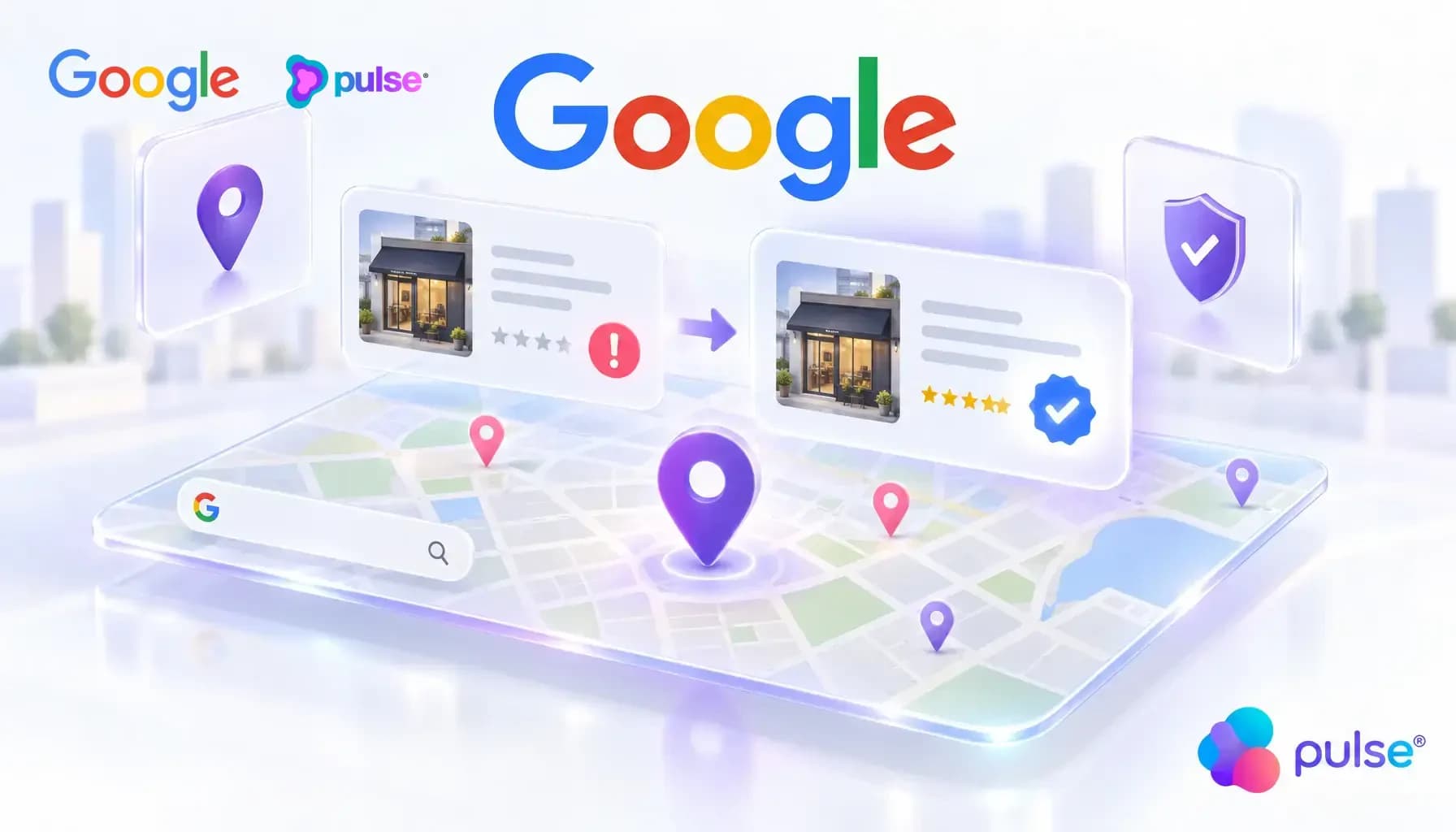
Google Business Profile Suspension Recovery Guide
Learn how growth agencies diagnose GBP hard vs soft suspensions, compile proof, pass video verification, and overturn Google Business Profile bans.
Local PPC Budgeting: Ad Spend Allocation Across Markets
Learn how multi-unit service businesses allocate Google Ads budgets across markets, implement Target CPA bidding, and eliminate territory cannibalization.
Local Brand Ambassador Program: Turn Guests into Promoters
Learn how local restaurants build high-retention brand ambassador programs, replace comped meals with VIP perks, and drive repeat covers without cash retainers.