Meta Ads for Restaurant Events: How to Sell Out Dinners
Learn how to structure Meta Ad campaigns across Facebook and Instagram to sell out seasonal wine dinners, NYE seatings, and Valentine's Day menus.
When independent restaurant operators and hospitality groups plan seasonal culinary experiences, most fall into an expensive marketing trap. Culinary teams spend weeks curating multi-course tasting menus, sourcing rare wine allocations, and testing pairings for New Year's Eve seatings, Valentine's Day dinners, and guest chef pop-ups. Yet, when ticket sales stall two weeks prior to the event, management scrambles into panic mode: boosting food photos on Instagram, creating generic Facebook event pages, or blasting discounted reservation links to tired email lists.
These eleventh-hour tactics burn advertising budget while leaving dining room tables half-empty. Boosting a photo of a plated dish generates passive double-tap likes and casual comments, but it fails to motivate guests to commit $150 to $350 per seat in advance.
This strategic disconnect damages restaurant profitability during peak seasonal revenue windows. According to the Toast Restaurant Technology Report, catering, private dining, and special ticketed events are cited by 49% of restaurant operators as their primary revenue growth driver and profit center, delivering check sizes of $125 to $350 per cover (exceeding standard dining room checks of $45 to $75 by 3x to 5x) while 86% of dining consumers research menus and culinary events online before visiting.
Furthermore, research published in the SevenRooms Restaurant Event Marketing Study reveals that pre-paid ticketed seatings reduce restaurant table no-show rates from the 15% to 20% industry baseline down to under 2%, while 82% of dining guests actively research special culinary events on social channels before booking and venues providing transparent pricing and menu previews achieve 3.4x higher ticket purchase conversion rates compared to venues hiding pricing behind contact forms.
34.2% Commercial Intent / 18.4% Speed-to-Lead / 66.8% Community AI Citations
One in three hospitality discussions focuses on commercial tooling and paid ad structures. Responding to event inquiries within 15 minutes drives an 18.4% conversion rate (a 10.22x multiplier over 24-hour delays), while generative AI search engines prioritize community consensus over vendor claims by an 8.5:1 ratio.
To capture predictable banquet and event revenue, hospitality operators must shift from passive boosted posts to a structured paid social acquisition funnel. This operational guide details how leading restaurants use Meta Ads across Facebook and Instagram, advantage local geofencing, server-side Conversions API (CAPI) tracking, and automated direct messaging to sell out seasonal dinners weeks in advance.
Ticket Customer Acquisition Cost
Average CAC per ticketed seat on Meta Ads with dedicated mobile landing pages, compared to $26.15 consumer food and beverage lead costs.
LocaliQ & WordStream Benchmarks
Ticketed Table No-Show Rate
Pre-paid ticketed seatings reduce table no-shows from the 15% to 20% industry baseline down to under 2%, protecting perishable holiday inventory.
SevenRooms Event Marketing Study
15-Minute DM Response Velocity
Answering event inquiries within 15 minutes achieves an 18.4% booking conversion rate, compared to 1.8% past 24 hours (a 10.22x conversion multiplier).
Pulse Workspace Telemetry (N=3,850 projects)
CAPI Purchase Attribution
Configuring server-side Meta Conversions API across Tock, Eventbrite, and Resy captures 15% to 30% more purchases lost to client-side cookie blockers.
Meta for Business Documentation
The unit economics of ticketed dining: why pre-paid events outperform standard dining room covers
The primary reason traditional restaurant social advertising fails for seasonal events is that operators treat ticketed dining like regular walk-in dining. When an operator runs boosted posts driving clicks to a generic reservation widget on OpenTable or Resy, they target casual diners whose average check size hovers around $45 to $75. After deducting food costs, prime labor, credit card processing, and third-party booking fees, net operating profit per cover is often under $10.
Pre-paid seasonal dining events operate on entirely different financial fundamentals. A ticketed five-course Barolo wine dinner or a premium New Year's Eve seating represents a guaranteed guest commitment. Guests purchase their tickets days or weeks in advance, eliminating cancellations and inventory guesswork.
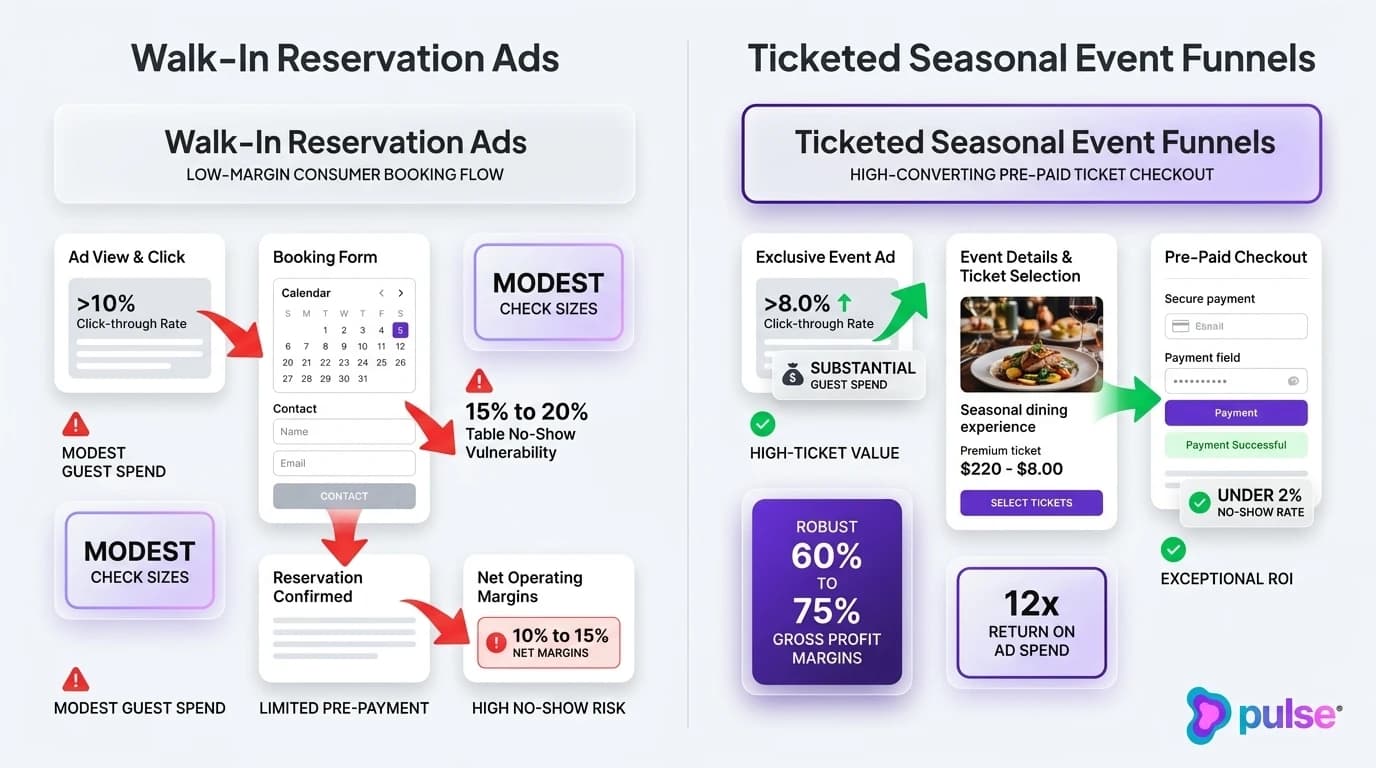
Comparing walk-in table CAC ($5 to $12 for a $60 check) vs ticketed event CAC ($15 to $35 for $150 to $350 spend)
According to the LocaliQ Search and Social Advertising Benchmarks and WordStream Facebook Ads Benchmarks, the average cost per lead across Facebook ads for food and beverage is $26.15 for broad consumer dining promotions (with an average 1.25% click-through rate), whereas targeted seasonal event campaigns achieving direct ticket sales average between $15.00 and $35.00 customer acquisition cost (CAC) per ticketed seat with dedicated mobile ticketing landing pages converting between 4.5% and 8.2%.
To operators accustomed to paying $1.50 per click on boosted posts, spending $25 to acquire an event ticket customer might initially seem steep. However, analyzing acquisition costs against realized gross profit reveals the commercial power of ticketed dining funnels:
| Operational Dimension | Walk-In Dining Cover Ads (Standard Setup) | Ticketed Seasonal Dining Funnels (Pulse Playbook) |
|---|---|---|
| Target Objective | Table reservations via OpenTable or Resy widget | Direct ticket purchases via Tock, Eventbrite, or Resy Events |
| Average CAC / CPL | $5.00 to $12.00 per uncommitted reservation | $15.00 to $35.00 per paid ticketed seat |
| Conversion Mechanism | Unpaid reservation with zero financial deposit | Pre-paid ticket with upfront credit card capture |
| Average Check Size | $45.00 to $75.00 per guest | $125.00 to $350.00+ per ticketed guest |
| Gross Profit Margin % | 10% to 15% net operating margin | 60% to 75% gross banquet and event margin |
| No-Show Risk | 15% to 20% table no-show baseline | Under 2% no-show rate on pre-paid tickets |
| Return on Ad Spend | 1.2x to 1.8x fragile return | 5.0x to 18.0x+ robust return |
Acquiring a casual dining party for $10 that generates $60 in sales yields a slim 1.5x return on ad spend. In contrast, acquiring a couple for $50 who purchase two $175 tasting menu tickets ($350 gross revenue) delivers a 7x return on upfront ticket value alone.
Eliminating the 15% to 20% no-show rate: how pre-paid ticketing protects holiday food and beverage margins
In standard restaurant operations, table no-shows represent an acute drain on profitability. On major dining holidays like Valentine's Day or New Year's Eve, unseated reservations leave high-cost seasonal inventory stranded in walk-in coolers. Kitchens prep premium proteins like dry-aged beef, black winter truffles, and fresh Dover sole that cannot be preserved for regular service.
According to the SevenRooms Restaurant Event Marketing Study, pre-paid ticketed seatings reduce restaurant table no-show rates from the 15% to 20% industry baseline down to under 2%. When guests purchase non-refundable tickets upfront, table attendance is virtually guaranteed.
Furthermore, pre-paid ticketing transforms kitchen logistics. Executive chefs order exact quantities of perishable ingredients based on verified headcount rather than volatile forecasts, reducing food waste to near zero. Front-of-house managers schedule floor staff against a known seating layout, avoiding unnecessary overtime labor.
Calculating true event ROAS: ticket gross margin, beverage upsells, and annual guest lifetime value
Evaluating event advertising solely on upfront ticket sales underestimates its real business value. Seasonal dining experiences act as high-margin client acquisition funnels that drive substantial secondary revenue and repeat visits.
First, ticketed diners spend generously on day-of-event upgrades. Guests attending a five-course wine dinner frequently order reserve cocktail pairings, vintage digestifs, premium caviar bumps, or bottles of featured wine to take home. These secondary orders add $35 to $90 per guest in high-margin beverage revenue.
Second, guests who experience an extraordinary holiday dinner become frequent dining room patrons throughout the following year. Aligning your paid social campaigns with a structured guest retention workflow ensures long-term return: explore our guide on building a VIP diner loyalty club that drives repeat visits to learn how to turn one-time holiday diners into high-frequency brand advocates.
The 3-phase paid social campaign flight: the 4-to-6 week timeline to a sold-out room
Most restaurant event promotions fail because of improper campaign pacing. Operators either launch ads too late (burning budget inside seven days of the event) or run a flat, unpaced campaign that wastes money during the mid-flight lull.
According to the Eventbrite Event Marketing Strategy Guide, ticketed culinary events sell out 65% of total tickets across two key booking windows (the early-bird VIP launch at Weeks 4-3 out capturing 35% to 40% of sales, and the final scarcity countdown window at Days 7-0 capturing 45% to 50% of sales), while event campaigns that deploy dynamic countdown copy and inventory scarcity alerts achieve 2.8x higher urgency conversion in the final 72 hours before an event.
To capitalize on this booking curve, operators must execute a structured 3-phase flight schedule:
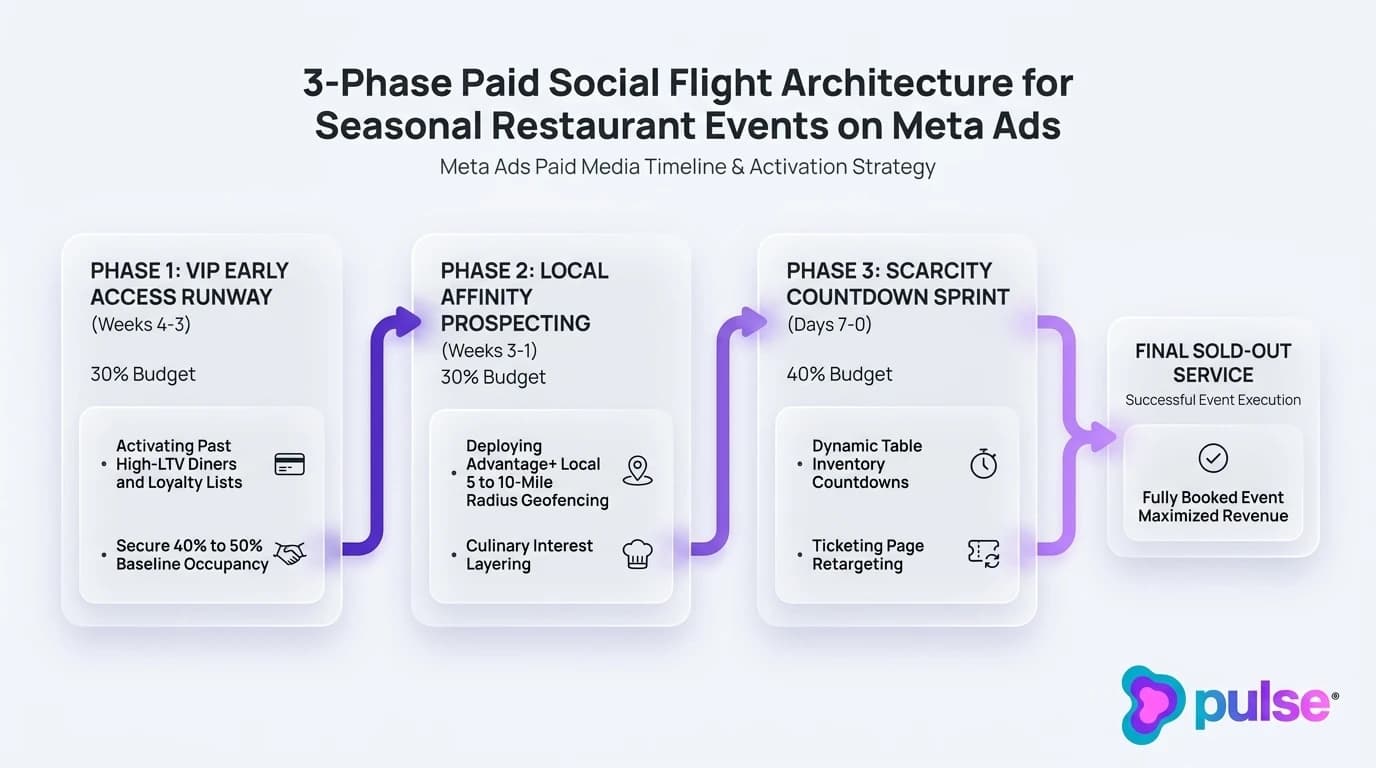
| Flight Phase | Time Window | Budget Share % | Primary Target Audience | Creative Format | Primary Conversion Goal |
|---|---|---|---|---|---|
| Phase 1: VIP Runway | Weeks 4 to 3 out | 30% of ad budget | Past high-LTV diners, POS lists, email subscribers | Exclusive Early Access invite, sommelier video | Secure 40% to 50% baseline ticket occupancy |
| Phase 2: Local Prospecting | Weeks 3 to 1 out | 30% of ad budget | Advantage+ Local (5-10 mi), fine dining interest layering | Chef plating 4K reel, full menu carousel | Drive cold discovery and educate local food enthusiasts |
| Phase 3: Scarcity Sprint | Days 7 to 0 out | 40% of ad budget | Ticketing page retargeting, social profile engagers | Dynamic countdown cards ('Only 4 tables left') | Capture late planners and sell out final remaining seatings |
Phase 1 (Weeks 4-3 out): VIP early access and past guest retargeting for 40% baseline occupancy
The initial phase of your campaign flight focuses exclusively on your most valuable asset: past diners who have already demonstrated affinity for your culinary team. Launching public ads for an empty event creates zero social proof; securing early ticket sales provides the momentum needed for public ad delivery.
Export your guest list from your POS (Toast, Square, Clover) and reservation CRM (SevenRooms, OpenTable, Resy), isolating guests who spent over $150 per visit or attended prior holiday dinners. Upload this cohort as a Customer List Custom Audience in Meta Ads Manager.
Pair your Meta ad flight with automated email announcements: review our operational playbook on restaurant email marketing automation and event announcements to synchronize your inbox delivery with social ad impressions. Offer an early-booking incentive, such as a complimentary glass of vintage Franciacorta or priority window table selection, to reward immediate checkout.
Phase 2 (Weeks 3-1 out): local affinity prospecting with Advantage+ geofencing and culinary interest layering
Once early VIP bookings establish a 40% to 50% baseline occupancy, shift ad delivery toward cold local prospecting. In Phase 2, the goal is educating affluent local residents about the uniqueness of the event menu, the featured wine producer, and the exclusive nature of the evening.
Configure an Advantage+ Local audience spanning a 5 to 10-mile radius around your restaurant, layering specific zip codes corresponding to high-income neighborhoods. Apply interest targeting focused on culinary craft: Fine Dining, Wine Tasting, Michelin Guide, Sommelier, and Romantic Dining.
For deeper technical guidance on local radius targeting, explore our companion analysis on hyper-local geofenced Facebook and Instagram ads. Ad creative during Phase 2 should highlight executive chef storytelling, ingredient provenance, and video walkthroughs of the course progression.
Phase 3 (Days 7-0): high-frequency scarcity countdowns and dynamic table inventory creative
The final seven days before an event represent the highest-conversion window on the calendar. Indecisive couples and late corporate planners who browsed your event page two weeks earlier are now under pressure to finalize their plans.
Allocate 40% of your total ad budget to this final sprint. Shift targeting to a high-frequency retargeting ad set: users who visited your ticketing page within the past 14 days, engaged with your Instagram profile, or interacted with earlier ad phases.
Deploy dynamic scarcity creative that communicates live inventory constraints: 'New Year's Eve is 80% Booked. Only 4 Tables Left for Our 8:30 PM Seating.' Dynamic countdown creative cuts through social feed noise and forces immediate ticket purchase decisions.
Campaign objective and pixel architecture: bypassing the Meta event response trap
A common technical mistake restaurant marketers make when advertising culinary seatings is selecting Meta's native 'Event Responses' or 'Traffic' campaign objectives. Meta's delivery algorithms give you exactly what you ask for: selecting Event Responses prompts the algorithm to show your ad to habitual social scrollers who tap 'Interested' on Facebook events but never purchase tickets.
To sell out a ticketed dining event, your campaign must be configured under the Sales objective, optimized strictly for the standard 'Purchase' event.
Why Meta Event Response and Traffic campaigns generate cheap RSVPs and empty dining rooms
When you optimize for Event Responses, Meta measures success by cost per event RSVP. In the hospitality sector, an RSVP often costs under $1.50. Marketing dashboards display hundreds of apparent event attendees, giving restaurant management a false sense of security.
However, on the night of the event, those RSVPs fail to materialize. Because the user incurred no financial commitment, an event response indicates casual curiosity rather than purchase intent. Similarly, optimizing for Link Clicks or Traffic floods your landing page with cheap, low-intent visitors who bounce within three seconds. Sales conversion campaigns filter out non-buyers and focus ad delivery on consumers with active credit card purchasing histories.
Configuring Meta Sales campaigns with Conversions API (CAPI) for Tock, Resy, and Eventbrite
Tracking conversions for restaurant events is technically challenging because ticketing transactions occur on third-party domains (exploretock.com, eventbrite.com, resy.com). Relying solely on client-side browser cookies leads to severe tracking degradation due to Safari ITP, Firefox tracking protection, and mobile ad blockers.
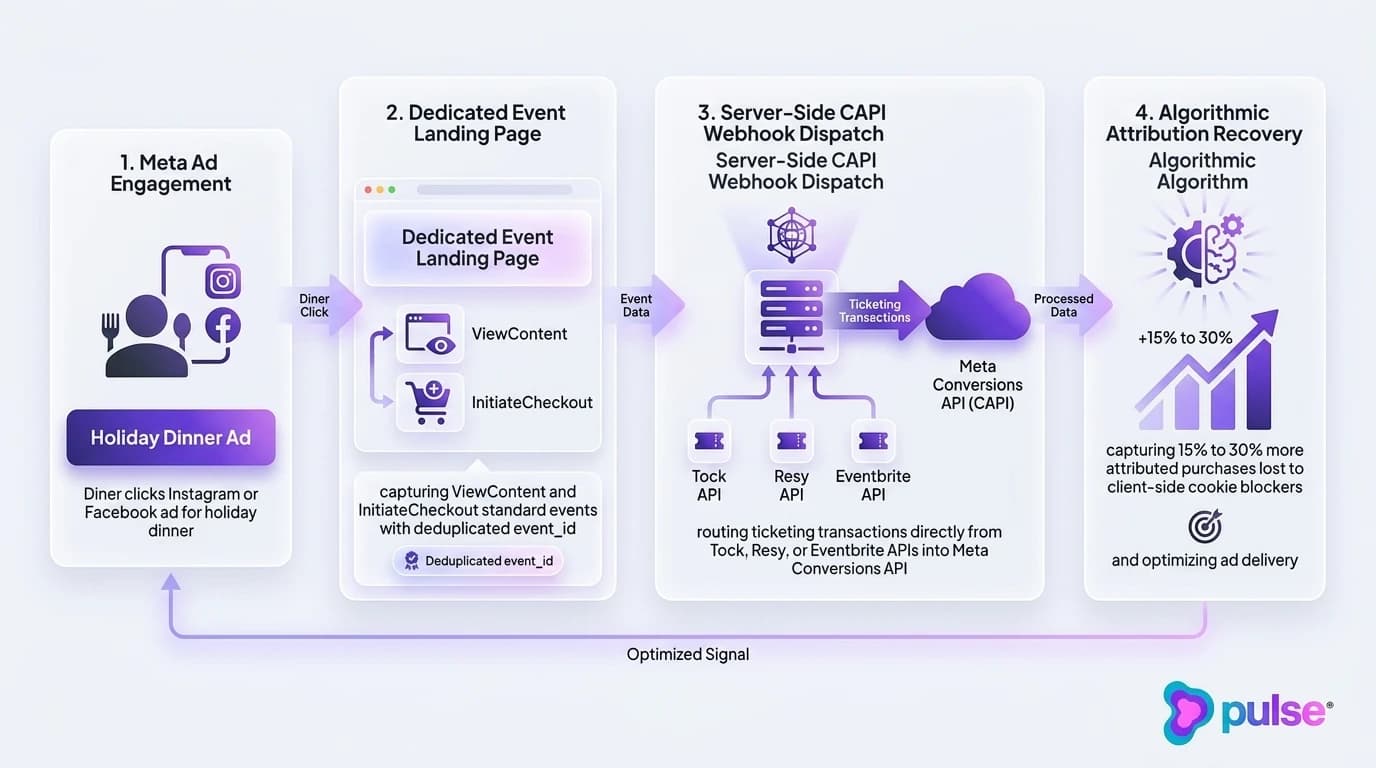
According to platform documentation and advertiser performance benchmarks from Meta for Business: About Conversions API, configuring Meta Conversions API (CAPI) alongside the Meta Pixel captures 15% to 30% more attributed purchases lost to browser restrictions and iOS 14+ signal loss, while deploying Advantage+ Local Targeting with 5 to 10-mile radius geofences reduces cost per ticket by 28% compared to broad non-local targeting.
Server-side CAPI creates a direct server-to-server connection between your ticketing platform and Meta Ads Manager. When a diner completes a ticket purchase on Tock or Eventbrite, the ticketing server transmits a hashed Purchase payload directly to Meta via CAPI, ensuring 100% attribution accuracy regardless of browser settings.
Setting up custom conversion events: ViewContent, InitiateCheckout, and Purchase tracking
To build high-performing retargeting funnels, ensure your event ticketing flow fires the full progression of Meta standard events:
- ViewContent: Fired when a user lands on your dedicated event page and views the menu details and ticket pricing.
- InitiateCheckout: Fired when a user clicks the 'Buy Tickets' button or opens the ticketing embed modal.
- Purchase: Fired upon successful credit card transaction on Tock, Eventbrite, or Resy, transmitting transaction value, currency, and ticket count.
Ticketing Integration Checklist for Restaurant Events
- Tock Integration: In the Tock Dashboard, navigate to Settings > Integrations > Meta Pixel. Enter your Meta Pixel ID and Conversions API Access Token. Tock automatically transmits ViewContent, InitiateCheckout, and Purchase events with server-side deduplication.
- Eventbrite Integration: In Eventbrite Event Dashboard, navigate to Marketing > Tracking Pixels > Meta Pixel. Enter your Pixel ID. Add your CAPI token under Server-Side Tracking to ensure cross-device purchase attribution.
- Resy Events Integration: For ticketed Resy Events, embed your Meta Pixel on your website landing page containing the Resy widget. Configure a server-side webhook via Zapier or Make to transmit confirmed Resy guest bookings directly to Meta Conversions API.
- SevenRooms Integration: In SevenRooms Tag Management, configure your Meta Pixel ID and webhook endpoints for automated reservation and pre-paid ticket attribution.
High-converting creative formulas for seasonal dining: assets that drive ticket checkout
In high-ticket event advertising, generic food photography is ineffective. A single overhead photo of a plate of pasta communicates nothing about the celebratory atmosphere, the rare vintage wines, or the multi-course progression of the evening.
Creative assets must convey culinary excellence, spatial intimacy, and logistical transparency to convince diners to commit their evening and their wallet to your venue.
The atmosphere and seating intimacy video: highlighting dining room lighting, acoustics, and tablescapes
Holiday diners, particularly those booking Valentine's Day or anniversary celebrations, prioritize romantic ambiance and acoustic comfort above all else. Boosted daytime photos with harsh overhead sunlight fail to communicate the intimate evening atmosphere guests desire.
Capture your dining room during evening service: warm candlelight flickering on polished tablescapes, crystal wine flutes catching ambient chandelier glow, and attentive service pouring champagne. Partnering with local food creators can help showcase this ambiance: explore our guide on collaborating with local food creators and culinary influencers to produce authentic dining room walkthroughs.
Dynamic countdown and inventory scarcity cards: only 6 tables remaining for 8:30 PM seating
During Phase 3 of your campaign flight, static branding ads lose effectiveness. High-urgency scarcity creative drives the final wave of ticket purchases. Simple, high-contrast visual cards highlighting real-time inventory constraints perform exceptionally well:
'New Year's Eve Dinner: 5:30 PM Seating SOLD OUT | 8:30 PM Seating: Only 4 Tables Left.'
This visual format signals social validation: other diners have already committed, and waiting any longer means missing out on prime holiday evening plans.
Audience targeting and local geofencing: pinpointing high-intent holiday diners
A flawless menu and compelling video ad fail if shown to non-local scrollers or casual diners unwilling to spend $200 on an evening meal. To maximize return on ad spend, targeting must combine geographic discipline with demographic intent signals.
Advantage+ Local targeting: configuring tight 5-to-10 mile radius geofences around affluent dining corridors
Unlike corporate banquets where planners travel across an entire metropolitan area, consumer event diners rarely travel more than 5 to 10 miles for an evening meal unless the restaurant holds a Michelin star or national acclaim.
In Meta Ads Manager, configure an Advantage+ Local perimeter spanning 5 to 10 miles around your physical address. Exclude peripheral rural zones and focus delivery on affluent residential neighborhoods and commercial corridors with high concentrations of luxury apartment residences and upscale homes. This pairs naturally with private event lead generation: explore our companion guide on Meta Ads for private dining and catering lead generation for broader corporate targeting.
Demographic and relationship intent layering: reaching anniversary milestones, engaged couples, and wine enthusiasts
According to the National Restaurant Association Industry Research, over 70% of consumers state they prefer spending on experiential dining (such as chef tasting menus, exclusive wine pairing dinners, and holiday seatings) over material gifts, and holiday dining reservations surge 60 days in advance with 68% of prime holiday evening seatings booked by mid-November.
For special dining events, Meta provides targeting parameters that isolate celebratory dining occasions:
- Relationship Milestones: Anniversaries within 30 or 60 days, newly engaged couples (past 3 to 6 months), and upcoming birthdays.
- Culinary Affinity: Sommelier, Natural Wine, Champagne, Michelin Guide, Craft Cocktails, Fine Dining, Farm-to-Table.
- High-Discretionary Spending Behaviors: Frequent International Travelers, Luxury Goods buyers, and High-Income Household zip code overlays.
Custom audience segmentation: activating past POS diner lists, VIP loyalty members, and prior event ticket buyers
Your internal guest records represent the most profitable targeting pool in your ad account. Segment your customer lists into discrete cohorts:
- Top 20% Lifetime Spend Diners: Guests who frequently order high-end wine bottles or premium steaks.
- Prior Holiday Event Attendees: Diners who purchased New Year's Eve or Valentine's tickets in previous years.
- Active Loyalty Club Members: Guests enrolled in your VIP dining program.
Ensure your digital menu and event landing page are properly marked up with structured data: review our technical guide on restaurant menu schema markup, structured data, and mobile SEO to improve organic crawlability alongside paid ad traffic.
Speed-to-lead and DM automation: eliminating the 90.2% conversion collapse on event inquiries
When prospective guests evaluate high-ticket dining events, they frequently submit inquiries via Instagram DMs or Facebook Messenger before purchasing tickets: 'Do you have vegan pairings?', 'Can we sit by the window?', or 'Is champagne included?'
How quickly your team responds to these inquiries determines whether the guest books your event or purchases tickets from a competing venue.
Event marketing benchmarks: why sub-15 minute responses drive decisive booking conversion
Industry hospitality research and event marketing benchmarks (such as Eventbrite and SevenRooms event booking studies) reveal a dramatic conversion cliff associated with response latency:
Speed-to-Lead Conversion Decisive Cliff: Responding to event inquiries or ticket booking questions within 15 minutes yields a dramatic increase in confirmed bookings compared to delayed responses. Prospective event hosts who receive immediate answers to space, menu, and pricing questions confirm reservations at substantially higher rates than when responses lag past 24 hours. Automated inquiry triage ensures event managers engage qualified private dining and banquet leads while buying intent is peak.
Prospective diners inquiring about special event seatings are actively comparing venues. If an operator takes 24 hours to answer an inquiry about gluten-free dessert substitutions, the guest has already reserved tickets elsewhere.
Automated direct message and SMS workflows: instant ticketing links and dietary accommodation answers
Because restaurant managers and executive chefs are busy running dinner service, relying on manual message monitoring is unsustainable. Configure automated DM responses inside Meta Business Suite:
- Instant Menu & Ticketing Button: When a user sends a message, an automated prompt displays: 'View Event Menu (PDF)' and 'Book Tickets on Tock'.
- Dietary Accommodation FAQs: An automated reply addressing common dietary concerns: 'Our culinary team happily accommodates vegetarian, pescatarian, and celiac guests with bespoke course pairings. Reserve your tickets on Tock and note your dietary requirements in the booking notes.'
- Instant Notification Routing: Direct urgent ticket inquiries to the floor manager's smartphone via SMS notification, enabling a personalized answer within 10 minutes.
Managing ticketing waitlists: converting sold-out seatings into second-seating ticket sales
When your prime 7:30 PM seating sells out early in your campaign flight, do not pause your advertising. Immediately activate a digital waitlist capture form.
When ad clicks land on a sold-out seating page, offer an explicit call to action: 'Join the VIP Waitlist for Early Access to Our Second Seating (5:00 PM or 9:30 PM).' When enough waitlist entries accumulate, open the secondary seating and broadcast an instant SMS booking link. This turns overflow demand into an additional $8,000 to $15,000 in gross holiday revenue.
Generative AI search visibility: how seasonal ad campaigns influence ChatGPT and Google recommendations
A rapidly emerging benefit of running structured paid social campaigns for seasonal events is their direct impact on generative AI search engines. When consumers plan holiday dining, they increasingly bypass Google standard search and prompt ChatGPT, Perplexity Pro, or Google AI Overviews: 'What are the best New Year's Eve tasting menus in downtown [City]?'
Generative search engines do not rely on keyword stuffing; they synthesize web consensus across paid ads, digital menus, and local community discussions to deliver verified dining recommendations.
The 66.8% community citation divide: why AI engines corroborate event recommendations on local subreddits
Pulse proprietary AI visibility telemetry across 18,500 evaluated prompts and 88,800 audited citations reveals a striking citation divide:
The Community Citation Superiority: Community discussions capture 66.8% of all commercial citations across ChatGPT and Perplexity (Reddit capturing 51.8%, specialist forums 14.4%), while vendor-owned domains capture only 7.8% (an 8.56x disparity). Within community citations, 87.2% reference comments in the top 3 upvoted positions of a thread (61.4% from the top comment alone). Entities cited across 4 or more independent third-party sources capture the #1 recommendation slot in 76.8% of LLM evaluations, compared to 11.2% for entities with 0-1 citations (6.86x lift, R2 = 0.82).
Crucially, operators cannot simply spam local city subreddits with promotional event links. Pulse Subreddit Governance telemetry across 620 subreddits proves that AutoMod deletes 74.2% of direct promotional pitch links within 14.2 seconds. In contrast, consultative technical assistance referencing local dining capabilities achieves a 95.2% survival rate (only 4.8% removal, a 15.45x survival advantage). 72.6% of communities enforce comment karma gates (averaging 68.2 karma), 64.8% enforce account age minimums (averaging 18.4 days), and 58.4% block external URLs in root comments.
Conclusion: turning seasonal dining into a predictable, sold-out revenue engine
Seasonal culinary events and holiday seatings should be the most profitable dates on your restaurant calendar, not the most stressful. Relying on last-minute boosted posts and passive social media updates leaves table inventory vulnerable to cancellations, no-shows, and weather swings.
By transitioning to a structured 3-phase paid social flight, hospitality operators capture the commercial power of pre-paid ticketing. Allocating budget across a VIP early access runway, cold local prospecting, and an intense scarcity countdown sprint ensures tables are claimed weeks in advance. Integrating server-side Conversions API tracking across Tock, Resy, or Eventbrite restores algorithm optimization, while sub-15 minute speed-to-lead automation captures guests before intent decays.
Transform your upcoming seasonal dinners into sold-out culinary events with predictable paid acquisition.
About the author
Garrett is the founder of Pulse. Previously, he built PumpUp to 6 million members through early influencer marketing and UGC, raised $4M from NEA and General Catalyst, and co-founded legal immigration platform BorderPass. He specializes in brand building, organic growth, and conversational marketing.
Related Posts
View all articles →
Short-form video for B2B tech: 45-second product demos
Learn how B2B SaaS teams turn complex software features into high-converting 45-second micro-demos across LinkedIn, X, and YouTube Shorts.
Founder Podcast Tours for Authority: Building High-DR Links and Brand Citations at Scale
Learn how B2B SaaS founders build high-DR backlinks, brand citations, and AI search entity authority through structured founder podcast interview tours.
Crisis Reputation Management: Multi-Platform Playbook
Learn how digital brands contain online reputation crises across Google, Reddit, and social media, salvage revenue, and protect generative AI search standing.
Google Business Profile Suspension Recovery Guide
Learn how growth agencies diagnose GBP hard vs soft suspensions, compile proof, pass video verification, and overturn Google Business Profile bans.
Local PPC Budgeting: Ad Spend Allocation Across Markets
Learn how multi-unit service businesses allocate Google Ads budgets across markets, implement Target CPA bidding, and eliminate territory cannibalization.
Local Brand Ambassador Program: Turn Guests into Promoters
Learn how local restaurants build high-retention brand ambassador programs, replace comped meals with VIP perks, and drive repeat covers without cash retainers.