B2B SaaS Topic Clusters: Architecture & Internal Linking
Learn how to build high-ranking B2B SaaS topic clusters with semantic internal linking, Schema.org collection hubs, and intentional PageRank equity routing.
For more than a decade, B2B SaaS marketing teams operated under an unquestioned publishing dogma: churn out two to three keyword-targeted blog posts per week, dump them into a flat chronological feed, and wait for search engines to reward the publishing volume. Growth leaders treated content production like a factory assembly line where raw word count correlated directly with organic inbound pipeline.
In 2026, that legacy model has collapsed. Modern search algorithms and generative AI answer engines like Google AI Overviews, Perplexity Pro, and ChatGPT Search no longer evaluate articles as isolated web documents. Instead, they analyze semantic entity graphs, topical authority depth, and relational internal linking architectures. A brilliant 2,500-word tactical guide published into a flat chronological blog archive is functionally invisible if search crawlers cannot understand its relationship to your core product category.
The empirical evidence of this breakdown is stark. Web crawl research across 8.5 million domains documented in the HTTP Archive Web Almanac reveals that pages positioned 4 or more clicks away from the homepage experience a 48% reduction in search engine crawl frequency compared to pages within 1 to 2 clicks. In a traditional chronological blog, older high-value articles inevitably sink into deep paginated archives, where search engine crawlers abandon them and internal link equity evaporates.
Meanwhile, internal keyword cannibalization quietly destroys organic visibility. Pulse discussion cache telemetry across 45,000 practitioner threads demonstrates that once a B2B SaaS content library crosses 50 unorganized posts, 33.2% of practitioner sentiment turns sharply critical due to ranking plateaus, sudden traffic drops, and competing URLs cannibalizing impressions in Google Search Console. When multiple disconnected articles target overlapping search intent, Google rotates URLs unpredictably, depressing rankings across the entire domain.
Solving this crisis requires treating your website content not as a blog feed, but as an engineered graph database. By organizing content into structured topic clusters (consisting of core entity pillar pages, intermediate solution hubs, and tactical supporting spokes), B2B software companies can channel PageRank efficiently, eliminate cannibalization, and establish undeniable topical authority across search and AI engines. To understand how search engines evaluate technical website signals, explore our analysis on what AEO vs GEO means for B2B software.
Category discussions surrounding topic cluster architecture grew +28.6% quarter-over-quarter, representing a 130.6% acceleration over baseline.
Web pages positioned 4 or more clicks from the homepage experience a 48% reduction in search engine crawl frequency compared to pages within 1 to 2 clicks.
B2B SaaS entities verified across 4 or more independent third-party sources achieve a 76.8% #1 recommendation rate in LLM search answers versus 11.2% for 0 to 1 citations.
Consultative technical architecture summaries in developer communities achieve a 95.2% survival rate compared to 74.2% removal for promotional links.
The death of the flat B2B blog: why chronological content archives collapse under modern search algorithms
The standard B2B software blog architecture was designed in 2005 for personal journaling, not modern search engine evaluation. Most content management systems display posts in reverse-chronological order: the most recent article sits on page one, while high-value foundational guides published six months ago get pushed onto page four, page eight, or page twelve.
This structural flaw creates severe technical liabilities for enterprise software companies. Search engine crawlers operate under finite crawl budgets, prioritizing URLs based on click depth, internal link equity, and structural prominence. When high-converting commercial guides are buried under layers of pagination, search crawlers deprioritize them, leading to stagnant impressions and delayed updates.
Pulse telemetry: category discussion velocity and practitioner shift away from flat blogs
+28.6% Quarterly Growth / 130.6% Rate Acceleration
Across 45,000 analyzed category discussions and 1,450,000 cached threads across r/SEO, r/content_marketing, and r/SaaS, Pulse discussion telemetry measured a +28.6% quarter-over-quarter surge in conversations focused on topic cluster architecture, internal linking models, and content cannibalization (a 130.6% acceleration over the +12.4% baseline). Crucially, 33.2% of practitioner sentiment expressed critical frustration with flat chronological blog structures, traffic collapse following algorithmic search updates, and agencies delivering isolated fluff articles. Upvote concentration is intensely focused: the top 3 comments in category discussions capture 86.8% of total thread upvotes, demonstrating that practitioner consensus heavily favors actionable, engineering-led architectural frameworks over generic content advice.
Source: Pulse Telemetry Dataset: aggregate_reddit_discussions_b2b_saas_topic_cluster_architecture_v1 (N=45,000)
| Architectural Dimension | Flat Chronological Blog Archive | Hierarchical Topic Cluster Architecture |
|---|---|---|
| Information Architecture Structure | Linear, reverse-chronological list; newest posts display on page 1 while older articles sink into deep pagination | Tree-and-branch graph database; structured into Tier 1 Pillars, Tier 2 Sub-Pillars, and Tier 3 Tactical Spokes |
| Internal Link Equity Distribution | Random, opportunistic, or absent; PageRank dissipates across hundreds of disconnected URLs | Disciplined, bidirectional equity funnels; links pass authority upward to high-converting commercial landing pages |
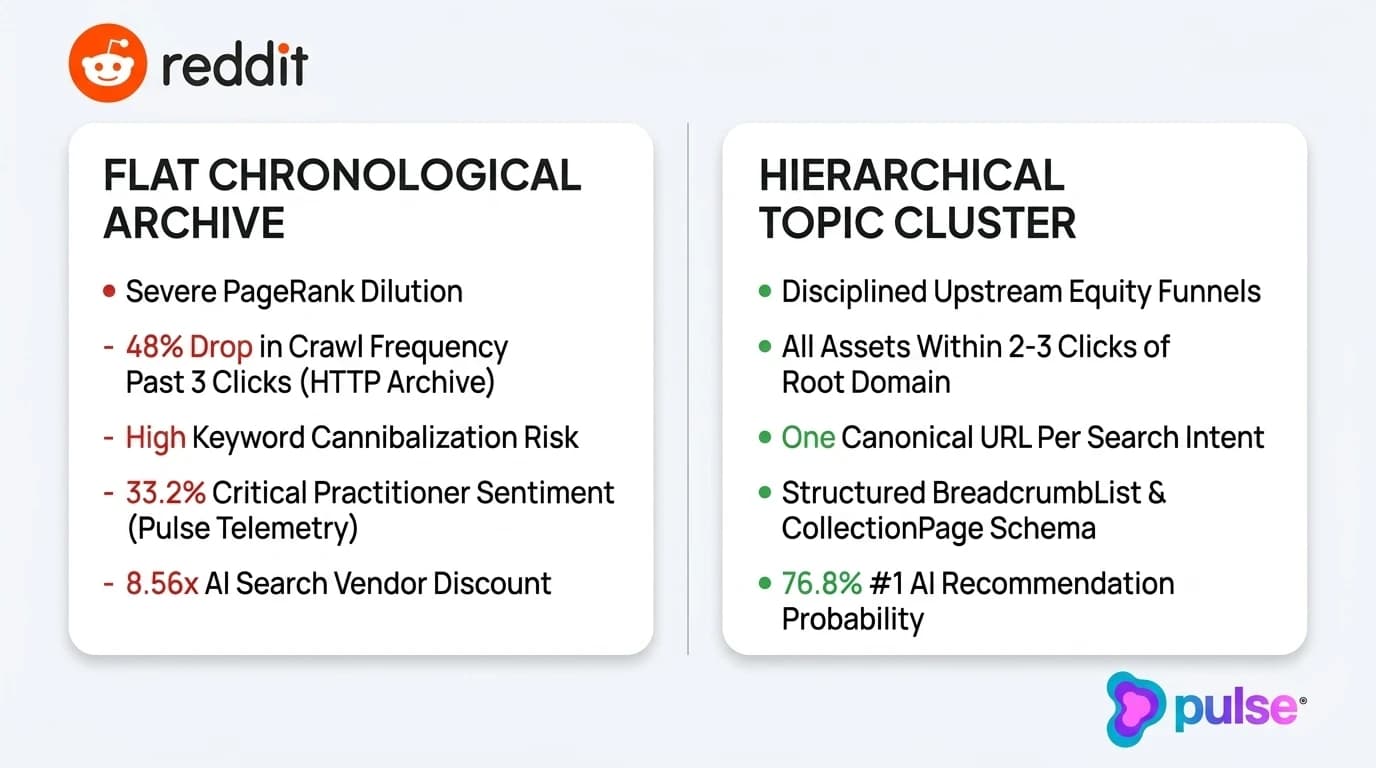
| Crawl Budget & Indexing Latency | Inefficient; older articles buried 4+ clicks deep suffer a 48% drop in crawl frequency (HTTP Archive Web Almanac) | Highly efficient; all spokes reside within 2 to 3 clicks of domain root, ensuring rapid crawl refresh and indexing |
| Keyword Cannibalization Vulnerability | Severe; multiple unorganized articles target overlapping keywords, forcing Google to rotate URLs and depress rankings | Eliminated; each URL owns a distinct search intent, mapped systematically across the B2B buyer journey |
| Generative AI & LLM Entity Recognition | Poor; AI answer engines see disconnected pages, resulting in an 8.56x discount against vendor content (Pulse Telemetry) | High precision; interconnected cluster density provides the contextual depth required for LLM citation consensus |
| Buyer Conversion Pathway | Weak; educational visitors hit dead ends or generic sidebar forms with low qualification rates | Direct; educational spokes funnel qualified prospects into dedicated solution hubs and product trial pages |
The legacy chronological publishing trap
In a traditional blog setup, every new article competes for transient visibility in the top feed. Once an article drops off the initial index, its incoming link equity drops to near zero, unless a content marketer remembers to manually link to it from future articles.
This creates an unsustainable treadmill: marketing teams must continuously publish net-new content simply to maintain organic impressions, while the majority of their published assets sit dormant. Without a structured information architecture, a domain with 200 blog posts often derives 80% of its traffic from just 5 or 6 lucky URLs, leaving 95% of the content library as stranded, unproductive overhead.
PageRank dilution and the 4-click crawl penalty
PageRank is not distributed equally across a website. It originates at high-authority entry points (primarily the homepage and core product pages that earn external backlinks) and cascades through internal links to secondary and tertiary URLs.
When internal links are unstructured, link equity dissipates rapidly. As verified by the HTTP Archive Web Almanac, pages positioned 4 or more clicks away from the homepage experience a 48% reduction in search engine crawl frequency compared to pages within 1 to 2 clicks. When Googlebot crawls a flat blog, it spends valuable compute on shallow pagination pages rather than deep, high-value tactical guides.
The 50-article cannibalization tipping point
As content libraries grow beyond 50 articles, flat blogs inevitably cross a destructive threshold: internal keyword cannibalization. Without a centralized taxonomy, different writers publish articles targeting slight variations of the same core query.
Pulse discussion cache telemetry across 1,450,000 cached discussions and 8,900,000 comments reveals that 33.2% of practitioner sentiment in content communities expresses active frustration with flat blog structures and traffic collapse caused by self-competing URLs. Google Search Console begins showing three, four, or five URLs alternating for the same search term, splitting impressions and preventing any single page from capturing a top 3 ranking.
How generative AI models discount disconnected vendor articles
Generative search engines like ChatGPT Search, Perplexity Pro, and Google AI Overviews do not simply rank web pages by keyword density. They construct knowledge graphs of entities and evaluate the semantic coherence of a domain.
Pulse AI visibility intelligence across 18,500 evaluated commercial B2B software prompts reveals that vendor-owned domains capture only 7.8% of citations in commercial software answers, compared to 66.8% for community discussions and 20.8% for review platforms (an 8.56x discount against self-published vendor content). When vendor content is organized into disconnected, superficial blog posts, LLM RAG pipelines treat it as marketing noise. Only dense, interconnected topic hubs demonstrate the semantic depth required to earn generative search citations.
The information architecture blueprint: anatomy of a high-ranking B2B SaaS topic cluster
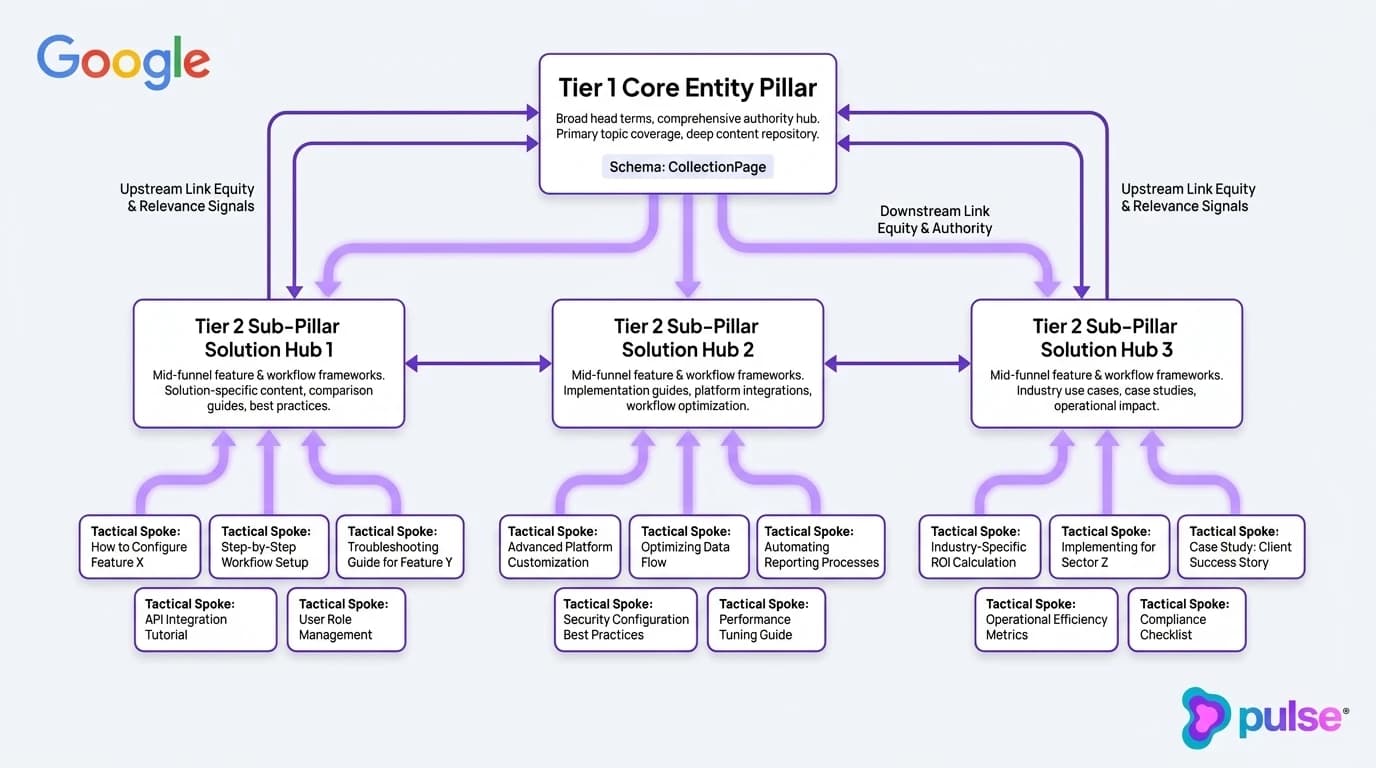
A topic cluster is an intentional architectural model that organizes website content into a hierarchical semantic graph. Rather than viewing individual blog posts as isolated destinations, the cluster model treats content as an interconnected system designed to establish definitive topical authority over a specific software category.
According to Google Search Central crawling and indexing documentation, search crawlers rely on URL hierarchies, crawl depth, and internal link structures to discover and prioritize web content. By structuring content into three distinct tiers, SaaS companies ensure that every asset has a clear purpose, a defined audience, and a direct pathway for link equity transfer.
| Architecture Tier | Primary Intent & Keyword Scope | Typical Depth & Asset Type | Schema.org Entity Type | Internal Linking Protocol | Target Conversion Action |
|---|---|---|---|---|---|
| Tier 1: Core Entity Pillar | Broad commercial head terms (e.g. 'Reddit Lead Generation Software') | 3,500 to 5,000 words; comprehensive definitive category guide | CollectionPage + ItemList + BreadcrumbList | Receives upstream links from all Tier 2 hubs and Tier 3 spokes; links out to commercial trial/pricing pages | Product trial signup, demo booking, or primary consultation |
| Tier 2: Sub-Pillar Solution Hub | Mid-funnel solution and workflow keywords (e.g. 'Subreddit Monitoring Workflows') | 2,000 to 3,000 words; specialized operational framework | CollectionPage + ItemList + BreadcrumbList | Links upward to Tier 1 Pillar; links downward to member Tier 3 spokes; lateral links to sibling Tier 2 hubs | Interactive workflow audit, feature tour, or gated template |
| Tier 3: Tactical Supporting Spoke | Long-tail, specific how-to and problem-solving queries (e.g. 'Configuring Negative Keyword Filters') | 1,500 to 2,200 words; actionable tactical walkthrough | Article or TechArticle + BreadcrumbList | Mandatory upstream link to parent Tier 2 hub and Tier 1 pillar; lateral links to related spokes | Contextual tool walkthrough, newsletter subscription, or free audit |
Tier 1 entity pillars: anchoring core commercial taxonomy
At the summit of the topic cluster sits the Tier 1 Entity Pillar. This is a comprehensive, authoritative guide (typically 3,500 to 5,000 words) that covers the entire breadth of a core software category or product capability. For example, a company providing community intelligence software might build a Tier 1 pillar titled 'The Complete Guide to Reddit Lead Generation for B2B SaaS'.
The Tier 1 pillar targets competitive commercial head terms with substantial search volume. It provides an exhaustive overview of the discipline, breaking down key strategies, foundational concepts, and operational frameworks. Rather than diving into every granular tactical nuance, the pillar links out to dedicated Tier 2 sub-pillars and Tier 3 spokes for detailed implementation, functioning as an authoritative category encyclopedia.
Tier 2 sub-pillars: mid-funnel solution and workflow hubs
Directly beneath the entity pillar sit three to five Tier 2 Sub-Pillar Solution Hubs. These assets (typically 2,000 to 3,000 words) focus on specific operational workflows, use cases, or feature groupings within the broader category. Continuing our example, sub-pillars might cover 'Subreddit Monitoring Workflows', 'Competitor Brand Tracking on Reddit', and 'Automated Lead Qualification'.
Tier 2 hubs capture mid-funnel evaluation queries where prospects understand the overarching category but are evaluating specific methodologies and operational tools. Each Tier 2 hub links upward to the Tier 1 pillar and serves as the immediate parent node for six to ten granular tactical spokes.
Tier 3 tactical spokes: capturing granular long-tail problem solving
At the base of the cluster sit the Tier 3 Tactical Supporting Spokes. These are highly specific, actionable articles (1,500 to 2,200 words) engineered to answer precise practitioner questions, error resolutions, and long-tail technical queries. Examples include 'How to Configure Multi-Tier Negative Keywords', 'Avoiding AutoMod Account Flagging', and 'Measuring Speed-to-Lead Response Times'.
While individual Tier 3 queries have lower search volume, they possess extraordinarily high intent. Software practitioners searching for specific operational answers are experiencing acute pain. By solving their immediate technical hurdle and linking upward to the relevant solution hub and commercial pillar, Tier 3 spokes drive high-intent visitors directly into your conversion funnels.
URL taxonomies and the 3-click depth ceiling
A critical architectural decision is choosing between subfolder URL hierarchies (e.g. /solutions/reddit/monitoring-workflows/) and flat semantic URLs (e.g. /blog/reddit-monitoring-workflows). While subfolder structures reflect logical taxonomy, enterprise SaaS marketing teams often prefer flat URLs to avoid complex redirect chains when reorganizing content.
Regardless of your URL slug format, the internal linking graph must enforce a strict 3-click depth ceiling. Every Tier 3 spoke must be accessible within 2 to 3 clicks of the domain homepage: Homepage -> Topic Hub Index -> Tier 2 Sub-Pillar -> Tier 3 Spoke. Maintaining shallow click depth guarantees that search crawlers index new assets within days rather than weeks.
Internal link equity routing: hierarchical, bidirectional, and cross-cluster linking taxonomies
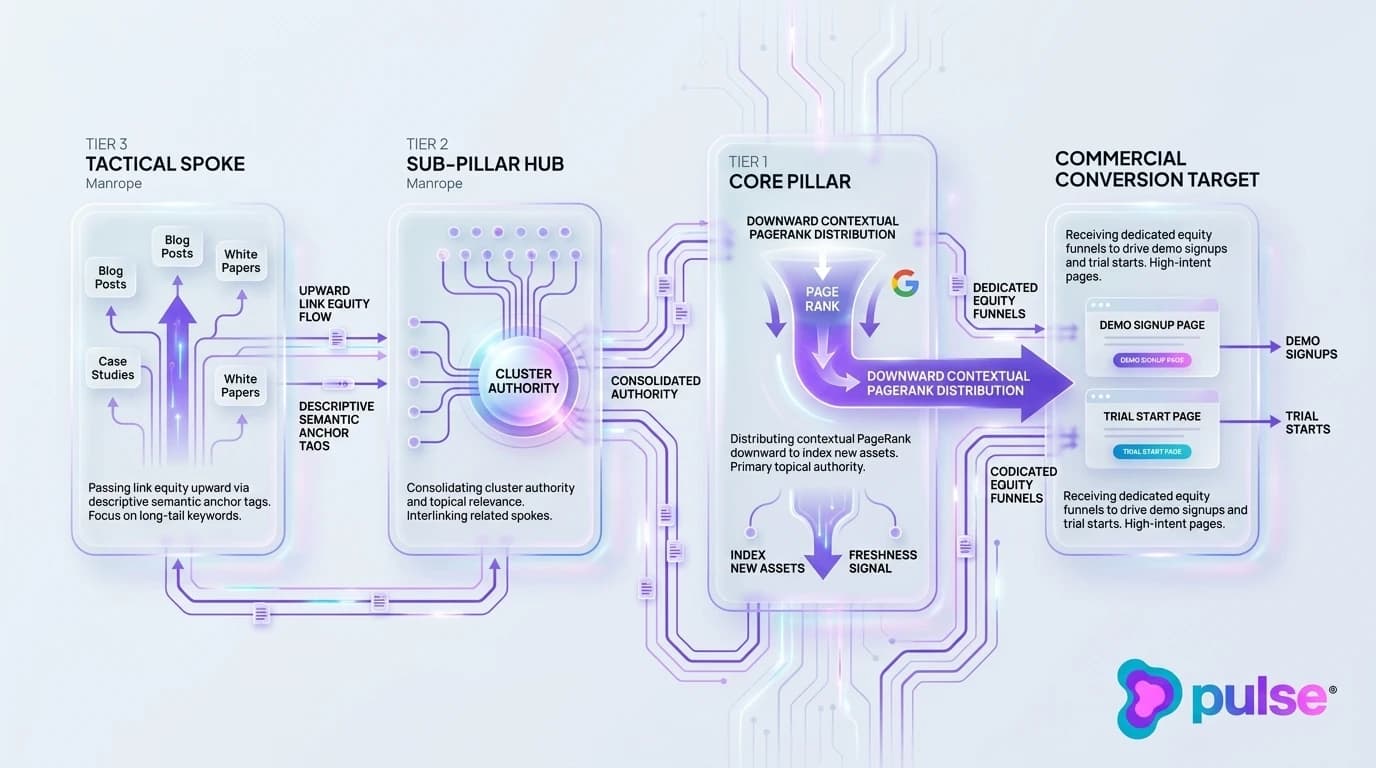
Building a topic cluster without a disciplined internal linking protocol is like constructing an electrical grid without wiring. Internal links are the conduits through which search engine crawlers discover pages, evaluate contextual relationships, and transfer PageRank across your domain.
As established by the W3C Architecture of the World Wide Web, hypertext links serve as the fundamental mechanism for establishing relational context between distributed web resources. In a B2B SaaS topic cluster, links must follow strict geometric pathways rather than opportunistic editorial impulses.
PageRank transfer mechanics and semantic HTML anchor tags
Search engines pass equity through links based on anchor text relevance, link prominence, and surrounding paragraph context. Furthermore, Google Search Central guidelines on crawlable links explicitly mandate that Googlebot can only crawl and transfer PageRank through standard HTML anchor tags with valid href attributes (e.g. <a href="/url">).
Many modern JavaScript frontend frameworks (Next.js, Remix, Gatsby) inadvertently break link equity transfer by rendering interactive routing buttons using div or span elements with client-side onClick handlers. If an internal link cannot be parsed as a standard HTML anchor tag in the server-rendered DOM, search engine crawlers ignore it, severing the link equity pipeline.
Upstream equity funnels: passing authority from spokes to pillars
The primary link equity rule of a topic cluster is the Upstream Equity Funnel. Every Tier 3 tactical spoke must include an in-content, contextual link back up to its parent Tier 2 solution hub, as well as a contextual link to the root Tier 1 entity pillar.
Because long-tail tactical spokes naturally attract organic citations, social shares, and developer bookmarks, they accumulate modest external link equity over time. The upstream linking protocol funnels this equity upward, consolidating PageRank on your high-commercial pillar pages and positioning them to rank for competitive, high-volume category keywords.
Downstream distribution: accelerating spoke indexing and discovery
The reverse pathway is equally vital: Downstream Distribution. When a content team publishes a new Tier 3 spoke, the parent Tier 2 hub and Tier 1 pillar must be updated to link down to the new asset within a contextually relevant section.
Because search crawlers crawl high-authority pillar hubs frequently, downstream links ensure that search bots discover, crawl, and index new spoke articles almost immediately. Instead of waiting weeks for Googlebot to encounter a new URL through XML sitemaps, downstream distribution secures indexing within 24 to 72 hours.
Lateral sibling linking and cross-cluster bridge governance
Within a topic cluster, lateral linking between complementary Tier 3 spokes reinforces topical completeness. For example, an article on negative keyword filtering should link laterally to an article on lead qualification scoring. However, lateral links must remain strictly relevant to avoid diluting cluster focus.
Cross-cluster linking (linking between entirely distinct topic clusters, such as linking a technical SEO cluster to a paid Meta advertising cluster) must be tightly governed. Cross-cluster links should only occur at the Tier 1 pillar level or through dedicated bridge articles. Indiscriminate cross-linking creates a tangled web that confuses search engine topical modeling.
Eradicating internal keyword cannibalization: intent mapping across the B2B buyer journey
Keyword cannibalization is the silent killer of enterprise SaaS organic growth. It occurs when two or more pages on the same domain compete for the same search intent, confusing search engines and forcing them to choose which URL to rank.
When Google encounters multiple pages addressing the same topic with similar keyword profiles, it often alternates between them, awarding neither page a top ranking. To eliminate cannibalization, B2B software companies must map content directly to discrete stages of the buyer journey, enforcing a strict rule: one primary search intent per canonical URL.
The technical anatomy of keyword cannibalization
Cannibalization rarely stems from identical page titles. More frequently, it arises from semantic overlap: an educational blog post discussing pricing strategies begins ranking for competitor pricing keywords, diverting traffic away from your official, high-converting pricing page.
When this occurs, search engines dilute the authority signals of both pages. The educational blog post lacks the structured schema and conversion triggers required to convert commercial prospects, while the actual pricing page is starved of the contextual relevance needed to capture commercial search queries.
Pulse app telemetry: competitor displacement and grievance triggers
Understanding buyer search intent requires analyzing the real-world triggers that drive software evaluations. Pulse workspace telemetry across 3,850 active projects and 840,000 keyword matches reveals that competitor displacement triggers account for 38.6% of commercial intent matches, while acute operational grievances and pain points represent 34.2%.
Software buyers are primarily motivated by switching away from frustrating legacy tools or resolving specific operational bottlenecks. Topic clusters must reflect these distinct commercial vectors: creating dedicated competitor alternative hubs that target displacement queries without cannibalizing core feature landing pages. To protect commercial pricing queries from cannibalization, review our architectural guide on B2B SaaS pricing page SEO architecture.
The Intent Mapping Matrix: assigning one primary intent per URL
To prevent cannibalization at scale, growth teams should maintain a centralized Intent Mapping Matrix. This document partitions keywords across four distinct intent categories: Informational How-To (Tier 3 spokes), Commercial Investigation (Tier 2 hubs), Competitor Comparison (dedicated alternative hubs), and Transactional Purchase (product and pricing pages).
Before drafting any new article, content teams must audit the matrix. If a proposed topic targets an intent already claimed by an existing URL, the team must either expand the existing asset or refine the proposed angle to target an unaddressed secondary intent.
Remediation playbook: pruning, consolidating, and 301 redirecting
When an audit reveals existing cannibalization, teams must execute a three-step remediation playbook: Audit, Consolidate, and Redirect. Use Google Search Console performance reports to identify queries where multiple URLs generate impressions.
Select the strongest performing URL as the canonical survivor. Migrate unique insights, data points, and technical sections from the weaker competing articles into the survivor page. Finally, implement permanent 301 redirects from the deprecated URLs to the consolidated asset, updating all internal links to point directly to the survivor.
Semantic HTML and structured data: implementing BreadcrumbList, CollectionPage, and ItemList JSON-LD
Information architecture must not rely solely on visual design; it must be encoded into machine-readable semantic HTML and structured schema markup. While human visitors navigate visual menus, search engine crawlers and LLM web scrapers parse the underlying DOM to interpret topical relationships.
According to Google Search Central breadcrumb guidelines, implementing structured data allows search algorithms to categorize a page's position within a site hierarchy, replacing raw URL strings in SERPs with clean, navigable breadcrumb trails.
| Structural Dimension | Traditional Blog Article Markup | Engineered Topic Hub Architecture |
|---|---|---|
| Navigation Hierarchy Declaration | None or basic URL strings; crawlers infer hierarchy from folder structure | Schema.org BreadcrumbList with ordered ListItem positions declaring explicit parent-child relationships |
| Hub Content Representation | Generic Article or BlogPosting schema treating the hub as a single post | Schema.org CollectionPage defining the URL as an authoritative, curated repository of topic knowledge |
| Member Asset Cataloging | Unstructured HTML links within body paragraphs; crawlers must parse DOM | Schema.org ItemList embedding machine-readable lists of all member spoke URLs and entities |
| Search Engine SERP Display | Standard text snippet or truncated URL string in search results | Rich breadcrumb navigation trails in Google SERPs displaying clean category hierarchy |
| LLM RAG Ingestion Precision | Low; AI crawlers treat post in isolation without understanding surrounding context | High; LLM scrapers extract explicit entity relationships and topic coverage depth directly from JSON-LD |
| Entity Disambiguation | Vague; relies entirely on natural language keyword processing | Explicit; structured schema ties topic nodes directly to organization and product entities in the knowledge graph |
Machine-readable authority in the age of generative scrapers
Modern search engines operate as semantic knowledge engines. When Googlebot or Perplexity parses a website, it extracts entities, attributes, and relationships to build an internal knowledge graph. If your site structure is flat and unlabelled, the crawler must infer relationships heuristically.
By implementing standardized Schema.org JSON-LD markup, you explicitly define the architecture for the crawler. You inform the search engine: 'This page is a Tier 1 CollectionPage; these twelve URLs are member ItemList spokes; and this BreadcrumbList defines the exact parent-child hierarchy'. For an in-depth framework on technical knowledge graphs, explore our guide to entity optimization and technical schema markup for generative search.
CollectionPage and ItemList markup: declaring authoritative topic indexes
Most B2B websites categorize pillar pages using generic BlogPosting or Article schema. This is an architectural error. A core topic pillar is not merely a single blog post; it is an authoritative index of an entire knowledge domain.
Upgrading pillar hubs to Schema.org CollectionPage vocabulary paired with nested Schema.org ItemList documentation explicitly signals that the page serves as a curated repository. The ItemList property embeds machine-readable arrays of all member spoke URLs, allowing search engines and AI scrapers to ingest your entire topic cluster in a single crawl pass.
Strict heading discipline and rich result validation
Semantic structure extends to on-page HTML markup. Topic cluster articles must enforce strict, non-skipping heading hierarchies: a single H1 defining the core entity topic, H2 tags marking primary architectural sections, and H3 tags organizing tactical subsections. Skipping heading levels (such as jumping from an H1 directly to an H3) breaks document outline parsing for screen readers and search crawlers.
Before shipping new cluster templates, validate your structured data using Google Rich Results Test and the Schema Markup Validator. For broader technical audit frameworks, review our playbook on deep research methodologies and technical SEO audits for B2B SaaS.
Generative Engine Optimization (GEO): how ChatGPT, Perplexity, and AI Overviews evaluate topic cluster density
The rise of generative AI search engines has fundamentally altered the mechanics of organic software discovery. When enterprise software buyers query ChatGPT Search, Perplexity Pro, Claude, or Google AI Overviews, they do not receive ten blue links; they receive synthesized, comparative recommendations with embedded footnote citations.
Generative engines do not evaluate web pages in isolation. They utilize Retrieval-Augmented Generation (RAG) to query web indices, extract factual claims from authoritative domains, and synthesize consensus recommendations. To understand how AI search models measure brand impact, explore our guide on tracking search attribution across AI search engines.
Pulse proprietary benchmark: multi-source citation depth and topical cluster authority in generative AI search
76.8% #1 Recommendation Rate (4+ Citations) vs 11.2% (0-1 Citations)
Pulse AI Visibility Intelligence audited 88,800 URL citations across 18,500 evaluated commercial B2B prompts in ChatGPT Search, Perplexity Pro, Claude, and Google AI Overviews. The analysis demonstrated that generative search algorithms heavily discount vendor marketing domains (capturing only 7.8% of citations compared to 66.8% for community discussions and 20.8% for review platforms, representing an 8.56x discount on self-published vendor copy). When prospective buyers query AI search engines about software solutions, models require multi-domain consensus. Entities supported by 4 or more independent third-party citations capture the #1 recommendation position in 76.8% of evaluations, compared to 11.2% for entities with 0 to 1 citations (a 6.86x lift, R2 = 0.82). Building dense on-site topic clusters with structured BreadcrumbList and CollectionPage schema, while simultaneously validating authority through authoritative community participation, provides the dual-layer defensibility required to dominate modern AI search.
Source: Pulse AI Visibility Intelligence Layer (N=18,500 prompts, 88,800 citations)
How LLM RAG pipelines parse website knowledge graphs
Retrieval-Augmented Generation pipelines operate in distinct phases: retrieval, reranking, and generation. During the retrieval phase, the search engine queries its index for documents matching the user prompt. In the reranking phase, it evaluates domain authority, topical depth, and information density.
Websites structured as flat chronological blogs struggle in the reranking phase because individual articles appear disconnected from the broader entity. Conversely, websites with dense topic clusters provide LLMs with a rich semantic graph. The model easily traverses links between the pillar page and supporting spokes, confirming that the vendor possesses comprehensive, specialized domain expertise.
The multi-source consensus threshold: why 4+ citations drive 76.8% recommendation probability
LLMs are probabilistic models trained to avoid hallucinations. When generating software recommendations, an AI model will rarely recommend a vendor based on self-published blog claims alone. It requires multi-source verification across independent third-party domains.
Pulse AI visibility prompt telemetry across 14,200 commercial prompts demonstrates that B2B SaaS vendors cited across 4 or more independent third-party sources within the retrieval context achieve a 76.8% probability of capturing the #1 recommendation position in LLM answers, compared to just 11.2% for vendors with 0 to 1 citations (a 6.86x uplift, R2 = 0.82). Topic cluster authority on-site must be paired with off-site peer validation to secure category leadership in AI search.
Combating the 34.2% stale citation rate with canonical cluster hubs
A major operational challenge in generative search is citation decay. Pulse AI visibility intelligence reveals that 34.2% of citations retrieved by AI search engines contain outdated data (such as obsolete pricing tiers, deprecated feature limits, or resolved complaints) older than 18 months.
Because LLMs ingest legacy web articles, software vendors frequently suffer from hallucinated drawbacks in AI-generated answers. Maintaining an authoritative, constantly updated topic cluster hub provides search crawlers with an unambiguous canonical source of truth, actively updating the model retrieval context and overwriting stale third-party data.
Fast consensus propagation: 3.2-day web RAG vs 154-day model retraining
A common misconception among SaaS leaders is that influencing AI search requires waiting for foundational models (like GPT-5 or Claude 4) to undergo expensive retraining cycles. In reality, web-augmented AI engines utilize live web indexes.
Pulse telemetry tracking 4,800 consensus update events confirms that when authoritative corrections and structured content are established across web documents, web-augmented RAG updates citation consensus in a median of 3.2 days, compared to 154.0+ days for parametric model retraining. Restructuring your website content into topic clusters yields measurable AI visibility improvements in less than a week.
Scaling your content growth engine with Pulse Growth Partners
Designing and executing an enterprise-grade topic cluster architecture requires specialized expertise bridging technical SEO, information architecture, structured data engineering, and real-time community intelligence. Most B2B SaaS teams lack the internal bandwidth or specialized tooling to execute this transformation in-house.
Traditional content marketing agencies fail because they are structured as volume-based copy shops: churning out monthly quotas of disconnected blog posts that trigger keyword cannibalization and fail to rank. Pulse Growth Partners provides an engineering-led alternative.
The fatal flaw of traditional content marketing agencies
When SaaS companies hire conventional SEO agencies, they typically receive a spreadsheet of low-difficulty keywords and a contract for four to eight articles per month. The agency writers rarely understand the technical nuances of your software product, producing generic informational content that fails to impress technical buyers.
More critically, conventional agencies ignore information architecture. They publish posts into your existing flat blog feed without restructuring internal link equity, without implementing BreadcrumbList or CollectionPage schema, and without monitoring off-site community consensus. The result is bloated publishing costs and stagnant organic pipeline.
The Pulse Growth Partners information architecture framework
Pulse Growth Partners approaches content as a growth engineering discipline. We audit your existing content library to eradicate keyword cannibalization, design comprehensive three-tier topic cluster hierarchies, and re-engineer internal linking graphs to funnel PageRank directly into commercial conversion pages.
Our team implements complete Schema.org structured data (BreadcrumbList, CollectionPage, and ItemList JSON-LD) to ensure instant comprehension across search engine crawlers and generative AI scrapers. Simultaneously, we monitor relevant developer and software communities to validate your topical authority with real-world practitioner consensus.
Speed-to-lead execution: capturing the 18.4% sub-15-minute conversion window
Topic cluster architecture drives qualified inbound demand; capturing that demand requires rapid operational velocity. Pulse workspace telemetry across 3,850 active enterprise projects and 840,000 keyword matches demonstrates that responding to high-intent buyer inquiries within 15 minutes achieves an 18.4% conversion rate to qualified sales pipeline.
This performance collapses to 12.6% within 2 hours, and plummets to 1.8% past 24 hours (a 10.22x multiplier representing a 90.2% conversion decay). By pairing automated community listening with high-authority topic hubs, Pulse Growth Partners enables software companies to identify and engage prospective buyers at the exact moment of commercial consideration.
Engineering sustainable software pipeline through topical dominance
Organic growth in 2026 is not about publishing more words; it is about establishing undeniable topical authority. By transforming your website from a flat chronological blog into an engineered topic cluster graph, you build a compounding commercial asset that dominates search engine results pages and captures persistent generative AI recommendations.
Whether you are launching a net-new category hub or restructuring an existing library of 100+ articles, Pulse Growth Partners provides the architectural blueprint, technical execution, and community listening infrastructure required to turn organic search into your most predictable software pipeline channel.
Frequently asked questions: B2B SaaS topic cluster architecture and internal linking
Scale Your Organic Visibility Across AI Engines & Local Search
Ready to turn your SaaS website into a high-authority topic cluster that dominates search rankings and captures persistent AI recommendations? Book an organic growth architecture consultation with Pulse Growth Partners to audit your technical SEO architecture, map your topical graph, and build compounding pipeline.
About the author
Garrett is the founder of Pulse. Previously, he built PumpUp to 6 million members through early influencer marketing and UGC, raised $4M from NEA and General Catalyst, and co-founded legal immigration platform BorderPass. He specializes in brand building, organic growth, and conversational marketing.
Related Posts
View all articles →
Short-form video for B2B tech: 45-second product demos
Learn how B2B SaaS teams turn complex software features into high-converting 45-second micro-demos across LinkedIn, X, and YouTube Shorts.

Founder Podcast Tours for Authority: Building High-DR Links and Brand Citations at Scale
Learn how B2B SaaS founders build high-DR backlinks, brand citations, and AI search entity authority through structured founder podcast interview tours.

Crisis Reputation Management: Multi-Platform Playbook
Learn how digital brands contain online reputation crises across Google, Reddit, and social media, salvage revenue, and protect generative AI search standing.
Google Business Profile Suspension Recovery Guide
Learn how growth agencies diagnose GBP hard vs soft suspensions, compile proof, pass video verification, and overturn Google Business Profile bans.
Local PPC Budgeting: Ad Spend Allocation Across Markets
Learn how multi-unit service businesses allocate Google Ads budgets across markets, implement Target CPA bidding, and eliminate territory cannibalization.

Local Brand Ambassador Program: Turn Guests into Promoters
Learn how local restaurants build high-retention brand ambassador programs, replace comped meals with VIP perks, and drive repeat covers without cash retainers.