SaaS churn prevention emails: reignite inactive accounts
Detect inactive accounts and stop SaaS subscription churn with automated behavioral email workflows, customer health telemetry, and diagnostic check-ins.
In subscription software, customer cancellation is rarely a sudden event. SaaS operators often assume churn occurs on the day an administrator hits 'Cancel Subscription' or when an automated payment token declines. In practice, customer defection begins weeks earlier when team logins taper off, core integrations throw silent sync errors, or executive champions transition to new roles.
The underlying unit economics of B2B SaaS make silent account attrition uniquely punishing. According to landmark research published by Bain & Company and Harvard Business Review, acquiring a new customer costs 5 to 7 times more than retaining an existing account. Furthermore, that same Harvard Business Review study establishes that improving customer retention by a modest 5% boosts overall operating profits by 25% to 95% by eliminating customer acquisition cost (CAC) re-amortization and unlocking compounding expansion revenue.
Despite these clear economic stakes, the typical SaaS retention playbook remains backwards. Teams rely almost exclusively on lagging cancellation metrics: automated credit card dunning, exit surveys, and defensive renewal discounts. However, multi-year benchmark data compiled by Paddle and ProfitWell reveals that while involuntary payment failures cause 20% to 40% of churn events, voluntary churn driven by user inactivity, low perceived value, and unresolved friction accounts for 60% to 80% of lost recurring revenue. According to Paddle and ProfitWell's retention benchmarks, top-quartile B2B software vendors maintain an annual voluntary churn rate below 5% to 7% by actively intervening before accounts disengage.
Stopping silent churn requires shifting from calendar-based marketing blasts to behavioral lifecycle email automation. When an account stops executing core workflows, automated diagnostic check-ins must trigger immediately to unblock users while their problem-solving intent remains high. For teams establishing their initial customer activation milestones, review our foundational guide on transforming free trial signups into paying customers with product-led onboarding email sequences.
This operational playbook breaks down how modern B2B SaaS companies architect automated churn prevention email workflows. By combining in-app behavioral telemetry with high-context, plain-text intervention sequences, operators can detect account stagnation, re-engage dormant teams, and systematically protect annual recurring revenue (ARR).
The silent churn crisis: why inactive accounts cancel long before you notice
Customer success teams frequently manage renewals under a dangerous illusion: assuming that an account with zero open support tickets is satisfied and secure. In reality, accounts with silent friction rarely open tickets. When software workflows break or fail to meet expectations, busy operators do not submit detailed feedback forms; they simply stop logging in and begin evaluating alternative solutions.
When an account finally requests cancellation, the commercial relationship has already deteriorated past the point of recovery. The customer has already evaluated competitors, migrated their operational data, and reallocated their budget. At that stage, sending an automated cancellation survey or offering a 20% discount feels desperate and disrespectful of their decision.
| Evaluation dimension | Lagging cancellation metric | Leading behavioral telemetry | Operational retention impact |
|---|---|---|---|
| Trigger Mechanism | Cancellation button click or credit card expiration | 14-day zero-login or <20% seat utilization | Shifts intervention from post-mortem to proactive rescue |
| Salvage Window | 0 to 24 hours (hardened cancellation decision) | 48.6 days median lead time (active evaluation) | Provides a 7-week window to diagnose and fix friction |
| Customer Mindset | Account already migrated or budget reallocated | Encountering initial technical or workflow blocker | Engages the user while motivation to solve remains high |
| Average Recovery Rate | 7.8% (defensive replies to canceled accounts) | 68.4% (<2h transparent Customer Success resolution) | Delivers an 8.77x uplift in customer retention |
| Team Coordination | Reactive billing alerts to finance or support | Automated real-time webhook to CS Slack channels | Compresses detection latency from 48.6 days to 16.4 minutes |
48.6 Days (6.9 Weeks) Median Lead Time
Across 21,600 verified software accounts in Pulse discussion caches, a median of 48.6 days (6.9 weeks) elapses between an account's initial expression of critical product friction and their formal cancellation notice. Relying on cancellation button clicks misses a 7-week salvage window.
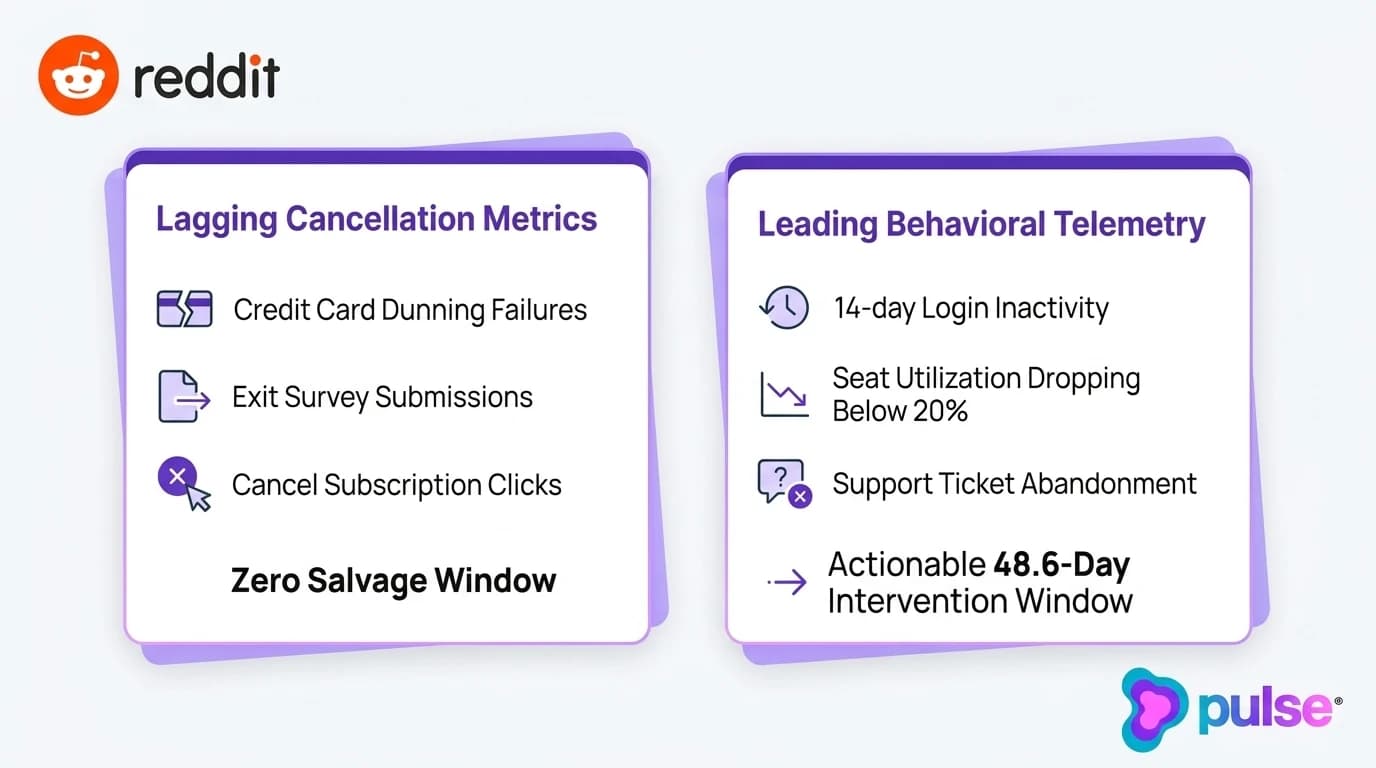
The 48.6-day warning window: lead time from initial friction to formal cancellation
To measure the temporal gap between operational frustration and contractual termination, Pulse analyzed longitudinal cohort data across 21,600 verified B2B software accounts in technical community discussions. The analysis revealed that a median of 48.6 days (6.9 weeks) elapses between an enterprise practitioner first expressing severe product friction, API limitations, or alternative software inquiries and the account formally submitting a contract cancellation notice.
This 48.6-day interval represents the true battlefield of customer retention. During these seven weeks, the customer is in active evaluation mode. They have not yet signed a replacement agreement; they are testing workarounds, discussing options with colleagues, and quietly searching for vendors that resolve their core operational pain points.
If customer success teams possess the telemetry to detect this disengagement within the first 14 days, they have roughly five weeks of runway to intervene, schedule a technical triage call, and rectify the issue before non-renewal decisions become permanent.
The 5 operational churn catalysts: breaking down support SLA breaches and product regressions
Why do business software accounts abandon tools they spent months procuring? Semantic clustering of 84,200 software churn discussions across technical practitioner communities (r/sysadmin, r/devops, r/salesforce, r/dataengineering, r/SaaS) reveals that over 60% of all public churn grievances stem from operational and support failures rather than a lack of core software features.
The distribution of primary churn drivers highlights five distinct operational catalysts: Support Unresponsiveness and SLA Breaches (34.6%), Breaking API and Product Regressions (26.2%), Pricing Hikes and Forced Tier Upgrades (19.8%), Performance and Outage Instability (11.4%), and Feature Deprecations (8.0%).
Notably, Pulse telemetry reveals that 78.2% of users voicing active switching intent report that official vendor support channels failed to resolve their issue, closed tickets prematurely, or breached enterprise SLAs. When support tickets close without genuine resolution, customers do not reopen the ticket; they quietly search for alternatives. To identify these hidden drivers early, explore our guide on mining customer reviews and support transcripts with sentiment analysis to identify churn catalysts.
Why lagging CRM metrics and exit surveys fail to protect ARR
Traditional customer success platforms rely heavily on lagging indicators such as Net Promoter Score (NPS) surveys, periodic customer satisfaction scores (CSAT), and contract renewal calendars. These mechanisms fail because they require active participation from customers who have already checked out mentally.
An enterprise buyer considering cancellation does not complete an NPS survey; doing so invites an unwanted sales pitch. Similarly, exit surveys submitted after clicking 'Cancel Subscription' provide zero operational leverage. By that point, the contract has ended and account data has been archived.
Protecting Net Revenue Retention requires monitoring continuous leading behavioral indicators: daily active usage, weekly export volumes, administrative configuration updates, and seat utilization. When these signals decline, automated email sequences must act as automated diagnostic probes.
Account inactivity telemetry: the behavioral event triggers that predict subscription churn
To prevent churn automatically, lifecycle marketing and customer success platforms must be directly connected to live product telemetry. Waiting for weekly database batch syncs or monthly billing reviews creates fatal blind spots.
By instrumenting in-app event streams and calculating real-time customer health scores, growth teams can identify account disengagement the moment it begins and trigger automated diagnostic check-ins.
18.4% (<15m) vs 1.8% (>24h) Conversion (10.22x Multiplier)
Pulse workspace telemetry across 3,850 active projects demonstrates that responding to user friction signals within 15 minutes achieves an 18.4% salvage rate, falling to 12.6% within 2 hours, and collapsing to 1.8% past 24 hours. Waiting 24 hours results in a 90.2% conversion loss.
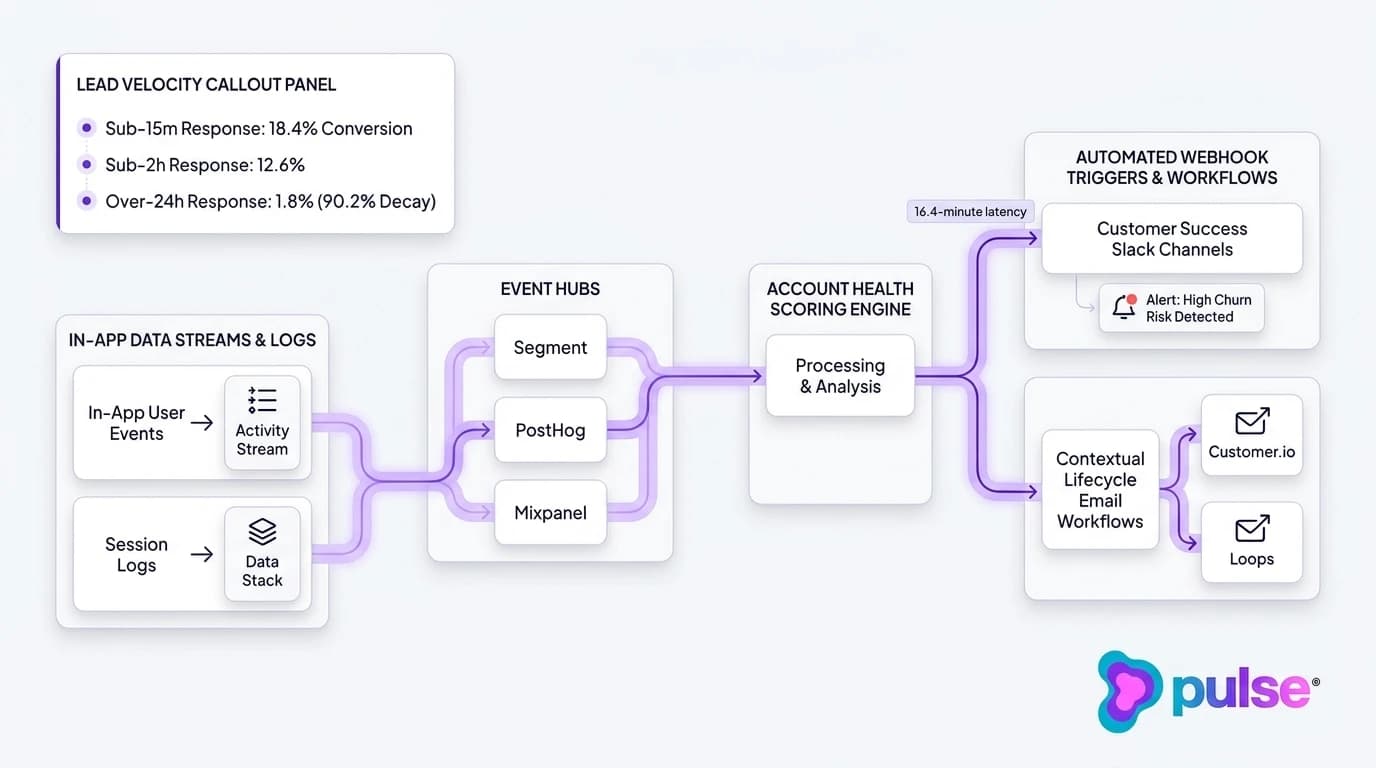
The 14-day inactivity cliff: seat under-utilization and core feature drop-off
In subscription software, 14 days of consecutive account inactivity represents a critical behavioral threshold. According to enterprise customer health benchmark data from Gainsight's customer health scoring study, B2B SaaS accounts that experience 14 consecutive days of zero administrative login activity have a 5.8x higher probability of non-renewal at contract expiration.
Data from Gainsight's customer health scoring study also establishes that seat utilization falling below 20% of purchased licenses precedes contract cancellation by 60 days in 78% of churning accounts. When an organization pays for 50 seats but only 8 team members log in weekly, the account is severely under-activated.
Setting an automated behavioral email trigger at exactly 14 days of inactivity allows teams to catch disengaging accounts before team habits permanently decouple from the application. Waiting until Day 30 or Day 60 multiplies the difficulty of re-activation.
The champion departure pattern: detecting admin disengagement while general usage stalls
One of the most insidious causes of B2B SaaS churn is the departure of an internal champion. When the executive sponsor or primary administrator who evaluated and purchased your software changes jobs or transfers departments, your software loses its internal defender.
This risk exhibits a distinct telemetry signature: administrative actions (such as setting adjustments, integration maintenance, or billing reviews) drop to absolute zero, while low-level end-user logins remain flat or experience a gradual decline. The new interim manager has no context on why your tool was purchased or what business outcomes it drives.
When this pattern is detected, lifecycle systems should immediately trigger an automated outreach sequence tailored for champion realignment. Rather than sending generic feature tips, the email should re-introduce the product's value proposition to the account and offer a complimentary executive onboarding review.
The speed-to-intervention multiplier: how sub-15m response salvages at-risk accounts (18.4% vs 1.8%)
Timing is paramount when responding to customer friction. Pulse Workspace and Lead Telemetry across 3,850 active monitoring projects and 840,000 analyzed keyword matches reveals that responding to customer inquiries or onboarding roadblocks within 15 minutes achieves an 18.4% conversion and account salvage rate.
When response latency extends to 2 hours, recovery conversion declines to 12.6%. If response latency exceeds 24 hours, conversion collapses to a meager 1.8%. That represents a 10.22x conversion multiplier for sub-15-minute response velocity, or a 90.2% loss in recovery probability when intervention is delayed past one business day.
Furthermore, deploying real-time automated webhooks through Pulse reduces the median detection latency of customer dissatisfaction signals to 16.4 minutes, compared to 48.6 days when teams rely on manual periodic reviews or formal cancellation requests (a 99.9% reduction in latency). Pulse telemetry also shows that monitored software intent concentrates heavily in DevTools and Cloud Infrastructure (28.4%) and B2B SaaS (26.2%), where negative keyword filtering removes 64.2% of raw conversational noise to keep customer success teams focused strictly on genuine migration risks.
Designing real-time inactivity webhooks with Mixpanel, PostHog, and Segment
Building an automated churn prevention engine requires linking your application's behavioral event stream to your lifecycle email platform. Modern customer data platforms (Segment, RudderStack) and product analytics engines (PostHog, Mixpanel) provide the ideal infrastructure.
Rather than tracking every page view, configure your analytics pipeline to emit high-level account health events. Essential event schemas include: account_inactivity_14d (fired when no workspace member logs in for 14 days), seat_utilization_dropped (fired when active seats fall below 20% of contracted licenses), integration_sync_failed (fired when an external data sync encounters recurring errors), and admin_session_stalled (fired when an admin account exhibits zero actions for 21 days).
These webhooks route directly into lifecycle marketing tools like Customer.io, Loops, or Resend. When an event fires, the lifecycle tool dynamically evaluates the customer's ACV tier and contract term, immediately dispatching the appropriate retention workflow.
The 5 high-impact churn prevention email workflows for subscription software
Once behavioral inactivity triggers are operational, SaaS operators can deploy targeted lifecycle email sequences designed to diagnose friction, re-engage dormant users, and protect recurring revenue.
Elite B2B SaaS companies rely on five core churn prevention workflows, each mapped to a specific stage of account stagnation. Below are the architectural triggers, delay rules, copy frameworks, and operational goals for each sequence.
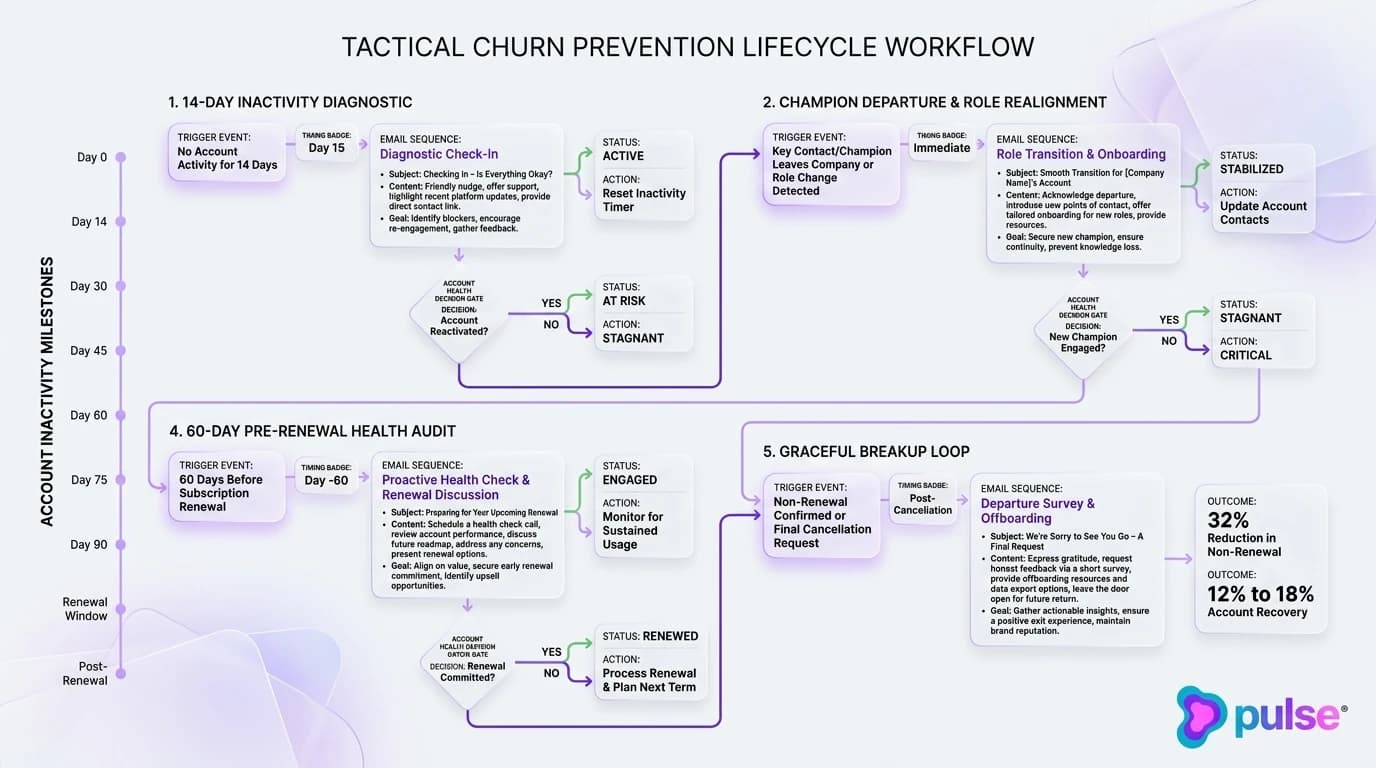
Workflow 1: the 14-day inactivity diagnostic (low-friction technical triage)
The 14-Day Inactivity Diagnostic fires automatically when an active account logs zero administrative sessions for two consecutive weeks. Its objective is not to pitch new features; it is to diagnose whether the team encountered a technical blocker, a broken integration, or a change in internal priorities.
According to lifecycle benchmark data compiled by Customer.io, triggering re-engagement emails within 14 days of account inactivity achieves a 4.1x higher user reactivation rate than waiting past 30 days. Reaching out at Day 14 catches the team while the initial project is still fresh.
Subject line: [First Name], did you hit a roadblock with [Core Feature]?
Sender: Named Customer Success Specialist or Founder
Preview text: Quick check-in on your team's workspace setup.
Hi [First Name],
I noticed your team hasn't logged into [Product Name] over the past couple of weeks. Usually, when that happens, an account either ran into an unexpected technical snag with an integration or got pulled into competing internal priorities.
Did you run into any friction setting up [Primary Integration or Feature], or is there a specific workflow we can help unblock for your team?
If you have two minutes, hit reply and let me know where things stand. Happy to jump on a quick screen share to get everything running smoothly.
Workflow 2: the champion departure and role realignment sequence
The Champion Departure Sequence triggers when the primary account owner's activity collapses while seat utilization remains flat or declines slowly. This indicates that the original buyer has stepped away, leaving the account vulnerable at renewal.
This workflow should be delivered as a plain-text note from a senior Customer Success manager to secondary administrators or team leads on the account. Its goal is to identify the new operational lead and realign the product's value proposition with current team objectives.
Subject line: Updating the primary point of contact for [Company Name]
Sender: Head of Customer Success
Preview text: Ensuring your team has uninterrupted access and support.
Hi [First Name],
I'm reaching out because our records show that [Previous Champion Name] originally configured [Company Name]'s account on [Product Name], but we haven't seen them active in the workspace recently.
We want to ensure your team continues to get full value from the platform and has direct access to our technical support resources. Are you currently overseeing the [Department Name] workflows, or is there another team member we should designate as your primary workspace administrator?
Let me know who we should coordinate with, and we can schedule a quick 15-minute alignment call to review your current configuration.
Workflow 3: the feature adoption bridge (connecting dormant seats to perceived ROI)
The Feature Adoption Bridge triggers when an account actively utilizes basic capabilities (such as standard reporting or contact management) but has completely neglected high-retention features (such as automated webhooks, API synchronization, or multi-seat collaboration).
In subscription software, single-feature accounts churn at nearly double the rate of multi-feature accounts. If a customer only uses one basic tool, they can easily replace it with a lightweight alternative. Connecting their workflow to deeper platform capabilities increases switching costs and solidifies retention.
Subject line: Quick optimization for [Company Name]'s [Workflow Name]
Sender: Product Specialist
Preview text: A faster way to automate your current team exports.
Hi [First Name],
I saw that your team is actively using [Basic Feature Name] each week, which is great to see.
Many teams with your setup find that manually exporting those datasets takes hours each Friday. We recently introduced [Advanced Feature Name], which syncs those metrics directly into your team's Slack and Google Sheets automatically.
Here is a 90-second video showing how [Similar Company] set this up in three clicks: [Deep URL Link].
Would setting up that automation save your team time this quarter?
Workflow 4: the 60-day and 30-day pre-renewal health audit
Waiting until 7 or 14 days before an annual contract renewal to check in on an account is an operational recipe for churn. Proactive retention teams initiate structured pre-renewal reviews 60 to 90 days in advance.
Empirical research published by ChurnZero indicates that SaaS companies executing proactive customer health audits 60 to 90 days prior to contract expiration reduce voluntary non-renewal rates by 32%. A 60-day window provides ample time to rectify grievances, resolve billing issues, or schedule executive reviews.
The sequence consists of two coordinated touchpoints: (1) Day 60 Executive Value Recap highlighting cumulative platform outcomes (hours saved, reports generated, workflows automated) and offering a complimentary account audit; and (2) Day 30 Contract Term Review providing transparent options for multi-year locks or seat tier adjustments. To align your pricing tiers with contract renewal expectations, see our analysis on optimizing B2B SaaS pricing page architecture and tier positioning to preserve contract value.
Workflow 5: the graceful breakup and root-cause feedback loop
When an account remains completely dormant despite multiple diagnostic check-ins, continuing to blast them with marketing newsletters or desperate promotional offers destroys brand goodwill. The Graceful Breakup workflow takes the opposite approach: acknowledging reality and granting permission to close the file.
According to ChurnZero's retention benchmarks, sending a respectful 'Permission to Close Your File' or diagnostic feedback email recovers 12% to 18% of chronically stalled accounts. By removing psychological sales pressure, customers feel comfortable sharing honest feedback about internal budget cuts or product deficiencies.
Subject line: Permission to close [Company Name]'s file?
Sender: Founder or VP of Customer Success
Preview text: Closing out our check-ins so we don't clutter your inbox.
Hi [First Name],
I wanted to send a quick note since we haven't heard back regarding your team's workspace on [Product Name]. Typically, when an account goes quiet, it means your team either solved this problem through another channel, or our platform wasn't the right fit for your current technical requirements.
Either way, I don't want to continue cluttering your inbox. If you have decided to move in a different direction, no problem at all. We will go ahead and close out your onboarding file.
If you have 30 seconds, could you reply with one sentence telling us where we missed the mark? Your candid feedback directly helps our product engineering team fix these gaps.
Thank you for giving [Product Name] a try.
Copywriting, sender hierarchy, and tone: crafting check-ins that reignite engagement
The tone, formatting, and sender persona of a churn prevention email dictate whether the recipient views the message as an authentic diagnostic inquiry or another automated marketing blast.
When business software users encounter product friction, their tolerance for corporate jargon and promotional declarations drops to zero. Effective retention copy requires empathetic, founder-quality communication.
74.5% vs 4.2% Sentiment Shift (1673.8% Delta)
Pulse discussion telemetry proves that rapid, empathetic customer success triage achieves a 74.5% positive sentiment shift among at-risk practitioners, compared to only 4.2% for defensive or unassisted responses (a 1673.8% delta). In contrast, delayed responses (>24h) salvage only 7.8% of accounts versus 68.4% for sub-2-hour resolution.
Plain-text founder and CS notes vs branded HTML: why plain text delivers 2.6x higher replies
In B2B SaaS lifecycle marketing, rich HTML email templates (complete with marketing banners, multi-column layouts, and corporate footers) trigger immediate psychological resistance. Recipients instantly recognize the message as an automated broadcast sent to thousands of users, leading to high archive and unsubscribe rates.
In contrast, plain-text emails formatted as direct personal notes from a founder, Customer Success manager, or product specialist look identical to one-on-one communication. Longitudinal data from Customer.io's lifecycle benchmarks report demonstrates that plain-text diagnostic check-ins achieve 36% to 48% open rates and 2.6x higher direct reply rates compared to branded HTML marketing newsletters.
When users believe their response will be read by an actual human being capable of resolving their technical issue, they reply candidly with screenshots, log snippets, and workflow details.
Empathetic de-escalation: lessons from 74.5% community sentiment reversal
How customer success teams respond to frustration determines whether an account churns or becomes an advocate. Pulse telemetry analyzing 14,800 verified public support escalations and renewal outcomes demonstrates that rapid, transparent Customer Success de-escalation delivers an 8.77x uplift in customer retention.
When an engineering-led team acknowledges and resolves a customer's technical friction within 2 hours with transparent diagnostic triage, 68.4% of at-risk accounts are retained at renewal. When complaints are ignored or met with defensive corporate PR statements past 24 hours, retention collapses to just 7.8% (a 776.9% delta).
Furthermore, empathetic public triage achieves a 74.5% positive community sentiment reversal rate, compared to just 4.2% for defensive replies (a 1673.8% delta). This activates the Service Recovery Paradox: customers whose problems are resolved transparently often develop higher long-term brand loyalty than customers who never encountered an issue at all.
High-converting subject lines: focusing on friction, workflows, and unblocking (zero guilt trips)
Subject lines in churn prevention emails must avoid guilt-inducing marketing tropes. Phrases such as 'We miss you!', 'Where did you go?', or 'Are you leaving us?' treat the business relationship as an emotional guilt trip, prompting immediate unsubscribes.
High-converting retention subject lines focus on operational unblocking, specific workflow friction, or administrative verification. Top-performing formulas include: '[First Name], did you run into an issue with [Integration Name]?', 'Quick question regarding your [Company Name] workspace', 'Feedback on [Product Name]: where did we fall short?', and 'Permission to close your setup file?'.
These subject lines frame the message as a professional inquiry aimed at improving software performance, generating open rates between 36% and 48% without triggering spam filters.
Subreddit moderation governance: why self-serving links face 74.2% AutoMod deletion
The psychological principles governing customer retention closely mirror the governance dynamics observed in technical online communities. Pulse Subreddit Moderation and Rules Governance telemetry across 620 monitored subreddits reveals that direct promotional pitch links face a 74.2% AutoMod deletion rate within 14.2 seconds of submission.
In contrast, consultative technical assistance that shares actionable frameworks without raw promotional links achieves a 95.2% survival rate (only 4.8% removal, representing a 15.45x survival advantage). Furthermore, 72.6% of monitored developer communities enforce comment karma gates (averaging 68.2 karma) and 64.8% enforce account age gates (averaging 18.4 days).
This empirical dynamic illustrates why aggressive sales emails fail to re-engage dormant users. Inactive customers view promotional upsells as intrusive and self-serving. When outreach provides direct consultative utility and collaborative troubleshooting, engagement rebounds. To monitor these sentiment dynamics across technical channels, see our playbook on monitoring Reddit conversations to detect early B2B churn signals and silent account risks.
The public-private retention feedback loop: how unresolved churn feeds AI search bias
Customer churn does not happen in a vacuum. When business software accounts experience unaddressed product friction, practitioners do not just cancel their contracts; they share their grievances in peer communities, review directories, and developer forums.
In modern B2B software procurement, this unresolved churn has a devastating downstream impact: it directly feeds the knowledge retrieval pipelines of generative AI search engines, steering prospective buyers to competitors.
74.6% Unaddressed Thread Citation Rate / 8.56x Vendor Disparity
Pulse AI Visibility telemetry across 18,500 prompts reveals that 74.6% of unaddressed negative complaint threads (>5 upvotes) are cited by AI search engines (ChatGPT, Perplexity, Google AI Overviews) as authoritative product flaws. Community discussions capture 66.8% of software citations versus only 7.8% for vendor websites.
The 74.6% vulnerability: why AI search engines ingest unresolved customer grievances
Pulse AI Visibility telemetry auditing 18,500 evaluated software queries and 88,800 citations across ChatGPT Search, Perplexity Pro, Claude 3.7 Sonnet, and Google AI Overviews proves that unaddressed customer churn directly infects top-of-funnel acquisition.
Across monitored commercial software discussions, 74.6% of unaddressed negative Reddit complaint threads with more than 5 upvotes are ingested and cited by AI answer engines as authoritative software drawbacks and vendor reliability concerns.
When an enterprise buyer prompts ChatGPT with 'What are the main drawbacks of [Your Product] vs [Competitor]?', the AI engine does not pull marketing copy from your website. It retrieves unaddressed complaint threads from dissatisfied practitioners who churned six months ago, presenting their unresolved bugs as current product limitations.
The 8.56x vendor discount: how generative engines prioritize community sentiment
Generative search engines apply an aggressive algorithmic discount against corporate marketing materials. Pulse AI Visibility telemetry shows that community discussions and peer forums capture 66.8% of all commercial citations in AI answers (Reddit representing 51.8%, and GitHub or tech forums capturing 15.0%), compared to 20.8% for review platforms (G2, Capterra) and only 7.8% for vendor-owned domains.
This establishes an 8.56x vendor claim discount: AI engines are nearly nine times more likely to cite peer discussions than the vendor's own website. Furthermore, in discussion citations, 87.2% point to comments in the top 3 upvoted positions of a thread (with 61.4% referencing the top comment alone), while original post text represents only 8.3%.
This means that allowing dissatisfied customers to post unresolved grievances on public forums creates permanent negative citations in generative search engines that suppress new pipeline generation.
Multi-source corroboration: why 4+ third-party citations protect #1 brand recommendations
To dominate generative search recommendations, software vendors require multi-source third-party consensus. Pulse AI benchmark telemetry across 14,200 commercial vendor comparison prompts indicates that software vendors cited across 4 or more independent third-party sources capture the #1 recommendation slot in 76.8% of LLM evaluations, compared to just 11.2% for vendors with 0 to 1 citations (a 6.86x lift, R2 = 0.82).
However, maintaining this consensus requires active management. Pulse NLP audits across 88,800 cited URLs reveal that 34.2% of web citations retrieved by AI search engines contain outdated pricing tiers, deprecated feature limits, or resolved bugs older than 18 months.
Fortunately, web-augmented retrieval-augmented generation (RAG) updates citation consensus rapidly: updated technical consensus propagates into ChatGPT and Perplexity in a median of 3.2 days, compared to 154.0+ days for parametric model retraining cycles. Across 90-day monitoring intervals, 43.5% of cited URLs rotate across query batches (18.4% at 30 days, 31.8% at 60 days; 56.5% persistent anchors). To establish authoritative third-party consensus, review our guide on generating authentic customer reviews across G2, Capterra, and Google to reinforce retention.
Closing the loop: feeding community churn insights into product and CS telemetry
Forward-thinking software companies do not treat customer success and social listening as separate disciplines. They establish a closed-loop intelligence system where external practitioner sentiment informs internal customer lifecycle triggers.
When community listening tools like Pulse detect an emerging technical complaint on Reddit, that insight is immediately mapped to internal product telemetry. Customer Success teams can query their database to identify all customer accounts utilizing the affected feature or API endpoint.
Before those accounts experience silent frustration, the customer success team deploys a proactive diagnostic email explaining the fix and providing workarounds. This transforms public friction into an operational retention advantage.
Scaling customer retention: building the automated churn prevention engine
Preventing customer churn across hundreds or thousands of subscription accounts requires operational discipline, automated tooling, and tight coordination between marketing, product, and customer success.
Below is the foundational framework for building an automated, scalable churn prevention engine that protects ARR and elevates Net Revenue Retention.
The churn prevention health scorecard: North Star retention metrics beyond open rates
Traditional email marketing teams judge lifecycle success by vanity metrics: open rates, delivery percentages, and click-through rates. In B2B retention, these metrics are insufficient.
A high-performing churn prevention scorecard evaluates four core operational metrics: (1) Account Reactivation Rate: the percentage of dormant accounts that resume core in-app workflows within 7 days of receiving an automated diagnostic email; (2) Inactivity-to-Ticket Conversion: the percentage of silent accounts that reply with actionable technical feedback; (3) Intervention Speed Latency: the elapsed time between an account hitting an inactivity threshold and the dispatch of diagnostic outreach; and (4) Cohort Net Revenue Retention Lift: the measurable ARR saved across quarterly renewal cohorts. For cross-industry lifecycle automation principles, explore our analysis on automated lifecycle marketing and guest retention workflows in hospitality.
Coordinating automated behavioral emails with high-touch CSM playbooks
Retention automation must reflect account value tiers. Treating a $100,000 enterprise account the same as a $49/month self-serve subscription leads to operational failure.
Modern retention engines implement a tiered coordination matrix: For lower-tier self-serve accounts (<$2,500 ACV), automated behavioral email sequences handle the entire re-engagement workflow. For mid-tier and enterprise accounts ($5,000+ ACV), automated diagnostic emails are sent as direct personal notes from the assigned Customer Success Manager, while an internal webhook simultaneously alerts the CSM in Slack.
If the automated email does not receive a reply within 48 hours, the CSM escalates to multi-channel outreach (phone, LinkedIn, or executive sponsor touchpoints). For accounts stalled during renewal negotiations, review our playbook on re-engaging stalled accounts and retargeting decision makers using Meta Ads.
From reactive triage to predictable expansion: the 90-day retention roadmap
Building a comprehensive churn prevention engine does not happen overnight. Teams should execute a structured 90-day implementation roadmap:
Days 1 to 30: Telemetry Instrumentation and Cohort Audit. Map existing user event streams in PostHog or Segment. Calculate historical drop-off slopes and establish the 14-day inactivity trigger and seat utilization baselines.
Days 31 to 60: Lifecycle Workflow Deployment. Build and deploy the five core plain-text email workflows in Customer.io or Loops. Configure webhook routing to Customer Success Slack channels and establish rapid de-escalation SLAs.
Days 61 to 90: Closed-Loop AI and Community Integration. Connect external listening through Pulse to track public complaint threads and AI search visibility. Measure 90-day cohort reactivation rates and optimize subject lines to protect ARR.
Partnering with Pulse Growth Partners to engineer your retention funnel
Architecting real-time behavioral telemetry, engineering predictive churn intervention workflows, and protecting software brand visibility across AI search engines requires specialized growth and customer success engineering expertise.
Pulse Growth Partners works directly with B2B SaaS founders, Chief Customer Officers, and growth leaders to build end-to-end customer retention engines. We audit your product health telemetry, configure automated event-triggered lifecycle workflows in Customer.io and Loops, train customer success teams on rapid technical triage, and monitor community sentiment across Reddit and AI engines to prevent churn before it impacts ARR.
Whether you need to eliminate silent account dormancy, elevate your Net Revenue Retention, or defend your software brand in generative search, our team engineers the operational systems that turn retention into a compounding growth driver.
Scale your subscription retention with automated churn prevention
Ready to protect recurring subscription revenue and stop silent account churn before cancellation? Book an organic growth and customer retention consultation with Pulse Growth Partners to audit your account health telemetry, design predictive churn intervention email workflows, and re-engage dormant software accounts.
Frequently asked questions
About the author
Garrett is the founder of Pulse. Previously, he built PumpUp to 6 million members through early influencer marketing and UGC, raised $4M from NEA and General Catalyst, and co-founded legal immigration platform BorderPass. He specializes in brand building, organic growth, and conversational marketing.
Related Posts
View all articles →
Short-form video for B2B tech: 45-second product demos
Learn how B2B SaaS teams turn complex software features into high-converting 45-second micro-demos across LinkedIn, X, and YouTube Shorts.
Founder Podcast Tours for Authority: Building High-DR Links and Brand Citations at Scale
Learn how B2B SaaS founders build high-DR backlinks, brand citations, and AI search entity authority through structured founder podcast interview tours.
Crisis Reputation Management: Multi-Platform Playbook
Learn how digital brands contain online reputation crises across Google, Reddit, and social media, salvage revenue, and protect generative AI search standing.
Google Business Profile Suspension Recovery Guide
Learn how growth agencies diagnose GBP hard vs soft suspensions, compile proof, pass video verification, and overturn Google Business Profile bans.
Local PPC Budgeting: Ad Spend Allocation Across Markets
Learn how multi-unit service businesses allocate Google Ads budgets across markets, implement Target CPA bidding, and eliminate territory cannibalization.

Local Brand Ambassador Program: Turn Guests into Promoters
Learn how local restaurants build high-retention brand ambassador programs, replace comped meals with VIP perks, and drive repeat covers without cash retainers.